


The story goes that the Teutonic Order colonised and christianised a pagan wildernes. Studies of the ecological impact in this medieval frontier landscape shows that cultivation by the Slavs had been going on for centuries
The Ecological Impact of Conquest and Colonization on a Medieval Frontier Landscape: Combined Palynological and Geochemical Analysis of Lake Sediments from Radzyń Chełminski, Northern Poland
By Alex Brown, Rowena Banerje, Amanda Dawn Wynne, Normunds Stivrins, Marc Jarzebowski, Lisa-Marie Shillito and Aleks Pluskowski
In: Geoarchaeology Volume 30, Issue 6, pages 511–527, November/December 2015
ABSTRACT:
Slavic and German colonization of the southern Baltic between the 8th and 15th centuries A.D. is well-documented archaeologically and historically. Despite the large number of pollen profiles from Poland, few palaeoecological studies have examined the ecological impact of a process that was central to the expansion of European, Christian, societies. This study aims to redress this balance through multiproxy analysis of lake sediments from Radzyń Chełminski in Northern Poland, using pollen, element geochemistry (Inductively Coupled-Optical Emission Spectroscopy [ICP-OES]), organic content, and magnetic susceptibility.
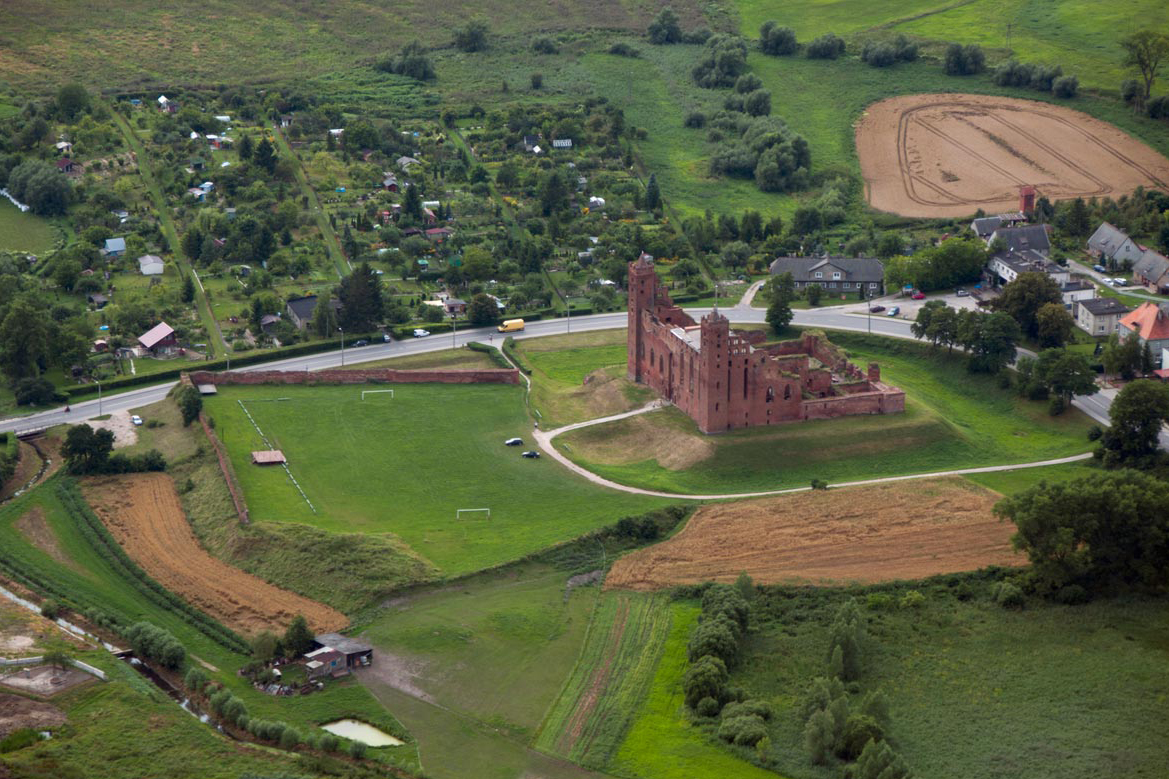
Radzyń Chełminski or Burg Rheden
The Chełmo-land was colonised by Slavs from the 8th century until it came under Polish control in the end of the 10th century. At this time the region functioned as an unstable frontier-zone between the Prussians and the Slavs. This led to increasing missionary activities by the Prussians. From the 13th century this was accompanied by the colonisation of the border-region and the construction of a number of fortified strongholds. In 1226 the teutonic Order was granted territory in the Chełmo-land by duke Konrad of Masovia. Form the 11th century a Slavic stronghold was situated adjacent to the lake at Radzyń and in 1234 the first timber fortifications were erected. The surviving brick-built castle is dated to 1310 – 1340. This was situated 500 m west of the stronghold and surrounded by former wetland. The castle retained its importance until 1454 when it became the centre of a local administration of the Polish_Lithuanian state. In the 16th century it was partially dismantled.
The close association between lake and medieval settlements has presented the ideal opportunity to reconstruct past vegetation and land-use dynamics within a well-documented archaeological, historical, and cultural context. Three broad phases of increasing landscape impact have become visible in the pollen and geochemical data dating from the 8th/9th, 10th/11th, and 13th centuries, reflecting successive phases of Slavic and German colonization.
Originally (AD 0-300) the area was a predominantly wooden environment characterised by widespread pines and birches, interspersed with nearby cultivated and grazed lands. In the migration period (AD 300 -700) the massive wooden environment continued. However, now oak-trees and hornbeams came to dominate the profile. From mid 10th century the woods were obviously in decline accompanied by a general shift from oaks and hornbeams to pines and birches. In the same period pollen from cultivation began to increase. Especially rye was leading this agricultural expansion. Finally, after 1234 cereal pollen values reached their maximum, slightly declining after the crisis in the 14th century.
It is obvious the progressive clearance of oak-hornbeam dominated woodland and the development of an increasingly open agricultural landscape took place before the Prussian invasion and colonization. Although the castles and towns of the Teutonic Order remain the most visible signs of medieval colonization, the palynological and geochemical data demonstrate that the major phase of woodland impact occurred during the preceding phase of Slavic expansion; Germans colonists were entering a landscape already significantly altered.
ABOUT THE AUTHORS:
- Alex Brown, Rowena Banerjee and Amanda Dawn Wynne are from the Department of Archaeology, School of Archaeology, Geography and
- Environmental Sciences, University of Reading, Reading, United Kingdom
- Norman’s Stivrins is at the Department of Geosciences and Geography, University of Helsinki, Helsinki, Finland
- Marc Jarzebowski works at the Institute of Geology, Tallinn University of Technology, Tallinn, Estonia
- Lisa-Marie Shillito works at the Friedrich-Meinecke-Institute, Free University of Berlin, Berlin, Germany
- Ales Pluskowski works at the School of History, Classics and Archaeology, University of Edinburgh, Edinburgh, United Kingdom


