


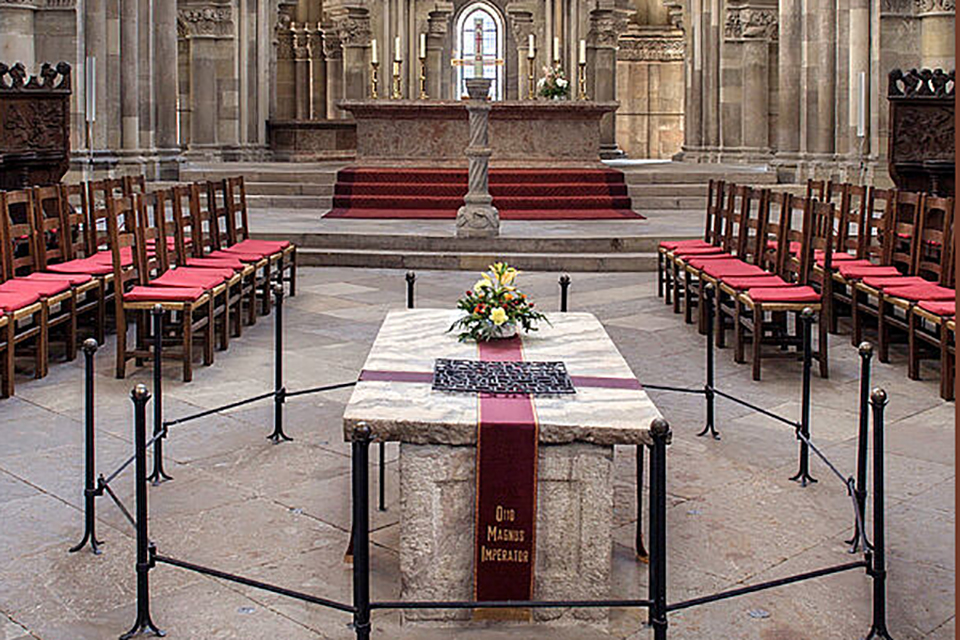
In January 2025, a major programme of conservation and research began on the tomb of Otto the Great in Magdeburg Cathedral. Serious deterioration had been discovered during routine monitoring in 2024, raising concerns about the stability of the limestone sarcophagus in the High Choir.
The conservation project was undertaken by the Kulturstiftung Sachsen-Anhalt and the Landesamt für Denkmalpflege und Archäologie Sachsen-Anhalt in collaboration with the cathedral authorities. The work involved not only stabilising the fragile medieval sarcophagus, but also opening the tomb and temporarily removing Otto’s remains. This provided an exceptional opportunity for archaeological, anthropological and scientific examination of both the burial and the emperor himself.
Opening the tomb

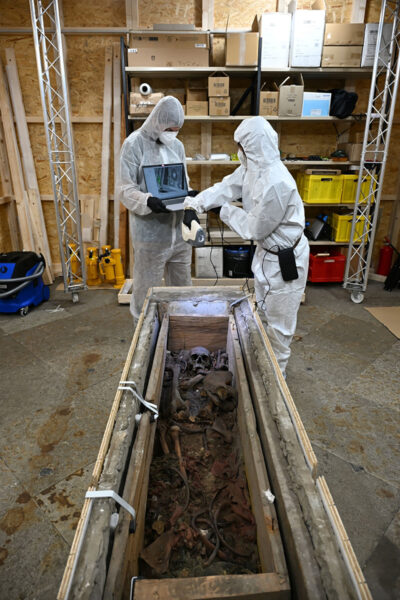
In preparation for the restoration, both the limestone sarcophagus and the wooden coffin inside it had to be opened. The contents of the coffin – human remains, textiles, organic material and sediment – were completely removed and documented.
The examination also made it possible to investigate the construction beneath the sarcophagus for the first time. Archaeological investigations conducted between January and June 2026 documented its foundations and the historical system of cavities and passages beneath the floor of the cathedral.
The conservation work revealed why intervention had become necessary. The limestone walls of the sarcophagus were extremely fragile, in places measuring only about one centimetre in thickness. Iron clamps and nails introduced during earlier openings and repairs had corroded, contributing significantly to the deterioration of the stone. Cement-like mortar used in previous repairs was also removed because it no longer served a stabilising function. Another problem was the enormous weight of the sarcophagus lid. The ancient marble slab weighs approximately 300 kilograms and had rested directly upon the fragile limestone walls. Stainless-steel supports have now been installed inside the sarcophagus so that the weight of the lid is no longer borne by the stone sides.
New foundation
Moisture rising from beneath the cathedral floor presented another serious threat. It carried damaging salts into the stone and contributed to the deterioration of the monument. The foundation beneath the tomb was therefore comprehensively reconstructed. A massive stone slab was first installed to bridge the cavities belonging to the historical passage system beneath the cathedral. Above this was placed a capillary-breaking layer of crushed limestone to prevent moisture from rising towards the sarcophagus.
A large granite slab now forms the principal foundation. Above it rests a smaller sandstone slab fitted with a lead barrier, upon which the restored sarcophagus has been placed.
An ancient imperial sarcophagus – and a new coffin

The limestone sarcophagus is particularly significant because Otto was in all probability according to Widukind already buried in it during the 10th century. Its massive lid has an even more remarkable history. It consists of Proconnesian marble – marble quarried on the island of Proconnesos in the Sea of Marmara – and is an ancient object reused for Otto’s burial. According to the Landesamt, the slab probably reached Magdeburg during Otto’s own lifetime. The tomb thus combines material from very different periods: an ancient marble slab, a medieval limestone sarcophagus, later interventions and repairs, and now a 21st-century structure designed to preserve the monument.
Reburial of Otto the Great
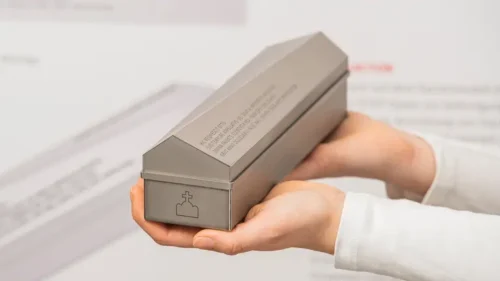
Following completion of the conservation work, Otto’s remains were returned to Magdeburg Cathedral on 1 September 2026. A new coffin had been commissioned following a competition organised by the Kunststiftung Sachsen-Anhalt. Designed by the artist Silke Trekel, it was placed inside the restored limestone sarcophagus in the centre of the High Choir. Before the tomb was closed, members of the public were given an opportunity to pass the open sarcophagus and view the new coffin. Otto’s remains were then reinterred, and the tomb was once again closed with its approximately 300-kilogram ancient marble lid.
This reburial did not, however, mark the end of the investigation. The Landesamt has emphasised that research resulting from the opening and documentation of the tomb will continue well beyond the reburial. This includes further study of Otto’s remains, the burial itself and the history of the monument.
FEATURED PHOTO:
The Tomb of Otto the Great Opening the tomb of Otto the Great in Magdeburg Cathedral. © Landesamt für Denkmalpflege und Archäologie Sachsen-Anhalt, Andrea Hörentrup.
PRESS RELEASE:
READ ALSO:
Marble for the Emperor—The Cover Slab of the Sarcophagus of Otto the Great in Magdeburg Cathedral, Germany
By Walter Prochaska, Vilma Ruppien˙e, Vasiliki Anevlavi, Harald Meller, Veit Dresely and Donat Wehner
In: Heritage (2026) Vol 9, pp


