How did medieval rulership over multiple kingdoms and lordships work out? A new book explores the political, but also the practical, challenges of kingship in the fluid territorial reality of the 13th century, while floating a new concept: “transregnal”. What might this mean?
 Transregnal is a curious, artificial word. Looking it up in the Oxford English Dictionary yields no hits. Neither does it appear in Google Ngram Viewer nor LTA (Diverse Lemma). Accordingly, it comes as no surprise that the editors of a new volume, Jörg Peltzer and Nicholas Vincent, admit in the introduction to having either invented the concept or somehow “dredged it up from their collective memories”.
Looking a bit further, though, it does appear in two very recent publications. One instance is found in a contribution by Jelle Wassenaar in the recent book Using and Not Using the Past after the Carolingian Empire, c. 900–c. 1050 (Routledge, 2020), where she writes:
“When asking his [Rather’s] fellow prelates to convene a synod, he did not write to the prelates of the Italian kingdom, but instead addressed his letter to ‘to the lord fathers and most reverend fellow-bishops throughout all Italy, Gaul, and Germany established in the Lord’, borrowing from an earlier transregnal Carolingian vocabulary.”
Here, the word is used for the first time (1) to denote the fact that the conventional use of a certain phrase in the tenth century might continue to be adopted across different kingdoms (regna).
A year later, the word was once more used in a medieval historical context by Björn Weiler in his book on Paths to Kingship in Medieval Latin Europe, c. 950–1200 (Cambridge University Press, 2021). Here, the word is used twice, both times to denote political or administrative structures transgressing the borders of kingdoms. In one case, the word refers to the Cistercians’ “finely tuned transregnal networks of dependency and oversight”. The second instance refers to how the self-representation of high medieval Europeans was “part of a transregnal community of norms and cultural practices” reflecting social and material realities. It appears here to be used in the same manner as we might speak of transnational, transregional, transimperial, transcultural, etc.: something extending across regna. To sum up, in both these publications, the word “transregnal” denotes cultural systems traversing realms or kingdoms in the plural.
Then, in March 2023, a conference at the German Historical Institute London was explicitly entitled Trans-Regnal Kingship in the Thirteenth Century. At that stage, the organisers, Jörg Peltzer and Nicholas Vincent, still hyphenated the word. Moreover, according to the conference report, the organisers did not intend “trans-regnal” as a “replacement for established concepts such as ‘unions’, ‘composite monarchies’, or ‘empires’”. Rather, it was meant as a heuristic category intended “to draw attention to the changing characteristics of kingship in the thirteenth century”, while maintaining a geographical focus on the Angevin Empire, the lands of Charles of Anjou, France, the Holy Roman Empire and the Papacy.
By publication in 2025, the hyphen had nevertheless disappeared: Transregnal Kingship in the Thirteenth Century is the title of the volume published as Proceedings of the British Academy, 275, by Liverpool University Press.
In this book, the word is explicitly presented as an exploratory “category” rather than as a heuristic tool, while surfacing in the title and being used 145 times in the different contributions. It appears as if what was a heuristic tool in 2023 is presented here as a “reality” to be studied. Apparently, there is now a new kid on the block – a transregnal kingdom rather than what elsewhere might be considered simply a more or less rounded-off realm or union (this obnoxious European idea avoided at all costs in Britain).
According to the introduction, this book is concerned with exploring how different types of rulership played out whenever they were combined in the 13th century, and what kinds of realms were created in this crucible. What might it mean to be ruler of a single “kingdom”, as opposed to being ruler over multiple kingdoms, often combined with major non-royal lordships? In short: how did it play out in the 13th century to be, at the same time, King of England, Duke of Normandy, Aquitaine and Brittany, while also Count of Anjou and lord of Ireland and Wales? Or how did it play out to be King of France as well as nominal lord of Normandy, Aquitaine, etc., and thus in a position to demand fealty from the King of England in his capacity as duke? Or to be King of Germany, King of Italy and Holy Roman Emperor while unceasingly embattled by everybody from the Danes in the north to the Normans in the south? And how did the different magnates go about organising their business of “ruling”?
Indeed, these questions are important parts of understanding the 13th-century European world, and we still need to do a great deal of nitty-gritty work to understand the wherewithal of these rulers and their business – especially when seen from a cultural-historical point of view.
Nonetheless, the invention of this new word, transregnal, is curious. Why is it important to construct this artificial concept (which the authors admit they have done)? One obvious reason is that they need an adjective. But why “regnal” and not “regal”?
Again, consulting the OED, we find that regnal is not in general use. Surfacing in 1612, it is scarcely used before 1820 and, compared with “regal”, is virtually absent from the literature until the 20th century. This is not the case with “regal”, which has been in use since the 14th century.
There is, moreover, an etymological and semantic distinction between the English adjectives regnal and regal. Regnal relates to Latin regnum – a reign, kingdom or realm – whereas regal derives from Latin regalis, itself formed from rex, “king”. Thus, while regnal directs attention towards the reign or the political framework of the regnum, regal directs attention towards the king: towards what pertains to, or is characteristic of, a rex. In this sense, regal may encompass not merely the possession of royal status, but also what it means to behave regally and to perform regality.
Accordingly, one explanation may be that the word regal carries connotations in which the authors are not particularly interested: namely, the cultural perspectives of performing what we might term “transregal”, or simply regal, power plays. Their perspective is another – transregnal, – concerned with how to wield authority or power in a fluid world in which the legitimisation of a composite portfolio might differ vastly. How does one rule as an anointed king while also being heir to an enfeoffed dukedom and other,lesser fiefs? (In a modern context, we would talk about “transnational”).
In this connection, it is perhaps appropriate to mention that we should not imagine that Henry II ever conducted himself as anything but regal while spending his life in his formally non-regnum – that is, his continental domains – where he lived for c. 21 years, as opposed to the 13 years he spent in England. However, he might occasionally have had to consider whether his regal standing could be tainted by the fact that, for instance, as Duke of Normandy he held the duchy of the French king. And indeed he did. After he was reconciled with his sons in 1174, his heir, Henry the Young King, offered to perform homage to his father. Henry II refused on the grounds that his son was already a king: a crowned king should not perform homage . Apparently, this would not have been “regal”. (Gillingham 2007)
However, this is not a question which appears to interest the editors of, or contributors to, the present volume. They are primarily interested in something else: namely, the political ramifications of having to negotiate authority over a complicated patchwork of dominions.
Hence, they have coined the phrase “transregnal”, which presents a deliberately constitutionally neutral umbrella term. The artificiality may therefore be the point. And that may actually be the key to why the word strikes us as unnecessarily artificial. It is not merely a new compound. It depends upon a medievalist’s Latinising reinterpretation of an existing English adjective from the 17th century, which is then transported backwards to cover a reality so different from the one, in which we live in our post-Westphalian world, where the question is not so much how to act transregnally as transnationally.
By making this choice, however, the research group marketing this new concept risks – once again – marginalising the emic approach. The question remains, after having read the book, how the elites themselves really thought about their lifeworlds and what, for them, it meant to be “regal” and not “regnal”.
ABTRACT:
Transregnal Kingship in the Thirteenth Century explores a wide-spread European phenomenon: rulership over multiple kingdoms, or a kingdom in combination with major non-royal lordships elsewhere. Perceptions of royal authority and kingly sovereignty changed significantly during the thirteenth century, and as the role played by kingdoms as sovereign polities was strengthened, the framework for transregnal kingship shifted. This volumes investigates the consequences, examining the theory, perception and administrative practices of transregnal kingship. Intended to provide a coherent picture that itself may facilitate comparisons, the work focuses on four distinct, but significantly intertwined polities: The Empire, France, The Angevin Empire, and the Papacy. Despite its frequent occurrence, transregnal kingship played a relatively small role in contemporary political thought, and transregnal practice took a great variety of forms, showing rulers and the ruled adapting to circumstance rather than pursuing any pre-conceived grand strategy. Meanwhile, the ruler’s frequent physical absence provoked the creation of multiple forms of vice-regal power. In the Empire, it also led to an increased use of arbitration as a means to solve disputes at regional level. Finally, an analysis of architecture and the built environment suggests that such things exhibit a fascinating combination of the political and the merely fashionable.
TABLE OF CONTENTS
- List of Figures
Notes on Contributors
Abbreviations
Preface
Introduction: Transregnal Kingship by J¨rge Peltzer | Jörg Peltzer and Nicholas VincentPart I: Theory - Transregnal Kingship in Thirteenth-Century Political Thought | Frédérique Lachaud
- A Special Case? The Papacy in the Early Thirteenth Century | Barbara Bombi
Part II: Imperium - Ruling Germany and the Empire: The Thirteenth Century | Martin Kaufhold
- ‘Profitemur imperium nichil prorsus iuris habere in regno Sicilie’: Relations between the Empire and Sicily during the Reign of Frederick II | Lioba Geis
- Perceptions of Transregnal Imperial Rule in Thirteenth-Century Germany | Len Scales
Part III: Mediterranean Worlds - The Fractured Empire of Charles I of Anjou | David Abulafia
- Holy Opportunity: Transregnal Lordship in Three Crusading Families | G. E. M. Lippiatt
- The Many Sicilies? ‘Angevin’ Architecture at the Turn of the Thirteenth Century with Notes on Robert Willis’s Remarks (1835) | Paula Vitolo
Part IV: England and France - The Plantagenet ‘Empire’ in the Thirteenth Century: Survival, Reorganisation and Reorientation | Daniel Power
- Royal Inquests in Western Gascony during the Reign of Henry III (1228–1255) | Frédéric Boutoulle
- mposition and Appropriation? Architecture, the Associated Arts, and the Presentation of Rulership in the Shell of the Angevin Empire, 1200–1300 | Lindy Grant
Part V: Crowned with Many Crowns - A Different Path? The Single Crown of Louis IX | William Chester Jordan
FEATURED PHOTO:
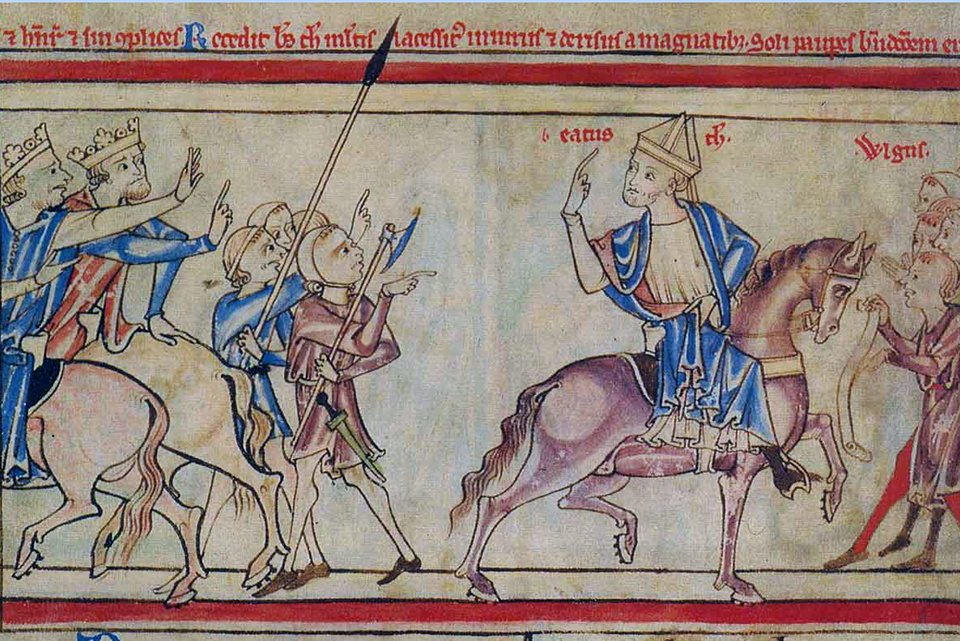
In January 1169, Thomas Becket met with Henry II and Louis VII at Montmirail negotiating a peace. The Becket-case represents a rather interesting inroad into the question of how to negotiate authority in a 13th century “transregnal” world . Although Thomas Becket appealed to and got the support of the French king, the latter did not use his position as formal overlord to order the English King, Henry II, to reconcile himself with Thomas Becket. Instead the French King incorporated the dispute into Capetian diplomacy while at the same time positioning himself as a protector of ecclesiastical liberty on par with his position towards the politics of Frederick Barbarossa and his excommunication.
SOURCES
Paths to Kingship in Medieval Latin Europe, c. 950–1200
Björn Weiler
Cambridge University Press, 2021)
Transregnal Kingship in the Thirteenth Century
Ed by Jörg Peltzer and Nicholas Vincent
Proceedings of the British Academy, Autumn/Winter, vol 275
Liverpool University Press 2025
Doing Homage to the King of France
By John B Gillingham
In Henry II: New Interpretations. Ed. by Christopher Harper-Bill, Nicholas Vincent
Boydell & Brewer 2007
ABOUT THE EDITORS:
Jörg Peltzer is Professor of Comparative Regional History in a European Perspective with a focus on the later Middle Ages at the University of Heidelberg, and British Academy Global Professor at the University of East Anglia.
Nicholas Vincent FBA is Professor of Medieval History at the University of East Anglia, and a Fellow of the British Academy.