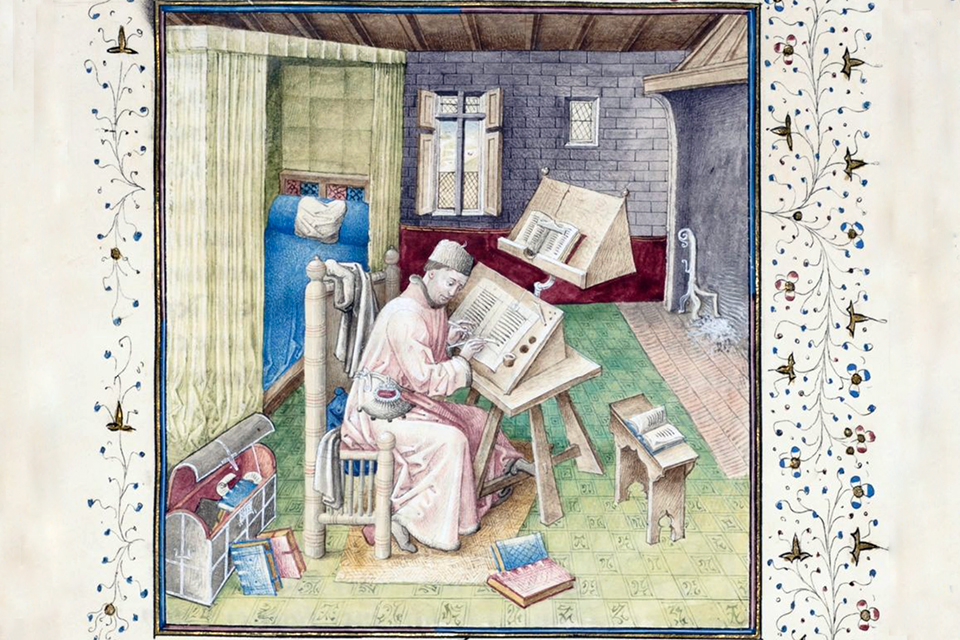
What did it mean to be an escripvain (or escrivain) in medieval France? Was such a person a professional copyist, a clerk, a secretary, a notary or an author? And how did the meaning of the term change as manuscript production developed into an increasingly specialised commercial enterprise during the later Middle Ages?
In this substantial study, Olivier Delsaux challenges the conventional understanding that the medieval French escripvain or escrivain gradually evolved from a copyist into a literary author. Instead, he demonstrates that the word possessed several overlapping meanings throughout the Middle Ages, reflecting the different activities involved in producing, reproducing and circulating written texts.
Based on more than 450 recorded occurrences of the term, drawn from literary works, manuscript colophons, administrative accounts, legal documents and medieval dictionaries, Delsaux reconstructs a world in which the boundaries between scribes, authors and other professionals working with texts were considerably less rigid than their modern equivalents suggest.
His central argument is that escripvain was a polysemous term whose underlying meaning was essentially someone responsible for recording discourse in writing. Whether that discourse originated with someone else or was composed by the person writing it was not necessarily decisive. Moreover, the different spellings, including escrivain and escripvain, did not denote separate occupations or stages in the development of the profession. They were variants of the same word, whose meaning depended on its particular context.
The professional scribe
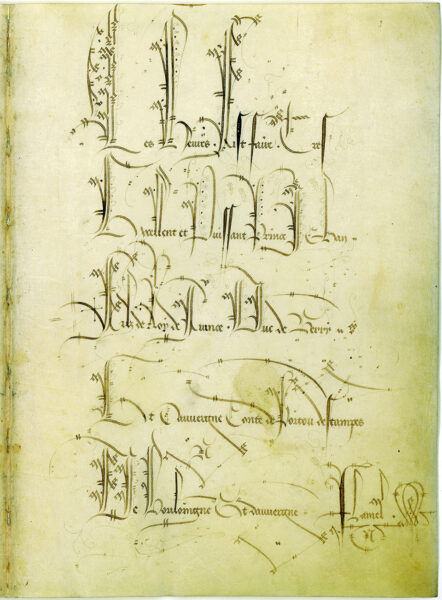
Throughout the Middle Ages, escripvain frequently designated a professional responsible for transcribing manuscripts. Such individuals might copy religious books, literary works or administrative documents, often working for wealthy patrons, ecclesiastical institutions or princely households.
However, their activities were not necessarily confined to copying texts. By the fourteenth and fifteenth centuries, professional scribes could undertake or supervise several stages of manuscript production, including preparing parchment, arranging illumination, correcting texts, binding volumes and organising the work of other craftsmen. Consequently, some escripvains increasingly resembled entrepreneurs operating within the manuscript trade rather than artisans specialising exclusively in handwriting.
Delsaux documents this development through surviving accounts of payments for manuscript production, particularly those associated with royal and aristocratic households. He also draws attention to the emergence of the escripvain du roi, an official designation associated with the French royal court under Charles V. In this context, the professional scribe could become responsible for delivering a complete manuscript, organising its physical production and ensuring that the resulting book satisfied the patron’s requirements.
The importance of these professionals is also reflected in the urban landscape of medieval Paris. Among the streets associated with writing professionals were the Rue des Notaires et Écrivains on the Rive gauche and the Rue des Escripvains (or Rue des Écrivains) on Rive droite. Meanwhile, Parisian tax registers from the late thirteenth and early fourteenth centuries identify numerous individuals by this occupational designation.
Scribes, clerks and notaries
Thus, the term also extended beyond manuscript production to people employed in administrative and legal writing. Here, escripvain could refer to someone recording transactions, preparing documents, maintaining accounts or otherwise producing written records. Accordingly, its meaning sometimes approached that of notaire, greffier or secrétaire. Indeed, medieval Latin–French dictionaries occasionally associated scriba with both escripvain and notaire.
Nevertheless, Delsaux does not argue that these occupations were interchangeable. Rather, his evidence demonstrates that the vocabulary used to designate individuals engaged in writing depended on the particular context and the nature of their employment.
This distinction is important. An individual described as an escripvain in a legal document was not necessarily a notary in the institutional sense. The designation might instead identify his established professional activity as someone engaged in the production or reproduction of written texts.
Furthermore, Delsaux distinguishes between an occupation and a formally recognised professional status. Although manuscript copyists could be identified by their trade, their professional position was often less clearly defined than that of other craftsmen involved in book production. Thus, escripvain or escrivain could indicate a regular and recognised occupation without necessarily implying membership of a distinct professional corporation or the possession of an official title.
Nicolas Flamel: an escrivain in medieval Paris
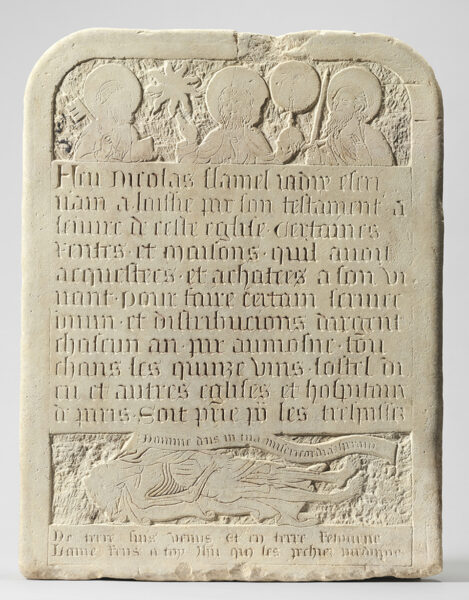
According to the inscription on Nicolas Flamel’s funerary monument, commissioned in accordance with his testamentary wishes, the man whom we know as a wealthy Parisian property owner wished to be remembered as an escrivain. This designation is particularly interesting because his memorial otherwise emphasised his substantial charitable foundations and the provision he had made for prayers and almsgiving after his death.
Moreover, Delsaux cites a document from 1395 concerning a property transaction involving a house called À la Brouette and its adjoining garden, in which Flamel is identified as: Nicolas Flamel, escrivain (1) Here, the designation is not connected with Flamel’s authorship of a literary work or with a particular manuscript he had copied. Instead, it identifies him by his occupation in a property document.
Delsaux places this example alongside other records in which professional scribes were identified by their occupation in legal and administrative contexts unrelated to the production of manuscripts. His point is that an escripvain could be recognised professionally as a copyist even when the document in question concerned an entirely different aspect of his life.
In Flamel’s case, the reference therefore supports the conclusion that he was recognised as a professional escrivain. Nevertheless, it does not tell us precisely what his daily work involved. He might have copied manuscripts himself, undertaken documentary writing or participated in the wider business of preparing and supplying books. The occupational designation alone cannot establish the precise balance between these activities. Indeed, one of the most interesting aspects of Delsaux’s study is his demonstration that professional scribes increasingly assumed responsibilities beyond the physical copying of texts. Some organised manuscript production, while others corrected, adapted or even rewrote existing works. Consequently, the distinction between the person responsible for producing a manuscript and the person responsible for its intellectual content could become difficult to maintain.
Against this background, it is particularly interesting that in 1434, when Guillebert de Mets composed his description of Paris, he mentioned two individuals named Flamel in his account of the city’s distinguished craftsmen and inhabitants. Guillebert wrote:
“Furthermore [there was] Gobert, the supreme scribe [escripvain], who composed the Art of Writing and that of sharpening quills, and his disciples who were retained by princes because of their writing skills, such as the young Flamel by the Duke of Berry, Sicart by King Richard of England, Guillemin by the Grand Master of Rhodes, Crespy by the Duke of Orléans, Perrin by the Emperor Sigismund of Rome and many others. Also many skilful artificers, such as Herman, who polished diamonds in various shapes; Willelm the goldsmith; Andry, who worked on brass and on silver and gold-plated copper; the potter who kept nightingales which sang in winter; the three illuminator brothers and other skilled trades. Also Flamel the elder, a writer [escripvain] who gave so many alms and such hospitality and built many houses where the tradespeople lived downstairs and with the rent they paid, poor workmen were supported upstairs.”
Quoted from: Guillebert de Mets, Description de la ville de Paris (1434), in Description de la ville de Paris 1434, medieval French text with English translation, notes and introduction by Evelyn Mullally (Brepols, 2015), p. 107.
The passage is illuminating because Guillebert uses the same occupational designation in two rather different contexts.
The younger Flamel appears among the pupils of Gobert, celebrated for their exceptional handwriting and their employment by European princes. In this context, escripvain clearly identifies a professional whose skills were associated with the production of manuscripts. The elder Flamel, on the other hand, appears primarily as a distinguished Parisian benefactor. Guillebert mentions neither the manuscripts he copied nor any texts he might have composed. Instead, he celebrates the charitable foundations and buildings through which Flamel provided accommodation and financial support for the poor. Nevertheless, he still identifies the elder Flamel as an escripvain.
At the same time, the reference to the younger Flamel raises further questions. His association with Gobert and the Duke of Berry places him within the world of highly skilled manuscript production connected with princely patronage. Whether he was related to Nicolas Flamel, and if so how, remains uncertain. The designation le jeune Flamel invites comparison with Flamel l’ancien, but does not in itself establish a family relationship. Nevertheless, Guillebert places both men within the same broad category of writing professionals. Guillebert’s account places both Flamels within the wider professional culture of writing and manuscript production in late medieval Paris.
Even so, the juxtaposition is suggestive. The elder Flamel had made his fortune and established his charitable reputation, while the younger Flamel was remembered for the exceptional quality of his handwriting and his association with a princely household. Yet, both could be described as escripvains, although the circumstances of their lives and careers might have been quite different.
Indeed, this is precisely the kind of distinction that Delsaux’s linguistic analysis helps us understand.
From copyist to author
Delsaux thus demonstrates that escripvain could designate someone who compiled, adapted, translated or composed written works. In many cases, however, these activities were closely related to the reproduction or reworking of existing material, as medieval authors frequently presented themselves as transmitters of inherited knowledge rather than creators of entirely original texts. This distinction between copying and composing was complicated by the practices of compilation, translation, adaptation and rewriting. Some scribes became editors or authors through their work on existing texts, while some authors became closely involved in the preparation of manuscripts containing their compositions.
During the fourteenth and fifteenth centuries, however, the relationship between these activities changed further. Authors increasingly participated in the physical production of their manuscripts, while some professional scribes assumed editorial responsibilities that brought them closer to the work of composition.
Delsaux observes that from the middle of the fourteenth century, and more consistently from the 1460s, escripvain was increasingly employed to designate a writer or author, particularly in Burgundian literary circles. Nevertheless, he emphasises that this did not mean the earlier sense of professional copyist had disappeared. The two meanings continued to coexist, sometimes overlapping in practice.
Furthermore, the change cannot be understood simply as the replacement of one meaning by another. Rather, it reflected developments within the manuscript trade itself. As professional scribes became involved in editing and rewriting texts, and authors became increasingly concerned with the material production of their works, their activities converged.
The arrival of printing eventually altered this relationship. As printed books increasingly replaced manuscript copies in the circulation of literary works, the distinction between the person composing the text and those responsible for reproducing it became more pronounced. Consequently, the meaning of escripvain gradually shifted towards that of the modern French écrivain. However, Delsaux emphasises that this development was neither straightforward nor complete by the end of the Middle Ages.
The changing meaning of writing
Delsaux’s study challenges the assumption that the emergence of the modern author can be understood simply as a change in vocabulary. Instead, the evolution of escripvain reflects broader transformations in literacy, literary production, professional identities and the material culture of the book.
Ultimately, the medieval escrivain, or escripvain, was defined less by authorship than by his relationship to the production of writing. Understanding that distinction allows historians to reconstruct the complex professional world in which medieval texts were composed, copied, adapted and circulated. Only gradually, and particularly following the introduction of printing, did the distinction between the professional scribe and the literary author acquire its modern significance.
FEATURED PHOTO:
Jean Le Tavernier (illuminator): Jean Miélot in his study (detail), after 1450, Buonaccorso of Pistoia, Brussels, Bibliothèque Royale MS 9278-80, fol. 10r (Bibliothèque royale de Belgique). SOURCE: Khan Academy
NOTES:
(1) The reference is preserved in the Archives nationales in Paris (AN, S94, no. 5)
READ MORE: