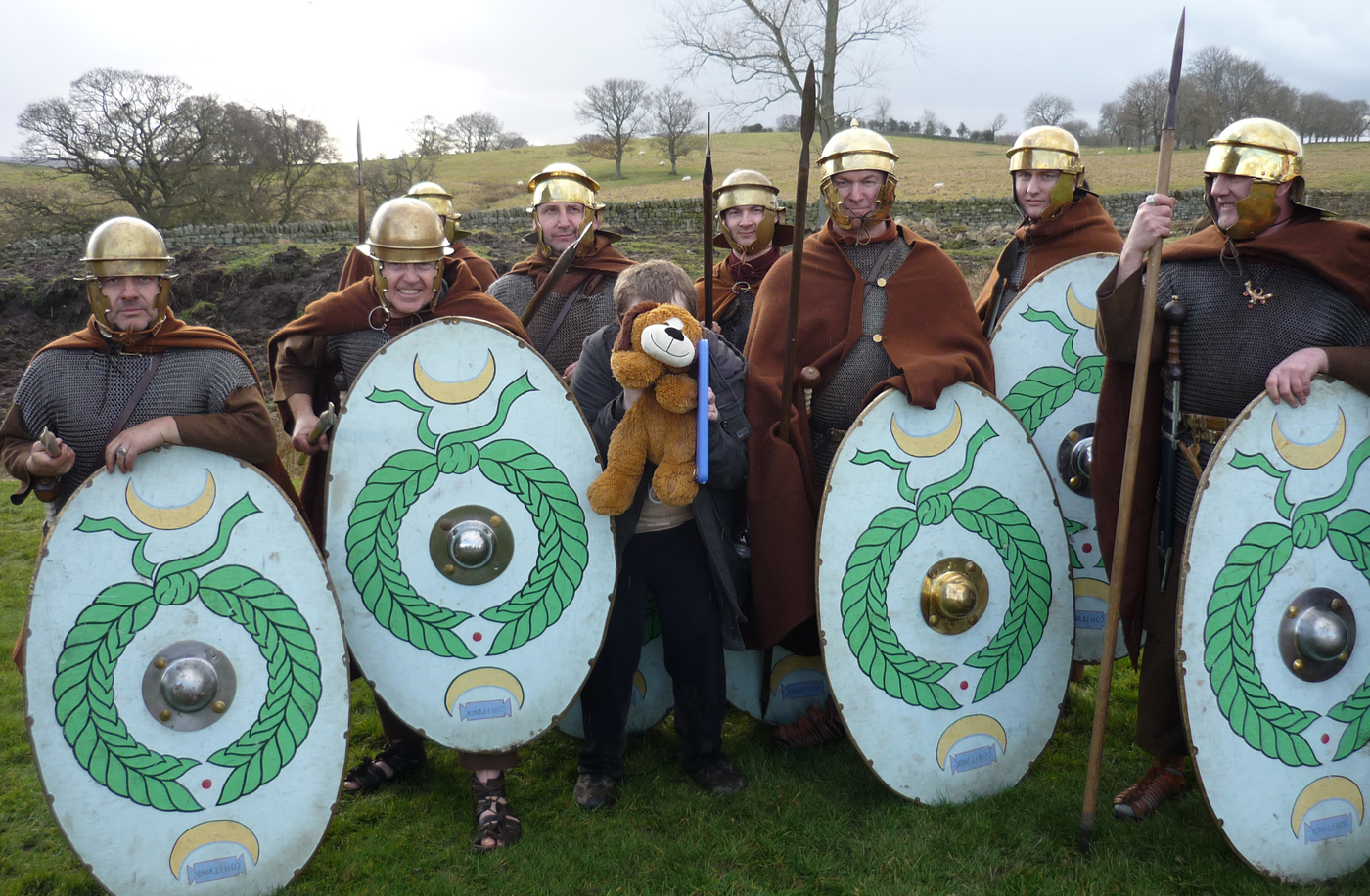
“Hadrian was the first to build a wall from sea to sea, 80 miles long, to separate the Romans and the barbarians…”
In AD122 a major construction project was initiated by the Roman emperor Hadrian. Though it is not the longest surviving part of the Roman imperial frontier, nor the best surviving, it continues to hold sway over our imagination. North were – according to the Romans – the blue-painted barbarians in Caledonia. South was civilisation represented by armies, well laid-out forts, baths, temples, statuettes of gods, olive oil, wine and literacy. North were damp forests, peaty bogs, impenetrable mountains and wild-mannered “others”.
This wall (for which different plans were laid) ended up with a 2.5 m thick x 6 m. high wall built of stones. In front was a ditch 9 meters wide and 4.5 meters deep. Behind the wall was another ditch, the vallum, which is poorly understood. Every 8 km. was a fort interspersed with watchtowers. Until around AD 400 the wall continued to play at least some role in the overall defense of Britain against the Northerners.
However, very early on the wall was also turned into a major tourism attraction. Soon souvenirs were produced in the form of small pans decorated with depictions of the wall and the names of the forts. Later renaissance scholars travelled to the wall in order to explore the geography and layout, while others excavated it in order to produce the vast scholarly literature, which amasses to more than 6000 titles and which continues to grow.
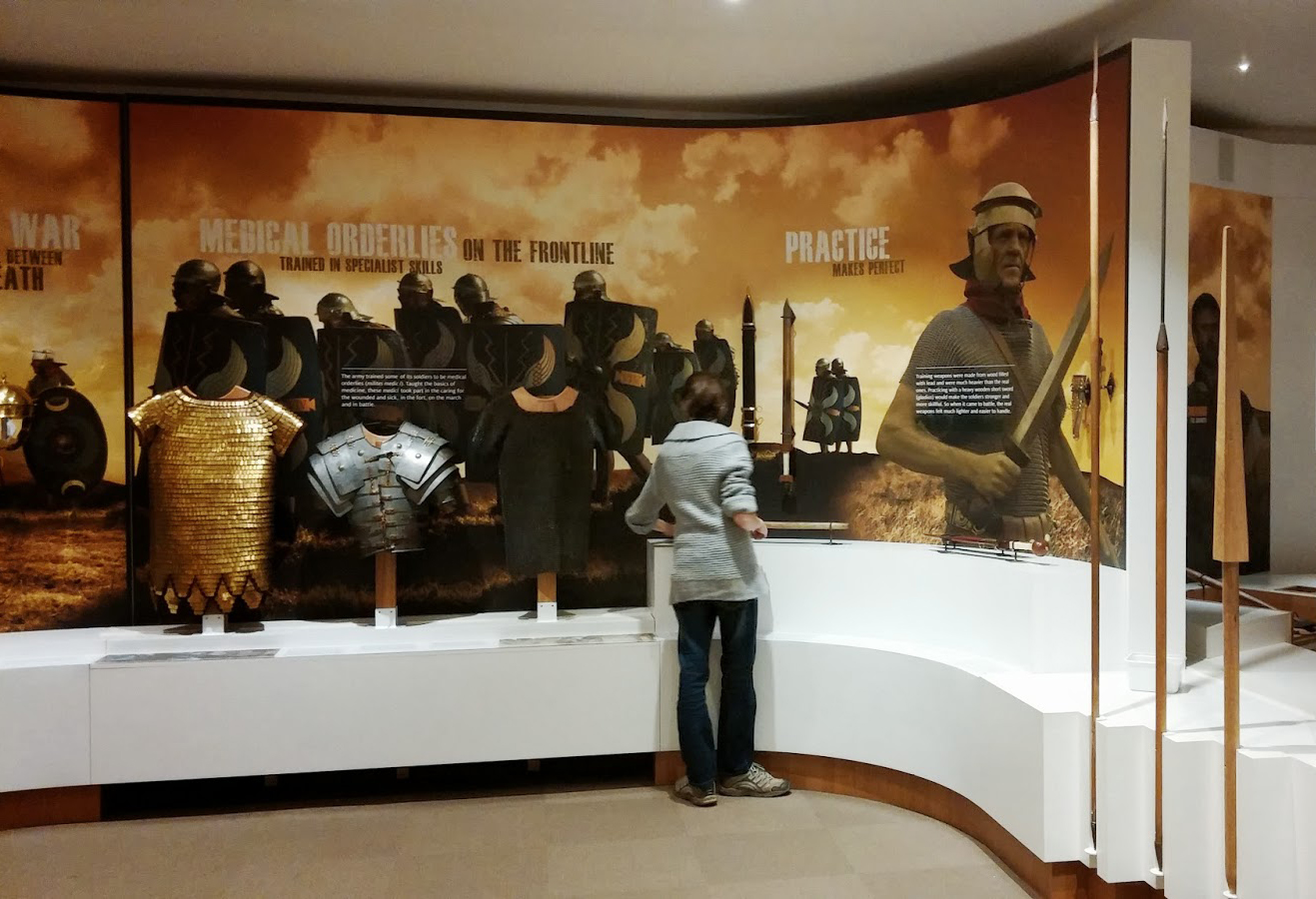
In recent years another aspect of the wall has been developed in view of its UNESCO status: the management of the wall as a tourism magnet. The overall question is of course how to both protect and manage the archaeological remains, while at the same time cater for the masses of visitors traipsing up and down the fragile wall in their search for the ultimate selfie (greetings from “me” at “wall”). A new book considers this question in a series of detailed essays, exploring the many dimensions pertaining to the management of a site, which in 2013 attracted 3.5 million staying visitors and brought the substantive sum of £880 million into the local economy; a remarkable feat in view of the challenges and conflicts, which are created by the very diverse ownership of the site, some of which runs directly through people’s private gardens. In fact more than 50 organisations and 700 private owners belong to the group of “shareholders”. And then there are all the “stakeholders”: archaeologists, conservators, biologists, geographers, tourism agencies etc.
An important new book chronicles this development – or rather transformation – of the management of Hadrian’s Wall, which has taken place since the 90s. Well worth a read!
Managing, Using, and Interpreting Hadrian’s Wall as World Heritage
Springer Briefs in Archaeology
By Peter G. Stone and David Brough (Eds)
Springer: New York, Heidelberg, Dordrecht, London 2014
ISSN 1861-6623
ISSN 2192-4910 (electronic)
ISBN 978-1-4614-93509
ISBN 978-1-4614-9351-8 (eBook)
CONTENT:
Managing Hadrian’s Wall in the Twenty-First Century
Prof. Peter G. Stone
Pages 9-13
ABSTRACT: This chapter puts the management of Hadrian’s Wall into a wider professional, academic and chronological context. It identifies a number of strands—the creation of English Heritage with a remit to be more entrepreneurial than its government predecessors, a growing academic concern over the misappropriation of heritage for commercial and political ends and a professional acceptance that heritage management required a particular skill-set—that converged about the same time as Hadrian’s Wall was inscribed as a UNESCO World Heritage Site. This new context created a new set of tensions and issues involved in conserving remnants of the past in the present—and in particular how such sites might contribute in a number of different ways as active components of the contemporary landscape. The chapter then outlines the range and scope of the rest of the book and how it relates to these tensions and issues.
The Archaeology, History and Significance of Hadrian’s Wall
By David J. Breeze, Royal Archaeological Institute, London, UK
Pages 15-20
ABSTRACT: This chapter describes the importance of Hadrian’s Wall in the context of Roman frontier studies. It summarises what we know about the history of the Wall and how our understanding has developed over several generations and, crucially, what key research questions have been identified for future work.
The Management Context
Christopher Young
Pages 21-32
ABSTRACT: This chapter introduces the concept of World Heritage for those readers who may be unfamiliar with the World Heritage Convention and its ideals. The chapter touches on the UK Government’s approach to World Heritage and, in particular, on how its sees its responsibilities towards World Heritage Sites and their management.
The Need for a Management Plan and the 1st and 2nd Plans
Christopher Young
Pages 33-45
ABSTRACT: Chapter 4 outlines the pressures to develop, and antecedents of, the first iteration of the Hadrian’s Wall World Heritage Site Management Plan. Simplistically, this 1st Plan was a conservation management plan, drafted and delivered by archaeologists, that was nevertheless ‘cutting edge’ as it alluded to broader interest in the World Heritage Site—for example, education and tourism. The chapter charts the reaction to the 1st Plan and discusses how the, often hostile, reactions to that Plan led to the development of the Management Plan Committee, and, then, the 2nd Plan was drafted with greater participation from stakeholders representing a wider range of interests.
Hadrian’s Wall Tourism Partnership
Jane Brantom
Pages 47-61
ABSTRACT: This chapter summarises the work of the Hadrian’s Wall Tourism Partnership (HWTP). HWTP was initiated in the mid-1990s by the Northumbria Tourist Board with an aim to ‘bring economic, social and environmental benefits to the area around Hadrian’s Wall World Heritage Site through the promotion and development of sustainable tourism, education, arts and community initiatives linked with the Roman frontier’. The Partnership was given a huge boost in 2000 when it was successful in a bid to the European Union’s (EU) Single Regeneration Budget for a 5 year project around the theme ‘Enterprise and Enrichment’. The project was delivered through six areas of work: Presenting Hadrian’s Wall; Hadrian Means Business; Roving Romans; Marking the Wall; and Access and Sustainable Transport.
Hadrian’s Wall Path National Trail and the World Heritage Site. A Case Study in Heritage Access Management
David McGlade
Pages 63-77
ABSTRACT: The Hadrian’s Wall Path National Trail opened in 2003 as part of a network of 15 National Trails in England and Wales. These are long distance routes for walking, cycling and horse riding through some of the finest landscapes in the country and the 84 mile Hadrian’s Wall Trail takes walkers along the riverside route in urban Tyneside, through farmland in Tynedale and the grazing upland section dominated by the Whin Sill escarpment before gradually descending to the rich pastures of Cumbria and finally the salt marsh of the Solway Estuary. The development of the Trail was contentious as archaeologists and other conservationists resisted its construction citing concerns that large numbers of walkers would have a damaging impact on the archaeological and natural value of the World Heritage Site. Although these concerns still persist, a robust management regime has protected the monument and natural environment while attracting large numbers of long distance walkers who provide a significant contribution to the local economy. The National Trail project has been cited as a world-leading example of sustainable heritage access management.
The Hadrian’s Wall Major Study and 3rd Management Plan
Prof. Peter G. Stone
Pages 79-87
ABSTRACT: The 2nd Management Plan (2002–2007) identified ‘the contribution which the World Heritage Site and its setting can make to the local economy’ as an issue for further study. The economic importance of the World Heritage Site was further underlined in the work carried out by the Hadrian’s Wall Tourism Partnership’s Single Regeneration Budget ‘Enterprise and Enrichment’ project. As the latter drew to a close, the two relevant Regional Development Agencies commissioned a ‘Major Study’ to look into the potential of Hadrian’s Wall to contribute to the economic regeneration of the North of England. While the Major Study led to the creation of Hadrian’s Wall Heritage Ltd (HWHL—see Chap. 9), the chapter suggests that much more could have been achieved. Alongside these developments, the Management Plan Committee (MPC) produced the 3rd (2008–2013) Plan which was originally drafted by six interest groups. The management of the Wall took a major step forward again, however, in that, supported by HWHL, the interest groups became responsible for delivering the action plans they developed while drafting the Plan.
The Management of Hadrian’s Wall 2006–2012
Linda Tuttiett
Pages 89-100
ABSTRACT: The three main recommendations of the Major Study were (a) that if suitable investment were made in the Wall, and in particular in its infrastructure, presentation, and interpretation, the World Heritage Site (WHS) had the potential to make a significant contribution to the economic regeneration of the North; (b) that the interpretation along Hadrian’s Wall needed to be both more differentiated (with different sites concentration on different stories) and more integrated (see Chap. 11); and (c) that in order to manage such investment a new body, with an overview of the whole Wall, would be needed. A number of partners, including the Regional Development Agencies (RDAs), English Heritage, and Natural England, contributed new, or transferred existing, funding to this organisation and Hadrian’s Wall Heritage Ltd. (HWHL) was created in 2006. HWHL became successful in attracting and unlocking funds from a variety of sources and, despite the dismantling of the RDAs and other reductions in government spending, its successor body, the Hadrian’s Wall Trust, is now continuing to build upon that success.
Hadrian’s Wall as World Heritage: The Museums
Lindsay Allason-Jones
Pages 101-113
ABSTRACT: Over the last hundred or so years, a number of museums have grown up along the length of Hadrian’s Wall. Most of these are based at major sites (forts) along the Wall and house collections deriving from that particular site and its hinterland (e.g. museums at Maryport, Vindolanda, and Chesters). Others are not immediately linked to the remains of a site (e.g. those in Carlisle and Newcastle). Some are managed by independent trusts (e.g. Maryport and Vindolanda), some by local organisations (Arbeia and Segedunum) and others by national agencies (e.g. Chesters and Housesteads). This chapter traces very briefly the development of these museums and their integration into the management of Hadrian’s Wall as a whole.
Managing Interpretation
Genevieve Adkins and Nigel Mills
Pages 115-125
ABSTRACT: The perception of visitors to Hadrian’s Wall identified in the Major Study was that all sites along the Wall presented the same interpretation of the Roman Army and Roman Frontier. Some did it better than others, but once one site had been visited, there was little point for the general visitor to spend time or money visiting more sites. The visitor spend in the region was therefore much less than it could be if visitors decided to stay and visit more than one site. This perception was reiterated in a more detailed work carried out by Hadrian’s Wall Heritage Ltd (HWHL). On the basis of this work, HWHL developed an Interpretation Framework for the whole Wall that allowed sites to develop their own interpretation set within a broader framework that both widened and enhanced the interpretation, thus encouraging visitors to spend more time in the region.
The Frontiers of the Roman Empire World Heritage Site
David Brough, John Scott
Pages 127-135
ABSTRACT: This chapter charts the creation and development of the serial transnational World Heritage Site across different sections of the Roman imperial frontier. It falls into three parts: (a) the development of the original concept for the transnational Frontiers of the Roman Empire (FRE) World Heritage Site to its creation in 2005 and subsequent development; (b) the wider context of serial transnational Sites within World Heritage; and (c) the issues relating to the management of the FRE World Heritage Site as it exists at present.
The Transformation of Management on Hadrian’s Wall… Ask not what World Heritage Can Do for You…
Peter G. Stone
ABSTRACT: This chapter draws the story of the recent management of Hadrian’s Wall to a close. It notes not only the incremental changes in approach to the management plan, which have developed a collective management approach—the major investment in the site—but also a sense of a missed opportunity with respect to the involvement of the Regional Development Agencies. The chapter ends with a challenge to all World Heritage Sites to not only accept the positive aspects of being inscribed as a World Heritage Site but also to work on how they can contribute to helping UNESCO fulfill its own wider goal of attaining world peace.
SEE MORE:
The one place to get up-to-date information about the wall and its surrounding sites before a visit is the website: Hadrian’s Wall Country