New interdisciplinary book on Vikings tells the story of a strong relationship between North Western Britain and Scandinavia about 800 – 1066.
In Search Of Vikings. Interdisciplinary Approaches to the Scandinavian Heritage of North-West England.
Ed. by Stephen E. Harding, David Griffiths and Elizabeth Royles.
CRC Press Taylor and Francis Group 2015
ISBN 9781482207576
REVIEW:
 According to the preface the title of this book is an apt reminder of the fact that the history of the Vikings in North Western Britain is not at all straightforward. It is something, we have to search for through deftly handling a plethora of sources. Until recently interdisciplinary efforts were not that common, write the editors; which is why they organised a conference in Chester in 2010 with the exact purpose of pooling the resources of archaeologists, place-name scholars, linguists, saga scholars, historians, and geneticists. The result is a thoughtful and delicate small book, which holds a number of contributions covering a wide variety of these fields.
The book opens with a very interesting presentation on the different interdisciplinary approaches to the Scandinavian Heritage of North-West England. Here we get a sense of how it all hangs together. The editors remind us that although Vikings play an important role as “ferocious others” in the imagination of people today, the facts on the ground tell quite a different story of hybridity and day-to-day interactions between people from two similar backgrounds – the Anglo-Saxons and the Norsemen. It is this more nuanced “version” of the history of the Vikings in Britain, which the contributors have sought to unpack. But this is not a scholarly collection of articles: The specific aim is to write for the general public and in an approachable and generous way.
The first chapter – A brief History and Archaeology of Viking Activity in North-West England presents us with a well-rounded introduction to what must be characterised as a relatively limited and fragmented corpus of finds. To this should be added the challenges, which explorations into landscapes, past environments and settlements pose. Griffith does end his paper on a sort of wishful tone. Perhaps, in the future, we will know more, he writes.
More “umpf” is to be found in the chapter by Judith Jesch on “Speaking Like a Viking: Language and Cultural Interaction in the Irish Sea Region, where she presents a succinct snapshot of the linguistic and cultural impact of the migration of Scandinavians to this region. Important evidence for this is the character of the place-names, which were apparently primarily topographical rather than attached to habitations or settlements. There are even a number of rivers, which got Norse Names. This, writes Judith Jesch, is indicative of the fact that the region must have been rather sparsely inhabited before the Vikings arrived. But also, that the migrations must have consisted of not only men, but their whole families. From here she moves on to consider the evidence from the many stone sculptures of mixed character, which she writes “represent diaspora in action”, characterised by a considerable influx of women, who kept some, but not all traditions intact.
This leads to the next chapter by Christina Lee, who touches upon the Viking Age Women and their handiwork and tells the story of how the Scandinavian women played an important role in the distinct textile production while they continued to speak their language for a long period.
The next two chapters, written by John Quarud and Paul Cavill, are representative of more traditional historical handiwork. More precisely they touch upon the history of two famous battles: the Battle of Tettenhall, AD 910 and the battle of Brunanburh in 937; the last one is specifically exploring the exact location of this battle in terms of the evidence from placenames and topography.
This leads to a very interesting paper by Robert a. Philpott, who writes about Viking Age Rural Settlement in Lowland-North-West England, in which he tries heroically to identify the invisible through place-names, field names and primary field enclosures. This is followed by a case-study of Workington in Cumbria, written by Mike Mccarthy and Caroline Paterson. The occasion was a fire in 1994, which destroyed a Victorian church. This gave the archaeologists the chance to excavate inside the church. Rather sensational, this yielded some 24 stone sculptural fragments as well as a number of pieces of metalwork, all reflecting a widespread Scandinavian influence in the 10th century.
Were there Vikings in Carlisle? Ask Mike McCarthy, Janet Montgomery, Ceilidh Lerwick, and Jo Buckberry. One can nearly hear the wistful dreams of excavating yet another York or Dublin. As it is, it appeared complicated to answer the question as the finds from an excavation in the Cathedral precinct yielded no actual confirmation.
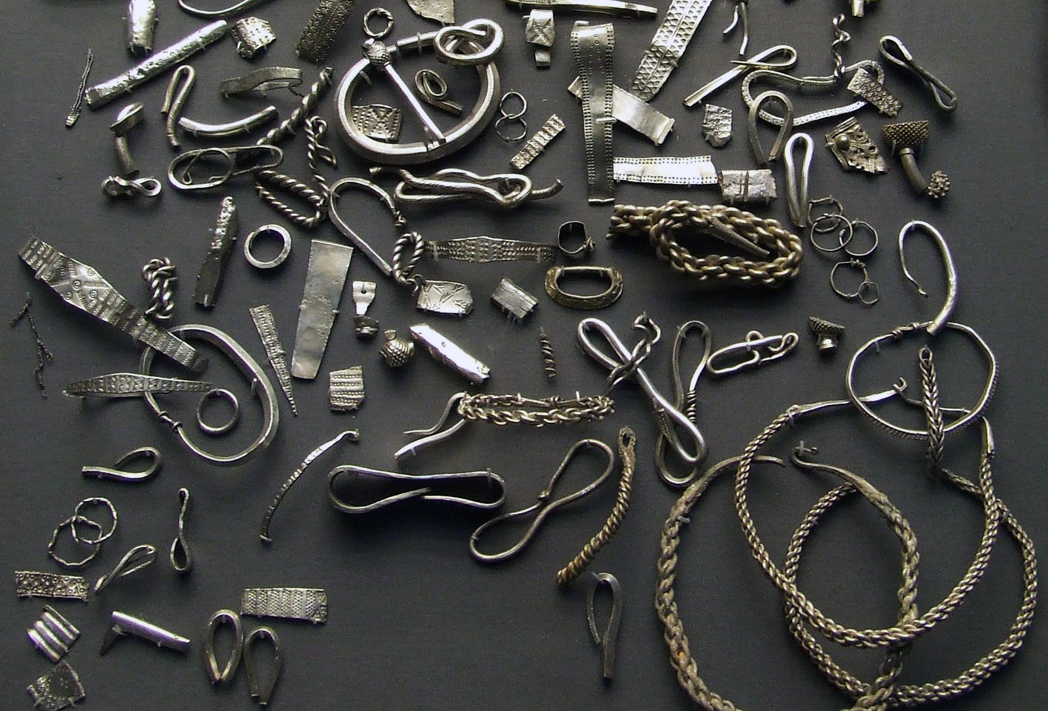
However, this cannot be said about the material culture, which Jane Kershaw treats: The Viking-Age Silver in North-West England: Hoards and single finds. The reason here, is, that we know of the precise difference between the monetized Southern England and the North-West, where hack silver was predominant. The region is home to a series of silver hoards, which witness to the practical as well as symbolic capital, which was invested in the hoards. These reveal the silver riches of the vikings as well as their close contacts to their “kindred” and compatriots in Dublin and the Danelaw. Kershaw is of the opinion that the extraordinary many hoards found in the region witness to the region as a transit corridor between the East and West. As it is: here we really see the Vikings in action.
In a final paper, the genetic “heroine” from Leicester University, Turi King, tries to tackle the complicated question of whether the Vikings genetically speaking were present in the Wirrel and West Lancaster. This she does by discussing in detail the finds from a survey of the genetic profile of individuals identified through their surnames as being probable descendants of medieval ancestors. This was a pilot study. Nevertheless it appeared that people from both the Wirrel and West Lancashire with this medieval ancestry were more likely to sport a particular chromosome type, frequent I Norway; (as opposed to the “modern” control sample).
Finally Roger White rounds it all off with a review of Neston Cross fragments in Cheshire which he interprets as created by a stone-carver celebrating their new-found Christianity but also working to remember the affinity with the old cultural roots.
This is a slight book and for specialists many of the conclusions are known from articles or books written by the contributors in a more scholarly context. However, for the general public – especially in North Western England – there is much on offer.
In general the tone of the book is generous: not complicated to read neither too “scholarly”, it does live up to its pretensions; and is recommendable.
However, it seems odd, that the editors chose a greedy publisher with obviously little love of the art of producing books. The price at Amazon is £31.99 for a paperback, which has obviously been produced on a print-on-demand machine. Photos are either black and white or photocopied on paper of somewhat better quality. However, the overall impression is lousy. It had, perhaps been better, to produce the book as a pdf for easy and free download as has been done in the Languages, Myths and Finds project.
Karen Schousboe