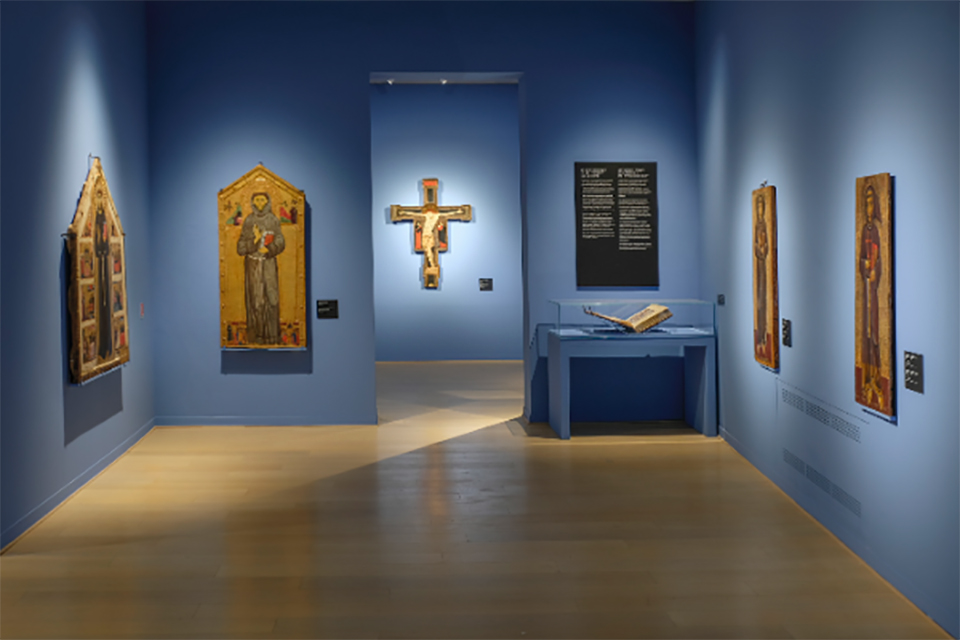
New Exhibition in Arezzo shows art and images celebrates the multiple imaginations of who St. Francis was. And showcases images from the 800 years since his death in 1226
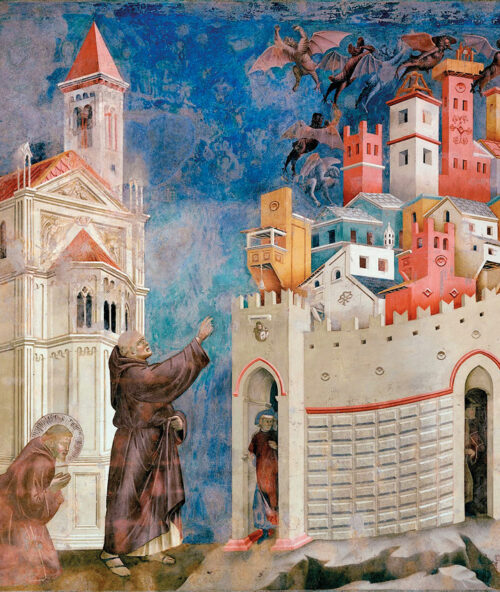
It was in the territory of Arezzo that Francis experienced some of the most intense and dramatic episodes of his life.
In Bonaventure of Bagnoregio’s Major Legend, Arezzo occupies a particularly significant place: “When blessed Francis saw the demons rejoicing above the city of Arezzo, he said to his companion: ‘Go, and in the name of God drive out the devils, as the Lord himself has commanded you, shouting from outside the gate.’ And when his companion obeyed and cried out, the demons fled, and peace was immediately restored.”
Beyond this dramatic episode, masterfully illustrated by Giotto in the Upper Basilica of Assisi, the relationship between the city, its surrounding territory and the great saint of Assisi was both long and profound.
Near Cortona, where he stayed in 1211, Francis founded the convent of Le Celle. On Mount La Verna, he received the stigmata from the crucified Christ with cherubic wings, bearing these wounds until his death. One of Italy’s most important Franciscan convents was subsequently established on the mountain.
For this reason, the territory around Arezzo is crossed by the pilgrimage routes known as Le Vie di Francesco – the Ways of St Francis – promoted by the Region of Tuscany. These routes retrace the journeys made by the saint and his fellow friars.
New exhibition celebrating 800 years of artistic legacy
Ttiled “The Image of St Francis – From the Middle Ages to the Twentieth Century”, the exhibition runs from 3 October 2026 to 10 January 2027 at two venues: the Galleria Comunale d’Arte Moderna e Contemporanea (Piazza San Francesco 4), adjoining the Basilica of San Francesco, renowned for its artistic masterpieces, particularly Piero della Francesca’s fresco cycle depicting the Legend of the True Cross; and the atmospheric spaces of the former Church of Sant’Ignazio (Via Giosuè Carducci 7), an outstanding example of Baroque architecture in Arezzo.
On the eighth centenary of St. Francis’s death, which fell on 4 October this year, Arezzo celebrates its special relationship with St Francis with a major exhibition exploring the iconography of the saint through the centuries. The exhibition includes works by Margarito d’Arezzo, the Master of the Crucifix, the Master of Figline, Tino di Camaino, Fra Angelico, Sandro Botticelli, Andrea della Robbia, Giorgio Vasari, Pietro da Cortona, Annibale Carracci, Guercino, Jacopo Ligozzi, Luca Giordano, Federico Barocci, Lorenzo Lippi, Antonio Ciseri, Libero Andreotti and Gio Ponti.
Important loans have been secured from museums including the Metropolitan Museum of Art in New York, the National Gallery in London, the Lindenau-Museum in Altenburg and the Vatican Museums. Visitors will also have the opportunity to discover works from churches and religious institutions in Tuscany and other Italian regions. Many of these are rarely moved and will be displayed together for the first time.
Particularly noteworthy are works from private collections and the numerous objects originating from churches, parish churches, monasteries and other religious institutions across Tuscany and Italy. These include the Cathedral of Sansepolcro; Franciscan churches in Lucignano, Locarno, Castiglion Fiorentino and Pontremoli; San Francesco al Palco in Prato; the Capuchin convents in Foggia and Arezzo; the convent church of San Bonaventura at Bosco ai Frati (San Piero a Sieve, Florence); the Church of San Francesco at Montughi; and the Church of San Michele at Pontorme.
Many of these panel paintings are difficult to lend and transport. Through careful curatorial work, the exhibition has made it possible to bring them together for the first time, allowing a wider public to appreciate them. Together, they document the development of an image that, over the centuries, also came to reflect changing cultural, religious and artistic concerns.
The exhibition has received the patronage of the National Committee for the Celebration of the Eighth Centenary of the Death of St Francis of Assisi. It is a project of the Municipality of Arezzo and the Fondazione CR Firenze, together with the Fondazione Guido d’Arezzo. It has also received the patronage and financial support of the Italian Ministry of Culture and the Region of Tuscany, and has been organised in collaboration with the Diocese of Arezzo-Cortona-Sansepolcro and the Regional Directorate of Museums of Tuscany.
The Exhibition, the Artworks and the Changing Image of St Francis
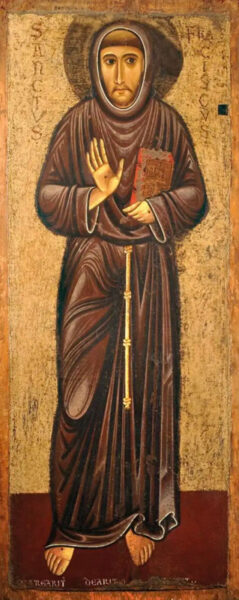
“Every age had its ‘own’ Francis, entrusting his image to the arts”, writes Cristina Acidini in her essay for the exhibition catalogue, published by Mandragora.
Across the various sections, visitors will encounter not only outstanding masterpieces but also the transformation of Franciscan iconography, beginning in the decades immediately following the saint’s death and rapid canonisation in 1228.
The panel painting by Margarito d’Arezzo, on loan from the Museo Civico in Montepulciano, is among the earliest surviving representations. It depicts Francis with a tonsure beneath his hood and a beard, which would disappear from later iconography.
The brown habit, prescribed by the Rule, already possesses a charismatic visual presence. Examples survive as relics at La Verna, Cortona and Santa Croce in Florence, complete with hood and cord bearing three knots.
In the mid-thirteenth-century altarpiece by the Master of the Crucifix, on loan from Pistoia, we witness the establishment of a lively narrative tradition that would find its fullest development in the frescoes at Assisi. The small scenes along the sides preserve for the faithful the memory of the saint’s extraordinary life and his posthumous miracles.
Artists devoted particular attention to developing and establishing the iconography of the Stigmatisation, fundamental to the Franciscan Order’s presentation of Francis as alter Christus – another Christ.
The setting is the rugged mountain of La Verna. The apparition takes the form of a crucified Christ with the red wings of a seraph, more commonly described as “cherubic”. Francis receives the rays emanating from the apparition and thereby acquires the five wounds.
In Fra Angelico’s refined panel St Francis Receiving the Stigmata, on loan from the Vatican Museums, divine light illuminates the mountain at night, creating extraordinary effects of light and shadow.
A gentle painting by Sandro Botticelli, St Francis with Angels, exceptionally lent by the National Gallery in London, alludes to the episode in which the suffering Francis found consolation in the music of angels.
During the Counter-Reformation, in the late sixteenth and seventeenth centuries, representations of St Francis developed in several different directions. Many of the great Baroque altarpieces have been brought together in a theatrical arrangement within the Church of Sant’Ignazio, one of the most important seventeenth-century buildings in Arezzo.
Reflecting contemporary religious sensibilities, artists increasingly emphasised the mysticism of the saint’s solitary meditation. We see him praying or in ecstasy, surrounded by symbols of devotion, as in Annibale Carracci’s St Francis Adoring the Crucifix.
Similarly, in Federico Barocci’s magnificent St Francis in the Grotto – exceptionally lent by the Metropolitan Museum of Art in New York – the saint is depicted absorbed in ecstatic meditation within a rocky shelter, embodying the strength of humility and the “riches of poverty”.
At the same time, the Veronese artist Jacopo Ligozzi, illustrating the Description of the Sacred Mount of La Verna (1612), represented the Franciscan sanctuary and its inaccessible surroundings with a powerful sense of rugged physical reality.
In the Baroque period, Francis became a participant in swirling, triumphal compositions, encountering the supreme divine figures in the glory of Paradise through ecstatic visions, as in Luca Giordano’s The Stigmata of St Francis.
In more recent centuries, artists returned to Francis with different approaches. Some revived the traditional narratives of edifying and miraculous episodes, while others emphasised his direct and essential spirituality.
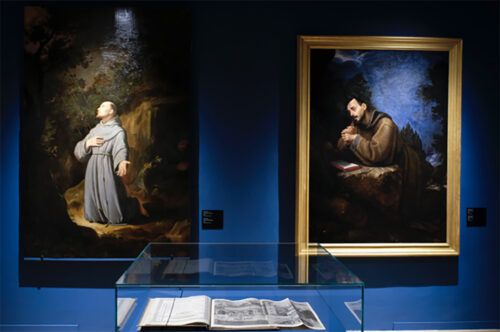
This is evident in Antonio Ciseri’s depiction of the saint before the Crucifix in St Francis Receiving the Stigmata (1887), in the ascetic figure of Libero Andreotti’s plaster sculpture (1920), reaching towards God, and in the wooden sculpture designed by Gio Ponti as part of a series of 22 figures of saints for the Church of Santa Maria Annunciata, adjoining the San Carlo Borromeo Hospital in Milan.
Other highlights of the exhibition include Giorgio Vasari’s The Holy Family with St Francis, Guercino’s St Francis Adoring the Crucifix, Pietro da Cortona’s Madonna Enthroned with the Child and Saints, and Angelo Ricci’s The Immaculate Conception among Franciscan Saints.
Also featured are sculptures by Andrea della Robbia and Tino di Camaino, together with illuminations executed by Don Simone Camaldolese for the precious Gradual of 1380, lent to the exhibition by the Historical Archive of the Opera di Santa Croce.
Finally, a special section examines the Franciscan commemorations of the twentieth century, particularly those of 1926, when artistic initiatives proliferated throughout Italy, frequently associated with nationalist propaganda.
A central figure in this context is Duilio Cambellotti, who, among other works, created a stained-glass window dedicated to the saint of Assisi and oversaw the entire artistic design of a volume devoted to the Little Flowers of St Francis and the saint’s miraculous stories, published in 1926. The exhibition includes numerous tempera paintings produced for that publication.
Pedro Fernández, St Francis Receiving the Stigmata, 1514–1515. Tempera and oil on panel. Galleria Sabauda, Musei Reali, Turin.
VISIT:
The Image of St Francis – From the Middle Ages to the Twentieth Century
3 October 2026 – 10 January 2027
Galleria Comunale d’Arte Moderna e Contemporanea and Church of Sant’Ignazio, Arezzo, Italy
READ ALSO:
The Image of Francis From the Middle Ages to the 20th Century
edited by Cristina Acidini
Exhibition catalogue Arezzo, Galleria Comunale d’Arte Contemporanea e Sala Sant’Ignazio, 3 October 2026-10 January 2027
READ MORE: