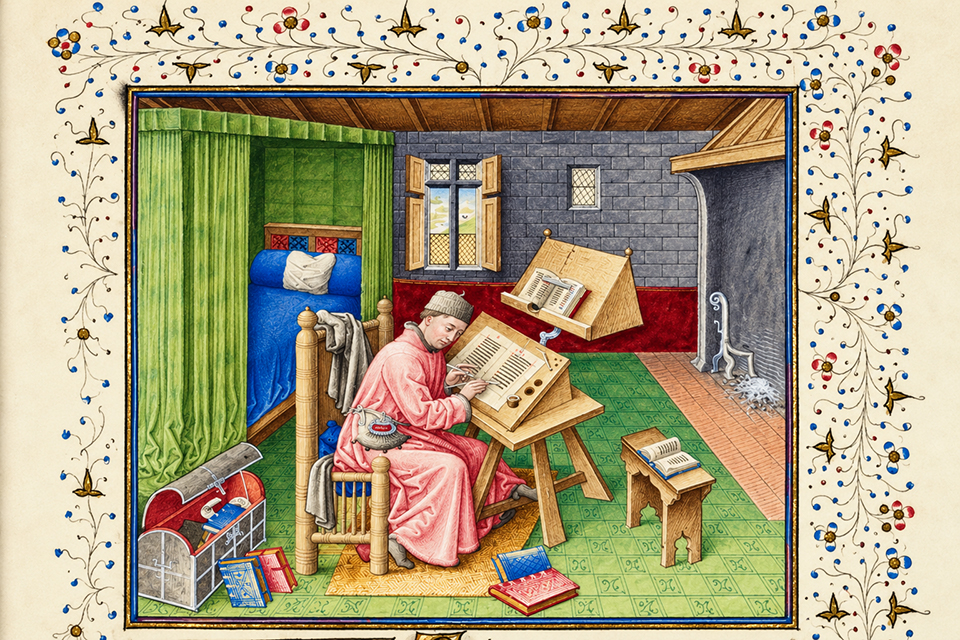
In 1418, Nicolas Flamel died in Paris, leaving behind a considerable fortune in houses, rents and other property. A prosperous “bourgeois de Paris”, he had spent much of his adult life acquiring real estate, financing religious buildings and arranging for prayers to be said for himself and his wife after their deaths. In doing so, he had also carefully cultivated his public memory, ensuring that his name and image would survive in the streets, churches and cemeteries of Paris.
He could hardly have imagined what would happen next. Within a century, this respectable Parisian businessman and skilled scribe had begun to acquire an entirely different reputation. According to increasingly elaborate accounts, Flamel had discovered the secret of the philosopher’s stone, mastered the transformation of base metals into gold and perhaps even achieved immortality. This enticing history has been on view at the Musee de Cluny in Paris in the winter of 2026.
While the exhibition focus on both the man and the myth, this booklet primarily concerns the man Nicolas Flamel using him to explore the world in which he lived and the ways in which he tried to secure his achievements and public memory.
CONTENT:
| 1. Setting the Scene - the Landscape of Medieval Paris | 6. The House Nicolas Flamel Built for the Living and the Dead in 1407 |
|---|---|
| 2. Nicolas Flamel – The Man Who Became an Alchemist After His Death | 7. Music in the Time of Nicolas Flamel |
| 3. What Was an Escripvain in the Middle Ages? Scribes, Authors and the Business of Writing | 8. Nicolas Famel in the Wider Social Landscape of Paris ca. 1400 |
| 4. The Devotional Landscape of Nicolas Flamel and Pernelle in Medieval Paris | 9. Reading Medieval Paris: Fifteen Books on the City |
| 5. Pernelle's wealth | 10. Stepping into the Heart of Medieval Paris |
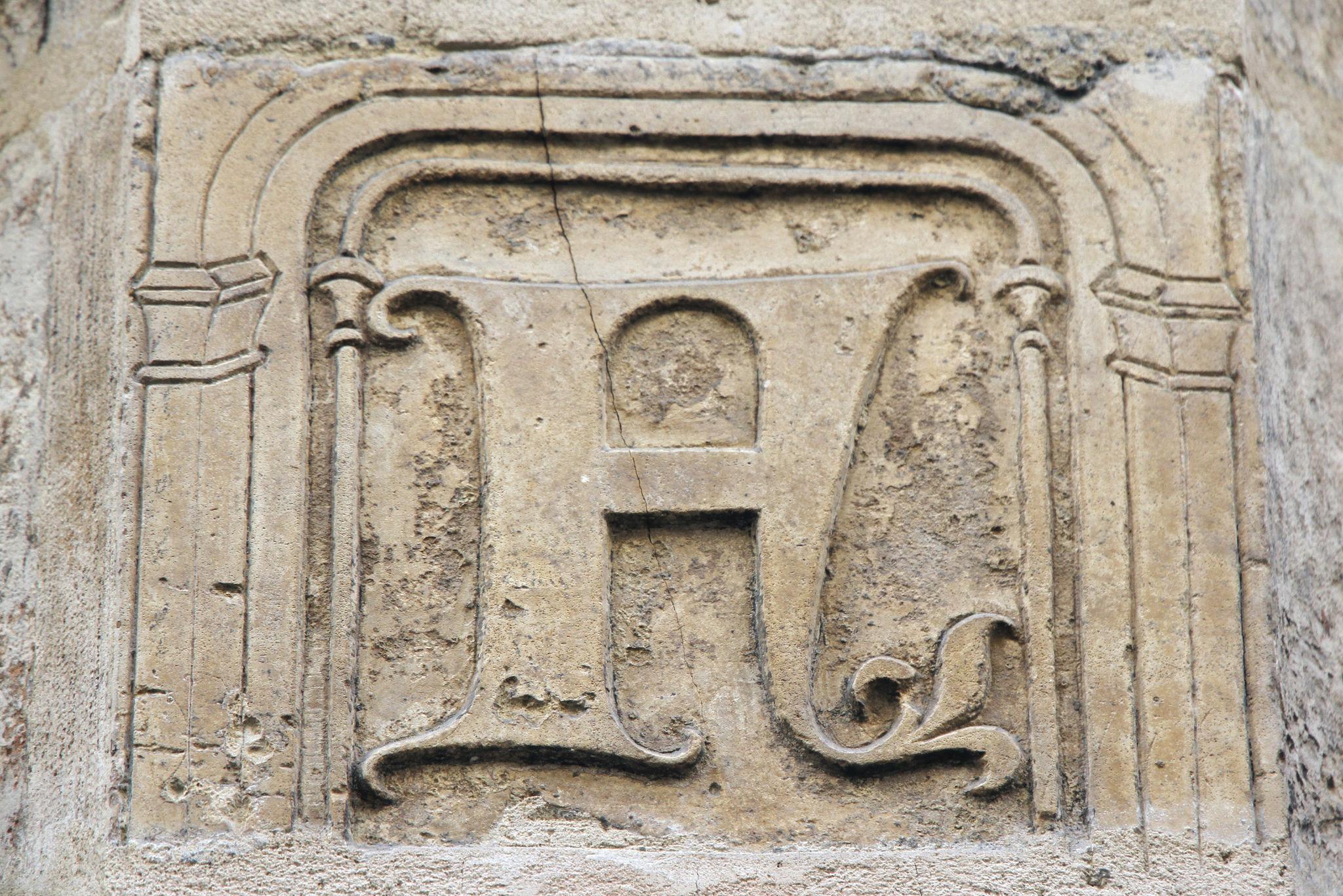
1. Setting the Scene – The Landscape of Medieval Paris
What was the physical world in which Parisians lived in the late Middle Ages? In a sense, Paris was still embedded in an ancient riverine landscape, despite being the only major metropolis in the region, perhaps numbering more than 200,000 inhabitants before the Black Death
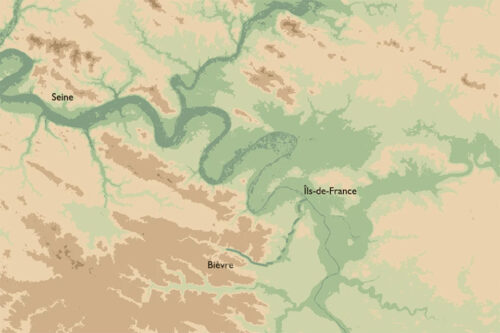
Long before Paris became a metropolis, the Seine carved its way through the great geological bowl of the Paris Basin. Across millions of years, successive seas deposited layers of chalk, limestone, marl, clay and sand, which were subsequently eroded into a landscape of rolling plateaux, shallow valleys and gently rising hills. Along the outer margins of the basin, the chalk formed pale escarpments, while closer to Paris, younger limestone formations shaped the higher ground and the river valleys cut through alternating layers of permeable and impermeable rock. Together, these geological formations created a landscape in which water was everywhere present, sometimes flowing freely, sometimes disappearing underground, only to emerge again as springs at the foot of the hills.
Through this broad, shallow bowl ran the Seine, gathering the waters of the Marne, Oise, Yonne and their numerous tributaries before continuing towards the sea. These rivers were not confined to the relatively orderly banks familiar today. Instead, their floodplains comprised a changing mosaic of channels, islands, sandbanks, backwaters and seasonally inundated meadows. Some channels gradually filled with silt, while others remained open or were reactivated by changing river conditions. Between them lay patches of marshland, reed beds, alder carr and wet meadows, where the boundaries between land and water shifted with the seasons.
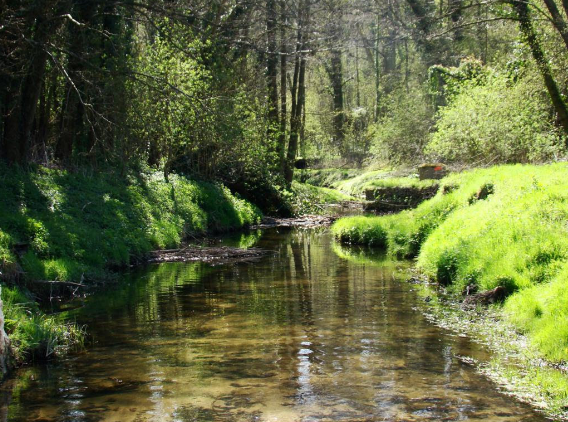
Along the smaller tributaries, the landscape could be even more intimate. Here, streams wound through narrow valleys where springs fed marshes and peatlands, and where willows and alders flourished in the waterlogged ground. On the better-drained slopes, oak, elm, hazel and other deciduous trees formed woodlands interspersed with clearings, grazing grounds and cultivated fields. Farther up, on the plateaux, the fertile loess soils offered favourable conditions for agriculture, although patches of woodland remained an important source of timber, fuel, pasture and other resources.
This was the natural setting in which medieval Paris developed. Yet it was by no means an untouched wilderness. Long before the Romans arrived, generations of farmers and herders had already cleared woodland, cultivated the slopes and exploited the river valleys to the west. Indeed, the history of the Paris Basin cannot be understood as a simple progression from forest to farmland. Rather, the landscape experienced repeated cycles of cultivation, abandonment, regeneration and renewed exploitation.
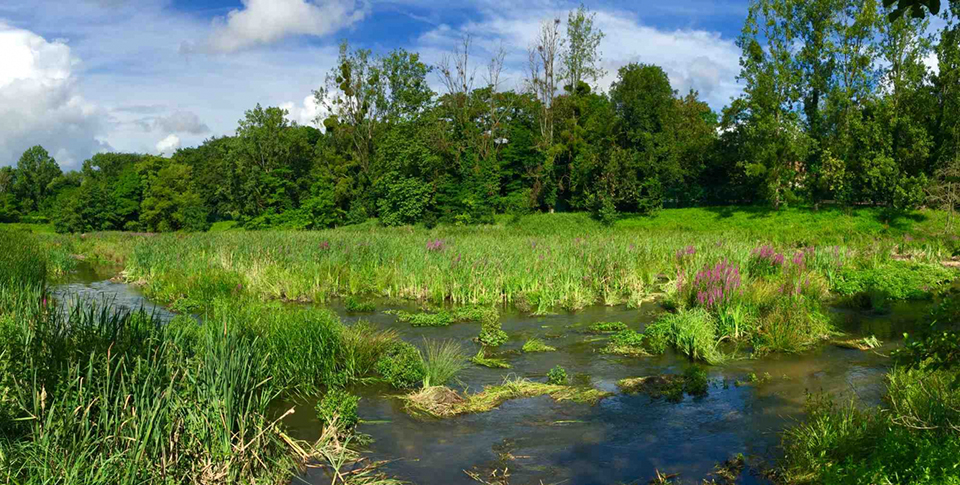
The Roman Optimum and the Early Middle Ages
During the relatively warm and stable conditions associated with the Roman Climate Optimum, agriculture flourished across substantial parts of northern Gaul. Fields expanded across the fertile plateaux, while villas, farms, roads and settlements formed an increasingly organised countryside. Woodland clearance and cultivation left their marks on the landscape, not least through the erosion of exposed soils, which were carried downhill and deposited as silt in the river valleys. Meanwhile, the rivers provided water, transport, fish and the power required for various activities. By late antiquity, the countryside surrounding Lutetia had already been shaped by many centuries of human occupation.
However, between the fourth and seventh centuries, this pattern began to change. The political and economic structures of Roman Gaul were transformed, while climatic conditions became more variable. The relatively favourable conditions of the Roman period eventually gave way to a period that included the pronounced cooling of the sixth century. Nevertheless, the environmental consequences were neither immediate nor uniform.
In some areas, cultivation contracted and woodland regenerated. Pollen evidence from the plateaux around Dourdan and Sénart suggests a substantial recovery of trees between the late fifth and seventh centuries, while reduced soil erosion in several smaller valleys points towards less intensive cultivation and perhaps a greater emphasis on pastoralism. Elsewhere, however, agricultural and pastoral activities continued. The banks of the Seine in Paris itself remained occupied and exploited, and the archaeological evidence from Quai Branly demonstrates that the river was already being managed during the Merovingian period.
Nor does the more recent evidence support the notion of a complete collapse of rural activity. A detailed investigation of the Mérantaise, a small tributary of the Yvette south-west of Paris, reveals a long history of agricultural and pastoral exploitation extending from the Iron Age through the Middle Ages. Although occupation at particular sites fluctuated, cereal cultivation continued to leave traces in the pollen record. From approximately AD 675, the sediments also reveal the retting of hemp in the valley’s waters. This activity demonstrates the exploitation of the stream for processing fibres, although it cannot in itself be taken as evidence of expanding settlement or intensified cereal production. Perhaps, the hemp was a cashcrop sold to shippers exploiting the commerce along the rivers and into the Channel? [1]
By the ninth and tenth centuries, therefore, the countryside surrounding Paris presented a varied picture. On some plateaux, woodland had returned to land previously cultivated. Elsewhere, fields and pastures remained in use, while farms, villages, churches and estates occupied the more favourable locations. Along the rivers, wet meadows, marshes and wooded banks continued to form a substantial part of the landscape. The environmental evidence from Quai Branly even suggests a local regeneration of woodland during the ninth and tenth centuries, although this should not be interpreted as a general retreat of agriculture throughout the region.
Paris in the High and Late Middle Ages
Around the millennium, however, the balance began to shift once more. Under the generally favourable conditions associated with the Medieval Climate Anomaly, cultivation and settlement expanded across much of northern France, although the pace and intensity varied considerably from one district to another. Woodland was cleared, existing fields were enlarged, and new settlements were established. Increasing agricultural activity also left its mark on the rivers, as soil erosion and sedimentation gradually intensified.
Yet perhaps the most remarkable transformation occurred in the watery landscapes of the valleys. Marshes and streams that had previously followed their own rhythms were increasingly subjected to deliberate management. Ditches drained wet ground, dams retained water, and millraces diverted streams to turn waterwheels. Meanwhile, artificial ponds were established for fish production, irrigation and the regulation of water supplies.
Religious institutions played an important role in these developments, particularly the Cistercians, whose monasteries were often founded near springs and marshy valley heads. However, they did not arrive in an untouched landscape, nor did they invent all the hydraulic technologies they employed. Many mills and watercourses had already been developed by secular landowners or earlier religious communities. Nevertheless, through their systematic organisation of ponds, drainage networks and mills, the Cistercians contributed to a wider transformation in which water became an increasingly managed resource.
As Paris grew, the demands placed upon its surrounding countryside intensified. Around 1200, the city may have contained some 60,000–80,000 inhabitants; a century later, estimates suggest approximately 250,000. Feeding such a population required an expanding network of agricultural production, transport and exchange. Grain, vegetables, fruit, wine, livestock, timber and other necessities flowed towards the capital, while the rivers and roads connected the city to an ever-widening hinterland [2]
The small rivers were no less important than the Seine itself. Their mills ground grain, their meadows supported livestock, and their waters served a variety of domestic and industrial purposes. As the historian Jean-Marc Moriceau famously observed, “Paris ate its nearby countryside”. Indeed, the growing metropolis increasingly depended upon the productive capacity of the whole surrounding region.
The calamities of the fourteenth century – poor harvests, warfare, epidemic disease and demographic contraction – interrupted this long expansion. Some settlements contracted or disappeared, while cultivation was abandoned in particular districts and woodland reclaimed former fields. By around 1450, the countryside was again undergoing change, although the consequences differed from place to place.
Thus, the landscape from which medieval Paris emerged was neither the wilderness imagined by later generations nor the familiar cultivated countryside of modern France. It was a living mosaic of water and land, shaped over centuries by climate, geology and human labour. Its rivers had always offered opportunities, but they also imposed limits. The extraordinary growth of Paris between the eleventh and fourteenth centuries depended in part upon the ability of its inhabitants and surrounding communities to negotiate those limits, transforming the watery landscape of the Seine Basin into one of the most productive and densely inhabited regions of medieval Europe.
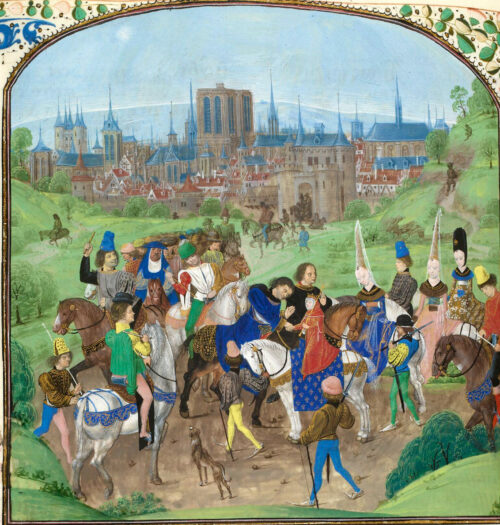
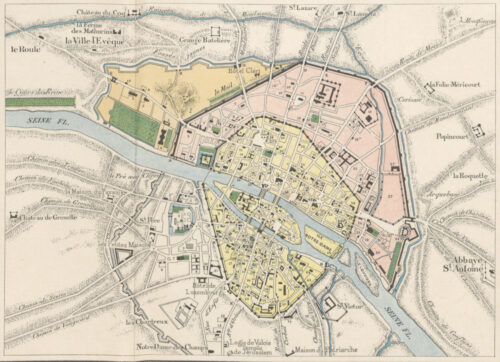
Within this landscape, Paris developed into a vibrant centre of trade and commerce on the Right Bank, while the University and numerous religious institutions made the Left Bank a thriving centre of scholarship and religious life. The city’s development was further consolidated under Philip Augustus around 1200, when the royal government became increasingly centred on Paris and formidable new walls were constructed to protect the growing city. By the late Middle Ages, Paris had become one of the great metropolises of Europe, inhabited by a multitude of merchants, scholars, clerics, craftsmen and labourers.
Among them lived the Parisian burgher Nicolas Flamel, whose life, properties and pious foundations offer us an opportunity to explore the intricate social and religious world of medieval Paris.
NOTES:
1. Might the hemp have been grown as a commercial crop, perhaps transported along the rivers towards the Channel? This remains an interesting possibility. However, evidence of retting does not establish the scale of production or the destination of the fibres. See: Lucile de Milleville et al., “Three thousand years of anthropogenic impact and water management and its impact on the hydro-ecosystem of the Mérantaise river, Paris conurbation (France)”, Quaternary Science Reviews 307 (2023), 108066.
2. Population estimates for medieval Paris vary considerably. These figures should be understood as approximations rather than precise counts.
2. Nicolas Flamel – a Parisian Pillar of Society 1350-1418
How did the life of a wealthy Parisian property investor and benefactor unfold arround 1400?
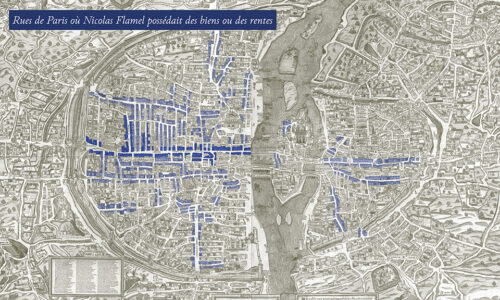
© Romain Tach – Lora Houssaye – Maïwenn Brochen 2026
Created for the exhibition, Nicolas Flamel, alchimiste de papier,
Paris, musée de Cluny – musée national du Moyen Âge
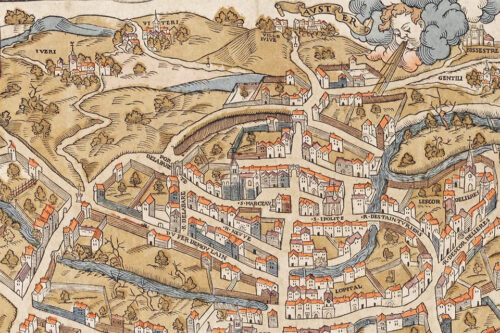
Based on the map: La Ville, cité, université de Paris. Plan de Paris / par Olivier Truschet et Germain Hoyau, dit plan de Bâle : [1552-1559] ; édité par Fritz Husner. source: ville de Paris / Bibliothèque Historique de la Ville de Paris
Born around 1340 -50, Nicolas Flamel lived through some of the most turbulent decades in the history of medieval France. His lifetime encompassed the devastation of the Black Death, the Hundred Years’ War, repeated outbreaks of plague, political upheavals and the growing instability of the French monarchy. Nevertheless, Paris remained a major European metropolis, with its markets, churches, university, monasteries and expanding urban neighbourhoods. For those with sufficient capital and commercial acumen, the city also offered considerable opportunities. Flamel belonged to this prosperous urban world. In contemporary documents, he was described as an epscrivain and bourgeois de Paris – a Parisian burgher. Traditionally, this designation has led historians to identify him as a professional copyist, bookseller or producer of legal documents. However, no surviving examples of his professional work have been securely identified. Consequently, the precise nature of his occupation remains fluid. What seems certain according to his testament is, that his income primarily derived from his activities as a slumlord involved in developing the quarters on the Eastern side of the Seine, La Rive Droite [1]. What we do know is that he must have been a successful investor, known to have lent or gifted substantial sums to the French King. Also, it does appear as if this accrued wealth primarily derived from his wife.
Around 1363, Flamel married Pernelle, who became his partner in the acquisition and management of her property. Twice widowed, she does not seem to have been very pleased with her third marriage. According to law, though, she was obliged to support her man. Their first documented purchase, in 1375, was a house known as the Fleur de lys, where they subsequently lived. Over the following decades, the couple steadily accumulated houses and, more importantly, rents secured on properties throughout Paris and its suburbs. By the time Flamel died, his estate included approximately ten houses and nearly 300 separate rents. These were concentrated particularly on the Right Bank, in areas south of the priory of Saint Martin des Champs and within the new city walls, completed around 1380.
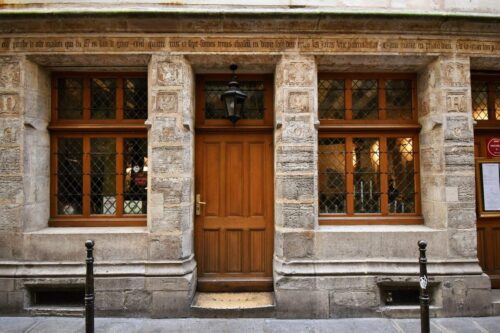
This was a shrewd choice. After the enlargement of the walls, parts of the outer districts were still relatively undeveloped, but the expansion of Paris promised increasing demand for housing and commercial premises. In effect, Flamel had invested in the future growth of the city. One of his more substantial building projects was a house constructed in 1407 in what is now the rue de Montmorency. Still standing at number 51, it remains one of the most evocative material reminders of his presence in medieval Paris. Yet Flamel’s prosperity was not simply a matter of accumulating wealth. Like many affluent medieval townspeople, he used his fortune to establish himself within the religious and social landscape of the city. [2]
Buying a Place in Eternity
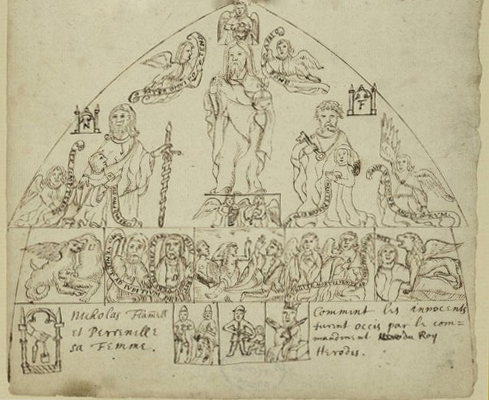
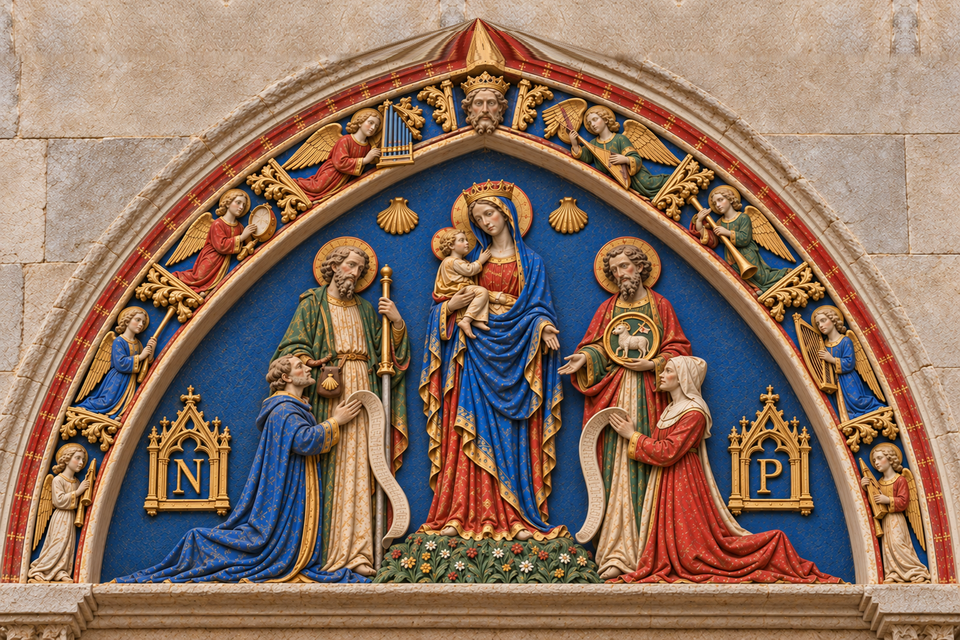
To understand Nicolas Flamel, we must remember that medieval property ownership was not solely concerned with financial security or social standing. Wealth could and would also be converted into spiritual benefits. For prosperous Christians, the foundation of masses, charitable donations and the construction or embellishment of churches offered opportunities to secure prayers for their souls. Such arrangements created enduring relationships between donors and religious institutions. They also allowed wealthy individuals to inscribe themselves into the fabric of their communities. Flamel was particularly energetic in this respect. Together with Pernelle, he financed improvements to churches, chapels and religious buildings across Paris. Thus, in 1389, the couple contributed to the refurbishment of the church of Saint Jacques de la Boucherie, their parish church, where they were subsequently depicted kneeling before the Virgin Mary on a tympanum.
Elsewhere, their images appeared on an arcade in the cemetery of the Saints Innocents, where they were represented praying before Christ, surrounded by angels. Following Pernelle’s death in 1397, Flamel continued these activities. In 1402, he contributed to the restoration of Sainte Geneviève des Ardents, where another representation showed him in prayer, wearing a long hooded tunic.
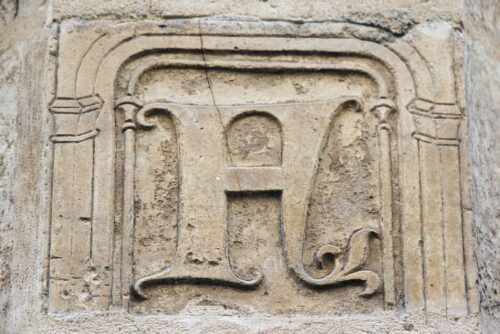
These were not incidental decorations. They belonged to a carefully organised culture of commemoration in which images, inscriptions, donations and prayers reinforced one another. Indeed, Flamel appears to have been especially conscious of the importance of ensuring that his presence remained visible. His initials and likenesses were displayed on portals, arcades and buildings, while his charitable foundations were intended to preserve his name within the liturgical memory of the city. At his death he donated a number of chalices to religious foundations and churches in Paris, which were emphatically ordered to be decorated with his initials NT.
His Will and Last Testament
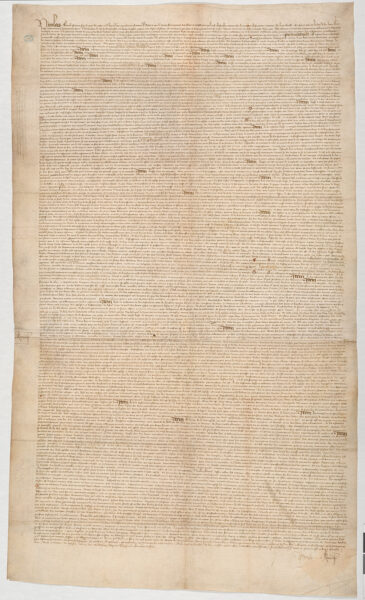
His final arrangements were equally elaborate. In his will, drawn up in 1416, Flamel designated his parish church as his universal heir. He also made provisions intended to preserve the charitable and religious foundations established by himself and Pernelle. Yet there was a complication. A surviving codicil shows that he wished to combine the resources of both estates to ensure that their respective commemorative obligations would continue. Unfortunately, her will had not been properly notarised and was therefore legally ineffective.
Consequently, the commemorative masses established by Pernelle eventually ceased for want of sufficient funds. Those founded by Nicolas, however, continued to be celebrated until shortly before the French Revolution, albeit reduced to an anniversary. There is something revealing about this imbalance. Even in a marriage characterised by substantial joint investments, the mechanisms of inheritance and religious patronage could preserve the memory of one spouse more successfully than the other. In the end, he was secured a free exit from the purgatory, while she – who had provided the wealth – was forgotten.
On the other hand, Flamel’s investment in his afterlife suggests that, although wealthy, he apparently did not belong to the highest ranks of Parisian society. This becomes apparent when we compare his donations to Saint-Jacques-de-la-Boucherie with those of other prominent parishioners. During the period when Flamel was active, several substantial commemorative foundations were established in the church. Among the most prominent benefactors was Nicolas Boulard, an officer in the royal household responsible for food service and provisioning. He founded a chapel dedicated to Saint Nicholas, established daily masses and arranged for a monumental tomb commemorating himself and his wife. Similarly, Simon de Dammartin, a royal clerk and financial adviser, founded a chapel dedicated to the Virgin, before which he was buried, and endowed daily masses. Meanwhile, Guillemette la Baillette, the wife of another royal financier, and Jeanne Taillefer provided for weekly masses. By comparison, Nicolas Flamel belonged to a group of four benefactors who endowed monthly commemorations. Of course, the frequency of these masses cannot simply be translated into a ranking of wealth. Nonetheless, when considered alongside the foundations of chapels and funerary monuments, the differences suggest a recognisable hierarchy of religious patronage. Flamel was certainly a prosperous and ambitious benefactor, but he appears to have occupied a position below the most prominent members of his parish. In this respect, his elaborate arrangements for securing his posthumous memory may tell us as much about his social aspirations as they do about his wealth.
The Extraordinary Journey of a Tombstone
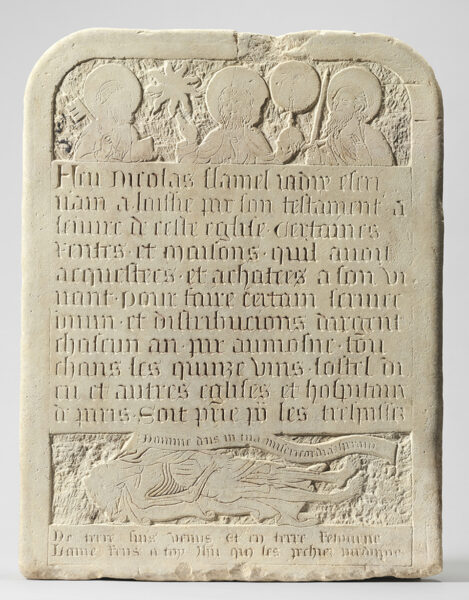
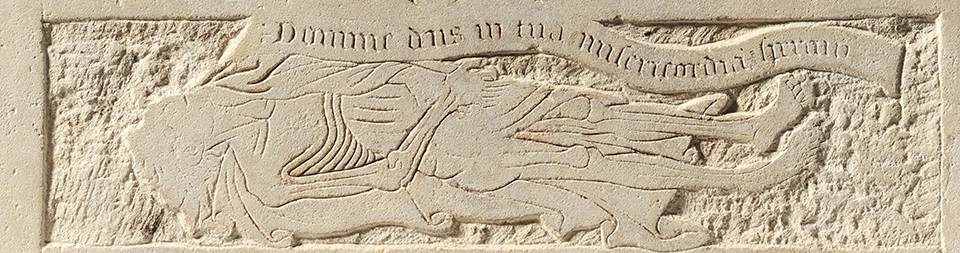
national du Moyen Âge) / Michel Urtado. FEU NICHOLAS FLAMEL IADIS ESCRI/VAIN A LAISSE PAR SON TESTAMENT A/ LEUVRE DE CESTE EGLISE. CERTAINES/RENTES ET MAISONS QUI AVOIT/ACQUESTES, ET
ACHATES A SON VI/VANT. POUR FAIRE CERTAIN SERVICE/DIVIN. ET DISTRIBUTIONS D’ARGENT/ CHASCUN AN. PAR AUSMONE TO/CHANS LES
QUINZE VINS. LOSTEL DI/EU ET AUTRES EGLISES ET HOSPITAUX A PARIS./SOIT PRIE POUR LES TREPASSEZ. (Translation: The late Nicolas Flamel, formerly a scribe, bequeathed by his testament to the fabric of this church certain rents and houses which he had acquired and purchased during his lifetime, in order to provide for certain divine services and annual distributions of money as alms to the Quinze-Vingts, the Hôtel-Dieu, and other churches and hospitals in Paris. Pray for the souls of the departed.)
Perhaps the most remarkable surviving testimony to Flamel’s concern with posterity is his epitaph, now preserved in the Musée de Cluny. According to his testament, Flamel commissioned the stone during his lifetime and kept it in his house until his death on 22 March 1418. It was then installed above his grave inside Saint Jacques de la Boucherie.
The stone records his charitable foundations and commemorates his concern for the poor and the religious institutions of Paris. Decorated with religious imagery, it reflects the world of late medieval piety. Its subsequent history is almost as improbable as the legends attached to its owner. Following the demolition of Saint Jacques-de la Boucherie in 1797, the epitaph disappeared. Eventually, a dealer in curiosities and shells discovered it in the possession of a Parisian fruit seller, who was using the medieval funerary slab to display spinach. The stone subsequently passed through the hands of several dealers before attracting the attention of the authorities in 1839. The City of Paris purchased it for 200 francs, initially intending todisplay it in the restored Tour Saint-Jacques, the surviving tower of Flamel’s former parish church. In the end, though, it entered the collections of the Musée de Cluny in 1845. This epitaph provides the starting point for the new exhibition, which brings together approximately fifty manuscripts, archival records, objects and other materials to reconstruct the history of Flamel. And not least, his subsequent transformation into an alchemist.
NOTES:
[1] Archives in the Service of Manuscript Study: The Well-Known Nicolas Flamel
By Rouse, Mary A.
In: Patrons, authors and workshops, patrons, authors and workshops: books and book production in Paris around 1400. Ed. by Croenen, Godfried. Louvain (2006) p. 69-90
[2] Guillebert de Mets. Description de la ville de Paris 1434. Medieval French text with English translation
Text, translation, and notes by Evelyn Mullally. Brepols 2025
[3] Villain,Étienne F. (1758). Essai d’une histoire de la paroisse de St. Jacques de la Boucherie: ou l’on traité de l’Origine de cette Eglise, de ses Antiquités. Paris: Prault. Villain, Étienne F. (1761) Histoire critique de Nicolas Flamel et de Pernelle sa femme : recueillie d’actes anciens qui justifient l’origine & la médiocrité de leur fortune contre les imputations des alchimistes : on y a joint le testament de Pernelle & plusieurs autres pieces intéressantes. A Paris : Chez G. Desprez
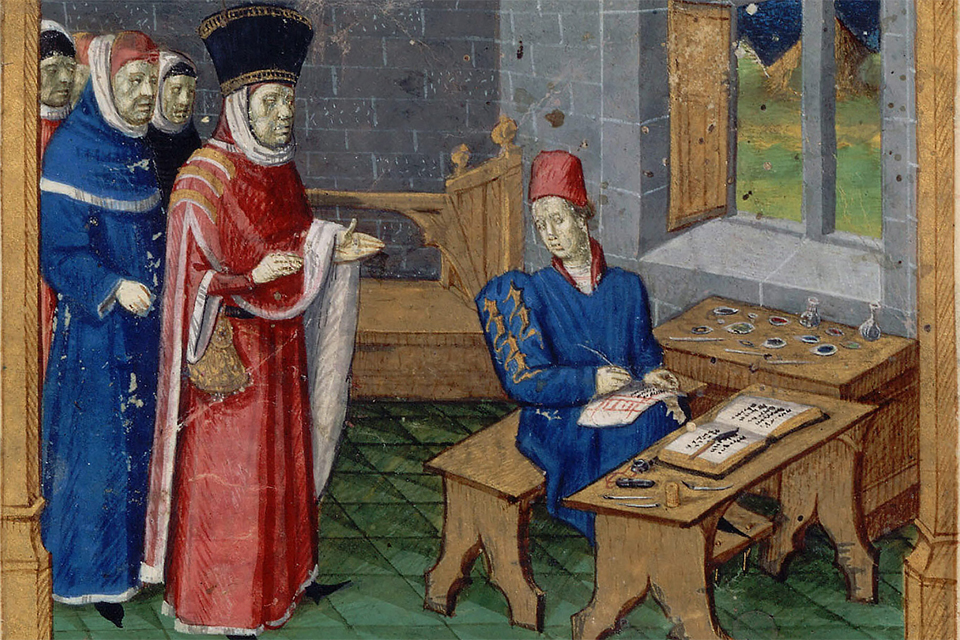
The chancellor, Guillaume des Ursins and his scribe/illuminator from the introduction to La Mer des histoires (Mare historiarum) de Giovanni Colonna. Notice the fat purse hanging from his belt. BnF, MS Latin 4915, fol. 1r
3. What Was an Escripvain in the Middle Ages? Scribes, Authors and the Business of Writing
What did it mean to be an escripvain (or escrivain) in medieval France? Was such a person a professional copyist, a clerk, a secretary, a notary or an author? And how did the meaning of the term change as manuscript production developed into an increasingly specialised commercial enterprise during the later Middle Ages?
On the tombstone of Nicolas Flamel, we read that he identified himself as an escrivain. Undoubtedly, this was a well-known profession in late medieval Paris, where two streets were known as Rue des Écrivains or Rue de l’Ecrivains – one near the university on the Left Bank and another beside which Nicolas Flamel lived. We also know that he offered his services from two stalls built beside his parish church, Saint-Jacques-de-la-Boucherie, presumably catering for the paperwork needed by businessmen, large and small, operating near the neighbouring Châtelet.
That there were many of these “writers” is not in doubt. But what were their main lines of business? Were they small-time bureaucrats? Notaries? Authors? And did it matter whether they called themselves escrivain or escripvain?
In a substantial study, Olivier Delsaux has challenged the conventional understanding that the medieval French escripvain or escrivain gradually evolved from a copyist into a literary author. Instead, he demonstrates that the word possessed several overlapping meanings throughout the Middle Ages, reflecting the different activities involved in producing, reproducing and circulating written texts.
Based on more than 450 recorded occurrences of the term, drawn from literary works, manuscript colophons, administrative accounts, legal documents and medieval dictionaries, Delsaux has reconstructed a world in which the boundaries between scribes, authors and other professionals working with texts were considerably less rigid than their modern equivalents suggest.
His central argument is that escripvain was a polysemous term whose underlying meaning was essentially someone responsible for recording discourse in writing. Whether that discourse originated with someone else or was composed by the person writing it was not necessarily decisive. Moreover, the different spellings, including escrivain and escripvain, did not denote separate occupations or stages in the development of the profession. They were variants of the same word, whose meaning depended on its particular context.
The professional scribe
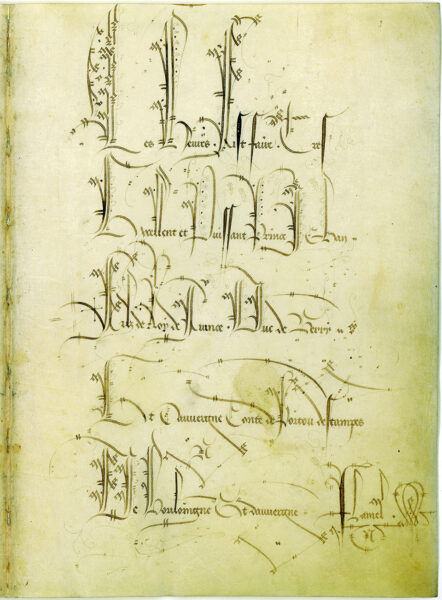
Throughout the Middle Ages, escripvain frequently designated a professional responsible for transcribing manuscripts. Such individuals might copy religious books, literary works or administrative documents, often working for wealthy patrons, ecclesiastical institutions or princely households.
However, their activities were not necessarily confined to copying texts. By the fourteenth and fifteenth centuries, professional scribes could undertake or supervise several stages of manuscript production, including preparing parchment, arranging illumination, correcting texts, binding volumes and organising the work of other craftsmen. Consequently, some escripvains increasingly resembled entrepreneurs operating within the manuscript trade rather than artisans specialising exclusively in handwriting.
Delsaux documents this development through surviving accounts of payments for manuscript production, particularly those associated with royal and aristocratic households. He also draws attention to the emergence of the escripvain du roi, an official designation associated with the French royal court under Charles V. In this context, the professional scribe could become responsible for delivering a complete manuscript, organising its physical production and ensuring that the resulting book satisfied the patron’s requirements.
Parisian tax registers from the late thirteenth and early fourteenth centuries identify numerous individuals by this occupational designation.
Scribes, clerks and notaries
Thus, the term also extended beyond manuscript production to people employed in administrative and legal writing. Here, escripvain could refer to someone recording transactions, preparing documents, maintaining accounts or otherwise producing written records. Accordingly, its meaning sometimes approached that of notaire, greffier or secrétaire. Indeed, medieval Latin–French dictionaries occasionally associated scriba with both escripvain and notaire.
Nevertheless, Delsaux does not argue that these occupations were interchangeable. Rather, his evidence demonstrates that the vocabulary used to designate individuals engaged in writing depended on the particular context and the nature of their employment.
This distinction is important. An individual described as an escripvain in a legal document was not necessarily a notary in the institutional sense. The designation might instead identify his established professional activity as someone engaged in the production or reproduction of written texts.
Furthermore, Delsaux distinguishes between an occupation and a formally recognised professional status. Although manuscript copyists could be identified by their trade, their professional position was often less clearly defined than that of other craftsmen involved in book production. Thus, escripvain or escrivain could indicate a regular and recognised occupation without necessarily implying membership of a distinct professional corporation or the possession of an official title.
Nicolas Flamel: an escrivain in medieval Paris
As noted above, the inscription on Nicolas Flamel’s funerary monument, commissioned in accordance with his testamentary wishes, identifies this wealthy Parisian property owner as an escrivain. Moreover, Delsaux cites a document from 1395 concerning a property transaction involving a house called À la Brouette and its adjoining garden, in which Flamel is identified as: Nicolas Flamel, escrivain (1) Here, the designation is not connected with Flamel’s authorship of a literary work or with a particular manuscript he had copied. Instead, it identifies him by his occupation in a property document.
Delsaux places this example alongside other records in which professional scribes were identified by their occupation in legal and administrative contexts unrelated to the production of manuscripts. His point is that an escripvain could be recognised professionally as a copyist or professional scribe even when the document in question concerned an entirely different aspect of his life.
In Flamel’s case, the reference therefore supports the conclusion that he was recognised as a professional escrivain. Nevertheless, it does not tell us precisely what his daily work involved. He might have copied manuscripts himself, undertaken documentary writing or participated in the wider business of preparing and supplying books. The occupational designation alone cannot establish the precise balance between these activities. Indeed, one of the most interesting aspects of Delsaux’s study is his demonstration that professional scribes increasingly assumed responsibilities beyond the physical copying of texts. Some organised manuscript production, while others corrected, adapted or even rewrote existing works. Consequently, the distinction between the person responsible for producing a manuscript and the person responsible for its intellectual content could become difficult to maintain.
Against this background, it is particularly interesting that in 1434, when Guillebert de Mets composed his description of Paris, he mentioned two individuals named Flamel in his account of the city’s distinguished craftsmen and inhabitants. Guillebert wrote:
“Furthermore [there was] Gobert, the supreme scribe [escripvain], who composed the Art of Writing and that of sharpening quills, and his disciples who were retained by princes because of their writing skills, such as the young Flamel by the Duke of Berry, Sicart by King Richard of England, Guillemin by the Grand Master of Rhodes, Crespy by the Duke of Orléans, Perrin by the Emperor Sigismund of Rome and many others. Also many skilful artificers, such as Herman, who polished diamonds in various shapes; Willelm the goldsmith; Andry, who worked on brass and on silver and gold-plated copper; the potter who kept nightingales which sang in winter; the three illuminator brothers and other skilled trades. Also Flamel the elder, a writer [escripvain] who gave so many alms and such hospitality and built many houses where the tradespeople lived downstairs and with the rent they paid, poor workmen were supported upstairs.”
Quoted from: Guillebert de Mets, Description de la ville de Paris (1434), in Description de la ville de Paris 1434, medieval French text with English translation, notes and introduction by Evelyn Mullally (Brepols, 2015), p. 107.
The passage is illuminating because Guillebert uses the same occupational designation in two rather different contexts.
The younger Flamel appears among the pupils of Gobert, celebrated for their exceptional handwriting and their employment by European princes. In this context, escripvain clearly identifies a professional whose skills were associated with the production of manuscripts. The elder Flamel, on the other hand, appears primarily as a distinguished Parisian benefactor. Guillebert mentions neither the manuscripts he copied nor any texts he might have composed. Instead, he celebrates the charitable foundations and buildings through which Flamel provided accommodation and financial support for the poor. Nevertheless, he still identifies the elder Flamel as an escripvain.
At the same time, the reference to the younger Flamel raises further questions. The designation le jeune Flamel invites comparison with Flamel l’ancien, but does not in itself establish a family relationship. Nevertheless, Guillebert places both men within the same broad category of writing professionals. Guillebert’s account places both Flamels within the wider professional culture of writing and manuscript production in late medieval Paris. Whether the younger was related to Nicolas Flamel, and if so how, remains uncertain.
Even so, the juxtaposition is suggestive. The elder Flamel had made his fortune and established his charitable reputation, while the younger Flamel was remembered for the exceptional quality of his handwriting and his association with a princely household. Yet, both could be described as escripvains, although the circumstances of their lives and careers might have been quite different. Indeed, this is precisely the kind of distinction that Delsaux’s linguistic analysis helps us understand.
From copyist to author
Delsaux thus demonstrates that escripvain could designate someone who compiled, adapted, translated or composed written works. In many cases, however, these activities were closely related to the reproduction or reworking of existing material, as medieval authors frequently presented themselves as transmitters of inherited knowledge rather than creators of entirely original texts. This distinction between copying and composing was complicated by the practices of compilation, translation, adaptation and rewriting. Some scribes became editors or authors through their work on existing texts, while some authors became closely involved in the preparation of manuscripts containing their compositions.
During the fourteenth and fifteenth centuries, however, the relationship between these activities changed further. Authors increasingly participated in the physical production of their manuscripts, while some professional scribes assumed editorial responsibilities that brought them closer to the work of composition.
Delsaux observes that from the middle of the fourteenth century, and more consistently from the 1460s, escripvain became increasingly employed to designate a writer or author, particularly in Burgundian literary circles. Nevertheless, he emphasises that this did not mean the earlier sense of professional copyist had disappeared. The two meanings continued to coexist, sometimes overlapping in practice.
Furthermore, the change cannot be understood simply as the replacement of one meaning by another. Rather, it reflected developments within the manuscript trade itself. As professional scribes became involved in editing and rewriting texts, and authors became increasingly concerned with the material production of their works, their activities converged.
Finally, the arrival of printing eventually altered this relationship. As printed books increasingly replaced manuscript copies in the circulation of literary works, the distinction between the person composing the text and those responsible for reproducing it became more pronounced. Consequently, the meaning of escripvain gradually shifted towards that of the modern French écrivain. However, Delsaux emphasises that this development was neither straightforward nor complete by the end of the Middle Ages.
The changing meaning of writing
Delsaux’s study challenges the assumption that the emergence of the modern author can be understood simply as a change in vocabulary. Instead, the evolution of escripvain reflects broader transformations in literacy, literary production, professional identities and the material culture of the book.
Ultimately, the medieval escrivain, or escripvain, was defined less by authorship than by his relationship to the production of writing. Understanding that distinction allows historians to reconstruct the complex professional world in which medieval texts were composed, copied, adapted and circulated. Only gradually, and particularly following the introduction of printing, did the distinction between the professional scribe and the literary author acquire its modern significance.
NOTES:
(1) The reference is preserved in the Archives nationales in Paris (AN, S94, no. 5)
4. The Devotional Landscape of Nicolas Flamel and Pernelle in Medieval Paris
A house with two street entrances, writing stalls against a church wall and a sculpted portal reveal how a Parisian couple connected domestic life, work and religious patronage in the 14th century
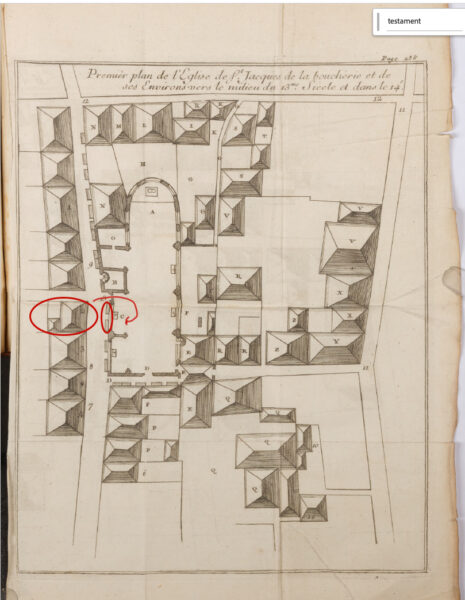
At the centre of Nicolas Flamel’s neighbourhood were the streets, his private house and the church next door. Thus, the most revealing house associated with Nicolas Flamel is not the surviving building in rue de Montmorency. Rather, it is the lost residence that he and his wife, Pernelle, established on the corner of rue Marivaux and rue des Écrivains, opposite the church Saint-Jacques-de-la-Boucherie. Here, within a few steps, stood their home, their professional premises and a church entrance bearing their kneeling images. Together, these places formed what we might call a devotional landscape: not a secluded religious retreat, but a highly visible arrangement of household, livelihood and public piety in the middle of Paris. [1]
As the house no longer stands, the strongest evidence comes from the account drawn up in 1399 by the executors of Pernelle’s testament, preserved in transcription by the Abbé Étienne-François Villain. Its description is not merely approximate. The couple had acquired an empty plot at the corner of rue Marivaux, opposite the church, and had a house built on it. By the time of Pernelle’s death in September 1397, it bore the sign of the fleur-de-lis. The account further describes “two frontages and two openings”, one towards rue des Écrivains and the other towards rue Marivaux. This was therefore a corner property with entrances from two streets, not a single narrow frontage inferred from a later picture of Paris.[2]
Later, after Flamel’s death, the original residence was divided into two houses: the corner property retained the fleur-de-lis, while the other took the sign of St Nicholas. While a later eighteenth-century description of “Flamel’s house” might refer to only half the earlier houses, the original structure was larger than that later surviving portion. We may safely imagine that his property consisted of two adjoined houses which was not uncommon. [3]
A further document gives the adjoining properties. The fleur-de-lis house bordered property associated with Master Jehan le François; on the rue Marivaux side it adjoined the house of Oudin le Fruitier, and at the rear that of Guérin Buquet. It lay within the censual jurisdiction of the bishop of Paris. These names and boundaries are more useful for any future cadastral reconstruction than the individual rooflines in the pictorial Plan de Bâle of the 1550s, which together with the reconstruction by Villain serves to give us a sense of the neighbourhood. [4]
A household in the business of writing
This home was not simply a residence to which Nicolas returned after work, but a combination of workspace and private space. The 1399 estate account records debts owed for “children going to and from school and boarding in the house” of Nicolas and Pernelle. Villain interpreted this as evidence that pupils were accommodated and taught within the household. Although the evidence no longer supply a floor plan of its rooms, they suggest a building sufficiently extensive to sustain domestic life, instruction and the operations of a professional escripvain.[5]
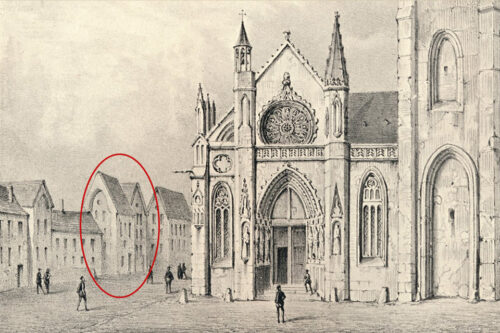
Across the street, against the walls of Saint-Jacques, stood the couple’s two small writing stalls, or ouvroirs, joined beneath a single covering. Their joint ownership is recorded in Pernelle’s estate account; on Villain’s first reconstructed ground plan they are marked with the number 9 (on the plan appended they are identified as located on the other side of the side entrance to the church as they elsewhere in the sources are identified as being located directly opposite to his house (see drawing here). These stalls belonged to the professional streetscape of rue des Écrivains, with the old bell tower and the church’s small northern entrance close by. These stalls should not be mistaken for the house itself. Nor should the bell tower of Flamel’s day be confused with the surviving Tour Saint-Jacques, constructed on a different site in the early sixteenth century.[6]
What matters is the spatial relationship. A client approaching the stalls, a visitor entering the house and a parishioner passing into church moved through the same small stretch of street. Villain speculated that the stalls functioned as public points of contact while more substantial writing might be undertaken in the residence. That division of labour is plausible, but it remains his reconstruction, not an explicit statement of the fourteenth-century inventory (which we unfortunately lack.[7]
The portal and the house faced one another
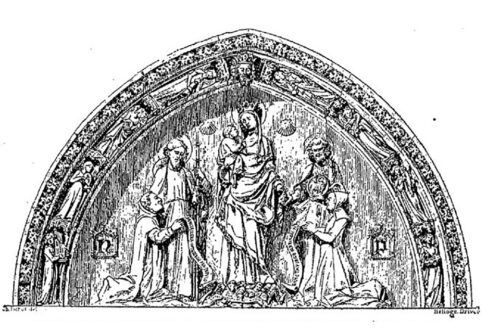
On the other hand, Villain was unusually precise about the church entrance. “What is certainly a work of Flamel”, he wrote, “is the small portal situated opposite rue Marivaux, and almost opposite this parishioner’s house.” This was on the side of the church facing rue des Écrivains, not the principal western entrance and not an entrance to the later tower. Villain’s third plan separately labels the “portal opposite rue Marivaux”. The alignment is therefore supported both by his text and by the topographical information assembled in his plans.[8]
Above this portal, Nicolas and Pernelle were represented kneeling before the Virgin. St James presented Nicolas; St John the Baptist presented Pernelle. These were public donor portraits, visible in the immediate vicinity of the couple’s own home. On the portal Flamel also had inscribed an instruction to say the Ave Maria upon entering and an invocation to greet the Virgin. Villain describes, on the western jamb, a sculpted angel holding a round black-marble insert with a fine gold cross, once kissed by the faithful. Its subsequent disappearance reminds us that the decorative programme was already incomplete when Villain described it [9].
Directly opposite, the house “answered” to the portal across the street. Villain had seen the remnants of its exterior decoration and wrote that the building had been covered with figures and inscriptions, although only one pillar still retained them. It showed a kneeling Flamel with two young figures behind him; above were the Virgin and St John, arranged as if at Calvary. Villain supposed that a cross had been removed, and conjectured that the St Christopher carved below had once been accompanied by St James. Neither reconstruction can be treated as something he actually saw [10]. The description appear to echo that of the house at rue de Montmorency.
Further, beneath a cornice, he placed an adaptation of the words from Lamentations: “My friends, you who pass along the way, look whether there is any sorrow like mine.” Another couplet counselled contentment: “Let each be content with what they have; whoever knows no sufficiency has nothing. ”These quotations are rather evocative. In Flamel’s time, the principal liturgical setting for the biblical Lamentations was the Office of Tenebrae, celebrated during the final three days of Holy Week. Here, the Lamentations were not simply read aloud, but chanted to a particular melodic formulae, known as the tonus lamentationum, which distinguished them from ordinary readings. These melodies varied between local liturgical traditions. By around 1400, composers in Italy were already experimenting with polyphonic settings of the Lamentations, adding new musical dimensions to an ancient tradition of sung devotion.
A devotional and colourful soundscape?
Might we imagine that the doorway beneath the portal opposite Flamel’s house was filled not only with the murmured prayers of parishioners pausing to recite the Ave Maria, as prescribed by the inscriptions surrounding the entrance? But also the evocative sounds of chanting and prayer, escaping into the street whenever the doors stood open during services? Perhaps even modern polyphonic singing might also have drifted into the narrow street. And should this growing interest in giving devotional texts a musical voice invite us to reconsider the inscriptions adorning Flamel’s houses? Were they intended not merely to be read, but to prompt words to be spoken and heard? Perhaps the devotional landscape of late medieval Paris was also a devotional soundscape. At least, this is what the angels framing the arch on the Tympanum also indicate. They are playing organs, tambourines, flutes, trumpets and harps. Also, the tympanum would have been painted inviting Flamel and his neighbours and guests to imagine the afterlife as a colourful and resounding heaven of joy.
Anyway, when Villain rejected the later alchemical reading of these carvings and took them to be devotional and moral in character, he was probably correct. Yet the two young figures remain unidentified. His passing suggestion that they were Flamel’s children is particularly insecure, given that the couple’s earlier mutual donation stated that they had no heirs of their bodies [11].
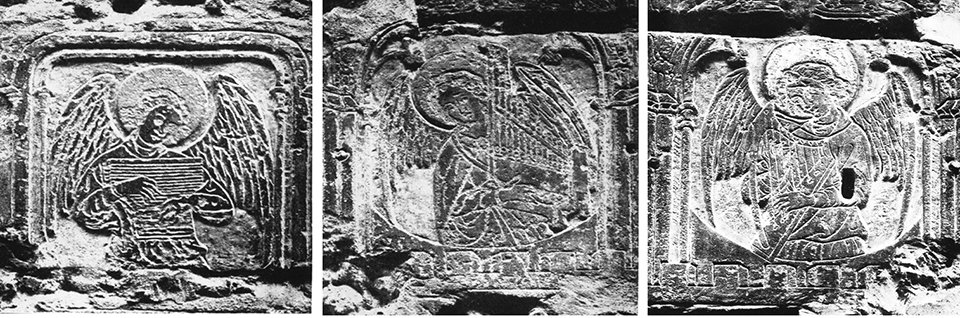
Pernelle’s share of the devotional landscape
Nonetheless, Pernelle was not simply an accompanying figure in Nicolas’s devotional self-presentation. The records identify their residence, the writing stalls and income-producing assets as property acquired by the spouses together. The year, she died, she added a codicil naming Nicolas among her executors, while making provision for her sister Isabelle. In this codicil, Pernelle provided for four weekly Requiem masses at Saint-Jacques for her soul and those of her relatives, friends and benefactors. By 1419 these commemorative observances were associated with the chapel of St Leu and St Gilles, marked C on Villain’s first plan. This gives Pernelle her own identifiable place within the church’s commemorative life, access to which was found beneath the portal which commemorated her and her husband. The text of the final settlement tells us that her last will and testament occasioned a series of rows among which the expenses incurred by her burial and requiem masses were a matter of dispute. [12] Nonetheless, we must imagine, Nicolas Flamel passing the street and entering the church totake part in the celebration of the masses commeorating his wife, Pernelle.
Outside the parish church the couple’s commemorative presence also appeared at the cemetery of the Holy Innocents, and Villain records a relief showing Nicolas and Pernelle on a section of the charnel houses associated with Flamel’s benefactions; he specifically links it to Pernelle’s burial there. It appears, she was not buried in or near the chapel af St. Leu and St. Gilles. However, Nicolas Flemal was buried close to this chapel in 1418. Such commemorations extended the couple’s identities through a network of urban sacred places. Still, it is the short distance between the Marivaux house and Saint-Jacques and filled with music, paryer and colours that makes this particular devotional landscape so unusually legible.[13]
From private residence to public remembrance
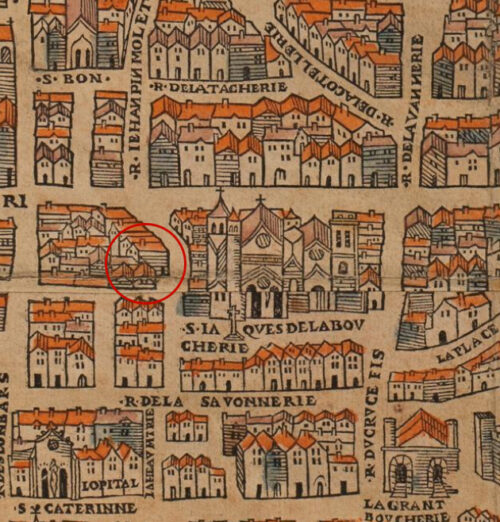
The now vanished house survived long enough to become a casualty of the legend of Flamel the alchemist. Villain records how, in 1756, a supposed benefactor offered to finance its repair. Behind the promise lay another search for hidden treasure. Workers dug into the building and eventually removed the decorated stones, breaking them into rubble despite the parish priest’s instruction to preserve them. Nothing of the imagined gold appeared. An eighteenth-century treasure hunt thus destroyed surviving evidence of a late medieval burgher’s public devotion.[14]
There is no need to call the portal to his home a “private chapel”, since Villain supplies no evidence for exclusive use or private access. What we can say is more interesting. By jointly acquiring a prominent corner house, maintaining professional writing stalls beside the church, appearing as donors of a coloured tympanum above its threshold and investing in liturgical remembrances and grave(s) with at least one burial-slab, Nicolas and Pernelle made their everyday surroundings carry a distinct religious meaning. At the meeting of two streets, their household was both part of an urban business community and visibly attached to the parish. The sculpted figures are gone, the colours faded, and the dwelling itself has disappeared; but the 1399 documents and Villain’s eighteenth-century testimony allow us to recover a space carefully laid out to foster devotion and piety.
SOURCE and NOTES:
The principal sources are Abbé Étienne-François Villain, Essai d’une histoire de la paroisse de Saint-Jacques de la Boucherie (Paris, 1758), and Histoire critique de Nicolas Flamel et de Pernelle sa femme (Paris, 1761). References below follow the printed pagination. The first two plans in the Essai are historical reconstructions, not medieval surveys. The 1399 estate documents survive here in Villain’s eighteenth-century transcriptions; a definitive diplomatic edition would require comparison with the underlying archival records.
[1] Villain, Essai (1758), pp. 39–40, 149–151; Histoire critique (1761), pp. 10–12, 318–319 and 327.
[2] Villain, Histoire critique (1761), transcription of the executors’ account of 1399, pp. 318–319 and 327. The account dates its formal presentation to 16 June 1399 and subsequent sessions, p. 315.[3] Villain, Histoire critique (1761), pp. 11–13; Essai (1758), first plan and its legend, pp. 244–252, especially the entries for houses 1 and 2.
[4] Villain, Histoire critique (1761), p. 353, transcription of the 1399 agreement identifying the house, neighbouring owners and tenure.
[5] Villain, Histoire critique (1761), pp. 320–321 (1399 account, including the phrase “enfans alans & venans à eschole & demourans en bourſe en l’ostel des dits mariés”); pp. 12–15 for Villain’s interpretation. In general, any abode – small or large – would hold working spaces and private spaces. This was the premodern norm until industrialisation took off in the 19th century.
[6] Villain, Histoire critique (1761), pp. 319 and 327 (jointly acquired stalls), pp. 353–354 (two stalls under one roof against the church wall); Essai (1758), pp. 39–40 and 244–252 (first plan, no. 9; old tower B); pp. 69–72 (construction of the later tower).
[7] Villain, Histoire critique (1761), pp. 13–15. Villain’s explanation of how the stalls and household offices worked should be distinguished from the wording of the 1399 account.
[8] Villain, Essai (1758), p. 39; pp. 257–258 and third plan, where no. 2 identifies the “Portail vis-à-vis la rue Marivaux”. Compare the first plan, labelled no. 9 for the stalls, and the discussion on p. 40.
[9] Villain, Essai (1758), pp. 39 and 149–150. The small portal and its sculpture must not be conflated with the separate southern porch or the western grand portal.
[10] Villain, Essai (1758), p. 151. The cross, the accompanying St James and the identification of the young figures as children are explicitly Villain’s conjectures.
[11] Villain, Essai (1758), pp. 151–152; Histoire critique (1761), pp. 10–11; the 1372/1373 mutual donation transcribed in Histoire critique (1761), p. 290, states that the spouses had “aucuns hoirs de leurs corps”. This describes their position at the date of the act.
[12] Villain, Histoire critique (1761), pp. 290–293 (mutual donation), 315–319 and 327 (estate account), 353–354 (the undivided halves and Nicolas’s life interest).
[13] Villain, Histoire critique (1761), pp. 89–97, 317–319, for the testament, reversal in the codicil, subsequent disputes and four weekly masses; Essai (1758), pp. 159–162 and first-plan legend, p. 244 (“Chapelle de S. Leu & S. Gilles … fondation faite pour Pernelle en 1419”).See also Villain, Essai (1758), pp. 148–149 (Saints-Innocents and Pernelle’s burial); pp. 149–151 (other inscriptions and monuments).
[14] Villain, Essai (1758), pp. 162–164. Villain states that his account of the destruction was added after delays in printing the book.
[15] Villain, Essai (1758), pp. 39–40, 149–152, 244–258; Histoire critique (1761), pp. 12–15, 317–321, 327, 353–354. The spatial and interpretative conclusion is a synthesis of these sources, not a claim made in those words by Villain.
5. The House Nicolas Flamel Built for the Living and the Dead in 1407
Built in Paris in 1407, the surviving house of the Parisian Bourgeois, Nicolas Flamel, offers an unusual glimpse into medieval housing, charitable foundations and the religious obligations of working people.
At 51 rue de Montmorency in Paris stands one of the city’s oldest surviving houses. Built in 1407, it is known as the House of Nicolas Flamel, the celebrated Parisian escripvain whose considerable fortune and charitable foundations eventually inspired the legend that he had discovered the secret of making gold.
Yet the house was not his private residence. Rather, it was one of several properties acquired and developed by Flamel following his marriage to Pernelle in 1368. Known as Le Grand Pignon, or the Great Gable, it was constructed to accommodate working people, combining housing with the religious obligation to remember the dead. What makes the building particularly interesting is that its medieval inscription survives, as do substantial parts of its fabric. Furthermore, eighteenth-century research into Flamel’s property transactions preserves details concerning the foundation and subsequent management of the house. This is not just any old house, but a building with a distinct history telling us about life in 15th century Paris.
A new building in the expanding city
In the early fifteenth century, the rue de Montmorency lay in an area of Paris that had developed beyond the older wall of Philippe Augustus and had subsequently been enclosed within the expanded city. The district was associated with the powerful priory of Saint-Martin-des-Champs, which retained important seigneurial rights over its properties.
Here, in 1406, Nicolas Flamel acquired property and negotiated with the monks concerning his proposed building. An agreement dated 17 November 1406 identifies him as “Nicolas Flamel, escripvain”. His plans involved the construction of charitable housing on land within the priory’s jurisdiction. The monks permitted the development, although the agreement restricted the establishment of an independent church or chapel. Flamel also undertook financial obligations towards the priory, including an annual rent. Already, at this point there is perhaps an indication that Flamel intended the building to serve as a hospital where the income in the form of rent from the ground-floor shops were redirected to pay for the infirm and poor people housed higher up. However, the backyard held a well, and some sources suggest this was also a local laundry.
The transaction is significant. Flamel was not simply distributing alms to the poor. He was actively acquiring, consolidating and developing urban property, negotiating with ecclesiastical landlords and incorporating his foundation into the legal, economic and pious structures of medieval Paris while at the same time trying to shore up his legacy.
A house for working men and women
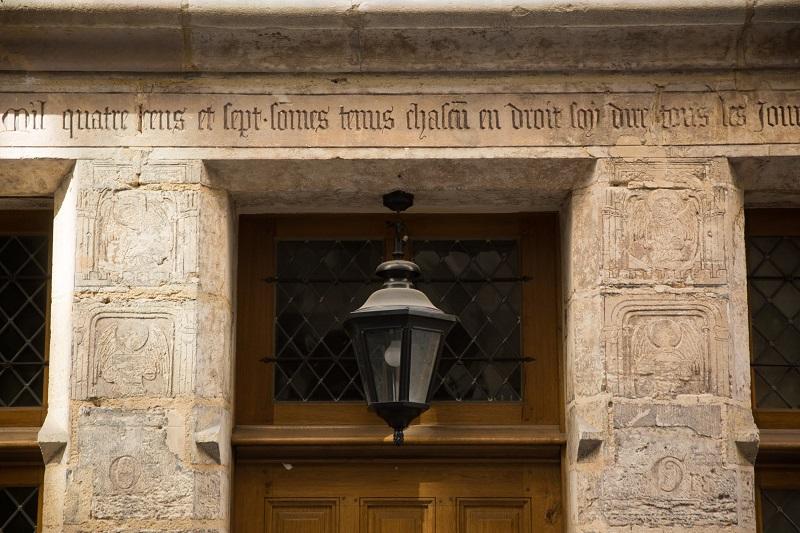
The building was completed in 1407, a date recorded in the inscription that still runs across its façade. The most remarkable feature of the house is this long inscription, carved in Gothic letters across the ground-floor façade, and which speaks in the collective voice of the occupants:
“Nous homes et femes laboureurs demourans ou porche de ceste maison qui fut faite en l’an de grâce mil quatre cens et sept, somes tenus chascun en droit soy dire tous les jours une paternostre et un ave maria en priant Dieu que sa grâce face pardon aus povres pescheurs trespasses, Amen.”
“We, working men and women dwelling beneath the porch of this house, which was built in the year of grace 1407, are each obliged, individually, to say every day an Our Father and a Hail Mary, praying that God, through His grace, may grant pardon to poor departed sinners. Amen.”
The wording deserves attention. First, the occupants are described as laboureurs. This need not mean agricultural labourers. In medieval urban usage, the term could encompass people who supported themselves by manual work. Accordingly, the inscription suggests a foundation intended for working people, rather than exclusively for the destitute, sick or elderly. Second, the obligation is explicitly religious. The inhabitants were expected to perform a daily act of intercession for the dead. In this respect, the building belonged to the wider economy of prayers, charitable gifts and commemorative services that characterised late medieval religious life. We may speculate – although there is no evidence – that the foundation was intended as a kind of beguinage such as the one nearby, called Sainte-Avoie. However, the inscription does not explicitly state that the inhabitants lived rent-free. This distinction becomes important when we turn to the later documentation.
Charity, rents and the business of housing
In his Histoire critique de Nicolas Flamel et de Pernelle sa femme, published in 1761, Étienne-François Villain reproduced records concerning Flamel’s properties and foundations. Among them are accounts of the subsequent letting of rooms in the house at rue de Montmorency, including a series of rentals from 1446 to 1455.These records indicate that at least some occupants paid rent. One particularly revealing entry explains that a room ceased to be let at Midsummer in 1450 because it was too high up and too difficult to reach. This is a splendid little detail of everyday medieval life. Behind the solemn inscription and charitable intentions were tenants, stairs, practical inconveniences and the ordinary difficulties of managing a multi-storey urban building.
This evidence also invites a reconsideration of its charitable function. The building may have begun as a foundation intended to accommodate people on favourable terms, with prayers forming part of their obligations. However, by the middle of the fifteenth century, at least some accommodation was being administered through a system of rents. Whether this represented a change in the original arrangements, or whether charitable housing and rental income had coexisted from the beginning, remains uncertain. Indeed, the distinction between charity and investment may itself be misleading. Medieval foundations frequently combined the provision of accommodation, the generation of income and the financing of charity with obligations to perform religious services. The dilemmas involved in this balancing of charity and financing surface directly in a provision in the testament of Nicolas Flamel where he grants his tenants twenty sous parisis each, either as alms or as a reduction in their rent.
Inside the medieval house
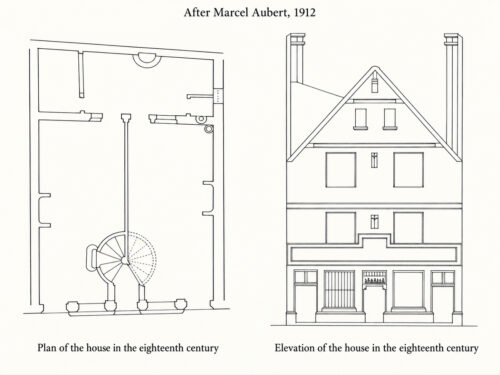
Although at present a near-empty shell, the surviving structure also provides evidence of domestic architecture in late medieval Paris having been repeatedly studied by arthistorians and archaeologists.
Already in 1912, the architectural historian Marcel Aubert examined the building and described its interior organisation in considerable detail. He tells us how the ground floor contained two large rooms separated by a longitudinal partition. Heavy transverse timber beams supported the ceilings, resting on stone corbels and a substantial square support. Similar structural arrangements continued on the upper floors. At the rear was a narrow courtyard, where traces of a former well could still be recognised. Beneath the house were two barrel-vaulted cellars, reached by a staircase from the rear courtyard. Also, it appears that there were three doors into the house from the street. On either side of the middle door, the doors and windows opened up to workshops, while the door in the middle gave access to a spiral staircase leading up to the upper floors.
Also, Aubert describes how its original appearance differed from that of the present structure. The great gable that gave Le Grand Pignon its name thus disappeared during the eighteenth century, when alterations changed the profile of the roof and upper storey. Nevertheless, the surviving stonework, together with Aubert’s observations, preserves important evidence of its original construction. The façade was classified as a French monument historique on 23 September 1911. Importantly, the legal protection applies specifically to the façade rather than automatically to every part of the building.
A façade covered with prayers and images
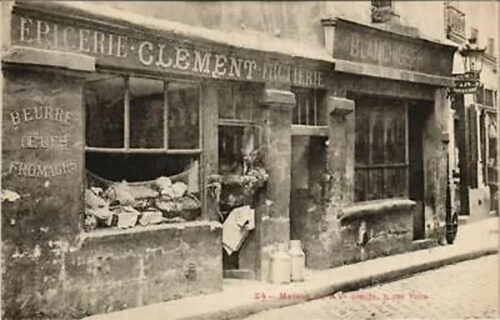
The inscription above was only one element of an elaborate decorative scheme. The stone uprights of the ground-floor openings bear carved figures, religious symbols and Gothic lettering. Among the sculptures are angels playing musical instruments, while other carvings appear to contain devotional messages. Aubert identified the letters of the phrase Deo gratias, as well as other fragments of religious inscriptions. He also drew attention to a small hand associated with the principal inscription, which he interpreted as a possible personal sign of Flamel. One figure, wearing a distinctive headdress, has occasionally been interpreted as a portrait of the founder. However, this identification remains conjectural.
What matters more is the overall conception of the façade. The building addressed the street through a programme of religious images and written obligations. Its decoration made the charitable foundation visible to passers-by, while reminding the inhabitants of their duty to pray. In this, the decoration aligns well with what we know of Flamels own private home in the Vie Ecrivain.
It appears, the prayers were intended to last forever. The tenants, meanwhile, still had to climb the stairs and pay their rent.
##################
10. Nicolas Flamel – the alchymist
<h3>The Invention of an Alchemist</h3>
<img class=”size-medium wp-image-34038″ src=”https://www.medieval.eu/wp-content/uploads/2026/10/WEB-livres-flamel-Bologne-400×600.jpg” alt=”Le Livre Flamel. Ca. 1500Manuscript from Bologne. © Bologne University Library, ms. 699, p. 46r” width=”400″ height=”600″ /> Le Livre Flamel. Ca. 1500<br />Manuscript from Bologne. © Bologne University Library, ms. 699, p. 46r
According to later sources, however, it appears that 60 to 80 years after his death, Flamel emerged as a man with a distinctly different reputation, that of an alchemist. The first signs of Flamel’s transformation emerged towards the end of the fifteenth century, several decades after his death. A manuscript now preserved in the University Library of Bologna, known as the Livre Flamel, is perhaps the earliest surviving alchemical work associated with his name. Written in French and dated to the late fifteenth century, it consists of two parts: a Theorica, discussing the principles of metallic transmutation, and a Practica, outlining a complicated procedure for achieving it. It is part of the exhibition in Paris.
Its instructions were sufficiently obscure to leave considerable room for interpretation. Nevertheless, the work circulated, was copied and translated, and gradually contributed to the reputation of Flamel as an authority on alchemy. Crucially, however, there is no evidence that the historical Nicolas Flamel wrote it. This phenomenon is known as pseudepigraphy – the attribution of a text to someone other than its actual author; and within medieval and early modern intellectual traditions, pseudepigraphic writings were particularly common in fields where authority depended on the possession of ancient or secret knowledge. A treatise attributed to a respected historical figure could thus acquire a credibility that an anonymous text might otherwise lack. Moreover, once such an attribution had entered the manuscript tradition, subsequent copyists and authors could reinforce it simply by reproducing the name.
<img class=”size-medium wp-image-34040″ src=”https://www.medieval.eu/wp-content/uploads/2026/10/Detail-alchemistic-manuscript-yale-Fleman-500×333.jpg” alt=”Illustration showing Flemand in his alchemistic laboratory. Pseudoepigrahic Treatisec. 1680 Manuscrit Mellon MS 100, p. © Yale University Library ” width=”500″ height=”333″ /> Illustration showing Flamel in his alchemistic laboratory. Pseudoepigrahic Treatise c. 1680. Manuscript, Mellon MS 100, p. © Yale University Library
Over time, however, Flamel’s supposed writings multiplied. In 1561, the Sommaire philosophique appeared in a collection devoted to the transmutation of metals. Written in verse, it presented alchemical teachings through metaphors, alliteration and personification. However, the decisive transformation occurred in 1612, with the publication of the Livre des figures hiéroglyphiques – the Book of Hieroglyphic Figures. This work did something fundamentally different from the earlier treatises. Rather than merely presenting alchemical instructions under Flamel’s name, it transformed him into the protagonist of an extraordinary autobiographical adventure. According to the account, Flamel had purchased a mysterious illustrated manuscript known as the Book of Abraham from an unknown stranger for two florins. For twenty-one years, he struggled to decipher its enigmatic images and instructions. Finally, he undertook a pilgrimage to Santiago de Compostela. During his journey, he encountered a Jewish physician named Master Canches, who helped him understand the mysterious text. Returning to Paris, Flamel devoted another three years to study, prayer and experimentation. Finally, on 17 January 1382, he succeeded in transforming mercury into silver. Then, on 25 April 1382, at approximately five o’clock in the afternoon, he accomplished the ultimate feat: the transmutation of mercury into gold. He had discovered the philosopher’s stone.
With this revelation, the entire history of the medieval businessman was transformed. His wealth no longer needed to be explained through property investment, commercial success or the accumulation of rents. Instead, it could be attributed to his mastery of the most elusive secret of nature. Following this, his charitable foundations acquired an equally remarkable explanation. Having produced gold through alchemy, Flamel had generously distributed his riches among the churches and hospitals of Paris. Even the religious images with which he had adorned the city were reinterpreted. According to the Livre des figures hiéroglyphiques, the sculptures on the arcade he had commissioned at the cemetery of the Saints-Innocents concealed alchemical secrets.
The anonymous author had taken authentic elements of Flamel’s biography – his wealth, charitable foundations, pilgrimage associations and commemorative sculptures – and rearranged them into a narrative of secret knowledge and miraculous discovery. In other words, the very monuments Flamel had commissioned to preserve his memory as a pious Christian benefactor became the evidence used to establish his reputation as an alchemist.
<h3>What Was Medieval Alchemy?</h3>
To understand why the story proved so compelling, it is necessary to consider what alchemy meant to medieval scholars. Today, alchemy is frequently dismissed as an irrational attempt to manufacture gold. Yet this interpretation overlooks the intellectual and practical complexity of the discipline. Medieval alchemy developed within a tradition of natural philosophy concerned with the properties of matter, the processes of transformation and the relationship between the visible world and the principles thought to govern it. Alchemists experimented with heating, distillation, dissolution and the combination of substances. Their workshops contained crucibles, mortars, vessels, furnaces and alembics. Some of their techniques contributed to the development of later chemical practices, even though their theoretical understanding of matter differed fundamentally from modern chemistry.
Central to many alchemical traditions was the idea that metals could undergo processes of purification and perfection. Gold, being resistant to corrosion and possessing distinctive physical properties, was often regarded as the most perfect of metals. Accordingly, the transformation of less perfect metals into gold could be understood as the acceleration or completion of a natural process. The philosopher’s stone was believed to possess the power to bring about this transformation. Furthermore, alchemical literature frequently described the process through symbolic stages, particularly blackening, whitening and reddening – nigredo, albedo and rubedo. These transformations were represented through elaborate imagery involving death, purification, resurrection and renewal. Consequently, alchemy occupied an ambiguous intellectual territory, combining practical experimentation, natural philosophy, cosmological speculation and religious or spiritual symbolism.
It is within this wider intellectual setting that the legend of Flamel must be understood. By attributing obscure alchemical writings to a successful medieval Parisian, later authors created an apparently historical example of someone who had achieved what generations of alchemists hoped to accomplish.
<h3>From the Philosopher’s Stone to the Immortal Magician</h3>
During the seventeenth and eighteenth centuries, Flamel finally became increasingly established within the European alchemical tradition as the epiphenomenon of an “alchemist” . Texts attributed to him appeared in major collections, including the Musaeum Hermeticum, the Bibliotheca Chemica Curiosa and the Bibliothèque des philosophes chimiques. Through these publications, the supposed writings of the Parisian alchemist reached readers far beyond France.
Among those who studied the Flamel tradition was Isaac Newton. The exhibition notes that Newton made a study of the Livre des figures hiéroglyphiques and produced a drawing of one of the monuments raised to commemorate the man. This should not surprise us. Newton’s extensive engagement with alchemical literature belongs to a period when the boundaries between chemistry, natural philosophy and older theories of transmutation were still being negotiated.
However, Flamel’s legendary career did not end with his incorporation into the history of alchemy. As the Enlightenment increasingly challenged the authority of alchemical writings, the Parisian began to acquire a different kind of existence: that of a literary character.
<img class=”size-medium wp-image-33935″ src=”https://www.medieval.eu/wp-content/uploads/2026/10/Nicolas_Flamel_CoG-500×333.jpg” alt=”Nicolas Flamel from the Harry Potter Universe” width=”500″ height=”333″ /> Nicolas Flamel from the Harry Potter Universe © Fantastic Beasts: The Crimes of Grindelwald /The Harry Potter Wiki Universe
In the nineteenth century, Romantic writers then discovered in Flamel an ideal figure through whom to explore forbidden knowledge, ambition, mystery and the disturbing possibilities of human transformation. Gérard de Nerval drew on the traditions surrounding Flamel in dramatic works, while Victor Hugo incorporated him into the imaginative world of Notre-Dame de Paris. In Hugo’s novel, Flamel becomes associated with the alchemical interests of the tormented archdeacon Claude Frollo. Also, Alexandre Dumas repeatedly reinvented him, eventually portraying him as a physician involved in the treatment of the mentally troubled King Charles VI. By this point, the historical Nicolas Flamel had become little more than a distant starting point for successive literary inventions.
Further on, the legend continued to evolve. In the twentieth century, the Surrealists rediscovered alchemy as a language of imaginative and spiritual transformation. For André Breton, the philosopher’s stone could serve as a metaphor for the transmutation of experience, the liberation of thought and the reconciliation of apparent opposites, and Flamel accordingly acquired yet another identity, becoming an emblem of the creative imagination rather than a historical practitioner of natural philosophy.
Finally, contemporary fantasy literature transformed him into an immortal magician.In Harry Potter and the Philosopher’s Stone (1997), J. K. Rowling presented Flamel as the creator of the philosopher’s stone, whose elixir could prolong life. Other novels, films and video games subsequently drew upon the same tradition.
<h3>An Extraordinary Story</h3>
During his lifetime, Flamel devoted considerable resources to ensuring that his memory would survive. His donations, buildings, funerary monuments and commemorative foundations were all intended to preserve his reputation as a respectable Christian benefactor and secure the salvation of his soul. In this respect, he was entirely a man of his time. Wealthy medieval Europeans regularly invested in such arrangements, creating elaborate networks of obligations between the living and the dead. Through prayers, charitable foundations and visible monuments, they sought to extend their social identities beyond the limits of their earthly lives.
Yet the subsequent history of his reputation demonstrates how little control an individual ultimately possesses over the memory he leaves behind. His images, originally intended to demonstrate humility and devotion, became supposed repositories of secret knowledge. His wealth, painstakingly accumulated through investment, became evidence of miraculous transmutation. His charitable activities, designed to secure prayers for his soul, were reinterpreted as the generous distribution of alchemically manufactured gold. Even his marriage to Pernelle acquired a new significance, eventually becoming part of a legend involving eternal life and enduring love.
And finally, he gradually became a figure who could escape death itself. Thus, the man who had devoted so much of his fortune to ensuring that he would be piously remembered after his death had finally achieved a curious form of immortality. Albeit in quite a different disguise.
<h3>But was he an alchemist?</h3>
<img class=”size-medium wp-image-34048″ src=”https://www.medieval.eu/wp-content/uploads/2026/10/final-page-of-manuscript-de-Flamel-459×600.jpg” alt=”Final page from BnF MS français 19978 © BnF” width=”459″ height=”600″ /> Final page from BnF MS français 19978 © BnF
The exhibition at the Musée de Cluny invites visitors to retrace these successive transformations and rediscover the historical man beneath the accumulated legends. And that is in itself very interesting.
Nevertheless, the exhibition appears NOT to raise a question that is begging to be asked: why was this – admittedly very wealthy – Parisian slumlord later clad in such an elaborate disguise? How did he come to appointed the alchemist par excellence among so many other notable and prominent figures in fifteenth-century France? At least, this question begs an answer.
The exhibition at Cluny wisely refrains from posing this question and offering an explanation for this conundrum. The evidence simply does not seem to allow for an answer. Nevertheless, one answer may perhaps be hidden in a manuscript preserved in the <a href=”https://gallica.bnf.fr/ark:/12148/btv1b9061890f/f68.item.zoom#”>Bibliothèque nationale de France, BnF MS français 19978</a>, entitled La Vraie pratique de la noble science d’alkimie (The True Practice of the Noble Science of Alchemy, also known by its alternative title, Le Livre des laveures). This manuscript is broadly dated to 1401–1500. However, the script appears compatible with the first half of the fifteenth century; and closer to 1400 than 1500. The challenge is posed by an inscription on the last page of the book, where an earlier inscription has been erased and the following ex libris entered:
<em>”Se present Livre est appartient á Nicolas Flamel de la Paroisse St. Jacques de la Boucheri, lequel il l’a escript et relié de propre main.” – </em>(This book belongs to Nicolas Flamel of the parish of St Jacques de la Boucherie, which [book] he had written and bound with his own hand.)
Generally, because an earlier inscription has been erased beneath it, the Flamel inscription is considered to be the work of someone who, at a later date, sought to attribute the manuscript to Flamel, thereby taking part in the general recasting of him as an alchemist. This is the interpretation presented by the BnF and adopted in the limited literature dealing with the manuscript (2).
Nonetheless, both the visual appearance and the wording of the inscription leave open the possibility that Nicolas Flamel did indeed own this manuscript. First of all, the erasure of the earlier inscription may have been carried out by Flamel himself. After all, other fifteenth-century manuscripts preserve successive ownership inscriptions, sometimes recording several owners. A very simple explanation might be that the epscrivain, Nicolas Flamel, did indeed copy the work for a client, and then the the book was never picked up or paid for. At which point Flamel changed the subscription to indicate his ownership.
Likely, this might the most elegant and economic explanation another one should also be considered based on a close reading of the wording of the inscription itself, which might (perhaps also) be translated thus:
“This book belongs to Nicolas Flamel of the parish of St Jacques de la Boucherie, as he has written [here]; and bound with his own hand.”
The semicolon inserted in the second translation is intended to indicate this possible alternative reading. What if Flamel is claiming to have written the notice of ownership himself, just as someone might have concluded a letter at this time by adding “[signed] with my own hand”? Based on a cursory viewing of the ex libris, it looks as if the sentence: As he has written here etc. is placed on a separate line.
In that case, the inscription would not necessarily claim that Nicolas Flamel had written, or rather copied out, the entire manuscript himself. Instead, it might refer to his having written the ex libris after erasing the previous owner’s inscription (or whatever text had been erased). He may then have bound the manuscript himself as he claims.
<img class=”size-full wp-image-34049″ src=”https://www.medieval.eu/wp-content/uploads/2026/10/subscript-to-Bnf-flamel.jpg” alt=”Ex libris from the final page from BnF MS français 19978 © BnF” width=”1028″ height=”225″ /> Ex libris from the final page from BnF MS français 19978 © BnF
Interestingly, the verb <a href=”https://www.medieval.eu/what-was-an-escripvain-in-the-middle-ages-scribes-authors-and-the-business-of-writing/”>escrire</a> could in Late Medieval France express responsibility for a written communication as well as the physical act of writing. Context determines whether a statement concerns composition, copying or the production of a document. Consequently, the wording of the ownership inscription may not, in itself, constitute a decisive argument against Nicolas Flamel having acquired the book and subsequently having it bound – perhaps even “with his own hands”.
But what about the palaeography? Does it offer any conclusions? Unfortunately, the question cannot be answered satisfactorily at present. We lack the results of a proper multispectral imaging (MSI) examination that might reveal what was erased and help distinguish the inks used in different parts of the inscription. Moreover, a careful examination of the name “Nicolas” might reveal whether it belongs to the same writing campaign as the surrounding text. Finally, it would be worthwhile to compare the handwriting of the ex libris with authenticated signatures or other specimens of Nicolas Flamel’s handwriting. If, indeed, any such specimens survive.
To conclude: it is fascinating to follow the fate and fame of a man such as Nicolas Flamel. Such microhistories really do make the Middle Ages come alive. And as opposed to “finished” stories about the beginning, middle and end of a proper history, there are always new questions, which might be raised. We owe the Museé de Cluny for offering us this possibility.
%%%%%%%%%%%%%%%%%%%%%%%%%%
SOURCES
1. Setting the Scene – The Landscape of Medieval Paris
Christine Chaussé et al., Holocene history of the River Seine, Paris, France: bio-chronostratigraphic and geomorphological evidence from the Quai-Branly, The Holocene 18, no. 6 (2008).
Joséphine Rouillard, Paul Benoit and Raphaël Morera, L’eau dans les campagnes du bassin de la Seine avant l’ère industrielle. PIREN-Seine 2023
François Gentili, L’archéologie au village en Île-de-France : quelques exemples d’études diachroniques, Archéologie du Midi médiéval 36 (2018), pp. 81–101.
Jean-Charles Picard, Un monde rural : les campagnes de l’Est parisien du VIe au XIIe siècle, originally published in Histoire du Val-de-Marne (1987), pp. 39–54; reprinted in Évêques, saints et cités en Italie et en Gaule (1998), pp. 425–438.
Monique Fort (Editor), Marie-Françoise André (Editor):Landscapes and Landforms of France (World Geomorphological Landscapes)Springer Verlag 2013
2. Nicolas Flamel – a Parisian Pillar of Society
Nicolas Flamel. Alchemiste de papier. Museé de Cluny 2026 (Press Release)
The Catalogue to this exhibition: Millefleurs n°35 : l’exposition “Nicolas Flamel, alchimiste de papier” et un dossier “Magie et alchimie au Moyen Âge”. Éditeur : Amis du musée de Cluny / Hathor Éditions
Villain,Étienne F.: Essai d’une histoire de la paroisse de St. Jacques de la Boucherie: ou l’on traité de l’Origine de cette Eglise, de ses Antiquités. Paris: Prault 1758
Villain, Étienne F.: Histoire critique de Nicolas Flamel et de Pernelle sa femme : recueillie d’actes anciens qui justifient l’origine & la médiocrité de leur fortune contre les imputations des alchimistes : on y a joint le testament de Pernelle & plusieurs autres pieces intéressantes. A Paris : Chez G. Desprez 1761
3. What Was an Escripvain in the Middle Ages? Scribes, Authors and the Business of Writing
Olivier Delsaux: Qu’est-ce qu’un escripvain au Moyen Âge? Étude d’un polysème
Romania Année 2014 525-526, pp. 11-158
4. The Devotional Landscape of Nicolas Flamel
Villain,Étienne F.: Essai d’une histoire de la paroisse de St. Jacques de la Boucherie: ou l’on traité de l’Origine de cette Eglise, de ses Antiquités. Paris: Prault 1758
Villain, Étienne F.: Histoire critique de Nicolas Flamel et de Pernelle sa femme : recueillie d’actes anciens qui justifient l’origine & la médiocrité de leur fortune contre les imputations des alchimistes : on y a joint le testament de Pernelle & plusieurs autres pieces intéressantes. A Paris : Chez G. Desprez 1761
5. The House Nicolas Flamel Built for the Living and the Dead in 1407
Étienne-François Villain, Histoire critique de Nicolas Flamel et de Pernelle sa femme (Paris, 1761), particularly pp. 143–157, with further rental documentation elsewhere in the volume.
Marcel Aubert, “La maison dite de Nicolas Flamel, rue Montmorency, à Paris”, Bulletin monumental 76 (1912), pp. 305–318.
Lucien Lambeau, “La maison de Nicolas Flamel, située rue Montmorency, 51”, La Cité 17 (1918), pp. 126–143.
Catherine Brut and Valentine Weiss, “La maison de Nicolas Flamel, la plus ancienne demeure conservée de Paris”, Les Dossiers d’archéologie 371 (2015), pp. 50–54.