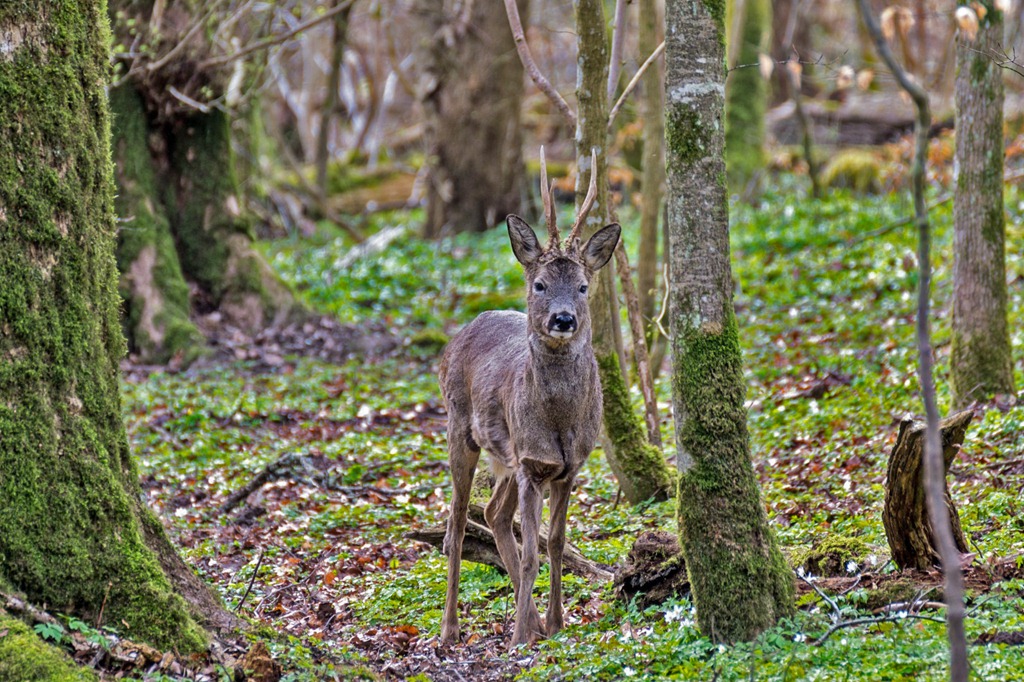
One of the more important elements in the Medieval Landscape was the deer park. Dalby Hage near Lund. This may be the earliest known example in Scandinavia. Perhaps it was inspired by the royal parks in England near Winchester?
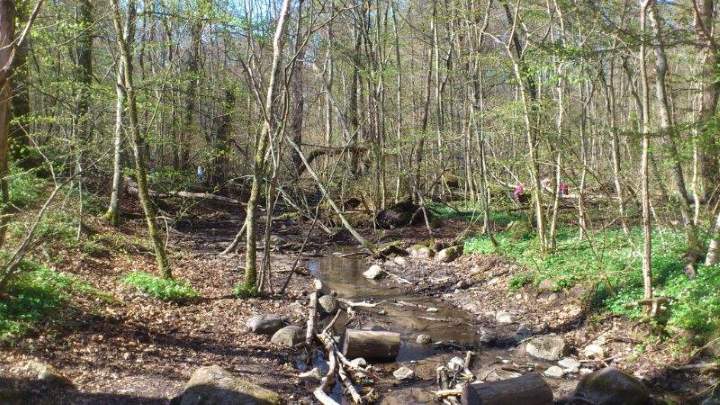
Deer parks were a significant aspect of the medieval landscape. In England, no less than 3200 deer parks in England have been registered in the 14th-century, ranging in size from 5 – 485 ha and with an average of 35 – 75 ha. This state of affairs would also apply to the medieval landscapes in Germany and France, where abundant traces of deer parks have been located and described.
At all times, hunting would have been pursued “wildly”. However, already in the Carolingian period, the hunt was carried out inside carefully fenced areas. Here, carefully staged hunts might be organised, ending in the obligatory feasts often partaken al fresco. It has been suggested that the importance of these semi-martial rituals decided the location of some of the royal palaces.
Formerly, such deer parks were not believed to have existed in the late Viking and Early Middle Ages in Scandinavia (late 10th- to 11th-century and during the reign of Canute the Great and his successors). Even though hunting – for instance, with dogs – was known to be a favoured Viking pastime, it was believed that hunting was primarily “wild”, taking place in unfenced forests and the wilderness.
However, in the 1990s, archaeologists succeeded in identifying a very early example of a royal deer park near Dalby Hage, close to the royal city of Lund. Here – one km east of what was in all probability a royal palace from the 11th-century. It appeared the park was into three parts: The Northern and Southern forests with a flat pasture ground between them. Through this landscape, a rampart was discovered, which surrounded an area of approximately 18 ha. A birch forest was found inside the rampart, while ash trees were abundant outside. Through the flat pasture flowed a stream, which has been dammed in two locations, providing water for the wild animals in the area.
The locality surrounding Lund – dominated by Uppåkra – was an important regional centre since the early Iron Age. In the late 980s, the regional centre was moved to the city of Lund, a royal and clerical foundation that was to become the Archdiocese of Denmark. Perhaps founded by Harold Bluetooth, his son Sweyn Forkbeard was reburied there after his death in England in AD 1014.

It is believed that a descendant of Cnut the Great, Sweyn Estridsson, was active in building the royal complex at Dalby. He may have learned how to hunt in England at Winchester and elsewhere at the court of his uncle. Or through his political relations with the Holy Roman Emperor, Henry IV.
Later historical sources tell us that the peasants belonging to the local manor (originally the monastery erected in Dalby on top of the former royal palace) were obliged to fence the pasture as part of their corvee, for instance, delivering more than 6000 loads of brushwood needed to maintain the fences of Dalby Hage in 1670.
Measures of phosphate levels indicate there might have been a small settlement in the northern part of the forest, perhaps a hunting lodge?. Finally, nearby toponyms refer to localities where deer may have been found (Hjortarummet and Hjortasulan). Probably pertinent, we might note that most combs and other crafted utensils in the nearby city of Lund until mid-12th-century were made entirely of antlers from red deer. Since red deer antlers are eaten up as soon as a deer dies naturally, the raw materials must have been a by-product of hunting.
Finally, the archaeologist, Anders Andrén, has speculated whether the complex of Dalby and Dalby Hage might have constituted a cosmological vision of “Paradise”. The church in Dalby (probably inspired by Hildesheim) was thought of as a celestial, heavenly Jerusalem. Later folklore points to Dalby Hage as the place where the first Christians met and celebrated (to the acute discomfort of the local trolls, perhaps aka the last pagans at Uppåkra).
Whatever the fact behind these stories, there is no doubt that the deer park in Dalby Hage must be considered one of the earliest documented deer parks in a Scandinavian setting.
Today, Dalby Hage is a National Park. located ten km east of Lund municipality in South Sweden, the park involves the two small forests with birches, ash, elms and oak trees. In between the northern and southern parts, is a pasture field, Hästhagen.
SOURCE:
Paradise Lost. Looking for Deer Parks in Medieval Denmark and Sweden
By Anders Andrén.
In: Visions of the Past. Trends and Traditions in Swedish Medieval Archaeology. Ed. by Hans Andersson, Peter Carelli and Lars Ersgård pp. 469 – 490
Series: Lund Studies in Medieval Archaeology 19.
Published by Riksantikvareämbetet. Arkeologiska undersökningar. Skrifter nr 24
READ MORE:


