What does Eschatology and Apocalypse mean? And how did people in the Middle Ages think about the End of Times?
Doom-scrolling is the modern version of the medieval murals, tapestries, and liturgies, which acted as backdrops for the Church’s staging of the apocalyptic horrors of the end of times. But what does eschatology and Apocalypse mean?
When talking about the End of Times, a number of expressions turn up. Thus, eschatology means “words” about the εσχάτων (eschatonor Last Things, while apocalypticism deals with the sudden cosmic turn of the world which will take place before the final end. Millenarianism refers to the belief that this involves a fundamental transformation while, finally, messianism deals with the role of a Messiah in these series of events:
Comparative Table
Eschatology – Study of last things/end times; covers afterlife, end of days, judgment, resurrection and the Kingdom of Messiah
Apocalypticism – Belief in imminent, catastrophic divine interventiona and sudden, cosmic upheavals; the new world replaces the old
Millenarianism – Expectation of a coming utopian era or a 1,000-year reign, often after a catastrophe; transformation of society
Messianism – Hope for a saviour figure who brings redemption. Focus on a Messiah; leads to a new age
Eschatology – Words about the End

Eschatology is the study of religious beliefs concerning human destiny after death (individual eschatology) and the fate of the world at the end of the current age (universal eschatology). The term derives from the Greek word eschatos, meaning “last” or “ultimate,” combined with the suffix -logy, meaning “words about the end”.
The impetus for studying and philosophising about the world’s end reflects the apparent meaninglessness of death. It raises profound questions about time, eternity, and the purpose of existence, highlighting the significance of our human efforts. Also, it is inspired by fast and seemingly uncontrollable changes following in the footsteps of natural catastrophes, epidemics or wars, involving apocalypticism.
Fundamental to this concern is the epiphenomena of religion, which – as a system seeking ultimate meaning – extends beyond our death to find significance in life beyond this world. Thus, on a personal level, eschatology deals with questions concerning death, rebirth, resurrection, the soul, and the cosmic end of time.
Eschatology, however, is not only concerned with describing what might happen after our deaths but also aims to shape how people live their lives in the shadow of this inevitable condition of life on earth while pondering the consequences in the next.
Thus, in Semitic religions (e.g., Christianity, Islam, Judaism), individuals are held accountable for their earthly actions before an all-knowing deity who delivers final judgment. In Hinduism and Buddhism, actions are understood as consequences of karmic or cosmic laws, influencing reincarnation or liberation.
Accordingly, it is common to distinguish between
- Individual and universal eschatology, albeit the two mythologies appear to be interwoven.
- Universal Eschatology
- Universal eschatology explores ideas about the ultimate end of the world.
Some religions envision a dramatic cosmic conclusion to history, such as Christianity’s Last Judgment or Islam’s Day of Reckoning. These events often involve natural disasters like earthquakes or eclipses, culminating in divine judgment for both the living and the dead.
A variation is found in Christian apokatastasis theology, which holds that nothing is condemned to destruction but will be restored.
Nordic religion and mythology vividly depict the end times through events like Ragnarök, characterised by cosmic destruction and recreation. Scholars debate how much Christian eschatology influenced these myths, particularly parallels between Ragnarök and apocalyptic imagery in the Book of Revelation. However, Nordic texts primarily reflect cosmic themes shared within earlier Indo-European religious traditions rather than direct Christian borrowing, focusing on the role of “actors” – God the Father and Eternal Christ.
Perhaps related to the Pre-Christian Scandinavian thinking, Indian religions propose yet another version focusing on an eternal cycle of creation and destruction, with periodic cosmic renewals following each world’s end.
A renewed interest in eschatology has surged in modern philosophy and theology due to global crises like world wars and ecological challenges. Hence, eschatological archetypes also characterise various secular liberation movements. Eschatological themes crop up during crises, advocating for revolutionary and even violent transformations of society while offering consolation for those who hope for a better world.
Modern examples are the thought worlds of Islamic terror organisations such as ISIS, but also those of the Oath Keepers, Proud Boys, and Three Percenters, plus representatives of the Q-anon movement.
Individual Eschatology
On a more individual level, religions differ in their views on personal continuity in a “life after death”.
Some traditions believe individuals continue to exist after death and are held accountable for their deeds. This may involve resurrection or an afterlife in Paradise or Hell, often located outside this world but concurrent with it (e.g., Greek religion, Christianity, Islam). A special version is part of the dogma in the Catholic Church, which holds that human beings are obliged to spend time in purgatory to be cleansed of sin before the resurrection.
Other beliefs assert that individuality dissolves at death. The person may persist as a shadowy or incorporeal being until rebirth in an endless cycle (e.g., Hinduism, Buddhism). Here, death reveals individuality as an illusion and dismantles the elements mistakenly.
Eschatology and Unique Histories
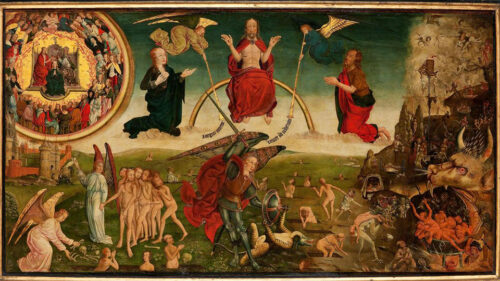
Whether dealt with as a cosmic or a personal series of imagined events, and whether time is understood as cyclical or temporal, eschatologies are about what has happened and will happen. The narration of eschatologies presents and builds upon a series of events.
For instance, apocalyptic thinking gets interwoven with the narratives about unique historical moments or events like the Exodus of the Hebrews from Egypt in the 13th century BCE or the Ascension of Christ and the coming of the Holy Ghost.
These historical encapsulations create difficulties when eschatologies from different religious traditions are imposed on the dogma and doxa of other religions. For instance, in the ancient Norse eschatology called Ragnarøk, there is no “end” but rather a cyclic pattern of cosmic destruction leading to a rebirth of the Natural World, creating a marked difference between the Old Norse religion and Christianity. Today, the Christian elements identified in the central Norse texts, such as parts of Voluspa, are recognised as nothing but a later icing on the cake.
Thus, eschatologies are always narrated in stories about what has been, what happened, and what will follow. Whether in prose or poetic form, the genre is “narration”. In the beginning, law and order rules. Eventually, decay and chaos enter, calling the world or the person to order again – either in this life or the next. Often performed by sayers, shamans or theatre troupes, the eschatological retelling takes the form of liturgical reenactments or cultic dramas featuring priests, kings and an audience. Alternatively, the eschatologies are presented in artistic forms such as literature, music, or art, which can be perused individually or personally.
Historical eschatology takes the form of millennialism, messianism and apocalyticism
Messianism and Millennialism
Redemption is at the heart of the messianic hopes of the advent of a redemptive figure, a Messiah, or Mashiah (Hebrew: “anointed”), who is expected to lead the elected people of God – either as a suffering group or an individual ¬– towards restoration and salvation in the time to come. Moving towards the restoration of the Grace of God, the narrative might evolve into fantasies of retribution and justice. Although Messianism derives its vocabulary from the Judeo-Christian tradition, it has been identified in numerous cultural and religious contexts worldwide for instance inside Islam where the Mahdi identified by Isil plays the same role.
Recognising the specificities of this word, scholars and scientists often prefer to talk about millennialism, which invokes the Christian view of the 1000-year advent of the earthly kingdom suffused with fellowship and peace while at the same time avoiding the particular connotations adhering to the word Messiah. By shifting the focus towards the advent of “the 1000 years”, millennialism avoids the topic of individual salvation while focusing instead on the collective resurrection of the “good world”. As such, it plays an integral part in the belief systems of religious churches and movements such as Adventists, the Jehovah’s Witnesses, and other minor movements and churches.
Apocalypticism
Another concept is apocalypticism, which refers to the mythical and mystagogical character of millennialism as it typically unfolds in the Judeo-Christian Revelations such as in the Book of Daniel and its later “versions”, the Book of Revelation, but also The Book of Daniel, the three Books of Enoch, the Second Book of Esdras, the Ascension of Isaiah, and the Apocalypse of Peter. Other variations of this theme may be found in the Qu’ranic copus as well as collections of Hadith, where the Day of Judgment (Yawm al-Dīn), the Day of Resurrection (Yawm al-Qiyāma), and the return of Jesus and his fight against al-Dajjāl (the Antichrist) are present in the texts. Occasionally, the salvific Messiah in the Islamic tradition is identified by the return of the Mahdi, a relation of the Prophet Muhammad.
Two motifs in these texts belonging to the Book-religions are prevalent: identifying the negative and negating the negative by extolling the future of a blissful and blessed existence. Thus, we read in Esaiah: Death is swallowed up by victory” (25:8) or in the Revelation that tells us how “death shall be no more, neither shall there be mourning nor crying nor pain any more, for the former things have passed away.” (21:4). At play in this scheme is both dualism and progressive futurism.
In the Middle Ages, three different traditions of eschatological thinking gave rise to competing debates and dialogues. Judaism, Christianity and Islam.
Judaism
Ancient Israel provided the basis for these three ways of envisioning the future of individuals, tribes, kingdoms and empires. Although historians, theologians and archaeologists differ as to when the vibrant Messianic beliefs came to fruition in the textual corpus called the Old Testament, we know that the expectation of a personal Messiah was a significant element during both Seleucid rule (c. 200–165 BCE) and later Roman and Byzantine rule (63 BCE–638 CE) in in Palestine. While Messianic Christianity won the day, the Qumrān sects, and the people caring for the Dead Sea Scrolls, also believed in a priestly messiah from the house of Aaron (the brother of Moses) and a royal messiah from the house of David ultimately leading to the stories of prophets such as John the Baptist and Jesus.
Christianity
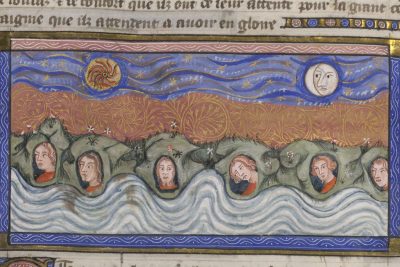
However, the eschatological thinking in Israel did not surface until the last centuries leading up to the preaching and ministry of Jesus Christ, which may have reflected contemporaneous Jewish apocalyptic beliefs. Arguably, his followers did see him early on as “The Anointed one” (Greek: Christos) and Son of Davis. Apparently, he adopted another eschatological term, the “Son of Man”.
The events in AD 33 and the following years led, however, to a profound disappointment, forging the later apocalyptic discourses engaged in redating the future events as predicted in the Gospels and not least in the Book of Revelation. Here, the call for missionary work to be undertaken before the apocalypse might take place appeared as the premier “logical” impediment.
Around AD 110, The Epistle of Barnabas formulated for the first time the” Sabbatical Thinking”, which claimed that God had created the World in six days and rested on the seventh and as each day was but a blink in the eye of the Lord (Psalm 89/90), it was to be expected that peace and joyful rest would spread universally after 6000 days. The question, of course, was when this might happen. Enter Hippolytus, who, around AD 200, published a chronology stating that as Jesus’ Incarnation had occurred 5500 years after Genesis, the future Parousia might be expected to occur in AD 500.
Around AD 400, Augustine of Hippo tried to establish a less fundamental set of expectations by formulating a non-millennial and more spiritual form of Christology. According to this, the present world was interim, leading to the Parousia or Second Coming at a time not predicated. Until then humanity lived in the intermediate “saeculum”, a secular time.
Unfortunately, the final text in the NT, the Revelation, stands out through its images of violence, upheavals, misery and despair. Obviously, this fuelled the minds and visions of people living through persecution and the general political and economic upheavals in Late Antiquity, while numerous sectarian Christian movements such as Montanism and Donatism let the phantasies loose. From Alaric’s sack of the “Eternal City” in 410 to the advent of the Huns in the mid-fifth century, the world was fraught with fear.
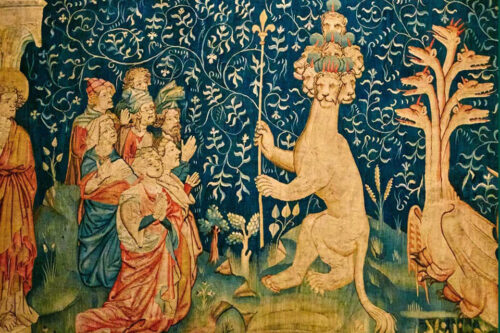 As years passed, one after another apocalyptic failures took place, leading to recalibrations and recalculations, such as, for instance, the Carolingian belief that the millennium was expected to happen in AD 801. Some historians believe that Charlemagne’s coronation by Pope Leo III on Christmas Eve AD 800 in Rome was intended to inaugurate this future Parousia. The same calibrations inspired Beatus of Liébana to create his life’s work, the Apocalyptic commentary known for its artistic legacy.
Unfortunately, also this day passed to the chagrin of theologians and historians. As the Carolingian Empire imploded and fragmented, the Hungarian, Norse, Slavic, and Muslim invasions caused havoc in the frontier zones, and the failure of the empire to provide stability and order left the apocalyptic question unresolved.
At this point, the years 1000 and 1033 loomed surfaced as the dates to be cognisant of, leading to a decidedly apocalyptic atmosphere among kings and clerics.
Especially the Ottonians in Germany fostered widespread anxiety while stimulating new artistic and liturgical projects – manuscripts, liturgies, ritualised events, etc. Meanwhile, people were inspired to take part in social events such as those invoked by “The Peace of God” movement. The French historian Radulfus Glaber described the multitudes shouting “Peace! Peace! Peace!” pledging themselves to God.
After the events at the turn of the millennium, apocalyptic fevers did not abate but were channelled into the Crusades. Finally, the Hundred Years’ War, the Black Death, and other 14th-century catastrophes led to a renewed millennial fervour repeated in the reformational 16th-century
Islam
While Islamic tradition contains a rich eschatological framework, it does not have a universally accepted apocalyptic tradition in the same sense as some strands of Christianity or Judaism.
The Quran primarily focuses on the certainty and imminence of the Day of Judgment, emphasising personal responsibility and the personal resurrection facing up to the end. Thus, the Quran is primarily eschatological, concerned with the impending Day of Judgment and the afterlife, rather than with apocalyptic visions of the far future involving detailed, symbolic narratives of cosmic destruction and renewal.
However, apocalyptic stories and figures (like the Dajjal and Mahdi) developed later, often influenced by Jewish and Christian traditions, and circulated more among the masses than among scholars. Any apocalyptic themes that exist may be found in Islamic folklore and some hadith collections. In summary, Islam’s core texts and mainstream theology prioritise eschatology (the certainty of judgment and afterlife) over apocalypticism (cataclysmic, symbolic narratives of world-ending events), and apocalyptic elements that do exist are later developments influenced by external traditions.
FEATURED PHOTO:
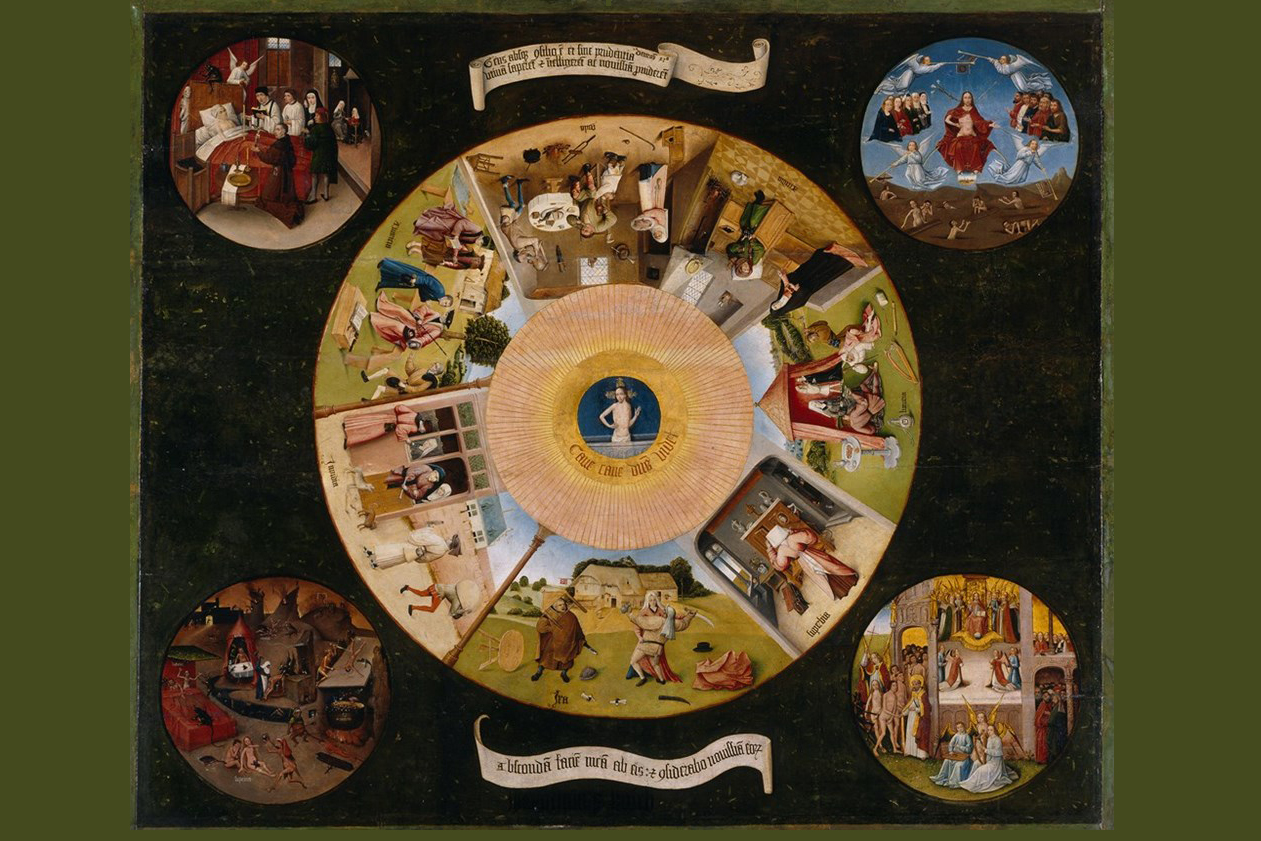
Hieronymus Bosch. Seven deadly sins and four last things. c. 1500 – 1525. Madrid, Prado. Source: Wikipedia
READ ALSO: