The Corpus of Anglo-Saxon Stone Sculpture is online
The Corpus of Anglo-Saxon Stone Sculpture identifies, records and publishes in a consistent format, English sculpture dating from the 7th to the 11th centuries. Much of this material is previously unpublished. Apart from its artistic qualities and its art-historical importance, it is of crucial importance when medievalists try to identify the earliest settlements of the Anglo-Saxon/Pre-Norman English. The Corpus documents the earliest Christian field monuments from free-standing carved crosses and innovative decorative elements and furnishings of churches, to humble grave-markers.
From Books to Online
A reliable and comprehensive catalogue of Anglo-Saxon sculpture has long been needed – by archaeologists, art historians, historians and place-name specialists, and interested non-specialists alike. Durham University, under the guidance of Professor Dame Rosemary Cramp, supported by more than thirty researchers spread throughout the country, has coordinated the production of a series of bound volumes documenting the sculpture in almost every English county. There are currently ten published Corpus volumes, the very latest (the West Midlands) published in mid 2012 and the very first (County Durham and Northumberland) published in 1984. Those volumes, which remain in print, may be purchased from the British Academy via the Oxford University Press. The remaining volumes, which are now out of print, will be published online in the near future. Already it is possible to access the bibliographies of the first six volumes covering the sculpture from County Durham and Northumberland, Cumberland, Westmoreland and Lancashire, York and Eastern Yorkshire, South-East England, Lincolnshire and Northern Yorkshire.

Northumbrian Stone Sculpture
The current online resource makes available the material contained in Volume 1: County Durham and Northumberland. Eventually, all Corpus volumes will be available online.
The Northumbrian stone sculpture is especially rich with its great stone crosses such as those at Ruthwell, Bewcastle, Rothbury and Otley. Carved in high relief, they are characterised by their complex iconographies as well as their evident classical connotations. It is obvious that skillful stonemasons, who were either imported from Gaul and Italy or alternatively trained there, must have carved the crosses as well as the rest of the early sculptures. It is generally believed that the crosses were positioned in the centres of the grand monasteries like Jarrow and Monkwearmouth embodying the focal and enduring character of the Christian Cross built on “Petros” – stone.
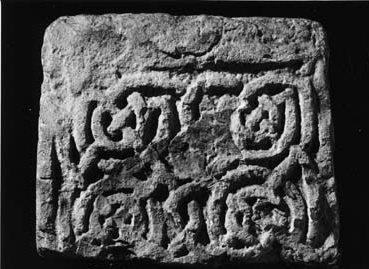
The photos are very fine and presents the viewer with the possibility to study the sculptures in detail. However, the photos are rendered in black and white, often highly contrasted. Thus the seductive surface of the withered stone eludes us. A more refined approach may be found at Kornbluth Photo, where Genevra Kornbluth presents some of the more prominent pieces with loving details.
Project Sponsors
The Corpus of Anglo-Saxon Stone Sculpture is supported by the Headley Trust, part of the Sainsbury Family’s Charitable Trusts, and by UK’s National Academy for the Humanities and the Social Sciences, the British Academy, with additional funding from the Pilgrim Trust and the AHRC.
SOURCE:
The Corpus of Anglo-Saxon Stone Sculpture
READ MORE:
Anglo Saxon Art
by Leslie Webster
The British Museum 2012