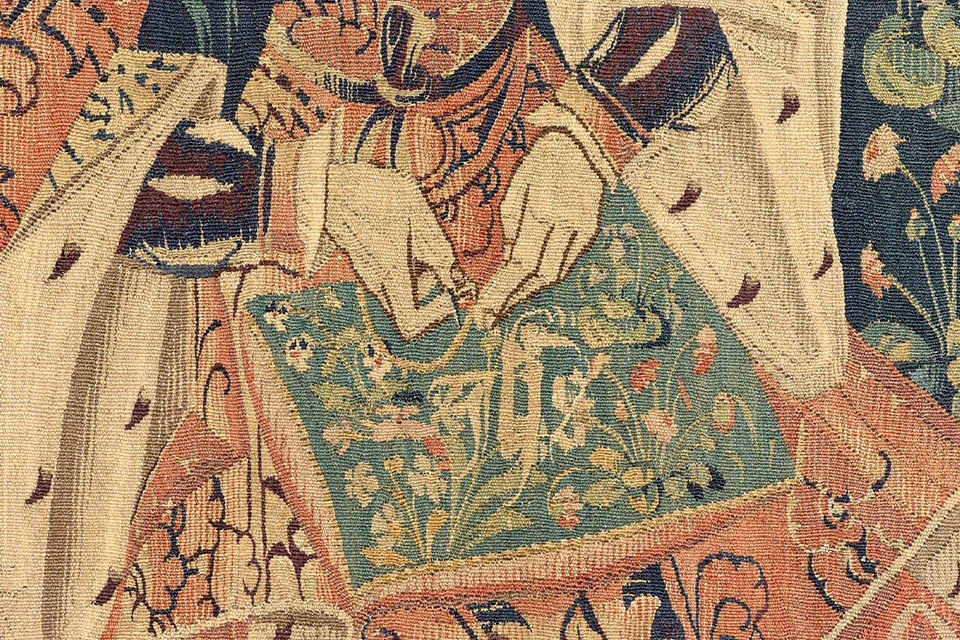
Embroidery was omnipresent in the daily lives of medieval men and women. New exhibition at Cluny offers visitors a unique possibility to study numerous embroidered objects.
Embroidery in silk, gold, and silver thread was among the most precious and prestigious arts of the Middle Ages. Yet these works remain little known today. The Musée du Moyen Âge in Paris holds one of the world’s finest collections of embroidery dating from the twelfth to the sixteenth century. The collections of the Musée National du Moyen Âge contain around fifty embroidered works dating from the twelfth to the early sixteenth century, originating from the Holy Roman Empire, England, France, Italy, and the Low Countries, although Spanish and Catalan embroidery is notably absent. Together they demonstrate the richness and diversity of medieval European embroidery. This exhibition provides an opportunity to present these works in dialogue with other masterpieces from international collections.
Embroidery is “the art of adding to the surface of an already woven fabric the representation of any desired object, whether flat or in relief, using gold, silver, or coloured threads” (Saint-Aubin, L’Art du Brodeur, 1770). Embroidery is therefore both a technique and an ornamental art applied to woven textiles. Alongside ordinary embroidery, executed using simple techniques and inexpensive materials, embroideries worked in silk, gold, and silver thread constituted luxury works of art. Reserved for the elite, they adorned court costume, the clothing of noblemen and wealthy burghers, the furnishings of princely residences, and liturgical vestments. Some embroideries, produced through the collaboration of a painter, who supplied the design, and a master embroiderer, were regarded as true “paintings with the needle”. However, embroidery might also be more modest and unassuming.
Domestic and professional embroidery
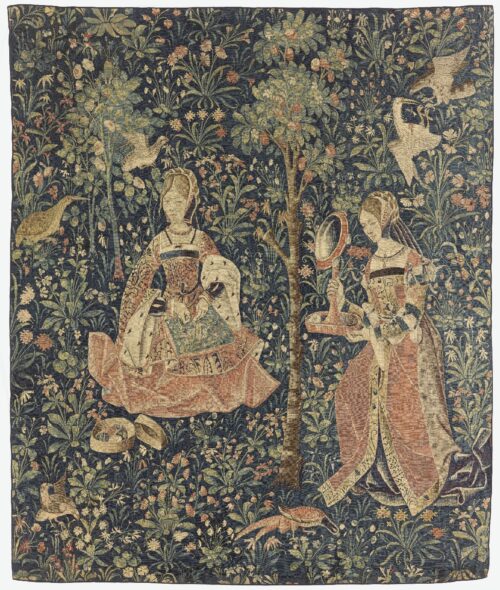
Domestic embroidery was practised throughout medieval society for both practical and recreational purposes (as illustrated by the tapestry “The Embroidery”. The surviving works, however, belong almost exclusively to the sphere of professional embroidery, which took three principal forms.
Most embroidery was produced in urban workshops employing both male and female embroiderers. In many towns these craftsmen belonged to organised guilds governed by written statutes regulating production standards and the duration of apprenticeship. In Paris, the earliest statutes governing the embroiderers’ guild date from the late thirteenth century. Embroidery was also practised in monasteries, where specialist workshops were maintained by monks and nuns. Finally, mention should be made of court embroiderers employed directly by princes. The most celebrated worked successively for several courts, including Sandre Lappert during the second half of the fourteenth century.
The Embroidery Workshop: Tools and Materials
 Professional embroiderers worked on a wooden embroidery frame mounted on trestles, over which the fabric was stretched taut. As precision was essential, the frame had to be positioned in good natural light. The principal tools included needles, pins, thimbles, scissors, scales, shears for cutting fabric, and smaller scissors for trimming threads. Before embroidery could begin, the design was transferred onto the fabric using a variety of techniques. In some cases the design was supplied by a painter commissioned by the patron. Court and urban embroiderers collaborated closely with painters. In his Libro dell’Arte (c. 1437), Cennino Cennini advises painters on transferring drawings to cloth using pen and ink. More commonly, however, the embroiderer was responsible for transferring the design to the textile. Support fabrics included wool, linen, silk, and occasionally leather, particularly for shoes and gloves, while embroidery materials comprised wool and silk threads, together with, in the most luxurious works, threads of silver and gilt silver in several forms, including passing thread, purl, and membrane strips (baudruches).
Embroidery might also be enriched with sequins, precious stones, and pearls. It was an art of luxury, not only because of its costly materials but also because of its sophisticated techniques, which demanded skills acquired through lengthy apprenticeships—lasting as long as eight years for Parisian embroiderers. Numerous embroidery stitches were employed. Split stitch was commonly used for silk, while laid work (or couching) was generally used for metal threads.
Germanic Embroidery from the 12th to 14th centuries
Germanic embroidery frequently features geometric decoration—crosses, lozenges, and similar motifs—which may also take the form of stylised plants, animals, or heraldic devices. Such decoration was often executed using so-called “needle tapestry” techniques that completely covered the surface of the textile. These geometric patterns also appear in figurative embroidery. On altar frontals, where scenes from the lives of saints are depicted, they embellish both the backgrounds and the garments. A surviving fragment of an altar frontal (or hanging), depicting the Apostles, testifies to the production of Lower Saxony. Entirely embroidered in chain stitch, it would have allowed the imagery to be read clearly within the church interior. Other fragments survive in London and Vienna, reflecting the unfortunate nineteenth-century practice of cutting medieval textiles into pieces for sale to different museums. However, treasuries in German Cathedrals and Abbey churches preserve huge collections while the corresponding French treasuries were often destroyed during the revolution.
Opus Anglicanum
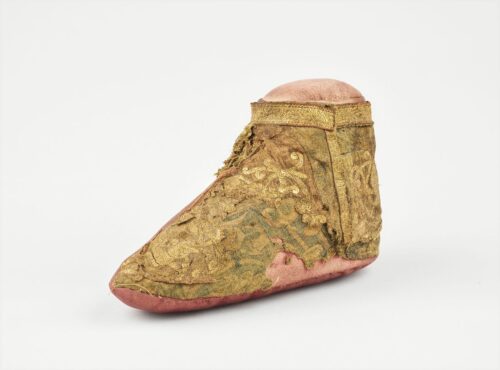
English embroidery—known in Continental sources as Opus Anglicanum—was celebrated throughout Europe for the finesse of its drawing and the extraordinary mastery of its techniques, particularly the underside couching stitch.
A remarkable group of liturgical vestments dating from the twelfth and thirteenth centuries, embroidered in gold on a red ground and ornamented with scrolling foliage inhabited by animals, demonstrates this highly sophisticated technique.
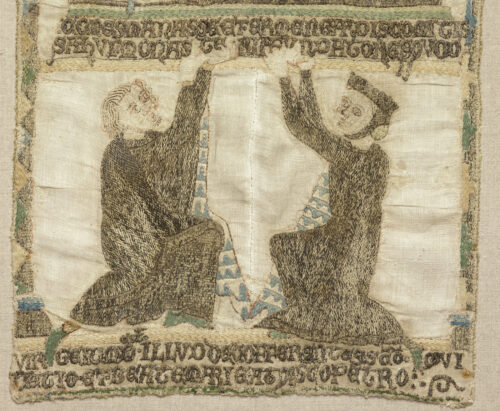
These embroideries, often discovered in tombs or church treasuries, may have been produced in England but were also made in France. The use of underside couching alone is therefore insufficient to identify an embroidery as English. Continental works, such as the Orphrey of Manassès and Ermengarde, almost certainly French on iconographic grounds, likewise employ this technique.
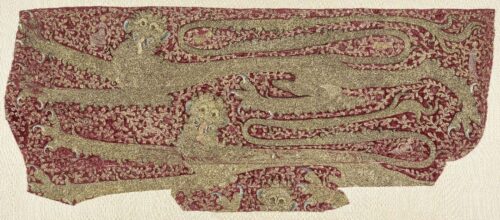
Conversely, not all English embroideries make use of underside couching. This is the case with the celebrated Leopard Embroidery, a royal horse trappings embroidered with heraldic decoration. Works commissioned by the king often had to be completed rapidly, and this embroidery therefore employs simple couching rather than the slower underside couching technique. Its artistic quality is nevertheless outstanding. The leopards’ coats ripple with movement, their eyebrows are embroidered in relief, and glass inserts enrich the decoration.These stylised animals inhabit a poetic landscape of animated foliage populated by courtly figures. The work is one of the very few surviving examples of secular English embroidery produced for the king and the nobility.
Embroidery in Paris and France (thirteenth–fifteenth centuries)
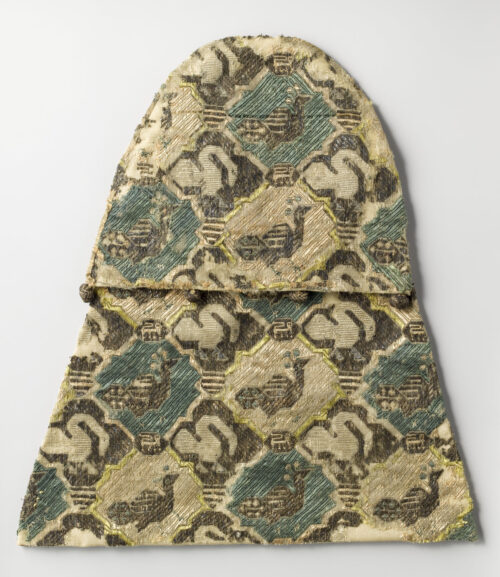
Parisian embroidery flourished during the thirteenth and fourteenth centuries. Other French centres likewise acquired distinguished reputations, notably Toulouse and Lyon, followed by Tours from around 1450, when Parisian production entered a period of decline. A group of fourteenth-century alms purses may confidently be attributed to Parisian—or more broadly French—production. These large trapezoidal purses, fashionable male accessories, are often decorated with courtly subjects.
The surviving cartoons are exceptionally rare. One purse, preserved only in fragments, depicts a sleeping Wild Man tamed by three elegantly dressed women.
Another trapezoidal purse shows a woman riding upside down upon a griffin surmounted by an angel, perhaps an allegory of love. Its companion piece depicts three hybrid musicians closely related to the grotesques inhabiting the margins of contemporary manuscripts.
Both purses may once have belonged to the treasury of the Abbey of Saint-Mihiel (Meuse), where they were reused as reliquary bags, demonstrating how secular objects could enter ecclesiastical treasuries and acquire religious functions.
A group of liturgical vestments, including several particularly fine mitres, may likewise be attributed to Parisian, or more broadly French, production. The embroidered mitre from the Treasury of the Sainte-Chapelle, probably executed from designs supplied by a painter active in Paris, is an exceptional work. This precious object, which rivals contemporary goldsmiths’ work, provides early evidence of the sophisticated technique known as or nué, or shaded gold embroidery. The excellence of fifteenth-century French embroidery is particularly evident in the cycle illustrating the legend of Saint Martin.
This exceptional ensemble, comprising thirty-two medallions and four shaped panels, originally formed part of a liturgical “chapel”, or matching set of vestments and furnishings. It is now dispersed among collections in Paris, Lyon, New York, and Baltimore. The shaped panels, including the Healing of the Blind Woman, were executed around 1440–45 by Pierre du Billant, embroiderer to René d’Anjou, from designs by Barthélemy d’Eyck, painter to the same prince. These highly pictorial embroideries may properly be described as paintings executed with the needle.
Tuscan, and especially Florentine, embroidery likewise enjoyed a considerable reputation. In contemporary texts, the term “opus florentinum” refers to works influenced by the style of Giotto and his followers. The relationship between painters and embroiderers was particularly close.
For works intended for serial production, models derived from painting circulated among workshops. They were reused, exchanged, and modified, sometimes over very long periods. The embroidered hood depicting the Ascension and the orphrey illustrating Scenes from the Life of Christ are characteristic of Florentine, or at least Tuscan, embroidery and of its close relationship with painting. The refinement achieved by Florentine embroidery during the mid-fifteenth century is evident in two panels from an altar frontal made for the Vallombrosan Order in Tuscany. They depict episodes from the life of Saint John Gualbert, the eleventh-century founder of the order. Executed with exceptional virtuosity, they employ several techniques, including or nué. This method enabled the embroiderer to reproduce, through subtle gradations of light and shade, effects more commonly associated with painting.
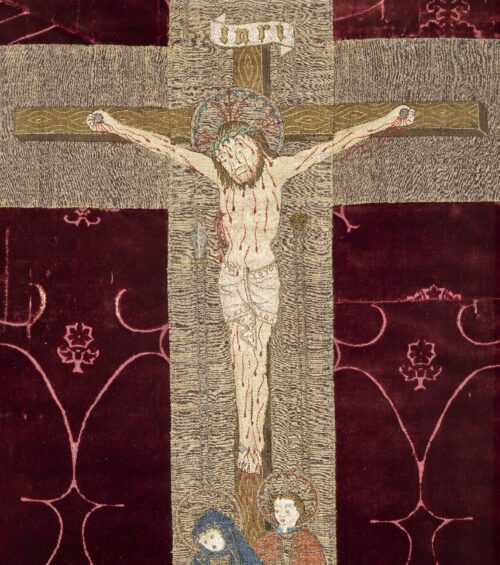
Towards the end of the Middle Ages, increasing demand for religious embroidery, encouraged by the flourishing cult of the saints, stimulated the growth of large-scale production. The so-called Cologne bands, woven orphreys for liturgical vestments that were exported throughout Europe, provide a notable example. They generally display repetitive iconography centred on the Virgin, Christ, and the principal saints, who are frequently identified by inscriptions. Such bands adorn the chasuble donated to the Musée de Cluny in 2019. Its cross depicts the Crucifixion, with the swooning Virgin supported by Saint John, a subject widely represented in German-speaking regions.
At this point, artists often took short cuts. Rather than embroidering directly onto the ground fabric, craftsmen produced individual elements, such as figures or coats of arms, separately before applying them to the principal textile. This process facilitated a division of labour, saving time and allowing embroiderers to be employed according to their particular skills: some specialised in the execution of figures, while others worked on the backgrounds. However, alongside this serial production, highly sophisticated luxury embroidery continued to flourish.
It belongs to a group of large Germanic appliqué figures of the Virgin and Child, intended to be sewn onto altar frontals or banners. Their execution was entrusted to the most accomplished embroiderers. The Virgin’s gown and mantle are worked in or nué, and the figure was originally adorned with pearls, of which only one survives. The composition was derived from a printed model. From the mid-fifteenth century onwards, embroiderers increasingly drew upon woodcuts and copper engravings as sources for their designs.
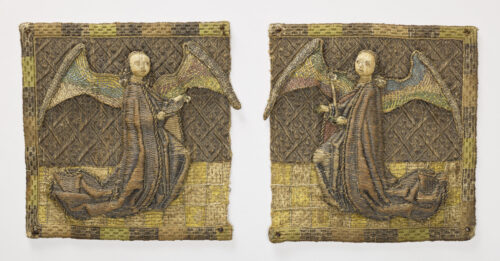
Another luxurious technique achieved considerable popularity during the fifteenth century: raised embroidery, which had first appeared in the thirteenth century.
Two angels, probably originally forming part of the cross of a chasuble, provide an example of embroidery executed in exceptionally high relief, sometimes described as embroidery “in the round”. In this technique, the bodies and draperies were built up from layers of linen, cardboard, or parchment, which were glued together, covered with fabric, embroidered, and subsequently attached to the ground textile. Such high-relief embroidery drew inspiration from sculpted altarpieces and works of goldsmiths’ art.
This catalogue was published to accompany the exhibition of the same name held at the Musée de Cluny in Paris from 24 October 2019 to 20 January 2020. During the Middle Ages, kings and princes appointed their own embroiderers or commissioned works from renowned workshops. Embroideries executed in silk, gold, and silver thread ranked among the most valuable and expensive artistic productions of the period. They nevertheless remain comparatively little known and have often been overshadowed by other artistic media.
This richly illustrated volume presents embroideries from the collection of the Musée de Cluny originating in the principal centres of production in Germany, England, France, Italy, and Flanders. The works date from the twelfth to the early sixteenth century.
These sumptuous objects are considered in relation to embroideries from major European textile collections, as well as to paintings, prints, ivories, and works of goldsmiths’ art. Whether working in an urban workshop or at court, embroiderers employed designs supplied by painters. These might be used for ornaments, coats of arms, and heraldic devices adorning rich garments or sumptuous horse trappings, or for the motifs, figures, and narrative scenes represented on banners and furnishing textiles. They were also employed in the production of precious liturgical “chapels”: matching ensembles of vestments and ecclesiastical furnishings.
The surviving embroidered works illuminate both the processes of manufacture and the various participants involved in their creation, including patrons, craftsmen, and merchants. Together, they produced genuine masterpieces, among them the Leopard Embroidery, the embroidered mitre of the Sainte-Chapelle, and the cycle of Saint Martin commissioned by René d’Anjou.
VISIT:
24.10.2019- 20.01.2020 L’art en broderie au Moyen Âge
Musee de Cluny, Paris
Curators: Christine Descatoire, Chief Curator of Heritage at the Musée de Cluny; Astrid Castres, Senior Lecturer at the École pratique des hautes études; and Nadège Gauffre-Fayolle, independent researcher, as associate curators.
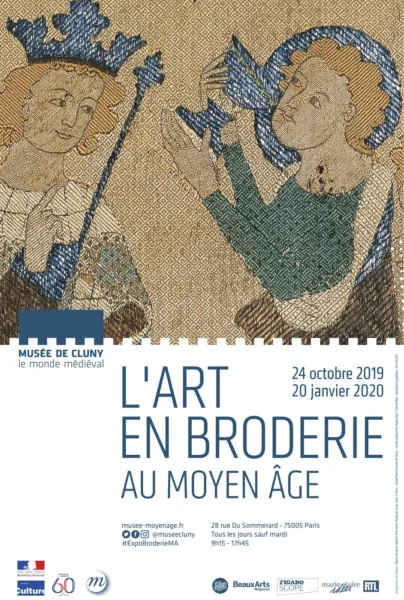 The exhibition is accompanied by a catalogue. This richly illustrated volume presents the Musée de Cluny’s outstanding collection of embroideries from the principal centres of production in Germany, England, France, Italy, and Flanders, dating from the twelfth to the early sixteenth century. These sumptuous works are considered alongside embroideries from major European textile collections, as well as paintings, engravings, ivories, and works of goldsmiths’ art.
Whether working in urban workshops or at court, embroiderers relied upon designs supplied by painters. These designs were used for ornaments, coats of arms, and heraldic devices adorning luxurious garments and richly caparisoned horses, as well as for the motifs, figures, and narrative scenes that embellished banners, furnishing textiles, and the precious chapels—matching ensembles of liturgical vestments and ecclesiastical ornaments.
The surviving embroideries illuminate both the processes of manufacture and the many individuals involved in their creation, including patrons, craftsmen, and merchants. Together, they produced genuine masterpieces, among them the Leopard Embroidery, the embroidered mitre of the Sainte-Chapelle, and the celebrated cycle of Saint Martin commissioned by René d’Anjou.