A Companion to the Medieval Papacy brings together an international group of experts on various aspects of the medieval papacy. Each chapter provides an up-to-date introduction to and scholarly interpretation of topics of crucial importance to the development of the papacy’s thinking about its place in the medieval world and of its institutional structures.
Topics covered include: the Papal States; the Gregorian Reform; papal artistic self-representation; hierocratic theory; canon law; decretals; councils; legates and judges delegate; the apostolic camera, chancery, penitentiary, and Rota; relations with Constantinople; crusades; missions. The volume includes an introductory chapter by Thomas F.X. Noble on the historiographical challenges of writing medieval papal history.
Contributors are: Sandro Carocci, Atria A. Larson, Andrew Louth, Jehangir Malegam, Andreas Meyer, Harald Müller, Thomas F.X. Noble, Francesca Pomarici, Rebecca Rist, Kirsi Salonen, Felicitas Schmieder, Keith Sisson, Danica Summerlin, and Stefan Weiß.
ABOUT THE EDITORS:
Keith Sisson, Ph.D. (2008), University of Memphis, is director of the Master of Arts in Liberal Studies program in University College at the University of Memphis. His monograph, Papal Hierocratic Theory in the High Middle Ages: From Roman Primacy to Universal Papal Monarchy (2009), examines the development of the hierocratic theory of government in the High Middle Ages, paying particular attention to the presentation of the theory during the Franco-papal conflict, 1296-1303. His primary areas of research are church and state relationships, political theory and practice, ecclesiology, cultural and intellectual history, and Scholasticism.
Atria A. Larson, Ph.D. (2010), Catholic University of America, is Visiting Scholar in the Center for Medieval and Renaissance Studies at Saint Louis University. She has published translations from Latin and German, editions of Latin texts, and articles in the field of medieval intellectual and legal history. Her monograph, Master of Penance: Gratian and the Development of Penitential Thought and Law in the Twelfth Century, won a 2015 Manfred Lautenschlaeger Award for Theological Promise.
FEATURED PHOTO:
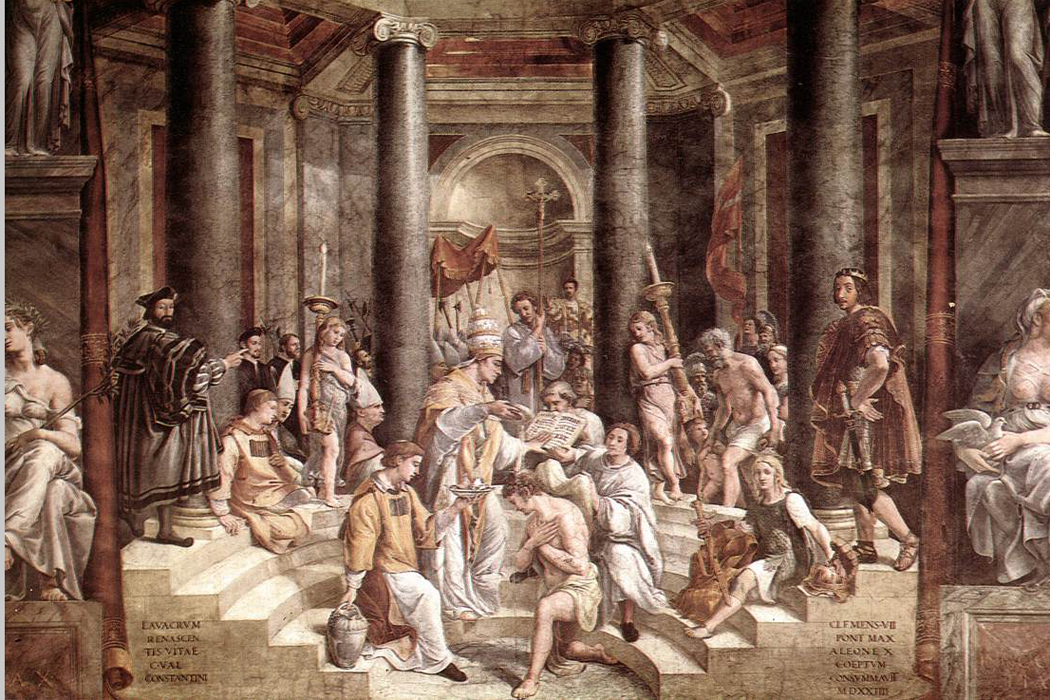
Raphael: The Baptism of Constantine
 A Companion to the Medieval Papacy. Growth of an Ideology and Institution