Home » Medieval Books » Page 27

Category: Medieval Books

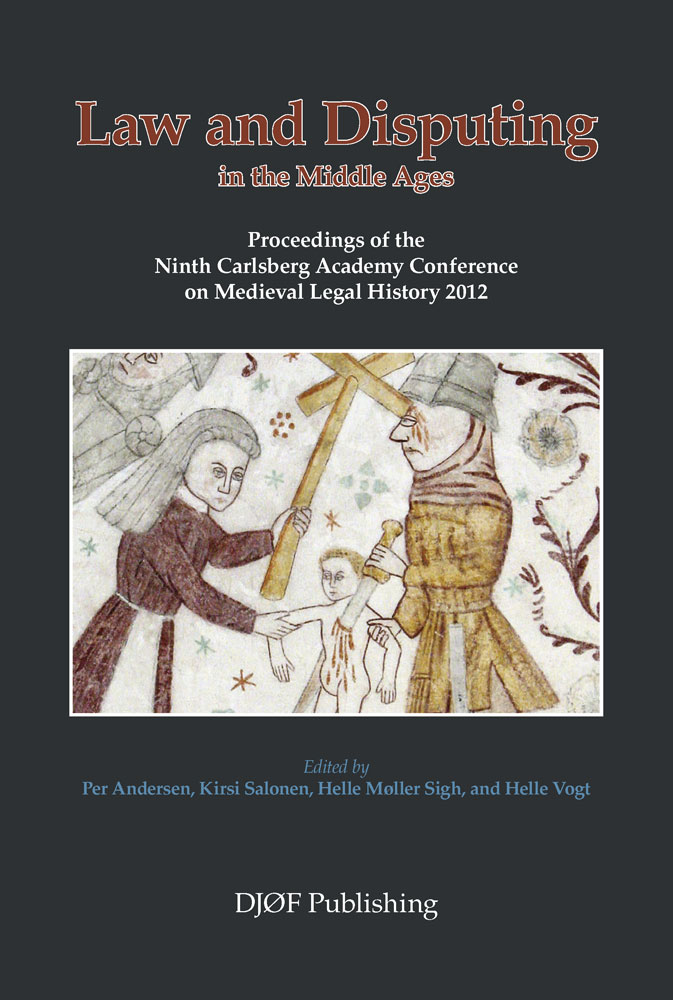
Law and Disputing in the Middle Ages

law-and-disputingLaw and Disputing in the Middle Ages: Proceedings of the Ninth Carlsberg Academy Conference on Medieval Legal History 2012 
Per Andersen (Author, Editor), Kirsi Salonen (Editor), Moller Sigh Helle (Editor)
Paperback: 200 pages
Publisher: DJOF Publishing (22 May 2013)
Language: English
ISBN-10: 8757426813
ISBN-13: 978-8757426816


Content:

List of Figures and Photography Credits

Introduction – af Per Andersen, Kirsi Salonen, Helle Møller Sigh og Helle Vogt

Legal Satire on the Bayeux Embroidery – af Stephen D. White

‘Disputing the Dead’ – Litigation over Sepultura in the Diocese of Limoges in the Early 12th-Century – af Bruce C. Brasington

The Crime of Dilapidation in the Church from Latter Half of the 12th-Century to the Beginning of the 13th-Century – af Bruno Lemesle

Bad Customs and Good Lordship – Disputing in Anjou, C. 987-C. 1150 – af Matthew W. McHaffie

Kin Conflict in 11th and Early 12th-Century Normandy – af Kate Hammond

The Law of Maintenance and the Obligations of Lordship – A Case Study – af Jonathan Rose

The Role of Arbitration in the Settlement of Disputes in Iceland C. 1000-1300 – af Jón Viðar Sigurðsson

Disputes and How to Avoid Them – Custom and Charters in England During the Long 12th-Century – af Paul Hyams

Dispute, Procedure and Sanction – Some Remarks on Dispute Settlement in Swedish Medieval Laws – af Pia Letto-Vanamo

The Use of Mediation and Arbitration in the Legal Revolution of 13th-Century Denmark – af Per Andersen

The Appellate Jurisdiction, the Emperor and the City – Republics in Early 13th-Century Northern Italy – af Gianluca Raccagni

The Practice of Legal Consulting and the Policy of Law in Late Medieval Dalmatia – af Nella Lonza

Interdict, Conflict Resolution and the Competition for Power in the Episcopal Seigneuries of Laon and Reims (C. 1100) – af Frederik Keygnaert

Competing Institutions and Dispute Settlement in Medieval England – af Joshua C. Tate

Church, State and Family in John Calvin’s Geneva – Domestic Disputes and Sex Crimes in Geneva’s Consistory and Council – af John Witte, Jr.

Litigating Abroad – Merchant’s Expectations Regarding Procedure Before Foreign Courts According to the Hanseatic Privileges (12TH-16TH C.) – af Albrecht Cordes

SOURCE:
Djøf Forlag

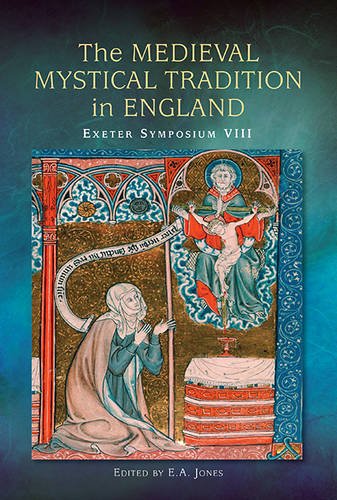
The Medieval Mystical Tradition in England

the-medieval-mystical-tradition-in-englandThe Medieval Mystical Tradition in England: Papers read at Charney Manor, July 2011 (Exeter Symposium 8)
E.A. Jones (Editor)
Hardcover: 226 pages
Publisher: D.S.Brewer (16 May 2013)
Language: English
ISBN-10: 1843843404
ISBN-13: 978-1843843405

Mystical writing flourished between the thirteenth and fifteenth centuries across Europe and in England, and had a wide influence on religion and spirituality. This volume examines a range of topics within the field. The five “Middle English Mystics” (Richard Rolle, Walter Hilton, the author of The Cloud of Unknowing, Julian of Norwich and Margery Kempe) receive renewed attention, with significant new insights generated by fresh theoretical approaches. In addition, there are studies of the relationships between continental and English mystical authors, introductions to some less well-known writers in the tradition (such as the Monk of Farne), and explorations around the fringes of the mystical canon, including Middle English translations of Boethius, Lollard spirituality, and the Syon brother Richard Whytford’s writings for a sixteenth-century “mixed life” audience.

E. A. Jones is Senior Lecturer in English Medieval Literature and Culture at the University of Exeter. Contributors: Christine Cooper-Rompato, Vincent Gillespie, C. Annette Grisé, Ian Johnson, Sarah Macmillan, Liz Herbert McAvoy, Nicole R. Rice, Maggie Ross, Steven Rozenski Jr, David Russell, Michael G. Sargent, Christiana Whitehead.

Contents

1 Introduction

2 The Colours of Contemplation: Less Light on Julian of Norwich

3 Behold Not the Cloud of Experience

4 Walter Hilton on the Gift of Interpretation of Scripture

5 Numeracy and Number in The Book of Margery Kempe

6 Religious Mystical Mothers: Margery Kempe and Caterina Benincasa

7 Authority and Exemplarity in Henry Suso and Richard Rolle

8 Mortifying the Mind: Asceticism, Mysticism and Oxford, Bodleian Library, MS Douce 114

9 The Meditaciones of the Monk of Farne

10 Envisioning Reform: A Revelation Of Purgatory and Anchoritic Compassioun in the Later Middle Ages

11 Walton’s Heavenly Boece and the Devout Translation of Transcendence: O Qui Perpetua Pietised

12 Reformist Devotional Reading: The Pore Caitif in British Library, MS Harley 2322

13 Richard Whytford, The Golden Epistle, and the Mixed Life Audience

Sea Monsters on Medieval and Renaissance Maps

sea-monsters-and-mapsSea Monsters on Medieval and Renaissance Maps
Chet van Duzer
Hardcover: 144 pages
Publisher: The British Library Publishing Division (10 May 2013)
Language: English
ISBN-10: 0712358900
ISBN-13: 978-0712358903

From dragons and serpents to many-armed beasts that preyed on ships and sailors alike, sea monsters have terrified mariners across all ages and cultures and have become the subject of many tall tales from the sea. Accounts of these creatures have also inspired cartographers and mapmakers, many of whom began decorating their maps with them to indicate unexplored areas or areas about which little was known. Whether swimming vigorously, gamboling amid the waves, attacking ships, or simply displaying themselves for our appreciation, the sea monsters that appear on medieval and Renaissance maps are fascinating and visually engaging. Yet despite their appeal, these monsters have never received the scholarly attention that they deserve. In Sea Monsters on Medieval and Renaissance Maps, Chet Van Duzer analyzes the most important examples of sea monsters on medieval and Renaissance maps produced in Europe. Van Duzer begins with the earliest mappaemundi on which these monsters appear in the tenth century and continues to the end of the sixteenth century and, along the way, sheds important light on the sources, influences, and methods of the cartographers who drew or painted them.

A beautifully designed visual reference work, Sea Monsters on Medieval and Renaissance Maps will be important not only in the history of cartography, art, and zoological illustration, but also in the history of the geography of the “marvelous” and of Western conceptions of the ocean.

Content:


Acknowledgements

Introduction


Classical Antecedents

The Earliest Medieval Maps with Sea Monsters: Beatus Mappaemundi

“Let the Waters Bring Forth Abundantly”: Sea Monsters in the Creation

Sea Monsters in the Harbor of Brindisi

An Imagined Mappamundi with Sea Monsters

Sea Monsters on the Ceiling

Giant Sea Monsters on Two Small Mappaemundi

“A Vast Sea Where There is Nothing But the Abode of Monsters”

Two Monumental Mappaemundi with Few Sea Monsters

Three Sea Monsters Battling in the Atlantic

Pictorial Excursus: The Dangers of Sea Monsters

Sea Monsters on Nautical Charts: Giant Octopuses, Sirens, Sharks

How to Buy a Sea Monster

Whaling Between Myth and Reality

A Nest of Sea Monsters at the Bottom of the World

Whales as Big as Mountains

Terrifying Monsters in the Indian Ocean

A Skeptic about Sea Monsters: Fra Mauro

Pictorial Excursus: Whimsical Sea Monsters

Invented Sea Monsters in the Circumfluent Ocean

The Manuscript with the Most Sea Monsters

Sea Monsters in Printed Editions of Ptolemy

The Sea Monsters of the Earliest Surviving Terrestrial Globe

The Sea Monsters of Waldseemüller’s Map of 1507 and Schöner’s Globe of 1515

Lighting a Fire on a Whale’s Back

Pictorial Excursus: The Cartographic Career of the Walrus


The Debut of the Sea Monsters of the Renaissance

Olaus Magnus and the Most Important Sea Monsters of the Sixteenth Century

Mercator’s Globe of 1541: The Influence of Olaus Magnus

The Ulpius Globe: Sea Monsters Before Their Time

The Monster that Stops Ships in Their Tracks

Pictorial Excursus: More Whimsical Sea Monsters

From Sea Dragons to a Sawfish: The Rylands Library Map of 1546

Evidence of a Sea Monster Specialist

The Curious Career of the Flying Turtle

The Eclecticism of Giacomo Gastaldi

The Sea Monsters of Gerard Mercator’s Great Map of 1569

Sea Monsters Cavorting Among the Mediterranean Isles

The Sea Monsters Surrounding Iceland in the First Atlas

A Haunting Sea Monster Reappears

Whales Fantastic and Realistic at the End of the Sixteenth Century

Two New World Sea Monsters

Conclusion

Endnotes

Index

Index of Manuscripts

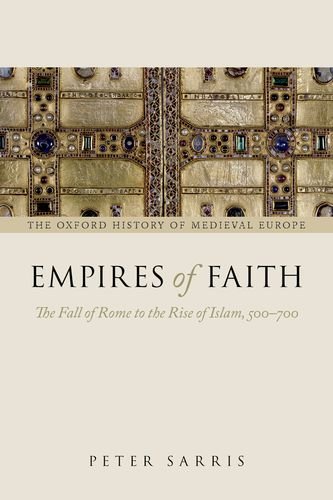
Empires of Faith: The Fall of Rome to the Rise of Islam 500-700

empires of faithEmpires of Faith: The Fall of Rome to the Rise of Islam, 500-700 (Oxford History of Medieval Europe)
Peter Sarris
Paperback: 448 pages
Publisher: OUP Oxford 2013 (2011)
Language: English
ISBN-10: 019967535X
ISBN-13: 978-0199675357

Empires of Faith

  • Is an unusually wide-ranging study which integrates medieval, Byzantine, and Islamic history
  • Draws on latest scholarship to form an up-to-date study of the era
  • Includes an extensive bibliography to provide a framework for future study

Drawing upon the latest historical and archaeological research, Dr Peter Sarris provides a panoramic account of the history of Europe, the Mediterranean, and the Near East from the fall of Rome to the rise of Islam. The formation of a new social and economic order in western Europe in the fifth, sixth, and seventh centuries, and the ascendancy across the West of a new culture of military lordship, are placed firmly in the context of on-going connections and influence radiating outwards from the surviving Eastern Roman Empire, ruled from the great imperial capital of Constantinople. The East Roman (or ‘Byzantine’) Emperor Justinian’s attempts to revive imperial fortunes, restore the empire’s power in the West, and face down Constantinople’s great superpower rival, the Sasanian Empire of Persia, are charted, as too are the ways in which the escalating warfare between Rome and Persia paved the way for the development of new concepts of ‘holy war’, the emergence of Islam, and the Arab conquests of the Near East. Processes of religious and cultural change are explained through examination of social, economic, and military upheavals, and the formation of early medieval European society is placed in a broader context of changes that swept across the world of Eurasia from Manchuria to the Rhine.

Warfare and plague, holy men and kings, emperors, shahs, caliphs, and peasants all play their part in a compelling narrative suited to specialist, student, and general readership alike.

Readership: Scholars and students of early medieval Europe; the interested reader

Read more about the Research Project here

A Dictionary of Medieval Terms and Phrases

A Dictionary of Medieval Terms and PhrasesA Dictionary of medieval Terms and phrases
Christopher Corèdon, Ann Williams,
Paperback: 320 pages
Publisher: D.S.Brewer 2013 (2006)
Language: English
ISBN-10: 184384138X
ISBN-13: 978-1843841388

An interest in the middle ages often brings the non-specialist reader up short against a word or term which is not understood or only imperfectly understood. This dictionary is intended to put an end to all that: it has been designed to be of real help to general readers and specialists alike.

The dictionary contains some 3,400 terms as headwords, ranging from the legal and ecclesiastic to the more prosaic words of daily life. Latin was the language of the church, law and government, and many Latin terms illustrated here are frequently found in modern books of history of the period; similarly, the precise meaning of Old English and Middle English terms may elude today’s reader: this dictionary endeavours to provide clarity. In addition to definition, etymologies of many words are given, in the belief that knowing the origin and evolution of a word gives a better understanding. There are also examples of medieval terms and phrases still in use today, a further aid to clarifying meaning.

CHRISTOPHER COREDON has also compiled the Dictionary of Cybernyms. Dr ANN WILLIAMS, historical consultant on the project, was until her retirement Senior Lecturer in medieval history at the Polytechnic of North London.

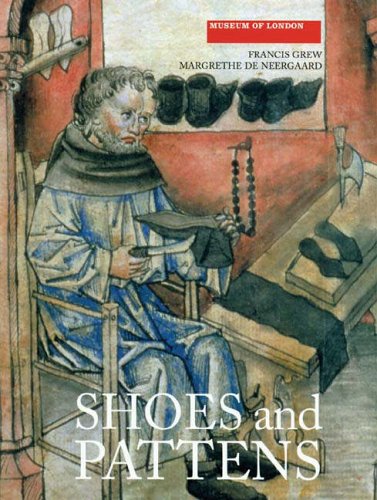
Shoes and Pattens – Finds from Medieval Excavations in London

shoes and pattensShoes and Pattens: Finds from Medieval Excavations in London (Medieval Finds from Excavations in London)
Francis Grew, Margrethe de Neergaard, Susan Mitford
Boydell & Brewer Press 2013 (2006)
ISBN-10: 1843832380
ISBN-13: 978-1843832386

Until recently, very little was known about medieval shoes. Glimpses in manuscript illustrations and on funerary monuments, with the occasional reference by a contemporary writer, was all that the costume historian had as evidence, not least because leather tends to perish after prolonged contact with air, and very few actual examples survived. In recent years, however, nearly 2,000 shoes, many complete and in near-perfect condition, have been discovered preserved on the north bank of the Thames, and are now housed in the Museum of London. This collection, all from well-dated archaeological contexts, fills this vast gap in knowledge, making it possible to chart precisely the progress of shoe fashion between the twelfth and fifteenth centuries.

Le Grand Ferré

51ZVlwUNYWL._SL500_

Le Grand Ferré : Premier héros paysan.
Colette Beaune (Auteur)

Until recently the “Grand Ferré” was known to everyone in the French schools. His story was part of the curriculum on the 100 years war, showcasing a brave man of morals, who – abandoned by the elite – showed the courage to defend his own. According to this story some peasants – thanks to the Herculean strength of Le Grand Ferré – succeeded to defeat the English mercenaries, who attacked their village to loot.

France at this time in history was marked by a series of terrible crises characterized by a particularly harsh climate, periods of hunger and starvation and the great plague. At the same time the king was a de facto prisoner of the English while the young regent was challenged by peasant uprisings. In the midst of reporting on all these calamities a mendicant friar born near Compiègne wrote the story down in 1360, thus securing the afterlife of a vibrant myth.

To find the truth behind this French “Robin Hood”, the historian Colette Beaune has conducted delved into the sources. The historian went on site in Picardy, where the popularity of the peasant is still intact. She tracked him down in the oldest archives of an abbey and followed the thread of his story until the 20th century. Century after century The Grand Ferré has played an important part as the symbol par excellence of resistence, whether turned against feudal oppressors or German invaders.

Colette Beaune is Emeritus professor of medieval history at the University of Paris Ouest and Nanterre and a specialist in political history, women’s history and the history of art. She has received numerous prices. For all of her work, Colette Beaune has received the Grand Prix of the French Academy in history – the Grand Prix Gobert 2012.

Le Grand Ferré : Premier héros paysan.
By Colette Beaune
Broché: 386 pages
Editeur : Librairie Académique Perrin (14 mars 2013)
Langue : Français
ISBN-10: 2262028915
ISBN-13: 978-2262028916
€ 23.00

Charlemagne

charlemagne-favier

Charlemagne
By Jean Favier

Charlemagne is a man of a myth – successor to the Caesars he ended up influencing the history of France as well as wider Europe. In this new edition of biography on the grand scale Jean Favier paints a nuanced portrait, while tackling the problems of distinguishing between the myth and the reality.

First he places the man in his historical context and provides a portrait of a king directed towards one goal: the political end religious unity of Western Christendom. But he also touches upon the – perhaps – more mythical matters: his joy of Latin Poetry, his interest in schools and education etc. At 769 pages and written by one of France’s foremost historians, yet another portrait does not seem superfluous.


Charlemagne
By Jean Favier
Broché: 769 pages
Editeur : Editions Tallandier 2013. 1. edition 1999
Langue : Français
ISBN-13: 979-1021000810
EUR 12,26


The Counts of Artois

41FOK1wHKTL._SL500_

Les comtes d’Artois et leurs archives : Histoire, mémoire et pouvoir au Moyen Age
[The Counts of Artois and their Archives: History, memory and Power in the Middle Ages] 

By Alain Provost et al

Preserved in the Departmental Archives of Pas-de-Calais, the Treasury charters Counts of Artois (XIII-XIV centuries) holds more than 10.000 documents. The vast wealth of information held in this archive is often overlooked. Studies gathered here focus on the creation and preservation of the many cartularies, surveys, accountbooks and delves more generally into the history of the counts and the County of Artois –the political society, the government and county government, the judicial and devotional practices plus the genealogical memory encapsulated in historical writings. The book is part of the current renewal of the history of writing practices.

By the diversity of topics and approaches, the book describes in detail the Counts of Artois archives as well as draws research perspectives. It will attract the attention of the scientific community on a documentary and provide exceptional public cultivated an important contribution to the knowledge of Artois in the Middle Ages and, more broadly, of the kingdom of France under the reign of the last Capetians.

Les comtes d’Artois et leurs archives : Histoire, mémoire et pouvoir au Moyen Age 
By Alain Provost et al
Broché: 180 pages
Publisher : Artois Presses Université 2013
Collection : Histoire
Langue : Français
ISBN-10: 2848321652
ISBN-13: 978-2848321653
€ 38.00

The Secrets of the Borgias

Dans-le-secret-des-borgias

Dans le secret des Borgia : Journal du maître des cérémonies du pape Alexandre VI (1492-1503)
[The Secrets of the Borgias: Diary of the ceremonial master to Pope Alexandre VI (1492 – 1503)]
By Johannes Burchard. Translated by Joseph Turmel, Vito Castiglione Minischetti and Ivan Cloulas

The Borgia family, during the pontificate of Alexander (1492-1503)is central to the writings in the diary of Johannes Burchard (1450-1506), who was master of ceremonies at the Vatican from 1483 to his death. In it he carefully noted the pomp and circumstances of this family, which reached the summit of temporal and spiritual power. Her we can read about bodies recovered in the Tiber, cardinals troubled by courtesans, obscene Roman Carnival masks, fighting bulls in the square in front of St. Peter, and a banquet where fifty courtesans were presented to the Vatican in the presence of the pontiff. Ivan Cloulas and Vito Castiglione Minischetti have chosen and commented on the most significant passages of the text, delivering a fascinating chronicle. With more than 1500 pages and in Latin the text is here made available in shorter version and in French.

Here the reader may discover the true source to the legend about the foibles and intelligence of Alexander VI, the marital woes of Lucrecia, the murder of Juan, Duke of Gandia and the brutality and the genius of Caesar, the “Prince” of Machiavelli.

Ivan Cloulas is a historian specializing in the Renaissance and the Borgia family, who has already drawn a faithful portrait of one of the members in the book on Cesare Borgia (Tallandier, 2005). Vito Castiglione Minischetti is curator at the Bibliothèque nationale de France. He is the author of the Commentaries of Pius II under the title Memoirs of a Renaissance Pope.

Dans le secret des Borgia : Journal du maître des cérémonies du pape Alexandre VI (1492-1503)
Johannes Burkhard.Translated by Joseph Turmel, Vito Castiglione Minischetti and Ivan Cloulas
Paperback: 516 pages
Publisher: Tallandier (7 March 2013)
Language: French
ISBN-10: 2847349626
ISBN-13: 978-2847349627
€ 24.90

Authentic Medieval Cooking

authentique-cuisine-moyen-age

Authentique cuisine du Moyen Age
[Authentic French Cooking from the Middle Ages]
By Françoise de Montmollin

For several years volunteer at the site of Guédelon – the French project to rebuild an original French Castle – Françoise de Montmollin has been the cook at the castle since 2009. In this book she presents the results of her research into the workings of medieval cooking. Illustrations are by François Folcher, who is a professional photographer who has followed since the beginning of the construction site of the castle of Guédelon.

Authentique cuisine du Moyen Age
Françoise de Montmollin
Ouest-France 2013
Langue : Français
ISBN-10: 2737360706
ISBN-13: 978-2737360701
€ 24.00

A Medieval River Port at Charente

41hP1YcUf3L._SL500_Archéologie et histoire du fleuve Charente : Taillebourg – Port d’Envaux : une zone portuaire du haut Moyen Age sur le fleuve Charente
[Archaeology and history of the River Charente: Tailleboourg – Port d’Envaux: A port from the High Middle Ages at the river Charente]
By Annie Dumont, Jean-François Mariotti et al.

The book is published in connection with a comprehensive research project, which aims to study the site Taillebourg – Port Envaux (Charente-Maritime). This archaeological deposit contains numerous witnesses related to activities at the Charente river (boats, dams, fish furniture, agricultural tools, etc..), dated mainly from the Merovingian and Carolingian periods.

The research conducted on this complex site have been based on the principle that one cannot separate the remains discovered under water with what is found further inland in the valley on the floodplain. To carry out this program, various sources of information – geophysical, bathymetric and underwater analysis of the archaeological map of the banks – have been conducted. This has been enhanced with and accompanying study of archaeological finds plus research into old maps and plans. This diachronic and interdisciplinary approach has renewed the knowledge of the evolution of a portion of the river between Saintes and the estuary. It provides understanding a medieval port area, rarely studied.

Archéologie et histoire du fleuve Charente : Taillebourg – Port d’Envaux : une zone portuaire du haut Moyen Age sur le fleuve Charente
[Archaeology and history of the River Charente: Tailleboourg – Port d’Envaux: A port from the High Middle Ages at the river Charente]
By Annie Dumont, Jean-François Mariotti et al.
Hardback: 350 pages
Editions Universitaires de Dijon 2013
Langue : Français
ISBN-10: 2364410339
ISBN-13: 978-2364410336
€40

Two Medieval Warlords

deux-chef-de-guerres-au-moyen-ageDeux chefs de guerre au Moyen-Age
[Two Medieval Warlords]

Jean de Vienne, admiral of France, and Bertrand du Guesclin, Constable, were as different as two major warlords can be, although they sometimes fought together during the Hundred Years War. However, while Bertrand du Guesclin, achieved a reputation as a great general, which still lingers in the French imagination, the admiral Jean de Vienne is virtually unknown.

And yet, du Guesclin would probably not have been able to achieve his glorious success against the English if Jean de Vienne had not won the supremacy over the English Channel. The author of this double biography asks the question whether it is legitimate to ignore the admiral who was the first to organize a real fleet of war for the kingdom of France?

History ended up glorifying Bertrand du Guesclin and ignoring Jean de Vienne. Now is the time to restore the memory of jean de Vienne who should be considered as the first founder of what became the Royal and our Navy.

Deux chefs de guerre au Moyen-Age
By Jacques D. de Certaines
Hardback: 224 pages
Publisher : APOGEE 2013
Language : Français
ISBN-10: 2843984289
ISBN-13: 978-2843984280
€ 17.10

Teachers and Students in the Middle Ages

Maître et élèves au Moyen Age

Maîtres et élèves au Moyen Age
[Teachers and Students in the Middle Ages]

“We are like dwarfs on the shoulders of giants”. This “bon mots” was famousy formulated by Bernard of Chartres in the twelfth century, when he described the situation of the clergy of his time. Crushed by the weight of the legacy of the ancients, all their efforts were on to restore and master.

Written by two leading experts, this story of teachers and students in the medieval West shows how to succeed at the time of cathedrals and monastic schools as well as at one of the most brilliant medieval revivals, the universities. These new institutions created the possibility for a wide the expansion of public teaching. The book delves into the lives of both teachers and students, describing the constraints on their aspirations and recalling what guided their work. Students and teachers shared the same requirements of high spirituality and the same insatiable curiosity.

Pierre Riché is Emeritus Professor of Medieval History at the University of Paris X Nanterre.

Jacques Verger is a professor of cultural history from the Middle Ages at the University of Paris IV-Sorbonne.

Maîtres et élèves au Moyen Age
By Pierre Riché and Jacques verger
Publisher: Fayard / Plural (13 March 2013)
Language: French
ISBN-10: 2818503329
ISBN-13: 978-2818503324
£8.55