‘Medieval Histories’ offers medievalists all the news about exhibitions, books, research, archaeology, travel-tips and much more from the Medieval World
‘Let Each Man Carry on with His Trade and Remain Silent’: Middle-Class Ideology in the Urban Literature of the Late Medieval Low Countries
ABSTRACT:
The vernacular literary output of the ‘chambers of rhetoric’ in the Low Countries provides us with some insight into the ideology of the urban medieval middling classes. This literature included criticisms of social order, and it is argued here that whilst these come from an inherited religious discourse of reform, they can nonetheless be read as speaking to a political ideology particular to the urban context of the late Middle Ages. This article seeks to bring these ideological expressions into view, to contribute to our understanding of the political practices and popular uprisings of this time and place.
ABOUT THE AUTHORS
Jan Dumolyn, Department of History, Ghent University, Sint-Pietersnieuwstraat 35, B 9000 Ghent, Belgium;, Email:
Jelle Haemers, Department of History, University of Leuven, Blijde Inkomststraat 21, B 3000 Leuven, Belgium;, Email: jelle.haemers@arts.kuleuven.be
Medieval Law in Context: The Growth of Legal Consciousness from Magna Carta to The Peasants’ Revolt (Manchester Medieval Studies)
Anthony Musson
Publisher: Manchester University Press 2001
ISBN-13: 978-0719054945
BOOK DESCRIPTION
Offering an important new perspective on medieval political, legal, and social history in England, Anthony Musson examines how medieval people at all social levels thought about law, justice, politics, and their role in society. He provides a history of medieval law and judicial developments in the 13th and 14th centuries, while interweaving within each chapter a special focus on different facets of legal culture and experience. This illuminating approach reveals a comprehensive picture of two centuries worth of tremendous social change.
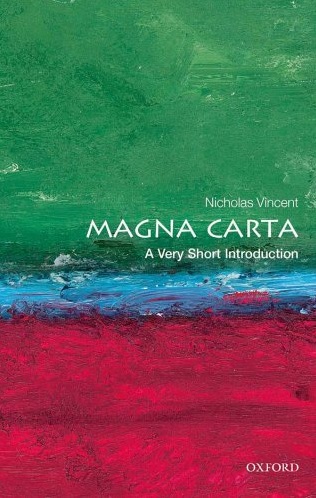
Magna Carta: A Very Short Introduction
Nicholas Vincent
Publisher: Oxford University Press (September 7, 2012)
ISBN-13: 978-0199582877
BOOK DESCRIPTION
The Magna Carta is arguably the greatest constitutional document in recorded history, yet few people today understand either its contents or its context. This Very Short Introduction, which includes a full English translation of the 1215 Magna Carta, introduces the document to a modern audience, explaining its origins in the troubled reign of King John, and tracing the significant role that it played thereafter as a symbol of the subject’s right to protection against the absolute authority of the sovereign. Drawing upon the great advances that have been made in our understanding of thirteenth-century English history, Nicholas Vincent demonstrates why the Magna Carta remains hugely significant today. The book is the result of
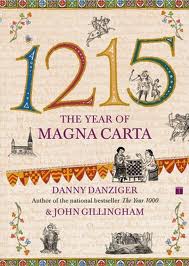
1215: The Year of Magna Carta
Danny Danziger (Author), John Gillingham (Author)
Publisher: Touchstone; Touchstone Edition edition (May 17, 2005)
ISBN-13: 978-0743257787
BOOK DESCRIPTION:
Surveying a broad landscape through a narrow lens, 1215 sweeps readers back eight centuries in an absorbing portrait of life during a time of global upheaval, the ripples of which can still be felt today. At the center of this fascinating period is the document that has become the root of modern freedom: the Magna Carta. It was a time of political revolution and domestic change that saw the Crusades, Richard the Lionheart, King John, and — in legend — Robin Hood all make their marks on history.
The events leading up to King John’s setting his seal to the famous document at Runnymede in June 1215 form this rich and riveting narrative that vividly describes everyday life from castle to countryside, from school to church, and from hunting in the forest to trial by ordeal. For instance, women wore no underwear (though men did), the average temperatures were actually higher than they are now, and the austere kitchen at Westminster Abbey allowed each monk two pounds of meat and a gallon of ale per day. Broad in scope and rich in detail, 1215 ingeniously illuminates what may have been the most important year of our history.
Repositioning a secular legal text like Magna Carta as “sacred” is a prerequisite for making a spectacular exhibition out of it
A first tour to Washington might very well be termed sacrilegious if the visitor only walks the mile from the Lincoln Memorial to the Capitol, but forgets to visit the National Archives at Constitution Avenue in order to inspect the American Founding documents in the Rotunda for the Charters of Freedom. Something like a neo-classical temple the showcases look like classical tombs, enshrining the holy of holies – the Declaration of Independence.
Rotunda in the National Archive in Washington
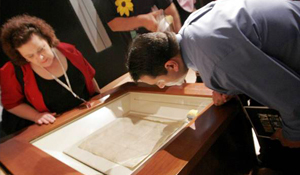
According to Richard Voase and Barry Ardley, both Lincoln University,who has carried out a study of visitors to the present exhibition in Lincoln of one of the four extant copies of Magna Carta, this is unfortunately not the experience, which people get. Until now the authentic document has been exhibited in a small rather cramped location in an old prison, which – although it is surrounded by sympathetic offers of well-intended introductions to the historical context – does not allow for visitors to experience the document as more than a small, old and unreadable piece of parchment.
In their highly inspiring article building on insights from sociologists like Émile Durkheim , Walter Benjamin and Daniel Bell the authors demonstrate how a proper exhibition would have to rethink this essentially secular document as a sacred artefact and imparting its renewed aura to visitors, presenting it in a spatial setting signaling gravitas as well as aura.
Lincoln Castle Revealed New vault for Magna Carta
The suggestion is pertinent as Lincolnshire is currently investing app. £20 million on a project called Lincoln Castle Revealed. Part of this project is to create a new vault to showcase the Magna Carta and the Charter of the Forest and complete this with a cinema space. However, the design does not look at all like a neo-classical Greek temple; rather the inspiration seems to have come from an Anglo-Saxon mound… one wonders to what extent the city was presented with the very clever arguments which can be found in the article: Magna Carta: repositioning the secular as “sacred”?
According to the project the investment should hopefully result in an increase in the overall value of tourism to Lincoln as well as 600 – 1100 new jobs.
Abstract of article:
Magna Carta is an English legal document, of mediaeval origin. Its salience subsists in the origination of principles such as habeas corpus, trial by jury, and the right of the people to representation in the government. This paper considers how one of the remaining copies, held in Lincoln, UK, can best be presented for public view. The approach is essentially conceptual, underpinned by primary research in the form of an exit survey. The findings suggested some visitor dissatisfaction with the current display. This is interpreted by a discussion of the nature of tourist gazing and anticipation, drawing on the theoretical work of Campbell, Urry, MacCannell and Foucault. A revised presentational paradigm is proposed, drawing on the writings of Durkheim, Benjamin, and Bell. It is argued, with reference to a comparable model elsewhere, that the key to meeting visitor expectations is to re-imagine the Magna Carta as a ‘sacred’ rather than a secular document. The practical implication is to present the document in a way as to generate aura. Forthcoming intentions to re-design the display, to coincide with the 800th anniversary of the signing of the document, add import to the discussion.
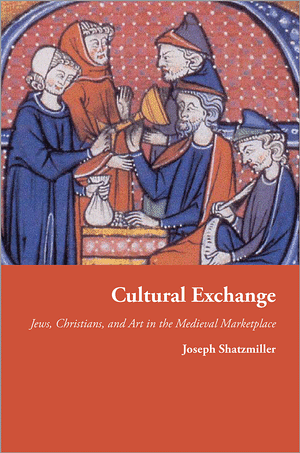
Demonstrating that similarities between Jewish and Christian art in the Middle Ages were more than coincidental, Cultural Exchange meticulously combines a wide range of sources to show how Jews and Christians exchanged artistic and material culture. Joseph Shatzmiller focuses on communities in northern Europe, Iberia, and other Mediterranean societies where Jews and Christians coexisted for centuries, and he synthesizes the most current research to describe the daily encounters that enabled both societies to appreciate common artistic values.
Detailing the transmission of cultural sensibilities in the medieval money market and the world of Jewish money lenders, this book examines objects pawned by peasants and humble citizens, sacred relics exchanged by the clergy as security for loans, and aesthetic goods given up by the Christian well-to-do who required financial assistance. The work also explores frescoes and decorations likely painted by non-Jews in medieval and early modern Jewish homes located in Germanic lands, and the ways in which Jews hired Christian artists and craftsmen to decorate Hebrew prayer books and create liturgical objects. Conversely, Christians frequently hired Jewish craftsmen to produce liturgical objects used in Christian churches.
With rich archival documentation, Cultural Exchange sheds light on the social and economic history of the creation of Jewish and Christian art, and expands the general understanding of cultural exchange in brand-new ways.
ABOUT THE AUTHOR:
Joseph Shatzmiller is the Smart Family Professor of Judaic Studies at Duke University. He is the author of Shylock Reconsidered and Jews, Medicine, and Medieval Society.
TABLE OF CONTENTS:
List of Illustrations vii
Preface xi
Introduction 1
Part 1 Pawnbrokers: Agents of Cultural Transmission 5
Chapter 1 Financial Activities in the Medieval Marketplace 7
Chapter 2 Securities for Loans: Church Liturgical Objects 22
Chapter 3 High Finance: Urban and Princely Pledges 45
Part 2 Human Imagery in Medieval Ashkenaz 59
Chapter 4 The Decorated Home of the Rabbi of Zurich 61
Chapter 5 German Jews and Figurative Art: Appreciation and Reservation 73
Part 3 At the Marketplace: Professionals in the Service of the “Other” 111
Chapter 6 Christian Artists and Jewish Patronage 113
Chapter 7 Jewish Craftsmanship at the Service of the Church 141
Conclusions 158
Appendix Jewish Traditions and Ceremonies: How Original? 162
Select Bibliography 167
Index 177
The Book is published in the series: Jews, Christians, and Muslims from the Ancient to the Modern World
Owain Glyndwr: A Casebook (Exeter Medieval Texts and Studies) Michael Livingston (Editor), John K. Bollard (Editor)
Liverpool University Press 2013
ISBN-13: 978-0859898843
BOOK DESCRIPTION:
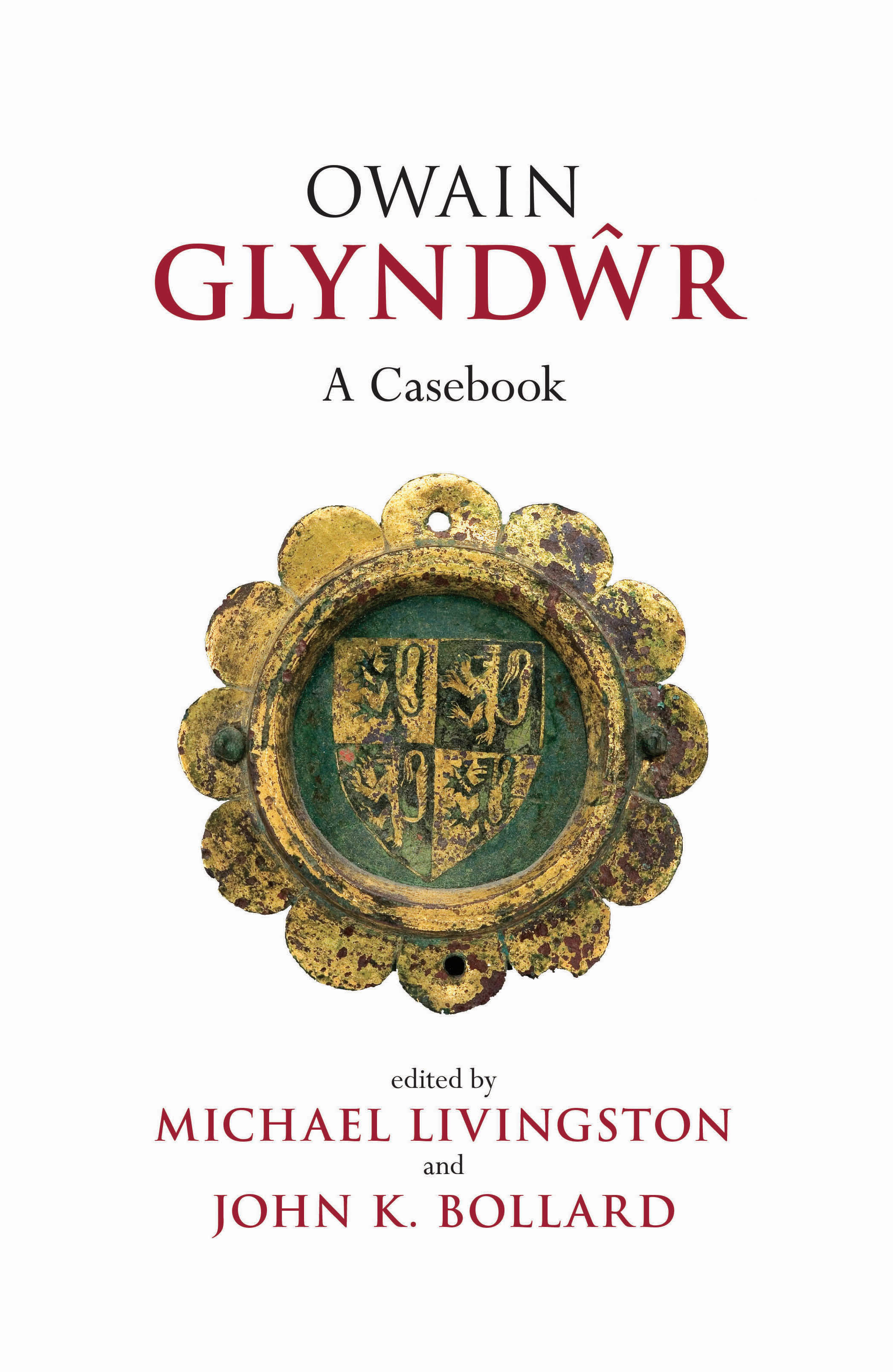
Owain Glyndwr (1357?-1415) was the last native Welshman to hold the title Prince of Wales and a revolutionary. This book presents the original text and English translations of the medieval and post-medieval records, documents, poems and chronicles relating to him, his career and his legacy. In addition, textual notes and essays on the historical, social and literary context of these documents will provide up-to-date perspectives and commentary on the man and his times. For the first time, historians, literary scholars, students and the general reader will be able to view a wide range of materials collected in a single volume and will be able to assess for themselves the significance of Glyndwr in Welsh, English and European history from the late Middle Ages into the Renaissance and to redress the imbalance of historical accounts past and present. The high profile international contributors include: John K. Bollard, Independent Scholar of Welsh Kelly DeVries, Loyola University, Maryland Helen Fulton, University of York, UK Rhidian Griffiths, Independent Scholar Elissa Henken, University of Georgia Michael Livingston, The Citadel Alicia Marchant, University of Western Australia Scott Lucas, The Citadel William Oram, Smith College Gryffydd Aled Williams, Aberystwyth University, UK
ABOUT THE AUTHORS:
Michael Livingston is an Associate Professor at The Citadel, The Military College of South Carolina. He is the editor of The Battle of Brunanburh: A Casebook (2011), along with scholarly editions of Siege of Jerusalem (2004), In Praise of Peace (2005), and The Middle English Metrical Paraphrase of the Old Testament (2011).
John K. Bollard is a Medieval Welsh scholar, editor, and lexicographer. He has published extensively on The Mabinogi and other early Welsh works, including popular translations of The Mabinogi (2006), Companion Tales to The Mabinogi (2007), and Tales of Arthur (2010).
Medieval Clothing and Textiles 9
Robin Netherton (Editor), Gale R. Owen-Crocker (Editor)
Hardcover: 182 pages
Publisher: Boydell Press (18 July 2013)
ISBN-13: 978-1843838562
BOOK DESCRIPTION:
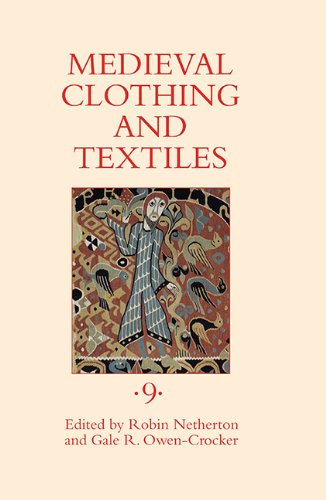
Topics in this volume range widely throughout the European middle ages. Three contributions concern terminology for dress. Two deal with multicultural medieval Apulia: an examination of clothing terms in surviving marriage contracts from the tenth to the fourteenth century, and a close focus on an illuminated document made for a prestigious wedding. Turning to Scandinavia, there is an analysis of clothing materials from Norway and Sweden according to gender and social distribution. Further papers consider the economic uses of cloth and clothing: wool production and the dress of the Cistercian community at Beaulieu Abbey based on its 1269-1270 account book, and the use of clothing as pledge or payment in medieval Ireland. In addition, there is a consideration of the history of dagged clothing and its negative significance to moralists, and of the painted hangings that were common in homes of all classes in the sixteenth century. Robin Netherton is a professional editor and a researcher/lecturer on the interpretation of medieval European dress; Gale R. Owen-Crocker is Professor of Anglo-Saxon Culture at the University of Manchester. Contributors: Antonietta Amati, Eva I. Andersson, John Block Friedman, Susan James, John Oldland, Lucia Sinisi, Mark Zumbuhl
CONTENTS:
Preface
Bridal Gifts in Medieval Bari
The Marriage of the Year [1028]
Clothing as Currency in Pre-Norman Ireland?
Cistercian Clothing and Its Production at Beaulieu Abbey, 1269-70
Clothing and Textile Materials in Medieval Sweden and Norway
The Iconography of Dagged Clothing and Its Reception by Moralist Writers
Domestic Painted Cloths in Sixteenth-Century England: Imagery, Placement, and Ownership
Medieval Life Cycles: Continuity and Change (International Medieval Research 18) Isabelle Cochelin (Editor), Karen Smyth (Editor)
Hardcover: 357 pages
Publisher: Brepols Pub (30 July 2013)
ISBN-13: 978-2503540696
BOOK DESCRIPTION:
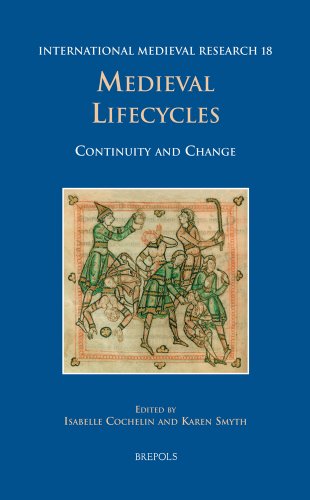
The essays in this collection present new research into a variety of questions on birth, childhood, adolescence, adulthood, middle age, and old age, ordered in a more or less chronological manner according to the lifecycle. The volume exposes attitudes and representations of the lifecycle from the Anglo-Saxon period to the end of the Middle Ages as being full of inconsistencies as well as definitive categories, and of variation and stasis. This attests to the fact that medieval conceptions and representations of the stages of life and their interrelationships are much more nuanced and less idealized than is usually credited. Medieval conceptual, mental, artistic, cultural, and sociological processes are scrutinized using various approaches and methods that cross disciplinary boundaries. What is emphasized across the volume is that there were varying, context-dependent rhythms of continuity and change in every stage of life in the medieval period. The volume’s selection of authors is international in scope and represents some of the leading current scholarship in the field.
LIST OF CONTENT:
Introduction: Pre-Thirteenth-Century Definitions of the Life Cycle by Isabelle Cochelin
Baptism and Infant Burial in Anglo‑Saxon England by Sally Crawford
Wanton Boys in Middle English Texts and the Christ Child in Minneapolis, University of Minnesota, MS Z822 N81 by Mary Dzon
Adolescence Uncloistered (Cluny, Early Twelfth Century) by Isabelle Cochelin
Rebellious Youth and Pliant Children: Jewish Converts in Adolescentia by Jessie Sherwood
Generational Discourse and Images of Urban Youth in Private Letters: The Nuremberg Tucher Family around 1550 by Christian Kuhn
Adulthood in Medieval Europe: The Prime of Life or Midlife Crisis? by Deborah Youngs
The Middle-Aged Meanderings of Margery Kempe: Medieval Women and Pilgrimage by Sue Niebrzydowski
‘Byð se ealda man ceald and snoflig’: Stereotypes and Subversions of the Last Stages of the Life Cycle in Old English Texts and Anglo‑Saxon Contexts by Philippa Semper
Imagining Age in the Fifteenth Century: Nation, Everyman, and the Self by Karen Smyth
In early fourteenth-century Lucca, one government organ began expanding its activities beyond the maintenance of public works to promote public hygiene and safety, and in ways that suggest both a concern for and an appreciation of population-level preventative healthcare. Evidence for this shift (which is traceable in and beyond the Italian peninsula) is mostly found in documents of practice such as court and financial records. These augment and complicate the traditional view afforded by urban statutes and medical treatises. The revised if still nebulous picture emerging from this preliminary study challenges a lingering tendency among urban and public health historians to see pre-modern European cities as ignorant and apathetic demographic black holes.
Basis for this conclusion is a careful analysis of the records of the “Curia Viarum”, – the Court of Roads. This body was mainly concerned with “maintaing urban, suburban and regional infrastructure” but it was also held responsible for “enforcing sanitary , labour and building regulations” (p. 398). 13 volumes of early court-proceedings have been preserved from the period 1336 -1377 and presents a series of diverse complaints and rulings pertaining to environmental violations and concerns, like the neglect of maintenance of ovens, contaminations of drinking water supplies, waste thrown into streets, blockage of sewers and drains, keeping animals inside the walls of the city, washing cloth in the fountains etc. The article is according to Guy Geltner a first presentation of the material, which is currently undergoing a more detailed study.
The earlier Anglo-Saxon laws offer the rare opportunity for semantic insight into the word riht, which was common to most Germanic languages and is still in use today in all of them. However, German Recht and English ‘right’ had a different semantic history. While the German word still has both an objective and a subjective meaning, ‘right’ kept only the subjective meaning of ‘personal right to something’. The semasiological study of seventh century legislation shows that the Old English word riht did originally have a wider meaning than ‘right’. It meant also customary norm, judgment, claim, fulfilment of the legal claim, legal duty, right to, privilege, sentence, process.
These findings have allowed the author to question both the assumption of German research about the mere subjective meaning of this word in the early middle ages and the interpretation of its semantic development according to a Latin model.
Cambridge, Corpus Christi College, MS. 383 is an English collection of Anglo-Saxon legal texts produced in the late eleventh century or early years of the twelfth century, possibly at or for St. Paul’s cathedral, London. This article focuses in particular on the scribal strategies and mise-en-page of the rubrics and emendations made to the manuscript by a scribal hand of the first half of the twelfth century. Developments in the concept and technology of the book were used by the scribes, who emended and updated the manuscript to facilitate and direct (potential and actual) readers’ interactions with the legal texts and allow intellectual interests in the continued role of Anglo-Saxon law into the twelfth century to be discerned. “Updating, adaption, appropriation and re-contextualizing of Anglo-saxon Law” continued throughout the 12th century, witnessing to a continued intellectual interest, Thomas Gobbitt argues.
The article is an attempt to define medieval treaties in their legal context, thereby re-aligning the medieval historiography with its modern counterpart, and to explore some of the textual and practical possibilities and problems of this context. It considers why some treaties in the early and high middle ages have been regarded as laws while others have not and argues that while the modern concept of international law is based on the three principles of treaties, practice and custom, and general principles of law (including canon or Roman law), medieval scholars have only looked to the latter principle, thereby disregarding the treaties themselves and the corresponding legal practice. Jenny Benham argues that medieval treaties belonged to the category laws.
The article analyses the Old English terms for ‘pledge-giving’ within the context of Anglo-Saxon law codes and related material such as charters and wills by means of a contextual analysis of the occurrences of such terms. It argues for the centrality of the concept to Anglo-Saxon legal interaction as the means by which agreements, in particular between individuals, were made binding and shows that this had linguistic consequences by tracing the development of the collocation að and wedd (‘oath and pledge’) into a formulaic word pair. Thus the article sheds light on the way in which Oaths and Pledges in Anglo-Saxon Laws were important aspects on the way in which “the prescriptive decrees of the law codes would have functioned in reality” ( and how this changed over time (p. 515).