Spectacular new find of a Viking hoard sheds new light on the Cross Coins of Harold Bluetooth
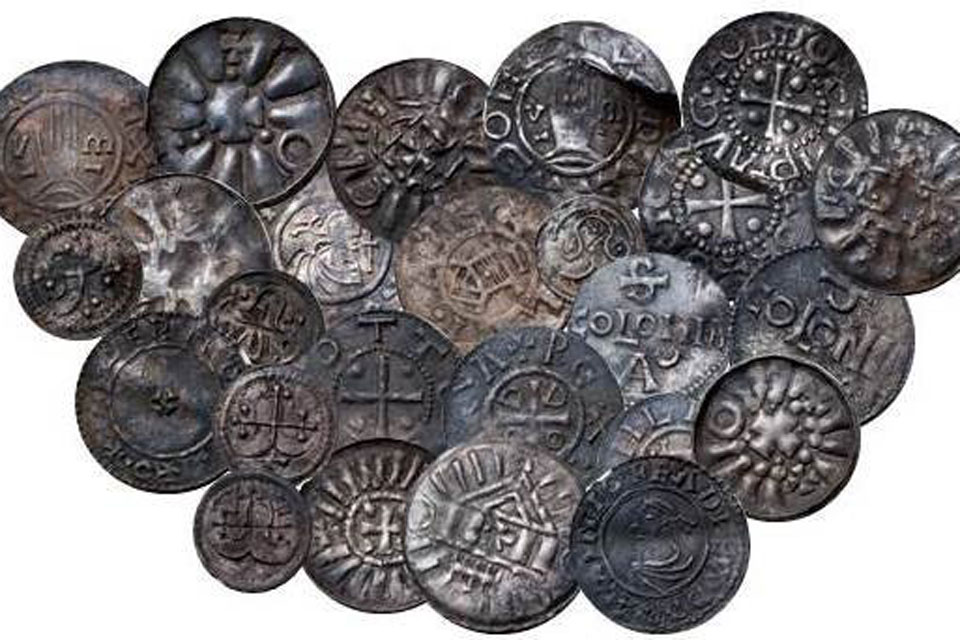
Spectacular new find of a Viking hoard sheds new light on the Cross Coins of Harold Bluetooth
 The Medieval Fold: Power, Repression, and the Emergence of the Individual (The New Middle Ages)
Suzanne Verderber (Author)
Hardcover: 216 pages
Publisher: Palgrave Macmillan (15 May 2013)
Language: English
ISBN-10: 113700097X
ISBN-13: 978-1137000972
Striking cultural developments took place in the twelfth century which led to what historians have termed ‘the emergence of the individual.’ The Medieval Fold demonstrates how cultural developments typically associated with this twelfth-century renaissance—autobiography, lyric, courtly love, romance—can be traced to the Church’s cultivation of individualism. However, subjects did not submit to pastoral power passively, they constructed fantasies and behaviors, redeploying or ‘folding’ it to create new forms of life and culture. Incorporating the work of Nietzsche, Foucault, Lacan, and Deleuze, Suzanne Verderber presents a model of the subject in which the opposition between interior self and external world is dislodged.
Table of contents:
Introduction
1. The Gregorian Reform, Pastoral Power, and Subjection
2. The Courtly Fold: The Subjectivation of Pastoral Power and the Invention of Modern Eroticism
3. Chrétien de Troyes’ Diagram of Power: Perceval
Conclusion
SOURCE:
 Medieval Crossover: Reading the Secular Against the Sacred (Conway Lectures in Medieval Studies)
Barbara Newman (Author)
Paperback: 416 pages
Publisher: University of Notre Dame Press (15 May 2013)
Language: English
ISBN-10: 026803611X
ISBN-13: 978-0268036119
The sacred and the secular in medieval literature have too often been perceived as opposites, or else relegated to separate but unequal spheres. In Medieval Crossover: Reading the Secular against the Sacred, Barbara Newman offers a new approach to the many ways that sacred and secular interact in medieval literature, arguing that (in contrast to our own cultural situation) the sacred was the normative, unmarked default category against which the secular always had to define itself and establish its niche. Newman refers to this dialectical relationship as “crossover”—which is not a genre in itself, but a mode of interaction, an openness to the meeting or even merger of sacred and secular in a wide variety of forms. Newman sketches a few of the principles that shape their interaction: the hermeneutics of “both/and,” the principle of double judgment, the confluence of pagan material and Christian meaning in Arthurian romance, the rule of convergent idealism in hagiographic romance, and the double-edged sword in parody.
Medieval Crossover explores a wealth of case studies in French, English, and Latin texts that concentrate on instances of paradox, collision, and convergence. Newman convincingly and with great clarity demonstrates the widespread applicability of the crossover concept as an analytical tool, examining some very disparate works. These include French and English romances about Lancelot and the Grail; the mystical writing of Marguerite Porete (placed in the context of lay spirituality, lyric traditions, and the Romance of the Rose);multiple examples of parody (sexually obscene, shockingly anti-Semitic, or cleverly litigious); and René of Anjou’s two allegorical dream visions. Some of these texts are scarcely known to medievalists; others are rarely studied together. Newman’s originality in her choice of these primary works will inspire new questions and set in motion new fields of exploration for medievalists working in a large variety of disciplines, including literature, religious studies, history, and cultural studies.
Barbara Newman is professor of English, religious studies, and classics at Northwestern University. She is the author of a number of books, including God and the Goddesses: Vision, Poetry, and Belief in the Middle Ages and Frauenlob’s Song of Songs: A Medieval German Poet and His Masterpiece.
SOURCE:
University of Notre Dame Press
 A Renaissance Wedding: The Celebration at Pesaro for the Marriage of Costanzo Sforza & Camilla Marzano D’aragona (26-30 May 1475) (Studies in Medieval and Early Renaissance Art History)
Jane Bridgeman (Author)
Hardcover: 208 pages
Publisher: Harvey Miller Pub (31 May 2013)
Language: English
ISBN-10: 190537593X
ISBN-13: 978-1905375936
This book offers an English translation of the Italian manuscript that commemorated the marriage of Costanzo Sforza Lord of Pesaro and Camilla d’Aragona of Naples, which took place in Pesaro in 1475. Furthermore, this richly illustrated text provides the reader with the necessary historical background and biographical details.
This publication is the first English translation from the Italian of the fascinating contemporary account of the spectacular four-day celebrations that took place in Pesaro in May 1475 to mark the marriage of Costanzo Sforza Lord of Pesaro and Camilla d’Aragona of Naples. The event was commemorated both in manuscript and early print in an anonymous narration that describes in great detail the arrival of the bride and her welcome procession into Pesaro; the actual marriage ceremony and the celebratory banquet that followed; the pageants, presentation of gifts and fireworks that filled the third day; and the final day’s excitement of jousts and yet more theatrical entertainment.
The translation has been made from the early printed text (the incunable in the British Library, I.A.31753 Sforza, Costantio Signore di Pesaro, 1475) and also directly from the unique illustrated presentation manuscript in the Vatican Library (MS Vat. Urb. Lat. 899) which, though previously thought to have been produced in 1480, may in fact have been made at the same time as the incunable edition. It is not known for whom the printed books were intended (7 copies only survive), but it is likely that the prominent dignitaries among the 108 guests – who included Federico da Montefeltro, the groom’s brother-in-law – would have been the recipients of the account when it was printed in November 1475.
This present edition of the text includes all the images that illustrate the original manuscript – 32 full-page miniatures that depict the floats that welcomed the bride at the city gates of Pesaro; the costumed figures at the wedding banquet who represented the presiding Sun and Moon or the male and female messengers of the classical gods and goddesses who announced the exotic dishes of the 12-course banquet; and further colourful, unusually interesting illustrations of the ballets, fireworks and triumphs of the final two days of the celebrations.
In addition to the Introduction that provides the reader with the historical background and biographical details of the protagonists and personalities of this special occasion, Dr Bridgeman also adds helpful and highly informative annotations to the narration itself. In addition she provides full descriptions and explanations of the illustrations – all reproduced here in colour – and devotes a separate appendix to listing and explaining all the dishes served at the wedding banquet, together with their ingredients and recipes.
Dr Jane Bridgeman is an Associate Lecturer in Fashion History and Theory at Central St Martin’s College of Art, London. After graduating in Italian at Birmingham University, she studied History of Dress under Stella Mary Newton at the Courtauld Institute of Art, London where she also gained her Ph.D. on Aspects of Dress and Ceremony in Quattrocento Florence. She has taught at a number of universities and art colleges in the UK and has published numerous articles in English and Italian on the iconography of dress and the history of textiles.
SOURCE:
 Medieval European Coinage: Volume 6, The Iberian Peninsula
Dr Miquel Crusafont (Author), Dr Anna M. Balaguer (Author), Philip Grierson (Author)
Hardcover: 924 pages
Publisher: Cambridge University Press (31 May 2013)
Language: English
ISBN-10: 0521260140
ISBN-13: 978-0521260145
This volume, Medieval European Coinage, is the first English-language survey to bring the latest research on the coinage of Spain and Portugal c.1000–1500 to an international audience. A major work of reference by leading numismatic experts, the volume provides an authoritative and up-to-date account of the coinages of Aragon, Catalonia, Castile, Leon, Navarre and Portugal, which have rarely been studied together. It considers how money circulated throughout the peninsula, offering new syntheses of the monetary history of the individual kingdoms and includes an extensive catalogue of the Aragonese, Castilian, Catalan, Leonese, Navarrese and Portuguese coins in the collection of the Fitzwilliam Museum. This major contribution to the field will be a valuable point of reference for the study of medieval history, numismatics and archaeology
Table of contents:
1. Introduction
2. Finds, hoards and monetary circulation in the Iberian Peninsula
3. The Muslim element
4. The Carolingians and the earliest coinages to c.1100
5. The crown of Catalonia-Aragon
6. The kingdom of Majorca, 1276–1343
7. The kingdom of Navarre
8. The kingdom of Castile-León
9. Kingdom of Portugal
Appendices
Bibliography
Catalogue
Concordances.
SOURCE:
Cambridge University Press
 The Cambridge Companion to Old English Literature
(Cambridge Companions to Literature)
Malcolm Godden (Editor), Michael Lapidge (Editor)
Paperback: 376 pages
Publisher: Cambridge University Press; 2 edition (2 May 2013)
Language: English
ISBN-10: 0521154022
ISBN-13: 978-0521154024
This book introduces students to the literature of Anglo-Saxon England, the period from 600-1066, in a collection of fifteen specially commissioned essays. The chapters are written by experts, but designed to be accessible to students who may be unfamiliar with Old English. The emphasis throughout is on placing texts in their contemporary context and suggesting ways in which they relate to each other and to the important events and issues of the time. With the help of maps and a chronological table of events the first chapters describe briefly the political, social and ecclesiastical history of the period and how poetry and prose in Latin and in the vernacular developed and flourished. A succinct account of Old English provides beginners with a handy guide to the rules of spelling, grammar and syntax. Subsequent chapters explore the range of Anglo-Saxon writing under different thematic headings. A final bibliography gives guidance on further reading.
Table of Contents:
1 – Anglo-Saxon society and its literature by Patrick Wormald
2 – The Old English language by Helmut Gneuss
3 – The nature of Old English verse by Donald G. Scragg
4 – The nature of Old English prose by Janet Bately
5 – Germanic legend in Old English literature by Roberta Frank
6 – Heroic values and Christian ethics by Katherine O’Brien O’Keeffe
7 – Pagan survivals and popular belief by John D. Niles
8 – Beowulf by Fred C. Robinson
9 – Fatalism and the millennium by Joseph B. Jr Trahern
10 – Perceptions of transience by Christine Fell
11 – Perceptions of eternity by Milton McC. Gatch
12 – Biblical literature by Malcolm Godden
13 – Biblical literature by Barbara C. Raw
14 – The saintly life in Anglo-Saxon England by Michael Lapidge
15 – The world of Anglo-Saxon learning by Patrizia Lendinara
Further reading
Read PDF
pp. 282-291
SOURCE:
 Runes: a Handbook
Michael P. Barnes (Author)
Hardcover: 256 pages
Publisher: Boydell Press; 2013 (2012)
Language: English
ISBN-10: 1843837781
ISBN-13: 978-1843837787
Runes, often considered magical symbols of mystery and power, are in fact an alphabetic form of writing. Derived from one or more Mediterranean prototypes, they were used by Germanic peoples to write different kinds of Germanic language, principally Anglo-Saxon and the various Scandinavian idioms, and were carved into stone, wood, bone, metal, and other hard surfaces; types of inscription range from memorials to the dead, through Christian prayers and everyday messages to crude graffiti. First reliably attested in the second century AD, runes were in due course supplanted by the roman alphabet, though in Anglo-Saxon England they continued in use until the early eleventh century, in Scandinavia until the fifteenth (and later still in one or two outlying areas).
This book provides an accessible, general account of runes and runic writing from their inception to their final demise. It also covers modern uses of runes, and deals with such topics as encoded texts, rune names, how runic inscriptions were made, runological method, and the history of runic research. A final chapter explains where those keen to see runic inscriptions can most easily find them.
Professor Michael P. Barnes is Emeritus Professor of Scandinavian Studies, University College London.
 Asinou across Time (Dumbarton Oaks Studies)
Annemarie Weyl Carr (Author), Andréas Nicolaïdès (Author), Gilles Grivaud (Author), Ioanna Kakoulli (Author), Sophia Kalopissi-verti (Author)
Hardcover: 416 pages
Publisher: Harvard University Press (21 May 2013)
Language: English
ISBN-10: 0884023494
ISBN-13: 978-0884023494
The church of Asinou is among the most famous in Cyprus. Built around 1100, the edifice, now a UNESCO World Heritage Site, is decorated with accretions of images, from the famous fresco cycle executed shortly after initial construction to those made in the early seventeenth century. During this period the church served the adjacent monastery of the Mother of God ton Phorbion (“of the vetches”), and was subject to Byzantine, Lusignan (1191–1474), Venetian (1474–1570), and Ottoman rule. This monograph is the first on one of Cyprus’s major diachronically painted churches. Written by an international team of renowned scholars, the book sets the accumulating phases of Asinou’s art and architecture in the context of the changing fortunes of the valley, of Cyprus, and of the eastern Mediterranean. Chapters include the first continuous history of the church and its immediate setting; a thorough analysis of its architecture; editions, translations, and commentary on the poetic inscriptions; art-historical studies of the post-1105/6 images in the narthex and nave; a detailed comparative analysis of the physical and chemical properties of the frescoes; and a diachronic table of paleographical forms.
SOURCE: Dumbarton Oaks
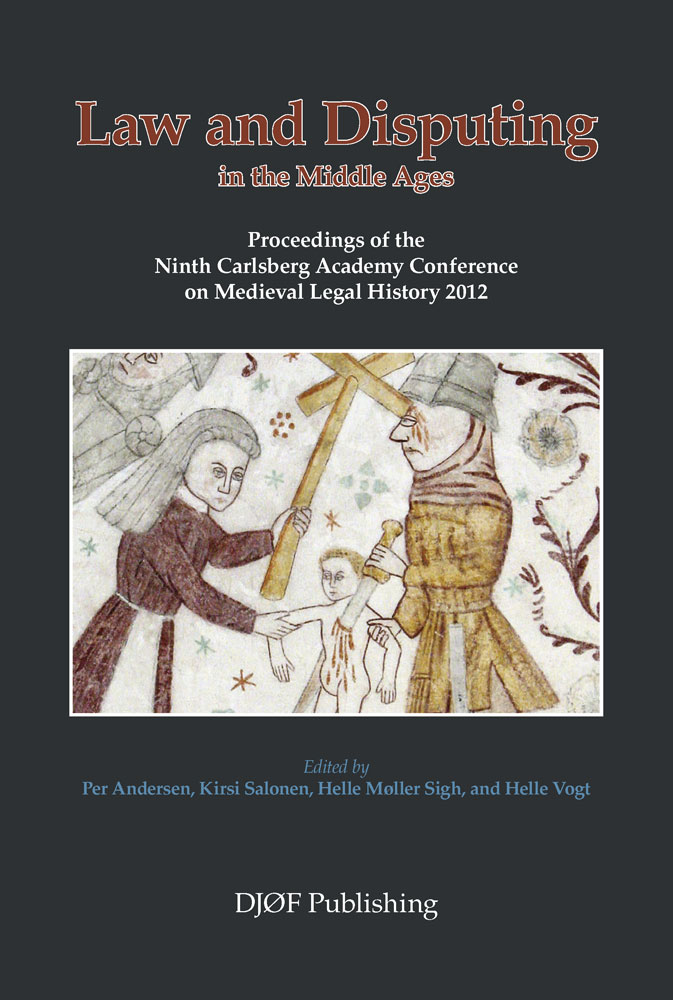 Law and Disputing in the Middle Ages: Proceedings of the Ninth Carlsberg Academy Conference on Medieval Legal History 2012
Per Andersen (Author, Editor), Kirsi Salonen (Editor), Moller Sigh Helle (Editor)
Paperback: 200 pages
Publisher: DJOF Publishing (22 May 2013)
Language: English
ISBN-10: 8757426813
ISBN-13: 978-8757426816
Content:
List of Figures and Photography Credits
Introduction – af Per Andersen, Kirsi Salonen, Helle Møller Sigh og Helle Vogt
Legal Satire on the Bayeux Embroidery – af Stephen D. White
‘Disputing the Dead’ – Litigation over Sepultura in the Diocese of Limoges in the Early 12th-Century – af Bruce C. Brasington
The Crime of Dilapidation in the Church from Latter Half of the 12th-Century to the Beginning of the 13th-Century – af Bruno Lemesle
Bad Customs and Good Lordship – Disputing in Anjou, C. 987-C. 1150 – af Matthew W. McHaffie
Kin Conflict in 11th and Early 12th-Century Normandy – af Kate Hammond
The Law of Maintenance and the Obligations of Lordship – A Case Study – af Jonathan Rose
The Role of Arbitration in the Settlement of Disputes in Iceland C. 1000-1300 – af Jón Viðar Sigurðsson
Disputes and How to Avoid Them – Custom and Charters in England During the Long 12th-Century – af Paul Hyams
Dispute, Procedure and Sanction – Some Remarks on Dispute Settlement in Swedish Medieval Laws – af Pia Letto-Vanamo
The Use of Mediation and Arbitration in the Legal Revolution of 13th-Century Denmark – af Per Andersen
The Appellate Jurisdiction, the Emperor and the City – Republics in Early 13th-Century Northern Italy – af Gianluca Raccagni
The Practice of Legal Consulting and the Policy of Law in Late Medieval Dalmatia – af Nella Lonza
Interdict, Conflict Resolution and the Competition for Power in the Episcopal Seigneuries of Laon and Reims (C. 1100) – af Frederik Keygnaert
Competing Institutions and Dispute Settlement in Medieval England – af Joshua C. Tate
Church, State and Family in John Calvin’s Geneva – Domestic Disputes and Sex Crimes in Geneva’s Consistory and Council – af John Witte, Jr.
Litigating Abroad – Merchant’s Expectations Regarding Procedure Before Foreign Courts According to the Hanseatic Privileges (12TH-16TH C.) – af Albrecht Cordes
SOURCE:
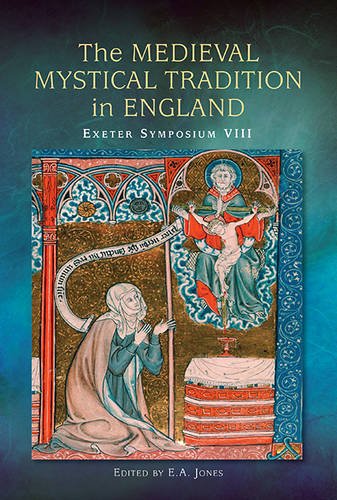 The Medieval Mystical Tradition in England: Papers read at Charney Manor, July 2011 (Exeter Symposium 8)
E.A. Jones (Editor)
Hardcover: 226 pages
Publisher: D.S.Brewer (16 May 2013)
Language: English
ISBN-10: 1843843404
ISBN-13: 978-1843843405
Mystical writing flourished between the thirteenth and fifteenth centuries across Europe and in England, and had a wide influence on religion and spirituality. This volume examines a range of topics within the field. The five “Middle English Mystics” (Richard Rolle, Walter Hilton, the author of The Cloud of Unknowing, Julian of Norwich and Margery Kempe) receive renewed attention, with significant new insights generated by fresh theoretical approaches. In addition, there are studies of the relationships between continental and English mystical authors, introductions to some less well-known writers in the tradition (such as the Monk of Farne), and explorations around the fringes of the mystical canon, including Middle English translations of Boethius, Lollard spirituality, and the Syon brother Richard Whytford’s writings for a sixteenth-century “mixed life” audience.
E. A. Jones is Senior Lecturer in English Medieval Literature and Culture at the University of Exeter. Contributors: Christine Cooper-Rompato, Vincent Gillespie, C. Annette Grisé, Ian Johnson, Sarah Macmillan, Liz Herbert McAvoy, Nicole R. Rice, Maggie Ross, Steven Rozenski Jr, David Russell, Michael G. Sargent, Christiana Whitehead.
Contents
1 Introduction
2 The Colours of Contemplation: Less Light on Julian of Norwich
3 Behold Not the Cloud of Experience
4 Walter Hilton on the Gift of Interpretation of Scripture
5 Numeracy and Number in The Book of Margery Kempe
6 Religious Mystical Mothers: Margery Kempe and Caterina Benincasa
7 Authority and Exemplarity in Henry Suso and Richard Rolle
8 Mortifying the Mind: Asceticism, Mysticism and Oxford, Bodleian Library, MS Douce 114
9 The Meditaciones of the Monk of Farne
10 Envisioning Reform: A Revelation Of Purgatory and Anchoritic Compassioun in the Later Middle Ages
11 Walton’s Heavenly Boece and the Devout Translation of Transcendence: O Qui Perpetua Pietised
12 Reformist Devotional Reading: The Pore Caitif in British Library, MS Harley 2322
13 Richard Whytford, The Golden Epistle, and the Mixed Life Audience
 Sea Monsters on Medieval and Renaissance Maps
Chet van Duzer
Hardcover: 144 pages
Publisher: The British Library Publishing Division (10 May 2013)
Language: English
ISBN-10: 0712358900
ISBN-13: 978-0712358903
From dragons and serpents to many-armed beasts that preyed on ships and sailors alike, sea monsters have terrified mariners across all ages and cultures and have become the subject of many tall tales from the sea. Accounts of these creatures have also inspired cartographers and mapmakers, many of whom began decorating their maps with them to indicate unexplored areas or areas about which little was known. Whether swimming vigorously, gamboling amid the waves, attacking ships, or simply displaying themselves for our appreciation, the sea monsters that appear on medieval and Renaissance maps are fascinating and visually engaging. Yet despite their appeal, these monsters have never received the scholarly attention that they deserve. In Sea Monsters on Medieval and Renaissance Maps, Chet Van Duzer analyzes the most important examples of sea monsters on medieval and Renaissance maps produced in Europe. Van Duzer begins with the earliest mappaemundi on which these monsters appear in the tenth century and continues to the end of the sixteenth century and, along the way, sheds important light on the sources, influences, and methods of the cartographers who drew or painted them.
A beautifully designed visual reference work, Sea Monsters on Medieval and Renaissance Maps will be important not only in the history of cartography, art, and zoological illustration, but also in the history of the geography of the “marvelous” and of Western conceptions of the ocean.
Content:
Acknowledgements
Introduction
Classical Antecedents
The Earliest Medieval Maps with Sea Monsters: Beatus Mappaemundi
“Let the Waters Bring Forth Abundantly”: Sea Monsters in the Creation
Sea Monsters in the Harbor of Brindisi
An Imagined Mappamundi with Sea Monsters
Sea Monsters on the Ceiling
Giant Sea Monsters on Two Small Mappaemundi
“A Vast Sea Where There is Nothing But the Abode of Monsters”
Two Monumental Mappaemundi with Few Sea Monsters
Three Sea Monsters Battling in the Atlantic
Pictorial Excursus: The Dangers of Sea Monsters
Sea Monsters on Nautical Charts: Giant Octopuses, Sirens, Sharks
How to Buy a Sea Monster
Whaling Between Myth and Reality
A Nest of Sea Monsters at the Bottom of the World
Whales as Big as Mountains
Terrifying Monsters in the Indian Ocean
A Skeptic about Sea Monsters: Fra Mauro
Pictorial Excursus: Whimsical Sea Monsters
Invented Sea Monsters in the Circumfluent Ocean
The Manuscript with the Most Sea Monsters
Sea Monsters in Printed Editions of Ptolemy
The Sea Monsters of the Earliest Surviving Terrestrial Globe
The Sea Monsters of Waldseemüller’s Map of 1507 and Schöner’s Globe of 1515
Lighting a Fire on a Whale’s Back
Pictorial Excursus: The Cartographic Career of the Walrus
The Debut of the Sea Monsters of the Renaissance
Olaus Magnus and the Most Important Sea Monsters of the Sixteenth Century
Mercator’s Globe of 1541: The Influence of Olaus Magnus
The Ulpius Globe: Sea Monsters Before Their Time
The Monster that Stops Ships in Their Tracks
Pictorial Excursus: More Whimsical Sea Monsters
From Sea Dragons to a Sawfish: The Rylands Library Map of 1546
Evidence of a Sea Monster Specialist
The Curious Career of the Flying Turtle
The Eclecticism of Giacomo Gastaldi
The Sea Monsters of Gerard Mercator’s Great Map of 1569
Sea Monsters Cavorting Among the Mediterranean Isles
The Sea Monsters Surrounding Iceland in the First Atlas
A Haunting Sea Monster Reappears
Whales Fantastic and Realistic at the End of the Sixteenth Century
Two New World Sea Monsters
Conclusion
Endnotes
Index
Index of Manuscripts
 Empires of Faith: The Fall of Rome to the Rise of Islam, 500-700 (Oxford History of Medieval Europe)
Peter Sarris
Paperback: 448 pages
Publisher: OUP Oxford 2013 (2011)
Language: English
ISBN-10: 019967535X
ISBN-13: 978-0199675357
Empires of Faith
Drawing upon the latest historical and archaeological research, Dr Peter Sarris provides a panoramic account of the history of Europe, the Mediterranean, and the Near East from the fall of Rome to the rise of Islam. The formation of a new social and economic order in western Europe in the fifth, sixth, and seventh centuries, and the ascendancy across the West of a new culture of military lordship, are placed firmly in the context of on-going connections and influence radiating outwards from the surviving Eastern Roman Empire, ruled from the great imperial capital of Constantinople. The East Roman (or ‘Byzantine’) Emperor Justinian’s attempts to revive imperial fortunes, restore the empire’s power in the West, and face down Constantinople’s great superpower rival, the Sasanian Empire of Persia, are charted, as too are the ways in which the escalating warfare between Rome and Persia paved the way for the development of new concepts of ‘holy war’, the emergence of Islam, and the Arab conquests of the Near East. Processes of religious and cultural change are explained through examination of social, economic, and military upheavals, and the formation of early medieval European society is placed in a broader context of changes that swept across the world of Eurasia from Manchuria to the Rhine.
Warfare and plague, holy men and kings, emperors, shahs, caliphs, and peasants all play their part in a compelling narrative suited to specialist, student, and general readership alike.
Readership: Scholars and students of early medieval Europe; the interested reader
A Dictionary of Medieval Terms and Phrases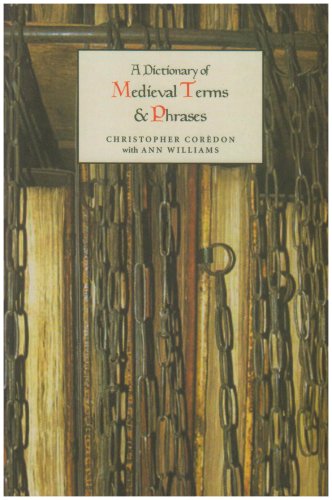
Christopher Corèdon, Ann Williams,
Paperback: 320 pages
Publisher: D.S.Brewer 2013 (2006)
Language: English
ISBN-10: 184384138X
ISBN-13: 978-1843841388
An interest in the middle ages often brings the non-specialist reader up short against a word or term which is not understood or only imperfectly understood. This dictionary is intended to put an end to all that: it has been designed to be of real help to general readers and specialists alike.
The dictionary contains some 3,400 terms as headwords, ranging from the legal and ecclesiastic to the more prosaic words of daily life. Latin was the language of the church, law and government, and many Latin terms illustrated here are frequently found in modern books of history of the period; similarly, the precise meaning of Old English and Middle English terms may elude today’s reader: this dictionary endeavours to provide clarity. In addition to definition, etymologies of many words are given, in the belief that knowing the origin and evolution of a word gives a better understanding. There are also examples of medieval terms and phrases still in use today, a further aid to clarifying meaning.
CHRISTOPHER COREDON has also compiled the Dictionary of Cybernyms. Dr ANN WILLIAMS, historical consultant on the project, was until her retirement Senior Lecturer in medieval history at the Polytechnic of North London.
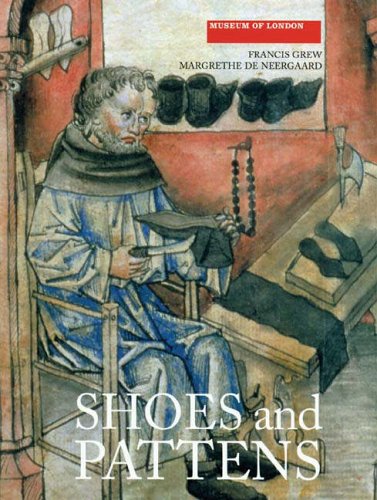 Shoes and Pattens: Finds from Medieval Excavations in London (Medieval Finds from Excavations in London)
Francis Grew, Margrethe de Neergaard, Susan Mitford
Boydell & Brewer Press 2013 (2006)
ISBN-10: 1843832380
ISBN-13: 978-1843832386
Until recently, very little was known about medieval shoes. Glimpses in manuscript illustrations and on funerary monuments, with the occasional reference by a contemporary writer, was all that the costume historian had as evidence, not least because leather tends to perish after prolonged contact with air, and very few actual examples survived. In recent years, however, nearly 2,000 shoes, many complete and in near-perfect condition, have been discovered preserved on the north bank of the Thames, and are now housed in the Museum of London. This collection, all from well-dated archaeological contexts, fills this vast gap in knowledge, making it possible to chart precisely the progress of shoe fashion between the twelfth and fifteenth centuries.
Violin: A Social History of the World's Most Versatile Instrument

Gregynog Festival presents the Tallis Scholars performing the Missa O Quam Suavis...