Cyfraith Hywel is the name of a new academic website examining all aspects of medieval Welsh law...
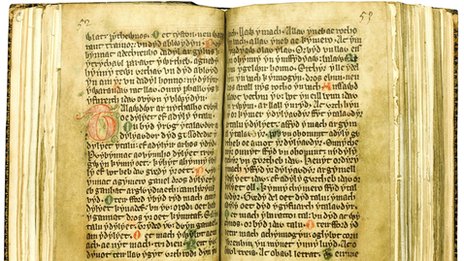
Cyfraith Hywel is the name of a new academic website examining all aspects of medieval Welsh law...
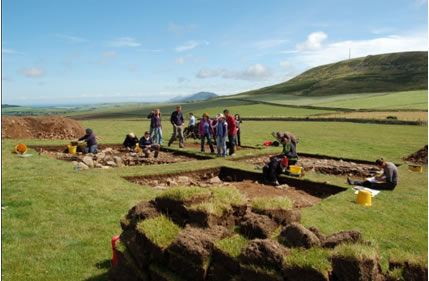
Focus is on the archaeological background for the emergence of Celtic languages...
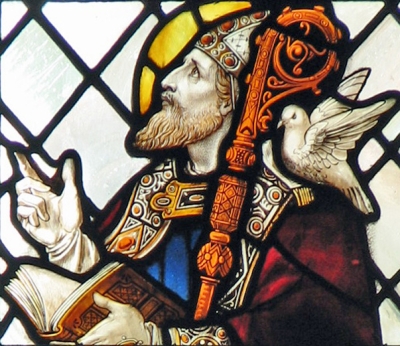
Scholars aim to study a neglected series of Medieval Welsh-language sources...
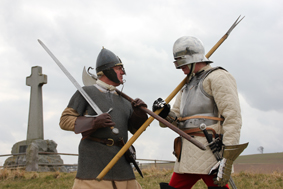
1513 an English army defeated James IV and his invading army at Flodden in Northumbria...

Earthly Bread and Heavenly Food…
Cabinet exhibition on the occasion of the Eucharistic Congress in Cologne.
The Catholic Church venerates the consecrated host as a symbol of the presence of Christ resurrected. In the Middle Ages Cologne was among the first cities in which on the feast day of Corpus Christi the body of Christ was carried through the city in a procession. For this occasion splendid monstrances were created, one of which is at the heart of this exhibition. Paintings and prints from Cologne from the Middle Ages to the modern era illustrate the veneration of the consecrated host through the ages. Today, as in the past, the celebration of the First Communion is at the centre of Eucharistic devotion.
Earthly Bread and Heavenly Food
Kölnisches Stadtmuseum
18.05.2013 –30.06.2013

Silk not Sin – Ceremonial Garments for the Preparation of the Holy Mass.
In the Middle Ages great attention was paid to the preparation of the celebration of mass. By the ritual laying on of clerical vestments accompanied by vesting prayers, priests and bishops completed a transition from the secular to the sacred. Beginning with precious undergarments – these rare items will again be on display for the first time since 1985 at Museum Schnütgen – the exhibition follows the cleric step by step in the solemn preparatory ceremony up to the combing of the hair and washing of the hands. Precious treasures of ecclesiastical textile art including an undergarment from the 14th century and the medieval vestments from the church of St Andreas are presented together with liturgical objects such as the famous ivory comb of St Heribert.
Museum Schnütgen, Köln
23.05.2013 – 24.08.2014

Charlemagne influenced a great deal in Europe. The changes and innovations brought about by him in many areas shaped the foundations of our culture. The 28th January 2014 marks the 1200th anniversary of the death of Charlemagne. On this occasion the Swiss National Museum will be devoting a large temporary exhibition to Charlemagne (741 – 814) and “Carolingian Switzerland”. The Exhibition will show what changed under Charlemagne, what effect his reforms had on education, faith and society and which innovations were made in art and architecture. Embedded in the European Context, the emphasis will be placed on Switzerland’s cultural heritage from Charlemagne’s time. The time frame will cover his reign of 771 – 814 through to the treaty of Verdun 843. Some topic areas will also take a look at the Merovingian period and the late 9th century. The exhibition is being prepared in close collaboration with the simultaneously planned book project “Die Zeit Karls des Grossen in der Schweiz” under the leadership of prof. Dr. Georges Descoudres, Dr. Jürg Goll and dr. Markus Riek. Project manager is Christine Keller.
Charlemagne and Switzerland
20.09.2013 – 02.02.2014
National Museum Zurich
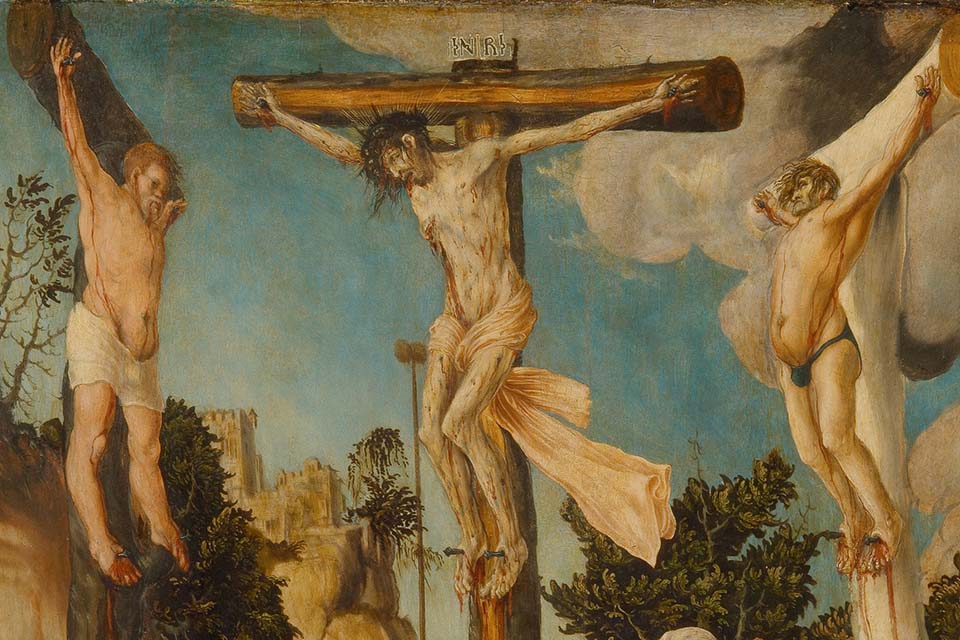
Time to revive Early Modern Sensuality? Seven Words of Christ

“The Lord says: Behold, I am sending you as lambs in the midst of wolves. Therefore, be prudent as serpents and simple as doves” (Matt 10: 16)
The quotation above was used the introductory bible-verse to chapter 16 in the Franciscan Regula non Bullata from 1221. This chapter was devoted to “Those going amongst the Saracens and other non-believers. The advise was pertinent as the Franciscans believed there were two ways of living among the Muslims. Either one could live their humbly and simply profess to be a Christian or one might boldly go there in order to preach the gospel. In that case on should not fear martyrdom. Already in 1220 five Franciscans had entered on this path. The five friars first went to Almohad Seville, where they preached the Gospel “and said many damnable things about Mohammad and his damnable law”. Accordingly the friars were imprisoned and sent to Marakech, where they began to preach anew. Finally the Caliph had them arrested, tortured and beheaded. Rumour later had it that the Caliph personally carried out the beheading and that his arm afterwards shrivelled to a pitiful stump. Whatever the truth of this, the bodies of the martyrs were taken to Portugal, where they duly performed miracles. According to a later source, Francis later exclaimed, “Now I can truly say that I have five brothers.” It is probably an unquestionable fact that Francis himself longed for a career as a martyr. (The story is told in Saint Francis and the Sultan. The curious History of a Christian-Muslim Encounter. By John Tolan. Oxford University Press 2009, pp. 6 – 7)
Perinde ac cadaver
Not so Ignatius of Loyola, the founder of the Jesuits. In 1553 he wrote in a letter to the Portuguese Jesuits the “we may agree to being surpassed by other religious orders in terms of fasts, vigils and other austerities… but in purty and perfection of obedience… and abnegation of judgment, dearest brothers, I hope most earnestly that those who follow God within this company may be singled out”.
At stake here was obviously the foundational core of the Jesuits that they according to Ignatius were supposed to “behave: first like a cadaver possessing neither will nor understanding; second, like a small crucifix that can easily be moved from one place to another…. In such a way must I stand ready to serve the Order and be used by it in all that may be commanded of me.” (Jesuits. A Multibiography. By Jean Lacouture. English Translation: Counterpoint 1995. p 75 ff.)
Such formulations later gave rise to the epithet: “perinde ac cadaver” (like a cadaver) signifying the chameleon-like character of Jesuits hell-bent on reaching a modus vivendi whether amongst Chinese, Muslims or Protestants.
To be a Franciscan was to bear public witness and if push came to shove end life as a martyr. To be a Jesuit was to serve silently and discreetly without needlessly throwing away one’s life or one’s health.
There is no doubt that the present Pope has lived with the dilemmas posed by these two different approaches “of how to go amongst the heathens” – in his case the murderous dictator Jorge Rafael Videla and his henchmen in the death squads during the Dirty War. What to do? Be prudent as a serpent or simple as a dove?
We don’t know exactly what took place during the war and how the Argentinian Jesuit, Jorge Bergoglio, handled the challenges, he met during the terrible years of 1973 – 1979, when he was provincial of the Jesuits in Argentina. However, as to the main charge against Bergoglio – that he was involved in the kidnapping of two Jesuit priests, Orland Yorio and Francisco Jalics, who were taken by Navy officers in May 1976 and held under inhumane conditions for the missionary work they conducted in the country’s slums – it seems he chose the route of the serpent by going behind the lines of the enemy and try to wriggle the priests out of the concentration camp, in which they were held. This is what he himself later claimed. A few days ago, one of the survivors – Francisco Jalics – finally broke the silence and confirmed this. According to The Daily News, Jalics, who now lives in a monastery in Germany, cleared the air Wednesday the 21st of March (2013) by issuing a statement: “I myself was once inclined to believe that we were the victims of a denunciation (by Bergoglio). But at the end of the ’90s, after numerous conversations, it became clear to me that this suspicion was unfounded. It is therefore wrong to assert that our capture took place at the initiative of Father Bergoglio,” he continued.
Thus it seems that “here endeth the lesson”. However, there is a postscript: By choosing the name of Francis, the present Pope has shown how important it is to know intimately the lives of the saints. Or in short: The History of the Church in its wider ramifications.
READ MORE:
Jesuits. A Multibiography.
By Jean Lacouture. Editions Seuil 1991.
English Translation: Counterpoint 1995.
Saint Francis and the Sultan.
The curious History of a Christian-Muslim Encounter.
By John Tolan.
Oxford University Press 2009.
 We all know what a proper edition is! Way back the standard was set by such gigantic projects like Monumenta Germaniae Historica or the homunculus Patrologiae Cursus Completus. Such projects later resulted in more nationally oriented editions of charters, manuscripts and other literary left-overs from both ancient and medieval history. Any medievalist worth his or her salt knows of the pertinent editions inside their field and that is all well; especially now when they are becoming digitized and generally more available for scholars and students in the periphery of minor universities and colleges around the world.
However, recent years have witnessed a whole new genre: the proper digitized edition of texts – complete with not only text-editions and translations, but also photos, links to relevant literature etc. Examples are The Roman de la Rose Digital Library and the edition of the plan of St. Gall presented at the very comprehensive website, Carolingian Culture at Reichenau and St. Gall. A new initiative is the ongoing digitization of the Vatican Apostolic Archive with over 80.000 manuscripts and 8900 rare incunabula in the pipeline towards the digital printing press. The digitization is going to fill up 2.8 petabytes and cover any publication before 1501. The digitization is sponsored by the EMC Corporation, which is a global leader in enabling businesses and service providers to transform their operations and deliver IT as a service.
Whether the last initiative will just provide storage or the plan is to supplement it later with proper editorial work is a yet unknown. The project, however, is part of this on-going trend: to deliver state-of-the-art-editions, which properly uses the medium to present not only content but also context.
Focus for the two scholarly roundtables at the upcoming meeting of the Medieval Academy 201 in Knoxville are initiatives as these. At the first roundtable “A New Age of Exploration: Scholars and Digitized Manuscripts” will be debated, while the next morning the debate will be broadened: Back to the Future: Exploring New Digital Initiatives in Medieval Studies.
Speakers will – amongst others – be:
READ MORE:
Preparing for the debates at the roundtable?
– read the illuminating article:
Medievalists and the Scholarly Digital Edition.
By Dot Porter.
In: Scholarly Editing: The Annual of the Association for Documentary Editing. Vol 34, 2013.
– delve into the fascinating material made available at www.digitalmedievalist.org, where all the digitizers convene.
– check out the Medieval Electronic Scholarly Alliance

Did the Esrick Ring belong to King Edwin or his son Osfrid, who both died at Hatfield Chase in 633?
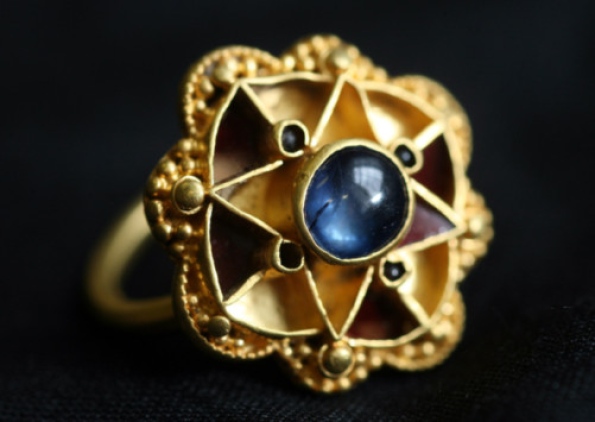
Expert believe that The Escrick ring is probably from the 5th or 6th century and possibly royal…
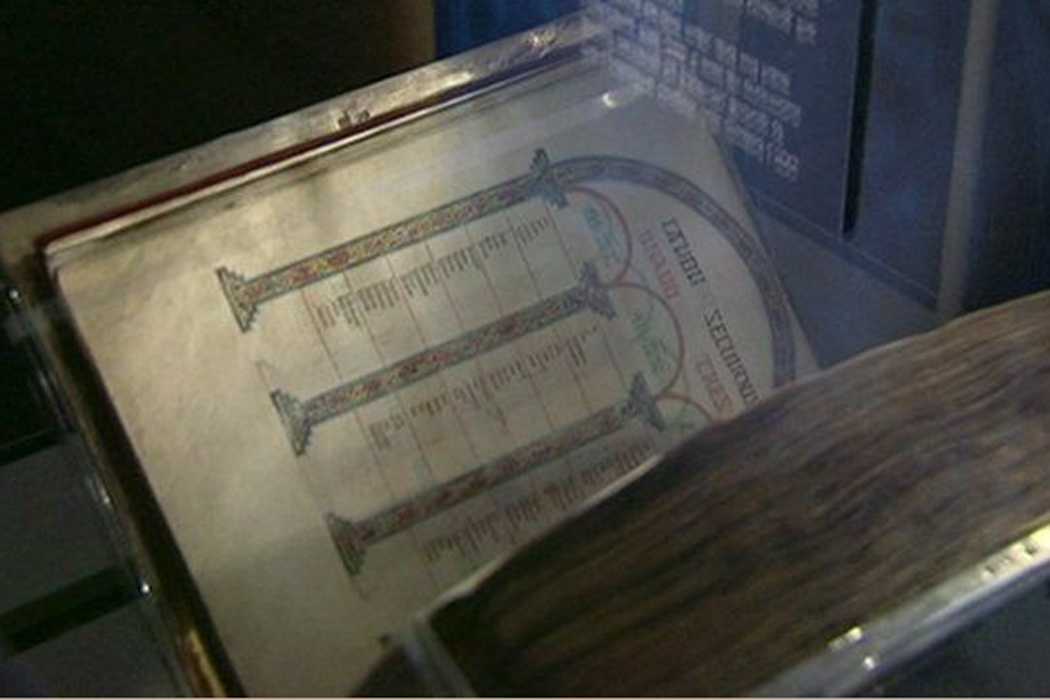
The Lindisfarne Gospels book is one of the greatest landmarks of human cultural achievement. Created by the community of St Cuthbert on Lindisfarne it is one of the best examples of creativity and craftsmanship from Medieval times.

Le Grand Ferré : Premier héros paysan.
Colette Beaune (Auteur)
Until recently the “Grand Ferré” was known to everyone in the French schools. His story was part of the curriculum on the 100 years war, showcasing a brave man of morals, who – abandoned by the elite – showed the courage to defend his own. According to this story some peasants – thanks to the Herculean strength of Le Grand Ferré – succeeded to defeat the English mercenaries, who attacked their village to loot.
France at this time in history was marked by a series of terrible crises characterized by a particularly harsh climate, periods of hunger and starvation and the great plague. At the same time the king was a de facto prisoner of the English while the young regent was challenged by peasant uprisings. In the midst of reporting on all these calamities a mendicant friar born near Compiègne wrote the story down in 1360, thus securing the afterlife of a vibrant myth.
To find the truth behind this French “Robin Hood”, the historian Colette Beaune has conducted delved into the sources. The historian went on site in Picardy, where the popularity of the peasant is still intact. She tracked him down in the oldest archives of an abbey and followed the thread of his story until the 20th century. Century after century The Grand Ferré has played an important part as the symbol par excellence of resistence, whether turned against feudal oppressors or German invaders.
Colette Beaune is Emeritus professor of medieval history at the University of Paris Ouest and Nanterre and a specialist in political history, women’s history and the history of art. She has received numerous prices. For all of her work, Colette Beaune has received the Grand Prix of the French Academy in history – the Grand Prix Gobert 2012.
Le Grand Ferré : Premier héros paysan.
By Colette Beaune
Broché: 386 pages
Editeur : Librairie Académique Perrin (14 mars 2013)
Langue : Français
ISBN-10: 2262028915
ISBN-13: 978-2262028916
€ 23.00

Charlemagne
By Jean Favier
Charlemagne is a man of a myth – successor to the Caesars he ended up influencing the history of France as well as wider Europe. In this new edition of biography on the grand scale Jean Favier paints a nuanced portrait, while tackling the problems of distinguishing between the myth and the reality.
First he places the man in his historical context and provides a portrait of a king directed towards one goal: the political end religious unity of Western Christendom. But he also touches upon the – perhaps – more mythical matters: his joy of Latin Poetry, his interest in schools and education etc. At 769 pages and written by one of France’s foremost historians, yet another portrait does not seem superfluous.
Charlemagne
By Jean Favier
Broché: 769 pages
Editeur : Editions Tallandier 2013. 1. edition 1999
Langue : Français
ISBN-13: 979-1021000810
EUR 12,26

Les comtes d’Artois et leurs archives : Histoire, mémoire et pouvoir au Moyen Age
[The Counts of Artois and their Archives: History, memory and Power in the Middle Ages]
By Alain Provost et al
Preserved in the Departmental Archives of Pas-de-Calais, the Treasury charters Counts of Artois (XIII-XIV centuries) holds more than 10.000 documents. The vast wealth of information held in this archive is often overlooked. Studies gathered here focus on the creation and preservation of the many cartularies, surveys, accountbooks and delves more generally into the history of the counts and the County of Artois –the political society, the government and county government, the judicial and devotional practices plus the genealogical memory encapsulated in historical writings. The book is part of the current renewal of the history of writing practices.
By the diversity of topics and approaches, the book describes in detail the Counts of Artois archives as well as draws research perspectives. It will attract the attention of the scientific community on a documentary and provide exceptional public cultivated an important contribution to the knowledge of Artois in the Middle Ages and, more broadly, of the kingdom of France under the reign of the last Capetians.
Les comtes d’Artois et leurs archives : Histoire, mémoire et pouvoir au Moyen Age
By Alain Provost et al
Broché: 180 pages
Publisher : Artois Presses Université 2013
Collection : Histoire
Langue : Français
ISBN-10: 2848321652
ISBN-13: 978-2848321653
€ 38.00