The Chapel of Teodolinda with the famous cycle of frescoes by the Zavattari Workshop has been painstakingly restored and has now been reopened
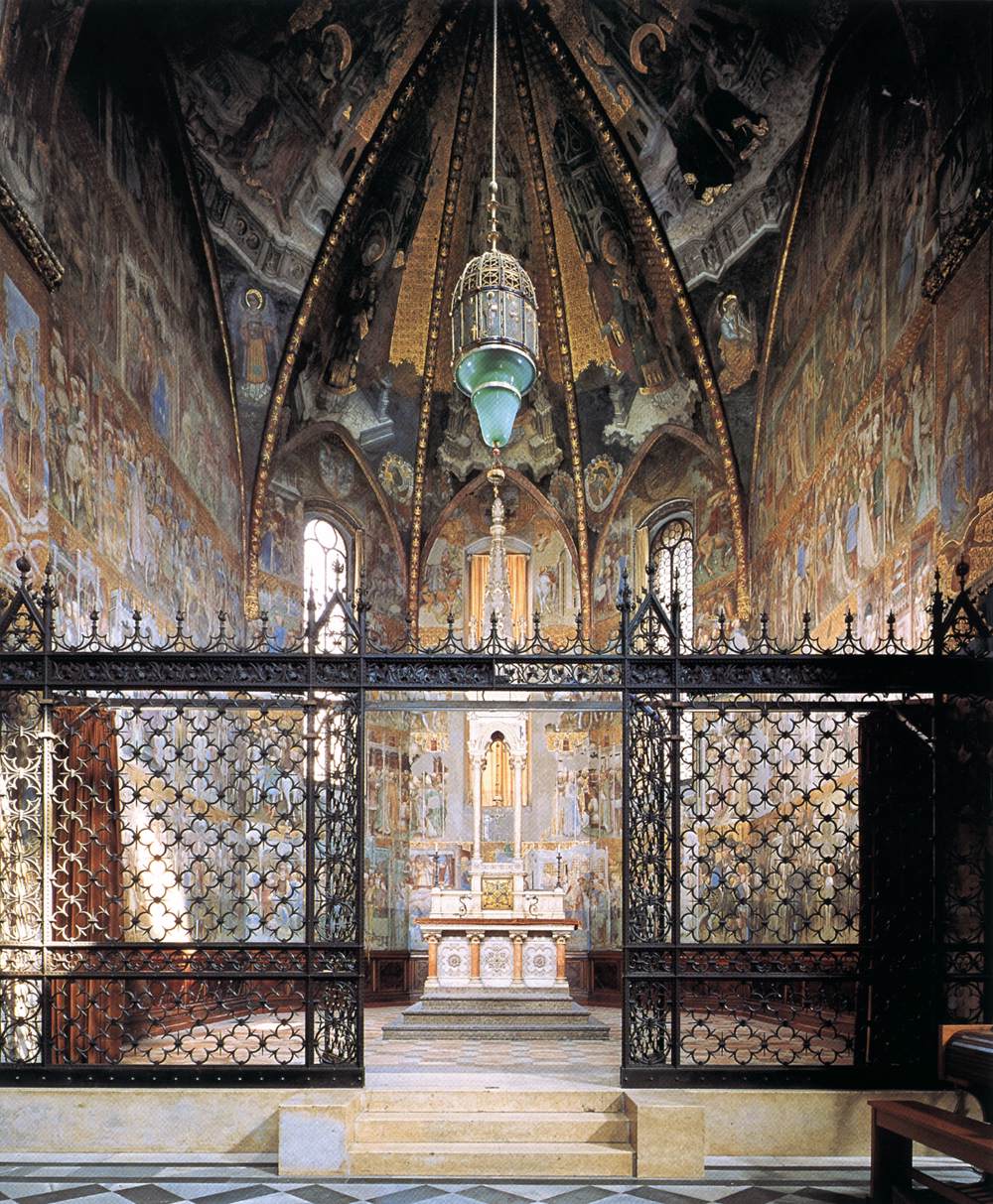
The basilica in Monza is not in itself a cathedral as it belongs to the diocese of Milan. However an arch-deacon is appointed to the church, whose obligation – among other things – is to care for the famous Iron Crown, which Italian kings have worn or been crowned with perhaps as far back as the Ostrogoth, Theoderic. This crown is kept in the Chapel of Teodolinda, which was recently reopened after a 7-year long restoration.
The basilica in Monza is believed to have been commissioned by Teodolinda (AD 570 – 627) as a royal chapel to serve the nearby palace. I was probably completed by 603, when the heir to the Lombard throne was baptised. Of this chapel, which is essentially the central left aisle of the present church, only the walls exist today. Here Teodolinda was later buried. Around the remains of this chapel a new church was erected in the 13th century. This is basically the church, which stands today. In 1606 the bell-tower was erected.
In the right transept is the entrance to the Museo e Tesoro del Duomo di Monza, which houses the treasury – though not the iron Crown – with important pieces of late antique and early medieval works of art, some of which were deposited there by Teodolinda herself.
Teodolinda – Queen of the Lombards 570 – 627
Teodolinda was queen of the Lombards from 590 – 627. She has for a long time been regarded as an important figure in the early medieval history of Northern Italy, primarily because her portrait depicted by Paul the Deacon in his Historia Langobardoum was so favourable. The question is, however, how much we really know?
The history of Teodolinda is full of myths, many of which were obviously spun by that infamous historian, Paul the Deacon, who was bent on glorifying his people and their history. The fact is, however, that he probably wrote nothing but what the Italians in general call: Una Bella storia, ma non e vera! (A beautiful story, though not true).
This was demonstrated elegantly in 1999, when Ross Balzaretti did us the service of collecting all the contemporary written evidence and compare it to the story told by Paul the Deacon 150 years after her death.
The result is of course a less romantic story. Nevertheless the evidence is certainly well worth visiting as we do in fact have some indication of what role she might have played and the context in which she live.
The sources, which Balzaretti draws our attention to, are five letters of Gregory the Great and two other letters by Columbanus and King Sisebut. Further there exists a diploma issued by King Adaoald (her son) in 624 and some short notices in a couple of chronicles: the Actarii Havniensis Extrema, the Fourth book of Fredegar, the Origo Gentis Langobardorum and the Codex Gothanus. Finally there exists a dedicatory inscription attached to the cover of the gospel book, kept in the treasury in Monza. This was in all likelihood a gift from Gregory the Great to the Queen in connection with the baptism of her son. To this should be added a collection of artefacts kept in the cathedral treasury in Monza, which are usually considered part of a donation to this church. (These artefacts are not discussed in detail in the article.)
As far as these sources tells us the basic facts are that she was the daughter of the Bavarian Garibald and his wife Walderata; and that she came to Lombardy with her brother Gundoald in order to marry Authari. He ruled seven years. After his death, the duke of Thuringians, Agilulf, travelled from Turin and married her, after which the Lombardians chose him as king. They had two children, a daughter called Gundeperga and a son called Adaoald. After Agilulf died she took part part in his rule (he was a minor, when his father died).
The facts are that we really do not know much more. But in a way this is also a lot: We know that she during her lifetime was considered a person to reckon with by important rulers like Gregory the Great, Columbanus and the Visigothic king of Spain, Sisebut (since they wrote letters to her and about her). We know that she and her son received precious gifts from the pope (some of which it is likely ended up in Monza). And indications are that she was revered by some people in her lifetime as a “Glorious Queen” (as witnessed by an inscription on the Evangeliary kept in the treasury in Monza, which in all likelihood was a gift to her from Gregory the Great).
What we also know that these fragments of a memory triggered Paul the deacon to write her vitae as if she was a saint. It was these inspirational stories, which later gave the impetus to the decoration of the magnificent Chapel of Teodolinda.
Chapel of Teodolinda
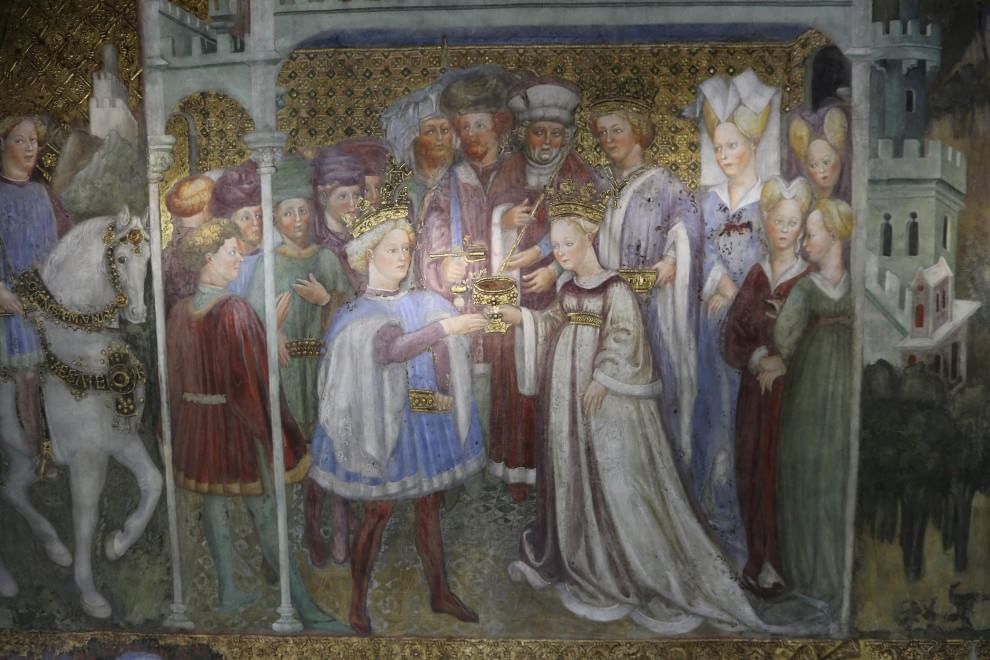
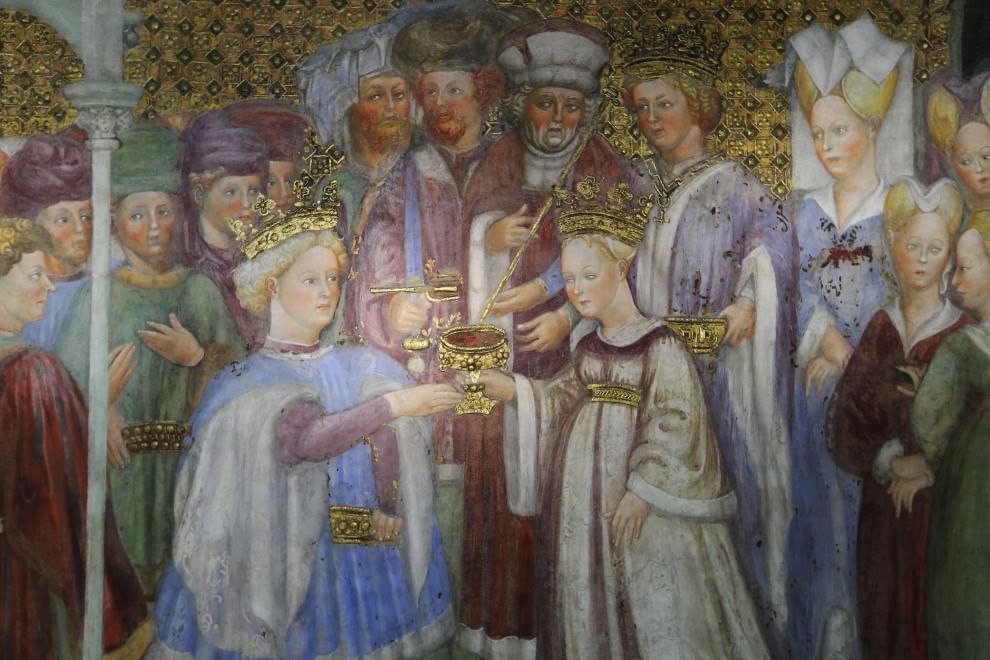
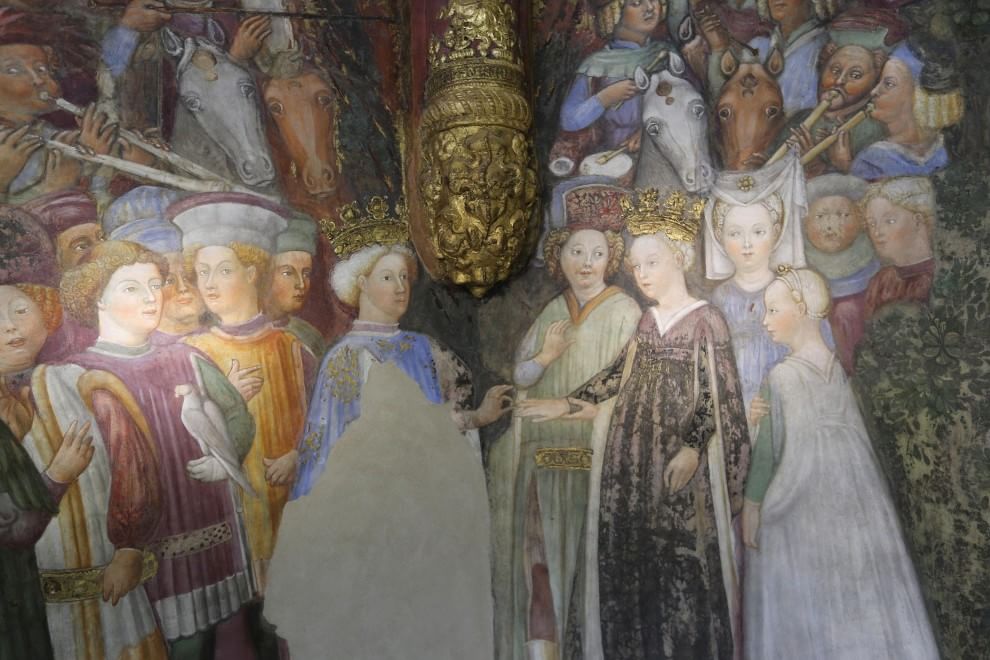
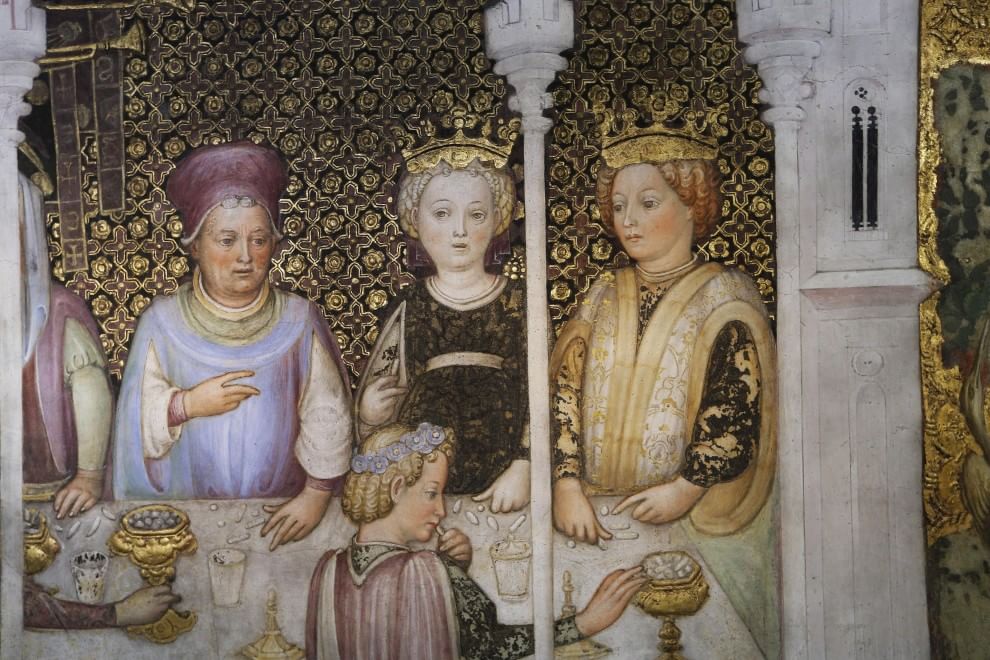
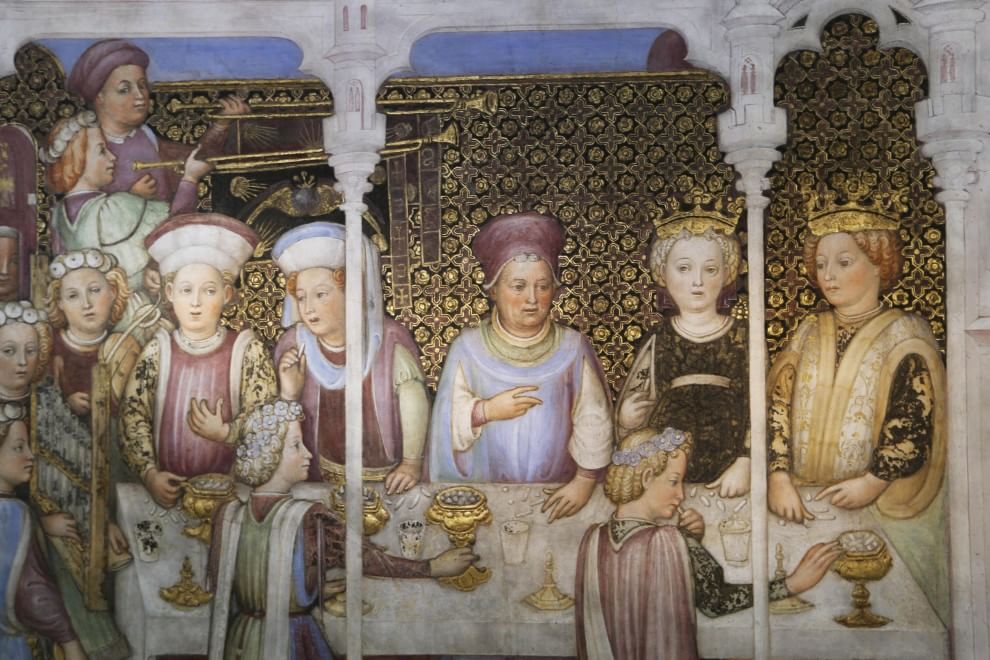
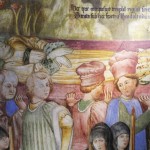
Apart from the Iron Crown and the other artefacts, the major attraction is the chapel itself with its 15th century frescoes from the Zavattari Workshop. These frescoes depict in 45 scenes the stories of the Queen’s life, her marriage, her meeting with her first husband, Authari, and her new marriage with Agilulf. All the figures in the painting are portrayed in luxurious surroundings and clothed in magnificent garments characteristic of the Visconti, the rulers of Milan at that time.
After more than six years of restoration it is now possible to see this circle of frescoes in something comparable to the original luminous colour- scheme and close up. However, only minor groups (max 15) are allowed into the chapel at a time and tickets have to be booked in advance: Phone 039-326383. In April the scaffolding will be taken down and the chapel may be visited more freely, but the frescoes will have to be seen from afar.

SOURCES:
A visit to the restored chapel is part of the official agenda for EXPO 2015 in Milan.
The restoration has been carried out by Anna Lucchini Restauri
Theodelinda, “Most Glorious Queen”: Gender and Power in Lombard Italy.
By Ross Balzaretti
In: The Medieval History Journal 1999, Vol. 2 No. 2, pp. 183 – 207
SEE MORE:
Il restauro della Capella di Teodolinda
An overview of the fresques – before restoration – can be found in the Web Gallery of Art