Every other year Corpus Vitrearum Medii Aevi organises a colloquium with a special theme. This year scholars and conservators meet to focus on “Dynastic representations in Stained Glass”.
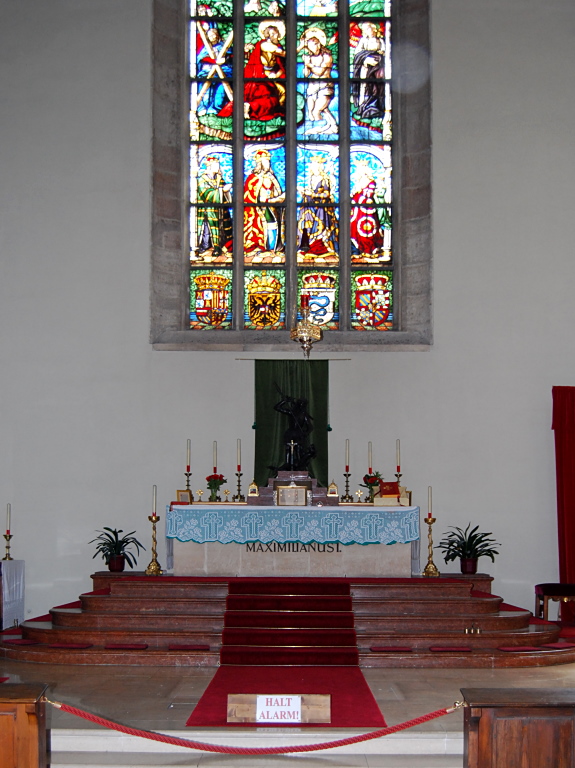
The colloquium will take place in Vienna in the next days and will – apart from lectures – be followed by a series of excursions to amongst other places the Chapel of St. George in the Wiener Neustädter Burg, where the Holy Roman Emperor Maximilian I is buried beneath a set of very famous stained glass portraits.
 The colloquium is organised as an extension of the European Science Foundation research network: Palatium, which aims at creating a common forum for researchers on the late medieval and early modern European court residence or palace (palatium)
The world of the courts – from 1400 to 1700 – constituted a network on a truly European scale and with an international character; however its architecture is only rarely studied in its “connectivity”. In this research networking programme, the “palace” is seen as a place for cultural – ceremonial – exchange.
The palace’s space and form carry multiple connotations. They represent power, lineage, tradition vs. innovation to the informed observer. The decoding of this system of signs necessitates not only input of historians of architecture and of art, but also of various other disciplines focused on fields such as archaeology, politics, literature, theatre and music. In connection with this the use of stained glass was a privileged form of art, which played a significant role on par with all the other types of media.
Corpus Vitrearum Medii Aevi
Dynastische Repräsentation in der Glasmalerei
Österreichische Akademie der Wissenschaften Festsaal
10.09.2012 -14.09.2012