How come the economy did not ground to a halt after 1349 -50, but rather kept nearly up with pre-plague levels in terms of production? And grew in terms of efficiency? New article aims to shed light on this conundrum
Microbes and Markets: Was the Black Death an Economic Revolution?
By Gregory Clark
In: Journal of Demographic Economics June 2016, Vol. 82, No. 2, pp. 139 -165
Abstract

Looking around our local community and whisking up to 50 % of your neighbours and family away, makes you wonder how people coped with the daily challenge of feeding and clothing themselves after 1349 – 50? Especially since the plague became endemic during the next centuries, keeping the population below pre-plague levels until at least 1600.
One consequence was naturally that wages soared. In fact, it appears they closely followed the falling output of labour. But what other economic consequences had the shift in the size of population? This is the question raised by Gregory Clark in a new article published in the Journal of Demographic Economics.
In his paper he examines the effects of the Black Death in England. Specifically, did it merely change relative factor prices, or did it lead to lasting gains in the efficiency of the economy after 1348? In other words: did the people in Late Medieval England (Europe) develop a technological and commercial efficiency in view of the lack of man-power? Was there a specific economics of the Black Death?
Careful study of output prices, wages, land rents, and the returns of capital does show a marked – and peculiar – gain in economic efficiency, which together with the high wages help to understand the “extraordinarily high living standards of 1450”. However, these gains in efficiency receded as soon as population began to rise once more (after 1500).
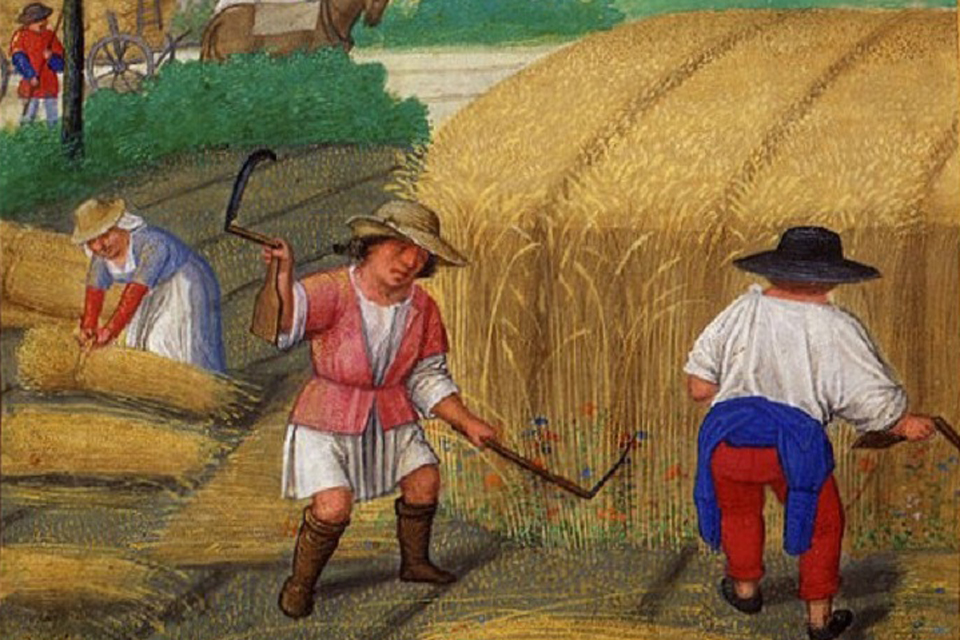
One explanation might be that people simply worked more days abolishing a number of feast days on the altar of higher wages. Another explanation might also be be that the population around 1450 was in fact simply better fed (more protein due to the development of more extensive farming practices). Clark notes that workers around 1400 thus mowed more meadow per day, reaped more acres and threshed more grain than those around 1300. The work rate was simply 33 – 40% higher. Perhaps some of this resulted in more sloppy work (more grain spilled in the fields). However, all-in-all efficiency did not falter in the post-plague period
There is thus “no sign of a connection between a labour scarce economy, and a switch to faster long run economic growth through technological advance”, concludes Gregory Clark
Concomitantly, we may add that the survivors probably also enjoyed the fact that so many people had died and so much clothing was floating around. Plus the fact that the animals did not die if people just had the wherewithal to feed and care for them. If 50% of our neighbours died – and it was not due to war – a significant number of us would overnight become 50% more materially wealthy.
ABOUT THE AUTHOR:
Gregory Clark is professor of Economic History at the University of California, Davis and editor of the European Review of Economic History, chair of the steering committee of the All-UC Group in Economic History, and a Research Associate of the Center for Poverty Research at Davis.
FEATURED PHOTO:
Simon Bening August Moving Wheat Binding Sheaves – Detail. Costa Hours 1515. The Morgan Library & Museum. Source: Google Art Project: