Last year celebrity cook, Hugh Fearnley-Whittingstall, called for a pan-European Fish Fight. The aim was to get EU to ban the discards of side-catched fish, daily thrown overboard due to the current system of quotas. As of now nearly 800.000 people have signed this petition on www.fishfight.net.
Last week (19.03.2012) the question of discards was discussed at a meeting in the European Fisheries Council. Although there was general agreement about the issues at stake, the Southern European member states once more argued for a complex step-by-step approach. The conclusion was that there was a need to identify species, which should be exempt from the general ban; species, which were not threatened with overfishing and thus not endangered by the habit of discard. It seems, however, that the question was not raised, why such by-catch should be discarded at all. If the fish taken as by-catch does not belong to threatened species, could it not just be landed? To the suspicious Europeans it all sounds very much as a way to once more find a loophole for allowing the praxis to continue. Add to this the fact that the Commission a few days before had (once more) fined Spain for overfishing of horse-mackerel, blue whiting and monkfish and imposing the fines on individual boats. However, representatives of the Spanish fishing industry said that these fines converted to cuts would only lead to an increase in discards, as horse-mackerel is often caught as by-catch.
It is well known that the European fisheries are very heavily subsidised. And moreover that most of the income ends up in the pockets of a few so-called fish-barons or fish-lords. For instance it has been estimated that the former agreement between Europe and Morocco about fishing quotas off the West Coast of Northern Africa has had serious consquences for the local people, the Saharawis, whose land is unlawfully occupied by the Moroccans; and that the income from these agreements has primarily lined the pockets of only 100 huge Spanish Vessels = 0.9% of the total fleet.
What is less well known is, that the concepts of environmental degradation, overfishing, authorities trying to install regulations, and the existence of veritable fish-lords are nothing new. All four elements existed in Antiquity as well as in the Middle Ages.
Environmental degradation
Up until the year 1000 the environmental pressure was not huge. The population in Europe was still sparse and mostly sustained by local subsistence economies based on fairly extensive forms of agro-pastoralism. From around the year 950 – 1000 a number of important changes began to take place. First of all the population started to grow. Hitherto pristine forests were slashed and burned, while the land was turned into tilled and farmed. Soil erosion and alluvial deposition was the direct consequence; bare fallow, the enlarged open fields and ploughing with the slope created silted waterways. Added to this was the introduction of watermills which impeded not only navigation, but also the movement of migratory fresh water fish. These changes created two new consumption profiles among the elites in Europe.
The saltwater fisheries
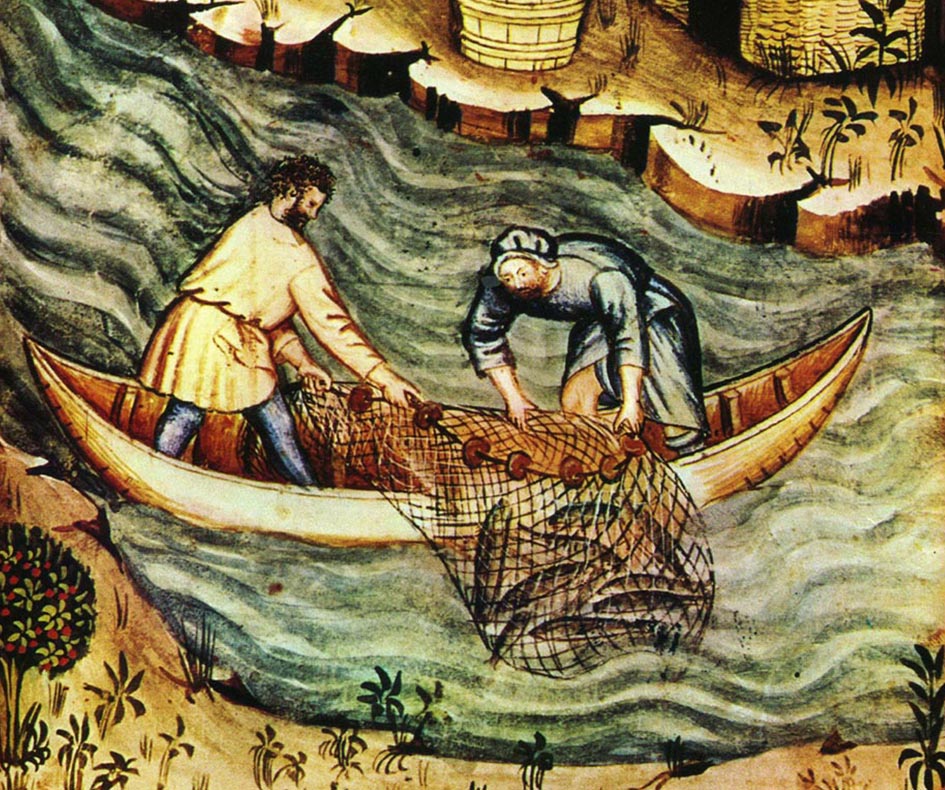
In Northern Europe the sporadic consumption of fresh water fish like salmon shifted towards the consumption of Marine species like herring and cod. Investigations of collections of fishbones at diverse locations in England has shown how the shift from freshwater to saltwater fish consumption took place inside a few decades around the year 1000. Cod was primarily fished by the Norwegians and shipped as stockfish. The trade in this commodity around 1000 was enabled by new shipbuilding techniques resulting in larger vessels with double carrying capacity. A little later salting, barrelling and shipping herring became a widespread economic activity along the Baltic Coast creating an important export venture for the Hanseatic League plus Scandinavia.
The carpe ponds
In the Middle and Central Europe the widespread silting of rivers, streams and lakes on the other hand created the opportunity for the introduction of the medieval carpe industry with its industrial complexes of huge fishponds known from the Danube basin; a fish-farming industry, which was later exported to the North West and came to dominate in Poland, Central Germany and along the large rivers of central France.
Thus, while people in Southern Europe continued to fish the Mediterranean, Northern and Central Europe post 1000 – 1100 experienced new possibilities for eating marine species of fish at a larger scale, while Central Europe began to farm carpes at a huge scale. At the same time the consumption of a number of traditional freshwater species became heavily reduced. One of them, the river sturgeon, practically became extinct.
Controversial delicacy
These changes may have had something to do with the dietary prescriptions introduced during the continuous reformations, where ascetic reformers tried to (re)install more proper ways of life in their monasteries or amongst their flocks. However, in principle these reforms always built on the rule of St. Benedict, which ordained a sparse regimen of bread, vegetables, cheese, oil, fowl and fish, but no meat from quadropeds; a regimen, which in time became the norm for ordinary people during Advent, Lenten and on other fast days. But fish was never declared an obligatory dish on fast-days and was in fact generally an expensive delicatessen enjoyed by the elites. Amongst some ascetic ecclesiastics in the 11th and 12th century it was accordingly considered a decadent pleasure to be avoided at all accounts.
Although the idea of eating fish at Lenten and on other of the obligatory days of fasting without doubt did contribute to create vigorous markets in the middle ages, it seems that this explanation for the new consumption patterns is not sufficient. Rather some of these changes –e.g. the shift around 1000 in England from freshwater to saltwater fish – were so rapid that other explanations must be proffered. Primarily the growing urbanisation and the accompanying trade, characterising the coasts of England at that time, are seen as the best explanations. Later the same explanations led to the discovery, overfishing and finally total collapse of the cod at Newfoundland.
Whatever the explanation, there is no doubt that human exploitation of both freshwater and seawater resources had wide-reaching impact on the environment both in the middle ages and later on.The “pristine” character of yesteryears fishing waters is thus a myth. This should, however, not in any way be understood as an invitation to stop the fish fight of the 21century!
Read more about Medieval Fisheries in ‘Medieval History’ 2012 3:2