More than 180 sessions within the special theme of Food, Feast and Famine as well as 405 other sessions are sure to make Leeds in July buzzing with medievalists running to and fro to find the correct lecture hall.
The main focus of this year’s IMC Congressin Leeds is ‘Food, Feast & Famine’. An astonishing amount of session and paper proposals meant that we were able to accept over 180 sessions with relation to the Special Thematic Strand, and a further 405 sessions covering the full spectrum of medieval studies. Many thanks to Paul Freedman (Department of History, Yale University) who expertly co-ordinated the academic programme for the special thematic strand and made it into a coherent and fascinating quilt of ideas. He is the author of the acclaimed “Food: The History of Taste”, and “Out of the East: Spices and the Medieval Imagination”
In 2016, Leeds offers four keynote lectures relating to the special focus.
 Christopher Woolgar (Department of History, University of Southampton): ‘‘The colour shall be green’: Food and Chromaticism in the Later Middle Ages’. Christopher Woolgar is known for his books on The Great Household in Late Medieval England. Yale University Press 1999/2006 and an edited volume on “Food in Medieval England” (Oxford University Press 2006
ABSTRACT:
Colour is intimately associated with our appreciation of food, yet we must not expect the hues and lustre of medieval foods to have offered the messages we might anticipate. For medieval people, colour provided important information about the nature of objects, and that was no less true of what they ate than of anything else. On one level colour might expose moral and spiritual connotations, on another it might offer indications of characteristics of a foodstuff according to medieval humoral theories. Beyond this, a few texts – medieval recipe books – tell us about the creation of colour and food. Display was a crucial part of elite cuisine, and control of colour was essential. Recipes instructed cooks how to colour dishes and to add verisimilitude to made dishes. Heraldic colours and designs were employed for ‘subtleties’, the set pieces that came to table with wider messages. There were general cultural associations between colours and culinary preparations: some types of dish show common patterns of colouring, such as the use of green sauce for fish, and red for dishes known as ‘Saracen’. However fleeting the colours of foodstuffs, they offer a further dimension to our understanding of meals and the material culture of dining.
 Pere Benito i Monclús (Departament d’Història, Universitat de Lleida): The Shifting Paradigm of Medieval Food Crises: Researching Dearth and Famine.
He is known for his edition of Crisis alimentarias en la Edad Mediea. Modelos, explicaciones y representaciones. Milenio. Lleida 2013 and a number of articles focusing on the concept of “crisis”
ABSTRACT:
The Shifting Paradigm of Medieval Food Crises: Researching Dearth and Famine
In the past 20 years, pre-modern food crises have moved from being considered an object of study firmly limited to the past to becoming a complex subject requiring a thorough historiographical renewal in light of contemporary research and theories of distribution. Two independent dynamics have come together to create this paradigm shift. The first is the development of new research into food crises which focuses especially on the European Mediterranean, has been launched by ground-breaking French and Spanish research programmes on the Crisis of the Late Middle Ages and on medieval food crises. The second is the reception of models of economic research addressing present-day crises of subsistence in the Third World, especially the ‘Entitlement approach’ by Amartya Sen (arguing in its core that famine is not caused simply by a lack of food, but also by people’s inability to access existing food), and by its advocates and critics. This lecture will offer an overview of these developments and some of their major achievements, as well as looking at future perspectives that lie ahead in the study of medieval famine.
 Massimo Montanari (Dipartimento di Storia Culture Civiltà, Università di Bologna): The Taste of Food.
He is known for his many books on Medieval food and tastes, the latest of which is the English translation of Medieval Tastes: Food, Cooking, and the Table (Arts and Traditions of the Table: Perspectives on Culinary History). In 2015 he founded centro di Storia dell’Alimentazione together with a number of his colleagues.
ABSTRACT:
Taste is an ambiguous word that refers either to the physiological sensation that begins in the body by contact with food, or the aesthetic evaluation that a particular society places on the gustatory experience (also in the metaphorical sense, in areas not only of gastronomy but also and above all else of art, literature, or music). Taste in its first meaning is an individual and biological attitude. Taste in its second meaning (understood now as Good Taste) becomes a collective and cultural attitude. This lecture sets out to show how the respective importance of these two meanings was modified over time – between the Medieval and Modern period – with a progressive disequilibrium away from the first to the second. It aims to show how both concepts might discover an essential affinity in the ‘principle of knowledge’ which, moreover, allows utilisation of the idea of Taste in a metaphorical sense; and how, through such a principle, the medieval ideal of Taste (restricted to the act of eating and particularly understood as a spontaneous datum) prepares the modern idea of Good Taste (extended to other activities and mostly as a cultural datum, that is, as the fruit of social learning) which, in turn, allows elaboration of the very idea of Food Taste as a Good Taste culturally learned.
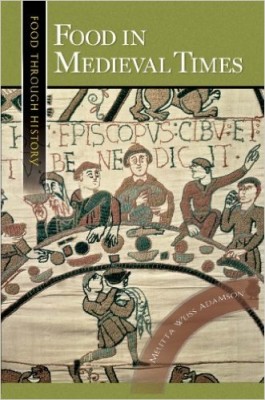 Melitta Weiss Adamson (Department of Modern Languages & Literatures, University of Western Ontario): Cookbooks, Health Books, Drug Manuals: Culinary Recipes in Search of a Genre.
She is the author of Food in Medieval Times, Greenwood 2004.
ABSTRACT:
In medieval Europe cookbooks started appearing only towards the end of the period. With over fifty recipe-collections ranging in length from several to several hundred recipes, Germany boasts the richest cookbook tradition, with all the extant manuscripts dating from ca. 1350-1500. A recently discovered Durham recipe-collection from the 12th century predates the oldest German cookbook by some two hundred years and is proof that European culinary recipes were recorded much earlier than previously known. The collection of ten sauce recipes which claim Poitou as their place of origin is written in Latin and included in a codex of medical recipes. The talk will explore the early beginnings of European culinary writing in the context of medieval medicine by using Germany as an example. It will look at monastic medicine, such as the medical writings of the nun Hildegard von Bingen, and the pharmacopoeias and regimens of health associated with the newly established medical schools and those by physicians from Germany and elsewhere who studied there. These sources illustrate the important role medical literature played in the early transmission of culinary recipes when a proper genre was still lacking as well as in the genesis of the late medieval cookbook.
In addition to these keynote lectures there will be a range of associated events linked to the special focus, from daily changing food stalls in University Square (‘A Feast for all Senses’), numerous additional street food options, a talk related to the University library’s collections, and a cheese tasting, through to a fully-fledged medieval feast, brought to us by the University’s Great Food at Leeds team.
ABOUT IMC
Entering its 23rd year, the International Medieval Congress is firmly established as the interdisciplinary forum for intellectual debate in all areas of medieval studies. The IMC is held at the University of Leeds every July, and this year will attract more than 2000 medievalists from around the world, some 1800 of which are actively involved in the programme. The IMC is unique in that it welcomes papers in any major European language, and the international nature of the Congress is central to its culture.
The IMC comprises a four-day programme of sessions, round tables, and special lectures and is also complemented by an exciting range of excursions, workshops, concerts, and performances, as well as receptions, book fairs, craft and historical society fairs, and the annual Congress dance.
Papers and sessions for the IMC are selected by an international Programming Committee of more than 30 leading medievalists, and proposals for papers in all areas of medieval study are welcomed. The IMC offers many opportunities to medievalists worldwide. Come and experience this for yourself at the IMC 2016!
FULL PROGRAMME:
International Medieval Congress 2016
04.07.2016 – 07.07.2016
FEATURED PHOTO:
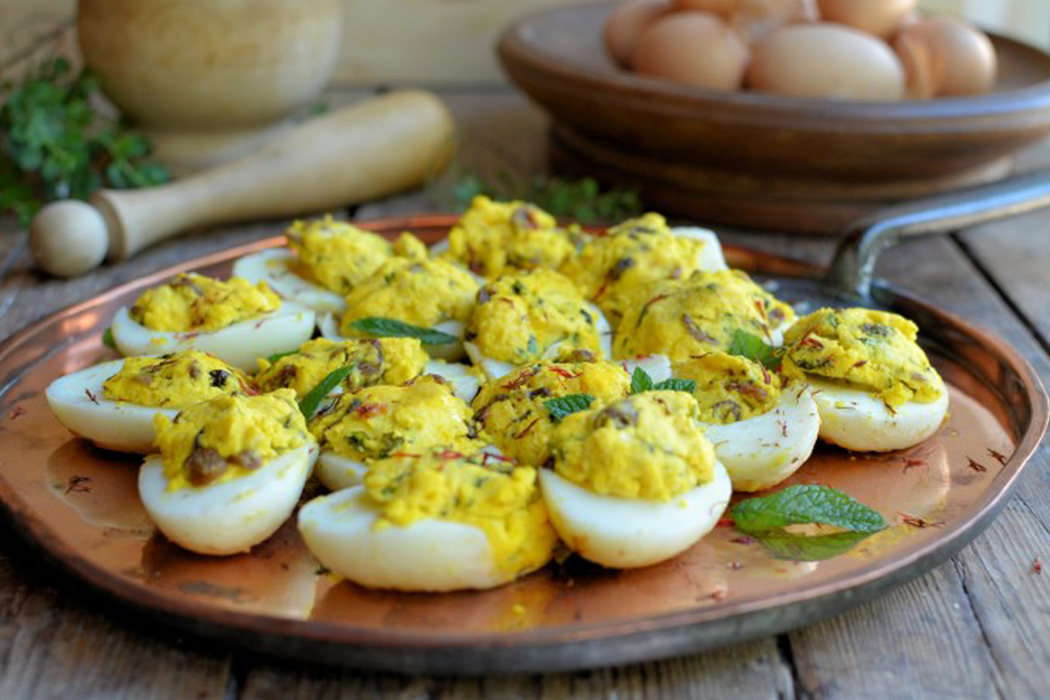
In 2014 stuffed eggs were served at the Medieval Feast in Leeds. Karen Burns Booth was asked to “test-drive” the recipes, which she later published at her blog: Lavender and Lovage. The Recipe can be found at her website