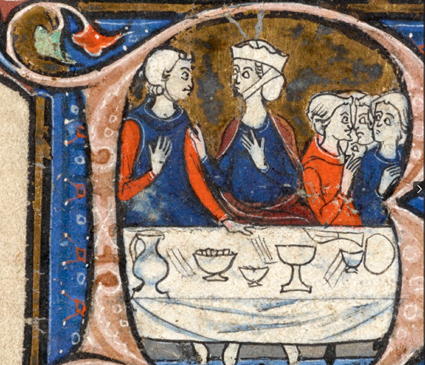
The Moving World is a celebration of French Medieval Manuscripts held by the University Library and colleges in Cambridge
This spring the University Library in Cambridge celebrates French Medieval Manuscripts held in the library and in Cambridge colleges. It presents a survey of how knowledge travelled in manuscript form around Europe and the Meditteranean between 1150 and 1530. “French” at this time was not just a klanguage associated with what we now call france. It was an international language of scholarship and trade, independent of political boundaries and cultural identitities. Nor was Paris the centre of manuscript production and transmission before the reign of Phillippe Auguste (Gonesse, 1165 – Mantes –La-Jolie, 1223).
Many French manuscripts were produced in England, the Low Countries, Italy, Cyprus, the Peleponnese and in the Middle East. They travelled widely across linguistic and cultural spheres. England, in particular, played a major role in the dissemination of Medieval French materials and many of the major traditions, including Tristan, the Lais of Marie de France and the Song of Roland have their earliest roots in England before moving, via English Manuscript Production, to the Continent. French continued to be used in Commerce, Law, and Literature in Medieval England; and Anglo-Norman, or insular French, developed its own characteristics and lexicon. This exhibition highlights this cross-fertilisation and celebrates the richly multilingual and itinerant nature of medieval French literary traditions.
Amongst the star attractions is an important manuscript of the Lancelot-Grail, which lay forgotten and unopened for five centuries until its rediscovery in North Yorkshire and its sale in 1944. Detailing the search for the Holy Grail, it goes on public display for the first time alongside the only existing fragment of an episode from the earliest-known version of the Tristan and Isolde legend. Also on display is an early example of the kind of guide familiar to thousands of today’s holiday-makers: a French phrasebook.
“The moving word: French medieval manuscripts in Cambridge” is the result of a collaboration between the AHRC-funded research project Medieval Francophone Literary Culture Outside France (MFLCOF) and Cambridge University Library.
Medieval Francophone Literary Culture Outside France is an AHRC-funded research project that aims, over three-and-a-half years (April 2011 to September 2014), to investigate the movement across Europe and beyond of francophone literature over the three centuries of the high Middle Ages. It represents a collaboration between King’s College, London (KCL), University College London (UCL) and the University of Cambridge. The project team unites specialists on the relations between the langue d’oïl or medieval Northern French and major European languages (Occitan, Italian, Dutch, German, English) to explore how key literary texts travelled along two principal axes: a northern route that stretches from England across the Low Countries to Burgundy and the Rhineland; a southern route across the Alps to Northern Italy and out into the Mediterranean and Adriatic seas, to the Middle East. The project will establish a database of manuscripts of the key texts in order to ask questions about cultural and linguistic identity, about medieval textuality, and about the literary history of Europe.
SOURCE:
The Moving World
Cambridge University Library
22.01.2014 – 17.04.2014
Video introducing the exhibition
Read also about the upcoming Conference at King’s College, Cambridge
READ MORE:
Conquering a continent: How the French language circulated in Britain and medieval Europe