New research traces a millennium of changing animal husbandry and cereal production in medieval England, while raising questions about the wider North Sea context of agricultural innovation.
Meat, Milk, Wool and Grain: The animal economy of medieval England (ce 400 to 1400)
By Matilda Holmes, David Orton, Helena Hamerow and Richard Thomas.
PLOS ONE.
Published 2 September 2026.
At some point in the Early Middle Ages, the agricultural system in Europe changed from an intensive mixed economy towards a system geared to feeding a growing population.
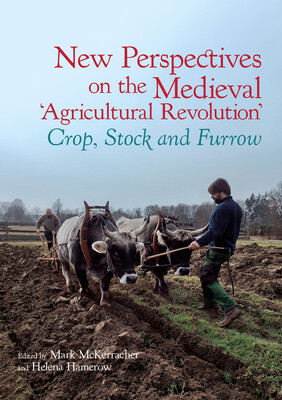
A major element in this transformation was the shift from more or less permanent, heavily manured cultivation within an infield–outfield system towards a more extensive model based on systematic open-field farming, involving the adoption of new technologies of cultivation (the mouldboard plough) and the use of draught animals (and improved harnesses).
Historically, the shift took place at different times, unfolding with considerable variation across different regions. Recently, a major research project, “Feeding Anglo-Saxon England” (FeedSax), led by Professor Helena Hamerow at the University of Oxford, has investigated in detail how this medieval agricultural revolution evolved while supporting a booming population in England between the end of Roman rule, c. 400, and 1400.
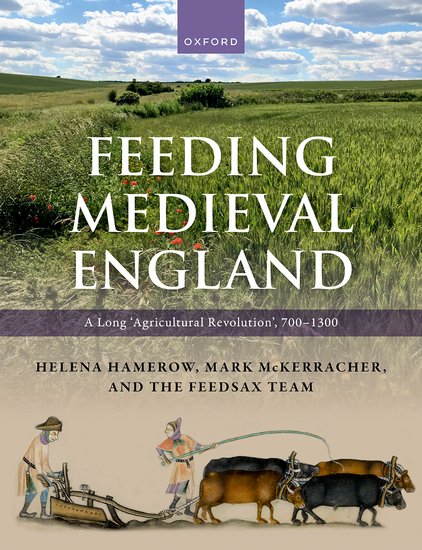
Apart from numerous articles and papers, the results were published in an impressive monograph by Oxford University Press in 2025, raising the fundamental questions: how did this shift come about? When and where did this long agricultural revolution take place, and what were the economic gains of “cerealisation”? With a special focus on the period 700–1300, the book will also be an immensely important resource for agricultural historians and medievalists engaged in exploring the longue durée of the history of the Middle Ages. The project ran for five years, from 2017 to 2022, and focused on archaeobotany, settlements, zooarchaeology and pollen records. However, the project continues to spawn further studies.
Recently, a major synthesis of the zooarchaeological evidence was published, investigating approximately a millennium of English animal husbandry and the relationship between livestock, cereal production and agricultural intensification.
Titled “Meat, Milk, Wool and Grain: The Animal Economy of Medieval England, c. 400–1400”, the lengthy study presents the results of the substantial zooarchaeological dataset compiled in connection with the wider project.
The study allows a more detailed understanding of when change took place and in what form. Key patterns include:
- 400–500: A continuation of Roman husbandry practices at some sites throughout the fifth century.
- 500–625: Self-sufficiency and small surpluses characterise the agricultural system, reflecting a major demographic downturn caused by the sixth-century crisis of climate, conquest and plague.
- 625–800: Sheep become more numerous, particularly in the Central Zone of England, a development suggested to have begun under monastic influence. Meanwhile, older and male cattle become more numerous, although there are few signatures of their use as draught animals.
- 800–1200: Grain production takes off, while sheep come to dominate. Wool emerges as one of the major products. Draught cattle dominate between 1000 and 1200.
- 1200–1400: Meat production becomes increasingly important, while horses appear to substitute for draught cattle. Dairy production also appears to play a larger role.
The overall documentation is impressive, and there is little reason to question the conclusions reached. However, one question does seem to arise: might the shift towards sheep also be related to a widespread and growing demand for wool to provide sails and clothing within the steadily developing North Sea and Viking world from the seventh century onwards? Similarly, might the creation of the so-called “wheat belt” in the period after AD 900 have been influenced by agricultural practices and ideas circulating from the Continent, not least through connections established within the pre-Conquest Scandinavian world? This possibility is discussed in Appendix 4 of the major publication.
More generally, this raises a question that lies somewhat beyond the principal focus of FeedSax. The project reconstructs extraordinarily well the chronology and ecology of changing agricultural practices within England, but gives less attention to the mechanisms of cultural transmission through which such practices may have reached particular English farming communities. A more explicitly comparative North Sea and continental perspective might therefore complement its findings.
In particular, it would be interesting to consider more systematically the extent to which successive movements of people – Frisians, Angles, Saxons, Scandinavians and, eventually, Normans – contributed to technological, cultural and social developments in medieval English agriculture. This question becomes especially pertinent because the project has consistently – including in this study – identified the Central Zone of England as a particular hotspot for the adoption of agricultural innovations.
FEATURED PHOTO
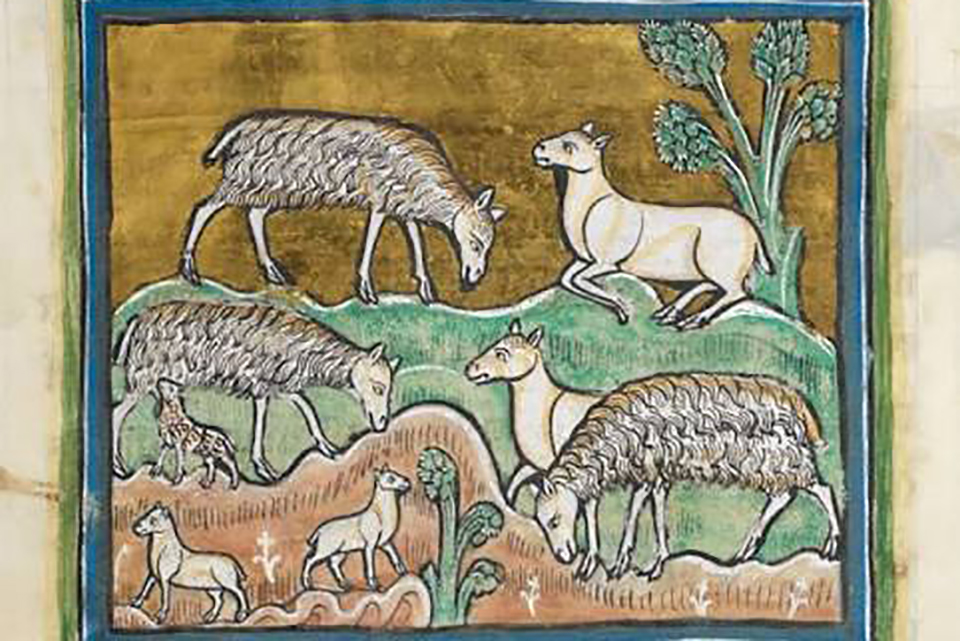
Sheep. From: Rochester Bestiary, ff35r-35v. British Library Royal MS 12 F.xiii
READ MORE: