NEW MEDIEVAL RESEARCH:
Gautberts church in Birka may have been located on the Hillfort
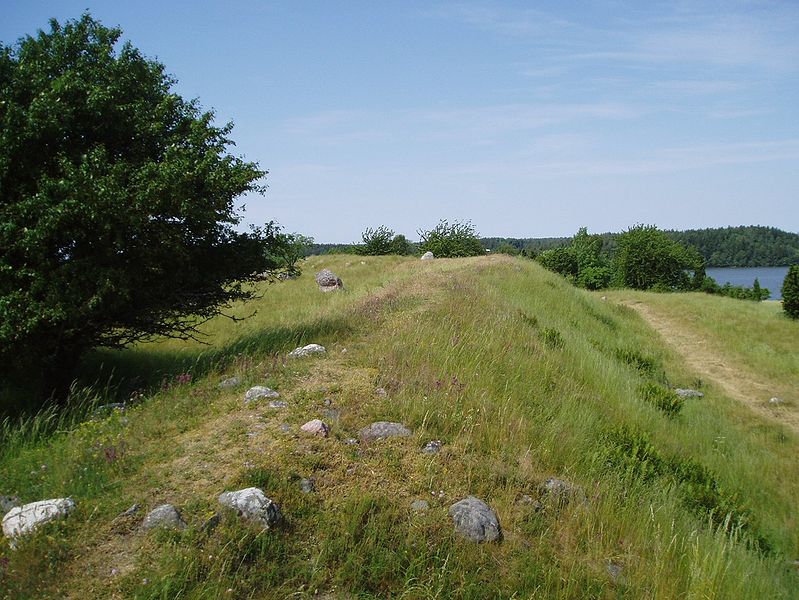
The hill fort (180 x 100 meter) at the Viking emporium at Birka (near present day Stockholm) was located on a stony hill above the city and defended by a 2-3 meter high bulwark, built out of stone and earth and with a palisade on top. In the 1990’s archaeologists excavated the fortifications of the hill and the city and found that part of these stemmed from the beginning of 800. This is very interesting in so far as we have rather precise descriptions of life in this Viking city in the Vita Ansgari, written by Rimbert, who was part of the mission to the Scandinavians in the years after 826. According to the Vita their mission resulted in a number of churches being erected and consecrated.
The archaeologist, Torun Zacrisson, has recently reflected in an article in Fornvännen upon the possibilities of correlating the rich archaeological findings in Birka and the descriptions in the vita; one important question has been the intensified interest in locating the two churches of Heirgeir and Gautbert. Heirgeir must have been a prominent nobleman in the region (the article identifies him as “jarl”), while the latter was consecrated as bishop of Birka in after 832, where he is said to have built a church and functioned as bishop for more than 10 years.
The church of Heirgeir is commonly thought to have been located at Helgö, where archaeological excavations in the 1960’s discovered several liturgical objects: a christening scoop from Egypt, an Irish crozier and a silver bowl ornamented with a cross. Another spectacular find were fragments of so-called Tating ware, which might have been used as liturgical pitchers. Other researchers, however, believe that the church of Heirgeir might have been located in Birka proper; and that the church of Heigeir was the predecessor of the one, which Gautbert built and consecrated, when he arrived at Birka in 832.
If this church was located in Birka, it is highly likely that it was built inside the fortified hill fort, claims Zacrisson. One argument is, that a comparison with cities elsewhere on the European continent, points to such a location, which would make it structurally similar. At the hill archaeologist found a large hall 19 x 9,5 meter with curved walls and strong posts, which must have been visible from far away. The nearest parallel is the great hall at Uppsala.
Thus, if the church was located at the hill fort, cities like Minden and Münster may have served as models. These cities were located near to the imperial Abbey of Corvey, where Ansgar, Rimbert and probably Gautbert lived before they embarked on their missionary travels. Another similar layout may have been found at Haithabu in Schleswig-Holstein in Northern Germany. At this emporium, we are told that Ansgar had a church built. Excavations have not demonstrated the exact location, but it is generally believed, that this church might have been located under or nearby the present Haddebyer church located north of the city at a hilltop, protected by the local stronghold on one side and the swamps bordering Schlien at the other side.
If it all went as the Vita tells us! Recently the medievalist, Eric Knibbs, published his investigations into the spin, which both Ansgar and Rimbert placed on their missionary efforts. According to Knibbs, Ansgar did not found an archdiocese at all. Rather, the idea of Hamburg-Bremen only took root in the tenth century, and royal sponsorship of the mission to Denmark and Sweden ended with the death of Louis the Pious 840.
Arkeologin bakom Rimbert. Om Hergeirs och Gautberts kyrkor och borgen i Birka. By Torun Zachrisson. Fornvännen 2011, pp. 100-112. (Articles in Fornvännen are made freely available at the internet with half a year’s embargo) [The Archaeology behind Rimbert. About the churches of Heigeir and Gautbert and the hill fort in Birka]
Ansgar, Rimbert and the Forged Foundations of Hamburg-Bremen (Church, Faith and Culture in the Medieval West)
Eric Knibbs
Ashgate 2011
Rimbert: Life of Anskar, the Apostle of the North, 801-865