
The summer exhibition at Louvre-Lens – Gold and Ivory – highlights the wealth of artistic exchanges between Paris and Tuscany 1250 -1320
Between 1250 and 1320 artistic exchanges between Paris and the leading city-states in Toscana flourished. Thanks to exceptional loans from around twenty prestigious European museums, a new exhibition lifts the veil on the relationships between the major centres of artistic creation of the period: Paris, Firenze, Siena and Pisa.
The exhibition brings together more than 125 exquisite works: monumental statuary, gold background paintings, illuminated manuscripts, fine enamels and ivories. In particular, these works reveal the influence of French exponents of High Gothic style on the Tuscan sculptors and painters in the late 13th century, within a region, which would become the cradle of the early Renaissance.
This exhibition at the Louvre-Lens is the first to examine this artistic interchange, which is of paramount importance to the history of art.
Paris 1250
In 1250 Paris was one of the largest European cities with nearly 300.000 citizens. It was also the capital of the Kingdom of France, home of Saint-Louis and a vibrant intellectual and artistic centre with a decidedly international reputation. With its great architectural sites (the Sainte Chapelle, the Lady Chapel at Saint Germain des Prés, the transept of Notre Dame) and the completion of the courtyard of the Palais de la Cité, Paris became the “capital of luxury”. Indeed, an abundant production of precious objects were produced there (illuminated manuscripts, ivories, goldsmithery), supported by an explosion of artistic commissions by the elite. Paris was the heart of what we now refer to as High Gothic. Paris was simply the ‘hot’ place to be.
Part of this repute was due to the architectural and artistic milieu, which developed in the wake of the building projects of the king. It has been claimed that Paris at that time underwent a development akin to what happened in Paris in the 19th century under the direction of Haussmann.
Descent from the Cross
 One of the best ways of getting a feeling for this special atmosphere is by studying one of the artistic masterpieces of that time: the Descent from the Cross from 1270 -1280 (see above). Full of expressive movement, the figures are clad in modern garb; they signal that a decidedly new artistic expression has come to town. In the second half of the 13th century Italian artists like Nicola Pisano and Cimabue were inspired by this. The result was the so-called “French Art”, which they developed in opposition to the old Byzantine tradition. Mingling inspiration from Paris with that of Rome in the Antiquity, these artists created some of the most amazing medieval sculptures and paintings, we may ever see.
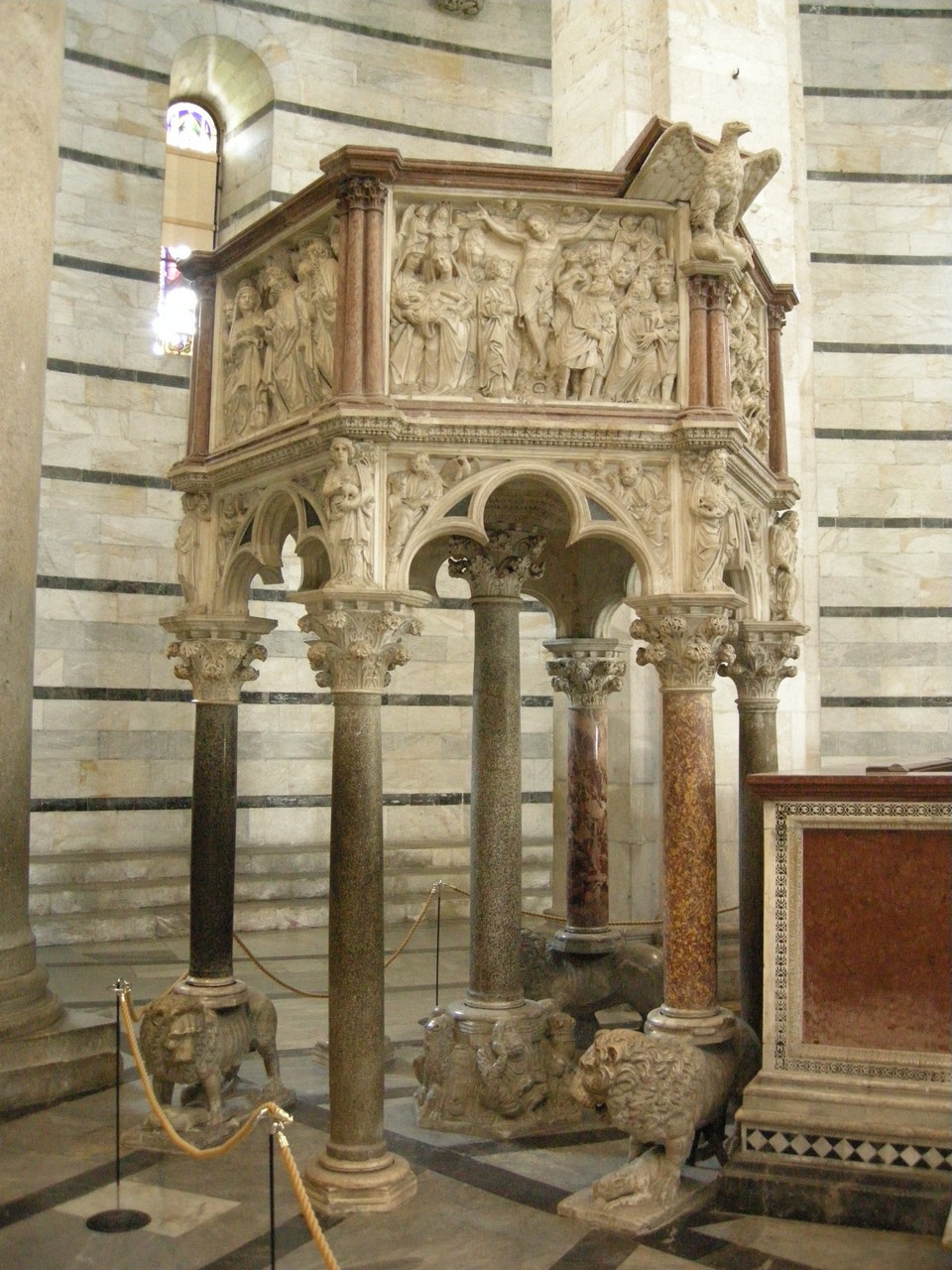
It stands to reason that the famous pulpit in Pisa will not grace the exhibition in Louvre-Lens this summer. But less can do!
What we may see are such minor ivories and other pieces of art like manuscripts and golden treasures, which were imported from Paris to the cities of Pisa, Prato, Firenze and Siena; and which obviously inspired the artists there.
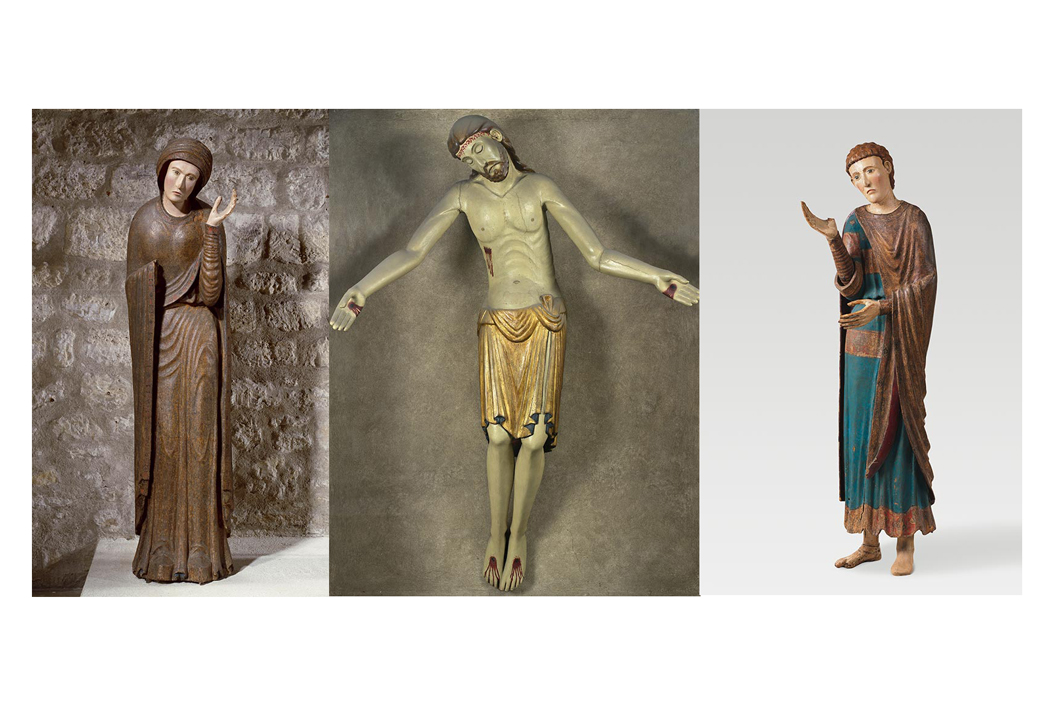
But we can also explore some of the great results of the artistic inspiration. One such highlight is the bringing together of a crucifix with Christ from the Cathedral of Prato and a Virgin and a Saint John now in the Cluny Museum. Exhibited side by side specialists are invited to explore whether the three sculptures originally belonged to the same group. There will also be a unique comparison of pieces from around 1300 with stylistic links – among them a Christ by Giovanni Pisano, fragments from the St. Gertrude cask from Nivelles and Maître Honoré’s La Somme Le Roy. A group of monumental painted sculptures from early 14th-century Tuscany will also help reassess the place they held in the creative culture of that time.
The exhibition is divided into four sections
Section 1: the 1250s
 The first section of the exhibition presents a brief overview of the birth of High Gothic, through four major Parisian architectural
sites: the Lady Chapel of Saint Germain des Prés, the Sainte Chapelle at the Palais de la Cité, and the transept and rood screen of Notre Dame. Architectural elements and monumental statuary are accompanied by royal manuscripts and stained glass from the same sites. Tuscan painting and sculpture from the mid- to late 13th century, still influenced by Byzantine art, are presented alongside each other
Some of the works in this section include:
- Jean de Chelles, Head of a Wise Man, Paris, Notre-Dame cathedral1250-1258, , limestone, traces of polychromy, Paris, musée de Cluny – musée national du Moyen Âge
- Childebert receives St. Germain, Paris, the Lady Chapel of Saint Germain des Prés, around stained glass, 1240-1245, London, Victoria and Albert Museum
- Virgin and Child, Paris, the Lady Chapel of Saint Germain des Prés, 1245-1255, limestone, Paris, church of Saint-Germain-des-Prés
- Virgin and St. John weeping ; Deposition of Christ, Prato, around 1250, wood, late polychromy, Paris, musée de Cluny – musée national du Moyen Âge (Virgin and St. John), Prato, Duomo (Christ)
Section 2. The formation of a taste: Cimabue and Nicola Pisano
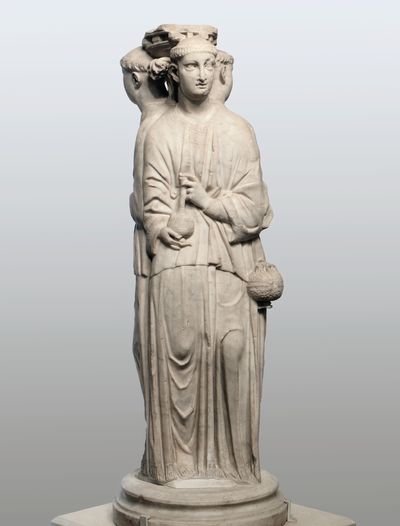
Pisa, around 1267, marble, Florence, Museo Nazionale del Bargello
This section of the exhibition shows how the style of Tuscan art took shape in the latter half of the 14th century, between a revival of the Byzantine tradition and borrowings from Gothic art, particularly that of Paris. Focus is on the work of Nicola Pisano and Cimabue. This section also presents the technical innovations that appeared in Tuscany, in particular translucent enamels. In parallel, this section considers the prominent figures of Parisian art between the end of the reign of Louis IX (St Louis, who died in 1270) and the beginning of the reign of Philip IV (from 1285).
Some of the works in this section include:
- Workshop of Nicola Pisano, Group of three apostles, Pisa, around 1270, marble, London, Victoria and Albert Museum
- Reliquary of Saints Lucian, Maximian, and Julian, Paris, Sainte-Chapelle, around 1261, engraved, carved, silver gilt, Paris, musée de Cluny – Musée national du Moyen Âge
- Gospels of St. Denis, top plate of the binding, around 800 (manuscript), 2nd half of the 13th century (bound), parchment, wood, engraved gold plated copper, Paris, Bibliothèque nationale de France
- Descent from the Cross, Paris, around 1270-1280, ivory, polychromy, Paris, muse du Louvre
- Arnolfo di Cambio, Column with three acolytes, Pisa, around 1267, marble, Florence, Museo Nazionale del Bargello
SECTION 3. A RENEWED ENCOUNTER
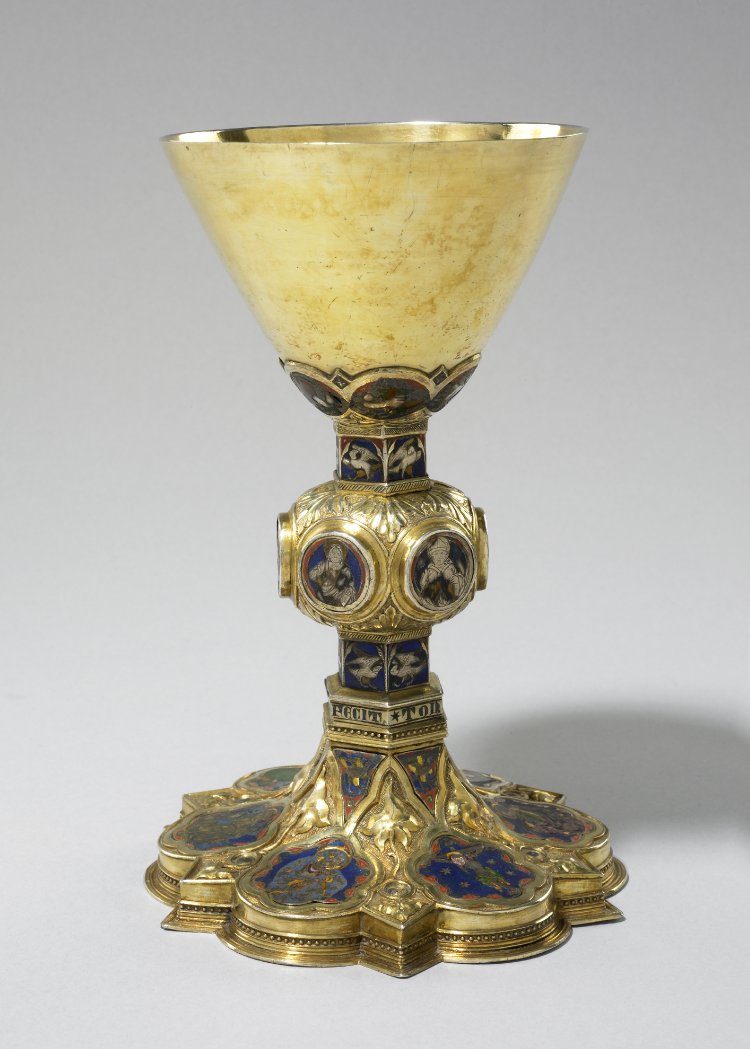
Siena, 1322-1328, silver gilt, translucent basse-taille enamel,
London, The British Museum
Through the examples of Giovanni Pisano, and then his pupil, Tino da Camaino, both acolytes of Nicola Pisano, the exhibition shows the influence of the sculpture of the court of Paris on the Tuscan artistic output around 1300
Some of the works in this section include:
- Angels of Saudemont, Northern France, around 1270-1300, wood, polychromy, Arras, museum of Fine Arts
- Giovanni Pisano, Sibyl (also called Miriam), Siena, cathedral, 1287-1297, marble, Siena, Museo dell’Opera del Duomo
- Angel blowing a trumpet, Poissy, collégiale Saint-Louis, after 1297, chalk, traces of polychromy, Paris, musée de Cluny – musée national du Moyen Âge
- Giovanni Pisano, The Crucified Christ, Tuscany, around 1290- 1300, ivory, London, Victoria and Albert Museum
- Tino da Camaino, Virgin of the Annunciation, around 1300, wood, polychromy, Florence, Museo Stefano Bardini
- Master Honoré, La Somme le Roi, Paris, 1290-1295, illuminated parchment, London, The British Library
- Queen of France (Joan of Navarre?), Paris, around 1310, limestone, Berlin, Bode Museum
- Tondino di Guerino and Andrea Riguardi, Chalice, Siena, 1322-1328, silver gilt, translucent basse-taille enamel, London, The British Museum
SECTION 4. A COMMON DESTINY
© RMN-GP (musée de Cluny – musée national du Moyen Âge) /
Jean-Gilles Berizzi
With the turn of the 14th century, new artists appeared, opening new avenues for Tuscan art, some of which would strongly inspire Parisian art. In the field of painting, the exhibition examines the influence of the major artists Giotto and Duccio, particularly on the illuminations of Jean Pucelle.
This final section also looks at the revival of Tuscan sculpture, with the divergence of the artistic styles of Florence and Siena.
Some of the works in this section include:
- Agostino di Giovanni, Virgin of the Annunciation, Tuscany, 1321, wood, polychromy, Pisa, Museo Nazionale di San Matteo
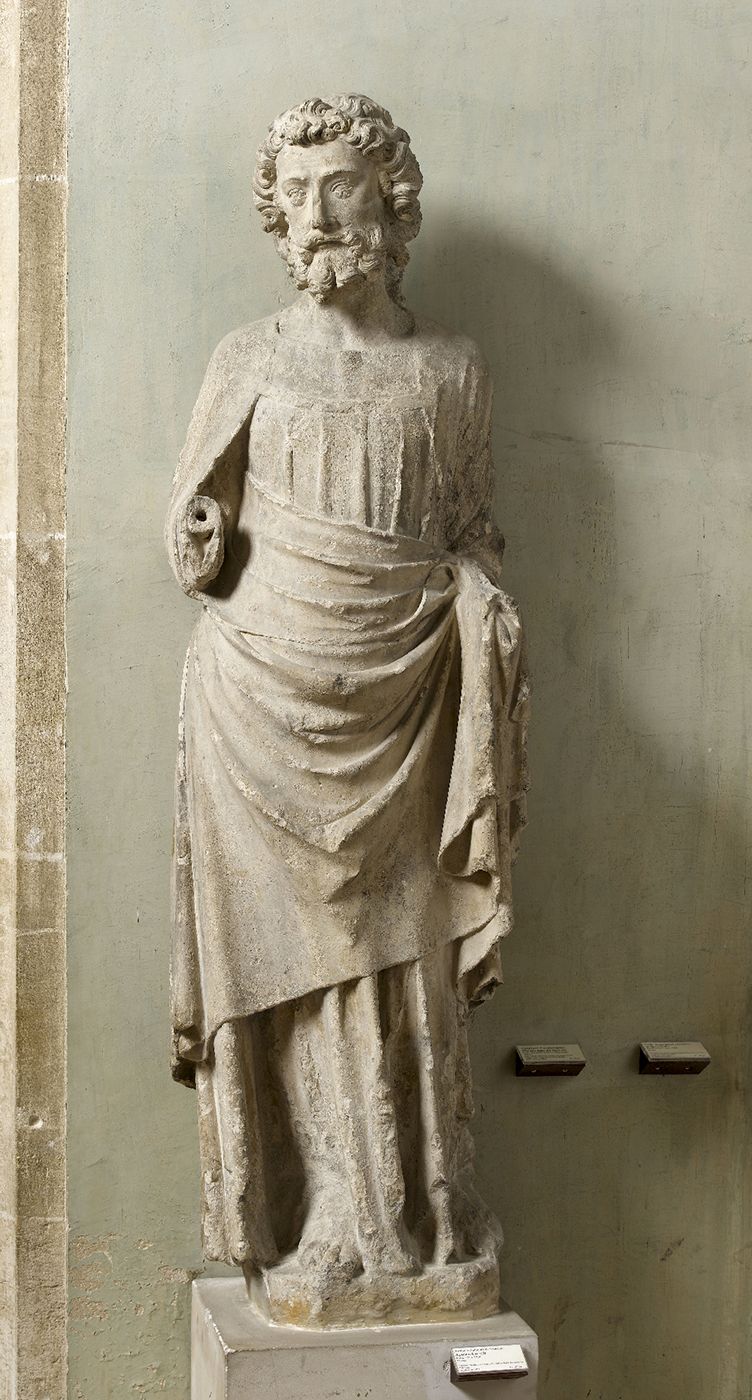
- Guillaume de Nourriche, Apostle , Paris, church of Saint-Jacques-de-l’Hôpital, 1319-1324, limestone, Paris, musée de Cluny – musée national du Moyen Âge
- Missal for the use of Sainte-Chapelle, Paris, early 14th century, parchment, London, The British Library
- Robert de Billyng (scribe), Jean Pucelle, Anciau de sens and Jacquet Maci (illumination), The Robert Billyng Bible, Paris, 1327, parchment, Paris, Bibliothèque nationale de France
At the centre of the exhibition, a mediation space considers the creative techniques of the period, through the sculptors’ materials and the painters’ pigments. It also addresses the issue of copying in the Middle Ages, which allowed these styles to spread across Europe.
Curators of the exhibition: Xavier Dectot, director of the Louvre-Lens museum; Marie-Lys Marguerite, director of Saint-Omer museums Exhibition organised by the Louvre-Lens, with the exceptional participation of the Soprintendenza BAPSAE di Pisa e Livorno and the Musée de Cluny – Musée national du Moyen Âge.
The exhibition is supported by Crédit Agricole Nord de France.
VISIT:
Gold and Ivory
Paris, Pisa, Florence, Siena. 1250-1320
Louvre-Lens, 99 rue Paul Bert
62300 Lens (France)
27.05.2015 – 28.09.2015
TAKE PART:
In connection with the exhibition an international symposium is organized in Rouen from 10.06.2015 – 11.05.2015:
Dialogues entre les arts. Un nouvel imaginaire en Toscane, 1250-1480
Catalogue:
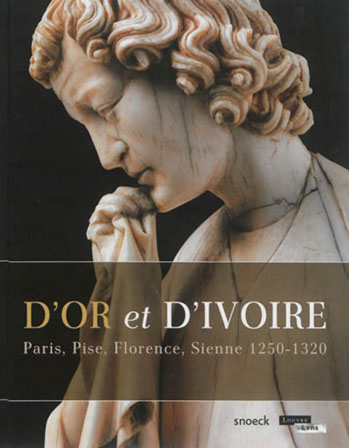 D’or Et D’ivoire : Paris, Pise, Florence, Sienne 1250-1320
Exposition Au Musée Du Louvre-Lens, Du 27 Mai Au 28 Septembre 2015
By Marie-Lys Marguerite et al.
Louvre-Lens,Snoeck Publishers 2015
ISBN-78-94-6161-228-1