Contemporaries noted a dramatic shift in the personality of Henry VIII. Have Neurologists from Yale found the explanation?
The head that wears the crown: Henry VIII and traumatic brain injury.
By Muahmmad Quaiser Ikram, Fazle Hakim Sajjad and Arash Salardini
In: Journal of Clinical neuroscience, 2016.
E-Pub 05.02.2016 – doi: 10.1016/j.jocn.2015.10.035.
ABSTRACT:
“There is no finer youth in the world than the Prince of Wales” (1507: the Spanish Ambassador) … “Prudent and wise and free from every vice” (1514: Venetian Ambassador)… a man of gentle friendliness, and gentle in debate; he acts more like a companion than a king” (1529: Erasmus of Rotterdam)
© Royal Armouries
Pic by Gary Ombler/ Royal Armouries
In his youth, contemporaries described Henry VIII in a very sympathetic fashion. Prudent, wise, gentle were just some of the characteristics, which ambassadors and others reported him to be. Nevertheless, we know him primarily from his many wives, two of which had their heads cut off, his executions of both Thomas Moore and Cromwell and many other courtiers plus some very unfavourable reports delivered in his later years. What caused this profound change?
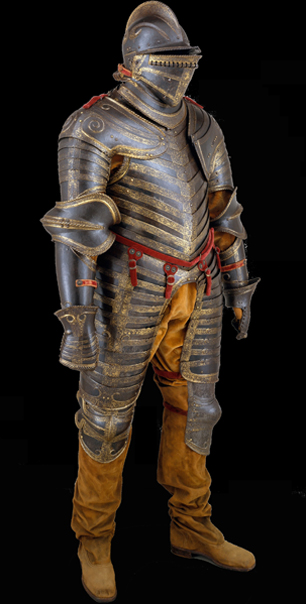
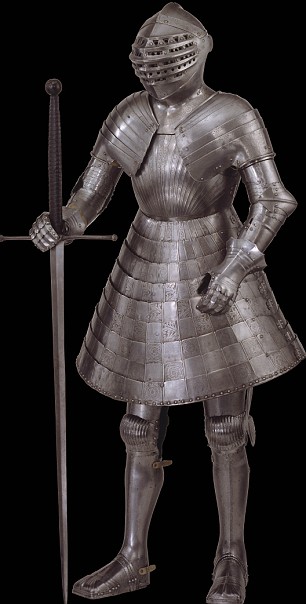
A group of neurologists at Yale School of Medicine recently published an overview of the clinical history plus a rather firm conclusion.One explanation is that Henry had Cushing’s syndrome. It is well known that Henry VIII gained a lot of weight, illustrated by a comparison of his armours througout his life. It has been estimated that he doubled his body mass index from c. 26 to c. 49 kg/m2 in his lifetime. Cushing’s syndrome is accompanied by abdominal obesity, a round red face and a fat lump between the shoulders plus not least a fragile skin, which heals poorly. This last bit fits very well with Henry’s “Sorre legge”, which was first mentioned in 1527. Later these ulcers returned with fistulating cellulitis and attacks of sepsis. In the end, Henry had to be transported around the palace in a sedan chair. Another more recent explanation suggested is that he suffered from a rare genetic disorder, McLeod syndrome. In another era Syphilis was suggested
However, already in 1931, the historian Frederick Chamberlain suggested that his cranky personality was caused by head injuries sustained in 1534 and/or in 1536. It is this hypothesis, which the neurologists from Yale have revisited in a newly published article.
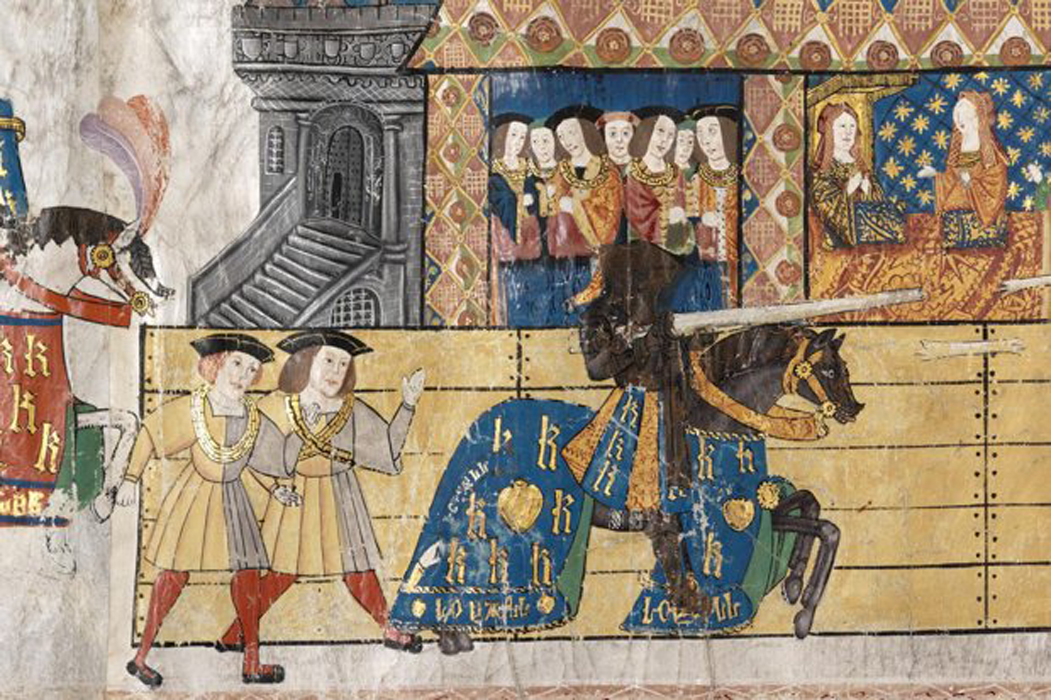
According to their overview, Henry VIII sustained a number of injuries during jousting and other sports. In 1524, the king was unseated after a jousting lance found its way into his open visor and splintered. De-horsed and dazed, the event did not prevent Henry from later taking part in a wide variety of sports, including hunting. This resulted in an accident in 1525, when the king was out hawking and fell from his horse into a ditch of water. It is told that a courtier had to heave him from the water, else he would have drowned. Again he seems to have suffered a concussion of some sort. Finally, in 1536 he suffered the famous fall, which left him unconscious for at least two hours “Without speaking”.
Based on the hypothesis that one or more of these events caused traumatic brain injury in Henry, the neurologists have sifted the available stories about the king for descriptions of symptoms.
Following this, they list events pointing to severe memory problems, irascibility and lack of impulse control, sociopathy, and depressions. To this list of psychological symptoms might be added the physical sufferings of headaches, insomnia, adipositas and venous ulcerations. All might have been caused by either growth hormone deficiency and possibly also something called hypogonadotrophic hypogonadism characterised by low libido and infertility.
“It is entirely plausible, though perhaps not provable, that repeated traumatic brain injury lead to changes in Henry’s personality”, writes Muahmmad Quaiser Ikram, Fazle Hakim Sajjad and Arash Salardini in their conclusion.
FEATURED PHOTO:
On the twelfth and thirteenth of February, 1511 Henry VIII held a tournament to celebrate the birth of his first son, Prince Arthur. The tournament is famously immortalized in the Westminster Tournament Roll (London, College of Arms, Westminster Tournament Roll) – a 60-foot long vellum roll that was painted soon after the tournament by the workshop of Thomas Wriothesley, Garter King of Arms. The roll illustrates the tournament’s festivities and depicts notable families who attended the event. © College of Arms 1511. Source: Pinterest.