2015 marks the 80th anniversary of the first publication of Herbert Grundmann’s monumental study Religious Movements in the Middle Ages and the 20th anniversary of its translation into English
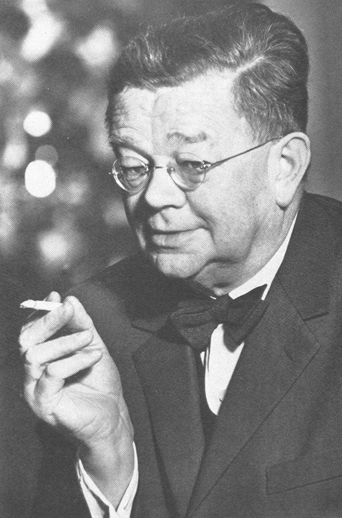 Herbert Grundmann, 1902-1970, was German professor in Königsberg in 1939 and later in Münster and München. He also acted as President of Monumenta Germaniae Historica. His main work was characterized by his interest in the religious life in the high Middle Ages, religious movements, sects and orders. His magnum opus was his ‘Habilitationsschrift’ from 1935: Religiöse Bewegungen im Mittelalter. Untersuchungen über die geschichtlichen Zusammenhänge zwischen der Ketzerei, den Bettelorden und der religiösen Frauenbewegung im 12. und 13. Jahrhundert und über die geschichtlichen Grundlagen der Deutschen Mystik (= Historische Studien. Bd. 267). Ebering, Berlin 1935 ( Originally: Leipzig, Universität, Habilitations-Schrift, 1933). It was translated into English in 1995. He was a dedicated and confessed Nazi. However, as “not-party-member” he was soon accepted into the Academic milieu after WW2.
2015 marks the 80th anniversary of the first publication of Herbert Grundmann’s monumental study ‘Religious Movements in the Middle Ages’ and the 20th anniversary of its translation into English and seven sessions at Leeds 2015 explores the origins and impact of Grundmann’s historiographical legacy.
The sessions have been organized by
Jennifer Kolpacoff Deane, Division of Social Science, University of Minnesota, Morris and Anne E. Lester, Department of History, University of Colorado, Boulder and are sponsored by Center for Medieval & Early Modern Studies, University of Colorado, Boulder
- Grundmann’s Legacy, I: Grundmann’s Method, Narrative, and Practice [Session No: 1010]
- Grundmann’s Legacy, II: Beyond the Binary: Heresy and Belief [Session No: 1110]
- Grundmann’s Legacy, III: Reassessing Religious Movements [Session No: 1210]
- Grundmann’s Legacy, IV: Apostolic Life and Religious Renewal [Session No: 1310]
- Grundmann’s Legacy, V: Gender, Social Mobility, and Religious Reform [Session No: 1510]
- Grundmann’s Legacy, VI: Nuns, Beguines, and Clerics – Interactions and Vernacular Culture [Session No: 1610]
- Grundmann’s Legacy, VII: Rethinking Reform in the Later Middle Ages [Session No: 1710]
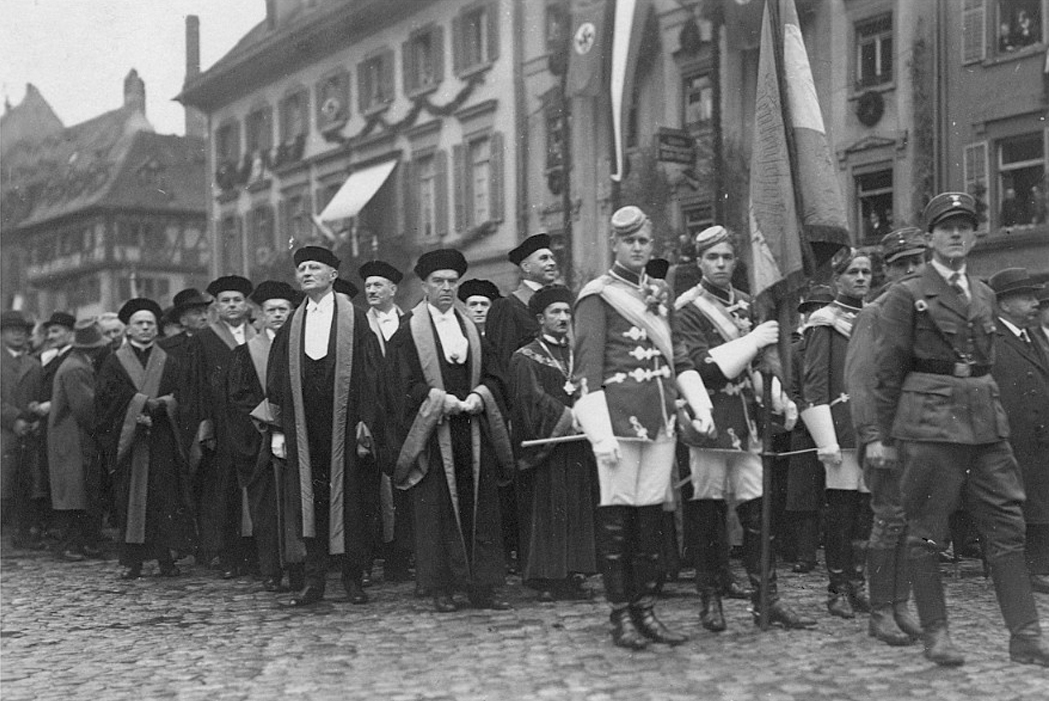
PHOTO
One of the papers [1010]: ‘Gottgläubig’: Herbert Grundmann, Religion, and National Socialism by Letha Böhringer, Historisches Institut, Universität zu Köln will of course touch upon the intimate collaboration of Herbert Grundmann with other Nazi-historians as well as his own work as Nazi collaborator. The featured photo here does not show Herbert Grundmann, but another famous Nazi, Heidegger, from an academic procession from 1933 in Freiburg. (Photos of Herbert Grundmann have obviously been exorcized from the web).
READ THE BOOK:
 Religious Movements in the Middle Ages: The Historical Links Between Heresy, the Mendicant Orders, and the Women’s Religious Movement in the Twelfth and Thirteenth Century
by Herbert Grundmann
University of Notre Dame Press 1995
ISBN-10: 0268016496
ISBN-13: 978-0268016494
Medievalists, historians and women’s studies specialists have welcomed this translation of Herbert Grundmann’s classic study of religious movements in the Middle Ages, which provides an historiography of medieval religious life – one that lies between the extremes of doctrinal classification and materialistic analysis. As such it is represents a major effort to underline the importance of women in the development of the language and practice of religion in the Middle Ages.
“Religious Movements in the Middle Ages” describes a lay religious movement of the 11th and 12th centuries that emphasised the centrality of lifestyle rather than doctrine. The religious groups that developed and solidified out of this movement were considered heterodox by some standards, orthodox by others. However, despite initial condemnation, these groups were eventually absorbed into the church and new groups, among them many women’s groups, were given permissive rules to suit their peculiarities. Grundmann explicates the doctrines that lay behind these religious movements and captures the material contexts that fostered them. Most importantly he is able to recapture the dynamism of the groups themselves and to identify the historically contingent events that carried them along their various paths. Perhaps the greatest synthetic daring of Grundmann’s study is his emphasis on the common point of departure shared by the religious groups that were ultimately to become located on either side of orthodoxy as defined by the Pope. Prior to Grundmann’s study scholars had only discussed either high medieval heresy or new orders within the Church, but Grundmann discusses here the common inspiration that lay behind both.