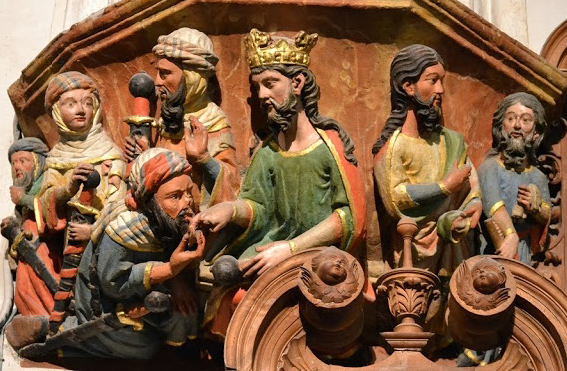
The story of “Fleur and Blanchefleur” is basically a ‘frontier’ tale of love and conversion. A series of magnificent Corbels in the Santa Catalina Chapel in Burgos tells the story.
The notion of Ductus lies beneath the composition of all kinds of texts – literary as well as visual. As such it poits to the experience of traveling through the pages of folios as well as visually organised spaces like embellished buildings or landscapes in a wider sense. This is a perspective, which has been used as an effective hermeneutical tool for understanding the magnificent Cathedral Of Chartres (1)
Recently the same perspective has been applied in an imaginative walk-through of the chapel of Santa Catalina in the Cathedral of Burgos by Rocío Sánchez Ameijeiras. In the article he invites the reader to accompany Juan Estébanez (responsible for the building of the new chapterhouse) guiding king Alfonso XI around his new edifice, admiring the painted corbels showing the story of Fleur and Blanchefleur. In the abstract he writes:
“The story of Fleur and Blanchefleur is basically a ‘frontier’ tale of love and conversion, characterized by generic flexibility both in its literary and its visual versions. A new figurative version of the story — carved in the corbels of the chapel of Santa Catalina of the Cathedral of Burgos — is analysed here. This version can be qualified both as a chronicle — encompassing its literary counterpart, the late thirteenth-century interpolation in the Cronica fragmentaria — and as courtly hagiography. The ensemble was intended to articulate Castilian national identity by presenting the seminal myth of an ancient Muslim Castile converted to Christianity by love; and to reinforce the identity of the powerful urban oligarchy (the caballeros villanos), as demonstrated by several supporting characters of the visual narrative.”
The full article may be read here…
History and Stories of Love and Conversion in Fourteenth-Century Burgos
By Maria del Rocío Sánchez Ameijeiras, professor at the University of Santiago de Compostela, Spain
In: Hispanic Research Journal, Vol. 13 No. 5, October 2012, 449–67
DOI 10.1179/1468273712Z.00000000028
The article is Part of a special Visual Arts Issue from 2012 published by the Journal: Hispanics Research Journal 2012: Picturing Kingship in Medieval Castile.(Vol. 13 No. 5, October 2012)
Footnotes:
(1) Crossley, P: Ductus and Memoria: Chartres Cathedral and the Workings of Rhetoric. In: Rhetoric Beyond Words. Delight and Persuasion in the Arts of the Middle Ahes. Ed. by M. Carruthers (Cambridge: Cambridge University press, 2010 pp. 2014 – 49)