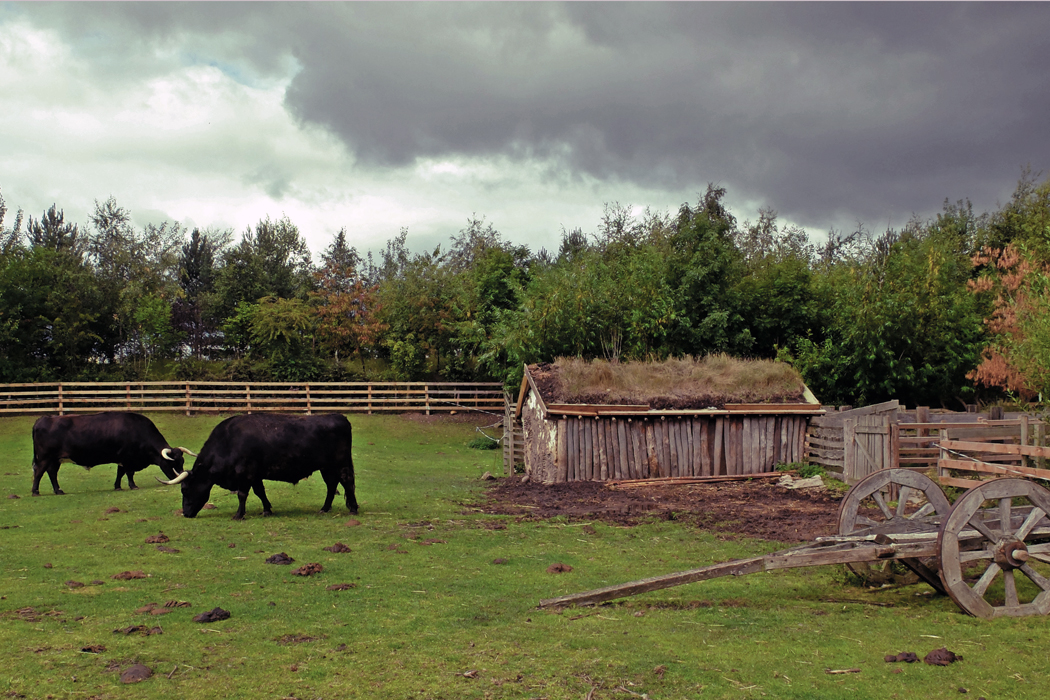
Cædmon was a herdsman with a poetic gift whom Bede (672–735) may have encountered at Whitby Abbey.
Perhaps Bede in his youth met Cædmon at Whitby Abbey. Perhaps Bede merely heard about the poet at nearby Wearmouth-Jarrow, where he lived and worked. Or perhaps Bede created the famous cowherd turned poet from stories he picked up elsewhere. Whatever the background history, and despite the fact that Bede write a paraphrase in Latin, we now have a famous poem or hymn which some scholars regard as the earliest piece of Old English poetry.
Bede wrote:
“There was in the monastery of this abbess a certain brother particularly remarkable for the grace of God, who was wont to make religious verses, so that whatever was interpreted to him out of Scripture, he soon after put the same into poetical expressions of much sweetness and humility in Old English, which was his native language. By his verse the minds of many were often excited to despise the world, and to aspire to heaven”, after which he presented the first poem of Cædmon to his readers. However, as Bede wrote in Latin, he rendered the only poem we know in that language, while lamenting that such a translation would never truly be able to honour the aesthetic qualities present in the original verses. For “this is the sense but not the order of the words, which he sang while sleeping. For songs cannot be translated literally, however well composed, from one language to another without the loss of their beauty and loftiness”.
Decor and dignitas
Apart from the very pertinent question of how we should translate the Old English text of the poem, as it may be found elsewhere in Anglo-Saxon manuscripts, this raises the further question of how to translate the two words Bede uses to describe his difficulties in providing a proper translation of the poem without diminishing it or causing harm to its “decoris et dignitatis” (“sine detrimento sui decoris ac dignitatis transferri”).
Indeed, how should we translate these two words, “decor” and “dignitas”, which Bede used to describe the poetic qualities present in the original Old English text? As “beauty and loftiness”, as Sellar did in 1907? Or, in a later translation by Bertram Colgrave (1991), as “beauty and dignity”? A third option, suggested by André Crépin, is that decor refers to sound, while dignitas refers to sense. In a very recent essay, Richard North translates the word as “weight”.
Recently, Matthew Reid has provided a learned and inspirational philological reflection on this conundrum. In his essay, he explains how Bede was likely referring to the written comments by Jerome on how to translate the Bible, as well as to the thinking of the grammarians Diomedes and Charisius.
In these reflections, Jerome points out that the danger is to be caught in the trap of cacozelia, that is, embellishing with too much “excessive rhetorical flourish”, thereby doing away with beauty or euphony. In this context, it appears that decor has to do with the form of the line and verse—the rhetorical scheme of things, including “figures of thought, sense, sound, and arrangement” (Reid, p. 301). In turn, dignitas refers to the correct order of the words, which cannot be altered without harming the composition and its charm, thus rendering translation virtually impossible.
And indeed, Reid then proceeds to demonstrate the obvious connection between Cædmon’s use of grammatical variation and alliteration to “facilitate a periodic structure” (p. 302), which evokes God’s roles as both glorious creator and guardian, forging a landscape presided over by the Lord God and his creative force.
To show how difficult translations are, compare the versions below
| nu scylun hergan hefaenricaes uard | Nu pue sciulun herga hefunricaes puard, | Now let us praise Heaven-Kingdom's guardian, | Nu skal vi ære Himmerrigets vogter |
|---|---|---|---|
| metudæs maecti end his modgidanc | metudaes maechti, and his modgeðanc, | the Maker's might and his mind's thoughts, | Skaberens magt og modige tanke |
| uerc uuldurfadur swe he uundra gihwaes | puerc puldurfadur suæ he pundra gihuaes, | the work of the glory-father—of every wonder, | Vældige faderværk som føder os undere |
| eci dryctin or astelidæ | eci drichtin, or astalde! | eternal Lord. He established a beginning. | Hér den evige Herre – dér i Østerliden |
| he aerist scop aelda barnum | He aerist[ scoop eordu bearnum | He first shaped for men's sons | Her skabte Han for oldinge* børn |
| heben til hrofe haleg scepen. | hefen to hrofe, halig sceppend; | Heaven as a roof, the holy Creator; | Himlen som mønning, hellige håndværk |
| tha middungeard moncynnæs uard | ða middumgeard, moncinnes peard, | then middle-earth mankind's guardian, | Hvor Midgård gærder mennesker |
| eci dryctin æfter tiadæ | eci drichtin, aefter tiade | eternal Lord, afterwards prepared | Hér Hersker til evig tid |
| firum foldu frea allmectig | firum on oldu, frea allmechtig. | the earth for men, the Lord almighty. | Over mænd i marken, den almægtige Frej. |
1. Richard Marsden, The Cambridge Old English Reader (Cambridge: Cambridge University Press, 2004
2. Rome, Biblioteca Nazionale
Centrale, Vitt. Em. 1452, 122v. As edited and published by Elisabetta Magnanti and Mark Faulkner, In A New Early-Ninth-Century Manuscript of Cædmon’s Hymn: Rome, Biblioteca Nazionale Centrale, Vitt. Em. 1452, 122v. In: Early Medieval England and its Neighbours , Volume 52 , 2026 , e9
3. Roy Liuzza, "Caedmon’s Hymn" from Old English Poetry: An Anthology. Copyright © 2014 by Roy Liuzza. Reprinted by permission of Broadview Press.
4. Danish translation © Karen Schousboe CCBYSA
The versions of the poem are generally divided into two versions - the "eolda" and the "eordu" versions - meaning the translation is either children of the elders or children of the earth. The recent find in a manuscript in Rome belongs to the seconc version
FEATURED PHOTO:
Cows at Yarrow Hall Museum © schousboe CCBYSA
SOURCE:
On the Meanings of Decor and Dignitas in Bede’s Account of Cædmon
By Matthew Reid
In: Notes and Queries (2025), Vol. 72, no. 4
READ MORE: