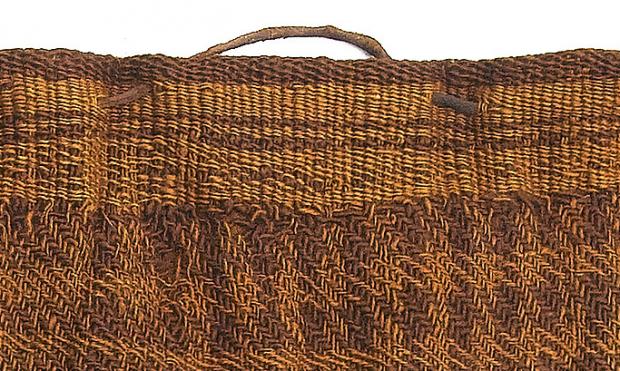
Peaty bogs are perfect for the conservation of clothes and textiles. In the National Museum of Denmark an internationally renowned collection of persons are on view. New scientific investigations show that – contrary to what was formerly believed –the preserved pieces of clothing and other textiles were both coloured and patterned. The new findings are the result of a study of 180 textile samples from 26 different bog finds. Ulla Mannering, a senior researcher and archaeologist at the Danish National Research Foundation’s Centre conducted the study for Textile Research at the National Museum.

The conventional theory was that colourful textiles only emerged in the centuries after the birth of Christ. Complicated technical research done in Belgium has however shown that colors were unknown during the bronze Age. The it exploded. “The beginning of the Iron Age (app. 500 BC) sparked a revolution in fashion in which clothes became coloured and patterned,” says Ulla Mannering, according to ScienceNordic , and continues: “Our analyses show – quite surprisingly – that colour and pattern came into fashion in the earliest part of the Iron Age. That’s 500 years earlier than previously thought.”
Further, her findings challenge the idea, that the “Bog-People” came from the lowest rung of the social ladder. Her personal opinion is that this view must be revised. “Because they were buried in a context, which is totally alien for us, it does not mean that they were destined to be sacrificed or punished”, she says.
One bog body, the woman from Huldremose, has been of particular interest to Manning and her colleagues : the Huldremose-Woman, who was found in 1879. According to Ulla Mannering, she must have been a rich lady. She wore a long skirt and a scarf, along with a petticoat woven with fibres from nettles. Furthermore she was wrapped in fur coats made from the skin of 14 sheep. Not only was her costume of high quality; it was also coloured in a multitude of colours like red, yellow and blue.
All of the colors may be found in the wild flora of Denmark. However, for instance Vajd demands a lengthy and complicated preparation before the dye can be extracted.
Links to the scientific publications of the research may be found at the presentation page of Ulla Mannering.