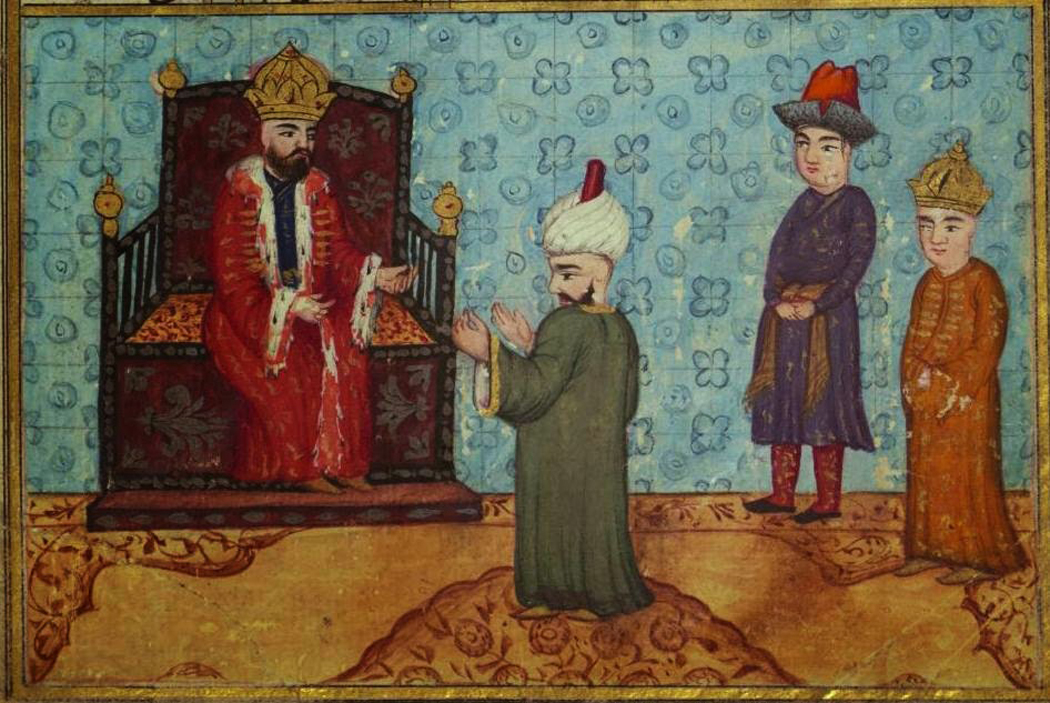
Medieval Anatolia was a hotspot for cultural interaction between Christians and Muslims. New book aims to present an overview over current research
Islam and Christianity in Medieval Anatolia
by A.C.S. Peacock, Bruno De Nicola and Sara Nur Yildiz (Eds)
Ashgate 2015
ISBN-10: 1472448634 ISBN-13: 978-1472448637
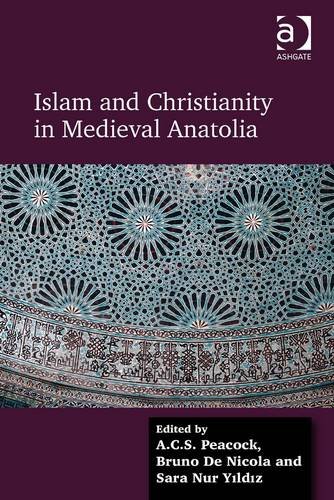 Islam and Christianity in Medieval Anatolia offers a comparative approach to understanding the spread of Islam and Muslim culture in medieval Anatolia. It aims to reassess work in the field since the 1971 classic by Speros Vryonis, The Decline of Hellenism in Asia Minor and the Process of Islamization which treats the process of transformation from a Byzantinist perspective.
Since then, research has offered insights into individual aspects of Christian-Muslim relations, but no overview has appeared. Moreover, very few scholars of Islamic studies have examined the problem, meaning evidence in Arabic, Persian and Turkish has been somewhat neglected at the expense of Christian sources, and too little attention has been given to material culture.
The essays in this volume examine the interaction between Christianity and Islam in medieval Anatolia through three distinct angles, opening with a substantial introduction by the editors to explain both the research background and the historical problem, making the work accessible to scholars from other fields.
The first group of essays examines the Christian experience of living under Muslim rule, comparing their experiences in several of the major Islamic states of Anatolia between the eleventh and fifteenth centuries, especially the Seljuks and the Ottomans.
The second set of essays examines encounters between Christianity and Islam in art and intellectual life. They highlight the ways in which some traditions were shared across confessional divides, suggesting the existence of a common artistic and hence cultural vocabulary.
The final section focuses on the process of Islamisation, above all as seen from the Arabic, Persian and Turkish textual evidence with special attention to the role of Sufism.
TABLE OF CONTENTS:
Introduction, A.C.S. Peacock, Bruno De Nicola and Sara Nur Yıldız.
Part I Christian Experiences of Muslim Rule:
- Christians in the Middle East, 600-1000: conquest, competition and conversion, Philip Wood;
- Christian views of Islam in early Seljuq Anatolia: perceptions and reactions, Alexander D. Beihammer;
- Patterns of Armeno-Muslim interchange on the Armenian plateau in the interstice between Byzantine and Ottoman hegemony, S. Peter Cowe;
- The rape of Anatolia, Scott Redford;
- Liquid frontiers: a relational analysis of maritime Asia Minor as a religious contact zone in the 13th-15th centuries, Johannes Preiser-Kapeller;
- The Greek Orthodox communities of Nicaea and Ephesus under Turkish rule in the 14th century: a new reading of old sources, Johannes Pahlitzsch.
Part II Artistic and Intellectual Encounters between Islam and Christianity:
- Byzantine appropriation of the Orient: notes on its principles and patterns, Rustam Shukurov;
- Other encounters: popular belief and cultural convergence in Anatolia and the Caucasus, Antony Eastmond;
- 13th-century ‘Byzantine’ art in Cappadocia and the question of Greek painters at the Seljuq court, Tolga B. Uyar;
- An interfaith polemic of medieval Anatolia: Qāḍi Burhạ̄n al-Dīn al-Anawī on the Armenians and their heresies, A.C.S. Peacock;
- ‘What does the clapper say?’ An interfaith discourse on the Christian call to prayer by ʿAbdīshōʿ bar Brīkhā, Salam Rassi.
Part III The Formation of Islamic Society in Anatolia:
- Sunni Orthodox vs Shiʿite heterodox?: a reappraisal of Islamic piety in medieval Anatolia, Rıza Yıldırım;
- Mevlevi-Bektashi rivalries and the Islamisation of the public space in late Seljuq Anatolia, Judith Pfeiffer;
- Battling Kufr (unbelief) in the land of infidels: Gülşehri’s Turkish adaptation of ʿAṭṭār’s Manṭiq al-Ṭayr, Sara Nur Yıldız;
- Islamisation through the lens of the Saltuk-name, Ahmet T. Karamustafa.
- Bibliography
- Index
ABOUT THE AUTHORS:
About the Editor: Andrew Peacock is Reader in Middle Eastern Studies in the School of History, University of St Andrews, UK and is Principal Investigator of the European Research Council-funded research project ‘The Islamisation of Anatolia, c. 1000-1500’.
Bruno De Nicola is Research Fellow in Middle Eastern Studies in the School of History, University of St Andrews, UK.
Sara Nur Yıldız is a Research Fellow at the University of St Andrews, UK, employed on a European Research Council-funded research project entitled ‘Islamisation of Anatolia, c. 1100-1500’ and is affiliated with the Orient-Institut Istanbul, Turkey.