Recent scientific studies of the bias involved in detecting the DNA of Yersinia pestis in buried individuals from the mid-6th century must lead to a re-evaluation of the consequences of the Justinianic plague.
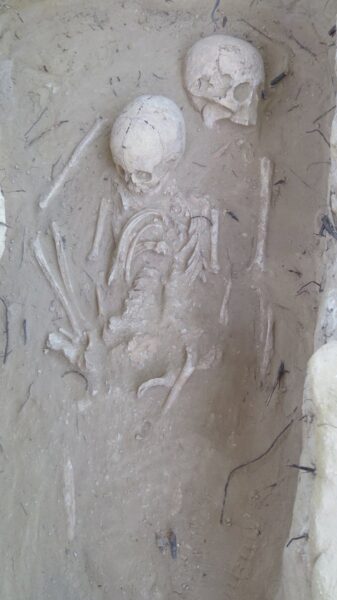
In AD 541, a devastating pestilence known as the Justinianic Plague spread across the Mediterranean, wreaking havoc throughout Europe over the following centuries.
In recent years, historians and archaeologists have debated how devastating the Justinianic plague may have been. On the one hand, multiple studies of literary evidence as well as proxies – such as mass graves in burial grounds, the abandonment of settlements, new agricultural systems, afforestation, contraction of mercantile networks and trade, etc. – have supported a maximalist position: that the Justinianic plague together with other “catastrophies” played a significant and devastating effect on life in early medieval Europe.
On the other hand, the continued low and sporadic presence of aDNA from Yersinia pestis, detected in individuals buried in mass graves and dated to the mid-6th century, has been used to argue that the plague was much less virulent than suggested by the proxies invoked by maximalists (coin production, palynology, etc.). A more complex set of potential causes – including widespread wars, famines, and other pestilences – should therefore be considered, as minimalists such as Lee Mordechai and Merle Eisenberg argued in 2019 in two widely debated studies, with which especially Mischa Meier has engaged in a somewhat vitriolic debate. Until now, though, the lack of hard-core evidence has kept the jury lingering.
Recent scientific work on transmission routes (since 2020), a new study on the presence of black rats, and, not least, a reassessment of the methods used to extract aDNA from dental pulp raise important questions about the minimalist position. To this should be added a number of new studies documenting victims of Yersinia pestis in additional locations, not least in the Iberian Peninsula.
Transmission routes
One of the key issues is that, depending on the transmission route of the plague, its effects vary markedly. For instance, aerosol transmission leads to the highly virulent pneumonic form, where mortality may approach 100%. However, this form tends to limit further spread, as victims die before transmitting the contagion widely. By contrast, the more common route – involving rats or other hosts infecting fleas, and from there humans, producing the typical bubonic form – yields mortality rates of c. 60%, allowing greater scope for wider contagion.
In a recent study – notably carried out by scholars associated with the “minimalist” camp – the spread and mortality of different transmission types were modelled using the size and structure of the population of Constantinople in AD 542, from which vivid contemporary descriptions survive. This modelling showed that the pneumonic form alone could not account for the scale of devastation described in the sources. However, bubonic or bubonic–pneumonic transmission, which features prominently in textual accounts, could plausibly produce outcomes consistent with these descriptions. In other words, the death tolls reported in contemporary sources were not only possible but may even have been conservative relative to modelled scenarios.
Nevertheless, the authors – Lauren White and Lee Mordechai – conclude that, “regardless of its effect in Constantinople, the Justinianic Plague would likely have had differential effects across urban areas around the Mediterranean”, as “there is very little evidence for sufficient rat populations in the premodern Mediterranean to sustain a pandemic”, given that rats and fleas are considered the principal vectors of the disease.
Rats galore – and Marmots
However, a study from 2022 presenting a palaeogenomic analysis of the black rat (Rattus rattus) reveals multiple introductions into Europe associated with human economic history. These findings indicate that black rats were introduced into the Mediterranean from Southwest Asia, proliferating during the hot and humid climate during the Roman Optimum to be followed by a marked decline in the early medieval period. The authors conclude that this depletion of rats and carriers likely occurred “after the First Plague Pandemic and/or post-Roman cooling”. This study demonstrates that rats were indeed present and continued to spread until their populations were negatively affected by climate deterioration, the decline of grain shipments, and/or as an after-effect of the Justinianic plague. Thus one of the main preconditions for a widespread pandemic, rats carrying the plague on ships across oceans, was present. However, added to this should also be the fact that plague may be carried by other animals of which more than 200 have been listed. Infected fleas are not picky and may indeed infect numerous animals some of which may later develop into hosts in local reservoirs, such as the Great Gerbil in present-day Himalaya. It is assumed that later epidemic events might be caused by interactions between such “local” hosts and people.
Ancient DNA and new laboratory techniques
Arguably, the discovery of individuals in burial grounds carrying aDNA from Yersinia pestis across such diverse regions as Britain, France, Germany, Spain, and recently also Constantinople and parts of the Middle East, is remarkable in itself. We are dealing with the proverbial needle in a haystack, as detection depends first on the archaeological identification of mass graves. The cost of randomly testing graves for the pathogen remains prohibitive.
Secondly, only victims suffering from primary or secondary septicaemia – that is, a blood-borne manifestation – are detectable archaeologically. Yet we know that many victims did not reach this stage before death. More often, death appears to have resulted from organ failure before systemic infection had fully developed.
Thus, although ancient DNA preserved in dental pulp offers one of the best opportunities to characterise the genomes of some of the deadliest pathogens in human history, the pathogen must have entered the bloodstream to be detectable there.
Furthermore, a recent study has shown that the laboratory techniques hitherto used to detect aDNA in skeletal remains must now be revised, as they appear to have produced a significant number of false negatives.
This was demonstrated in a study of 120 teeth from 89 individuals in French mass graves and cemeteries associated with the Second Plague Pandemic (the Black Death).
By tracking the kinetics of ancient Yersinia pestis DNA released during pre-digestion of dental pulp, the researchers found that most DNA was released within 60 minutes at 37°C under experimental conditions.
In practice, the researchers first applied the “old” standard method to 33 teeth, subjecting dental pulp powder to a two-step process: pre-digestion in extraction buffer for one hour at 37°C, followed by overnight incubation with agitation at 42°C. This procedure yielded less than 0.93% detectable Y. pestis DNA in the samples, despite the burial ground being a well-documented plague site. A reduced procedure using only the initial step resulted in detection rates between 37% and 98% – a three- to fourfold increase.
Consequences for earlier studies of Yersinia pestis aDNA
These findings have significant implications for earlier aDNA studies that relied on the older methodology, where one of the most puzzling features has been the sporadic presence of Yersinia pestis DNA in some human remains but absent in others. For example, in mass graves containing multiple individuals and clearly buried simultaneously, often only a single individual has tested positive for plague.
Taken together, the new findings on transmission modelling and the presence of rat vectors should prompt a reassessment of the minimalist approach to estimating the severity of early pandemics such as the Justinianic plague.
In particular, they call into question the weight placed on the sporadic detection of aDNA in skeletal remains from the mid-6th century – a line of evidence that has played a disproportionate role in minimalist interpretations.
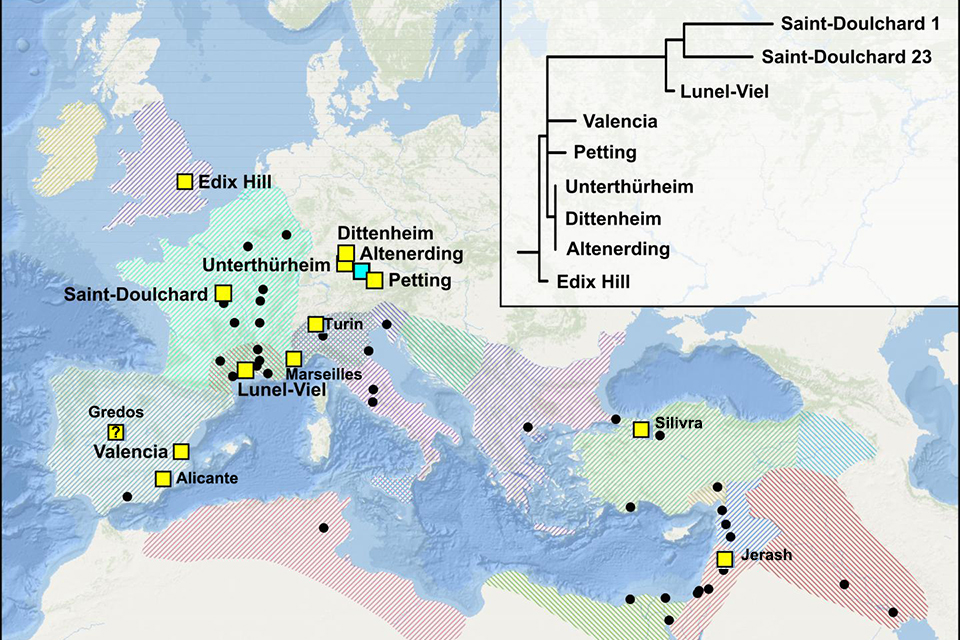
MAP:
The map shows the locations where DNA of Yersinia Pestis from the first pandemic (The Justinianic Plague) has been identified (yellow squares). Black Spots mark the places where written or epigraphic sources document the pandemic. Source: Map is based on work published in the following article and presented in a press release: Die Analyse von acht neu rekonstruierten Pestgenomen der ersten historisch überlieferten Pestpandemie offenbart eine bisher unbekannte Diversität und erbringt erstmals den genetischen Nachweis der Justinianischen Pest auf den Britischen Inseln. Here brought up to date with recent aDNA-finds in Europe (2026) based on The Justinianic Pandemic in the Iberian Peninsula by Henry Gruber et al. In: Human Ecology, 2025. The aDNA find in the foothills of the Sierra de Gredos are still waiting publication (April 2026).
SOURCES:
For the discussion of maximalist and minimalist positions
Meier M. The ‘Justinianic Plague’: the economic consequences of the pandemic in the eastern Roman Empire and its cultural and religious effects. Early Medieval Europe. 2016;24(3):267–292.
Mordechai L, Eisenberg M. Rejecting catastrophe: the case of the Justinianic Plague. Past & Present. 2019 Aug;244(1):3–50.
Mordechai L, Eisenberg M, Newfield TP, Poinar H. The Justinianic Plague: an inconsequential pandemic? Proceedings of the National Academy of Sciences of the United States of America. 2019 Dec 17;116(51):25546–25554.
Meier M. The ‘Justinianic Plague’: an “inconsequential pandemic”? A reply. Medizinhistorisches Journal. 2020;55(2):172–199.
Mordechai L, Eisenberg M, Newfield TP, Izdebski A, Kay J, Poinar H. Quantitative analysis and plagued assumptions: a response to Mischa Meier. Medizinhistorisches Journal. 2020;55(3):290–293.
McCormick M. Gregory of Tours on sixth-century plague and other epidemics. Speculum. 2021;96(1):38–96.
Sarris, P. Viewpoint New Approaches to the ‘Plague of Justinian’ Past & Present, 2022; 254 (1): 315–346,
For the new scientific studies
White LA, Mordechai L. Modeling the Justinianic Plague: comparing hypothesized transmission routes. PLoS One. 2020;15(4):e0231256. Available from:
Clavel P, et al. Improving the extraction of ancient Yersinia pestis genomes from dental pulp. iScience. 2023 May 19;26(5):106604.
Yu H, et al. Palaeogenomic analysis of black rat (Rattus rattus) reveals multiple European introductions associated with human economic history. Nature Communications. 2022;13:2399. Available from: