The Karlštejn Treasure is a collection of around 400 objects dating back to the 14th century. On show now (2016) this is an extra reason to make the trip from Prague into the Czech countryside.
 he Karlštejn Treasure consists of two parts: the first involves of a number of representative golden drinking cups such as a precious gilded bowl with enamel decoration, several silver goblets and a gilded bowl with the portrait of a woman wearing a royal crown. The other part consists of fashion accessories – jewellery, buttons, clasps, pendants etc. One unique object is a pomander intended to wear hanging from the waist and holding aromatic herbs. Such buttons, hooks and clasps were invented in the 14th century, when tight close fitting dresses and doublets became fashionable during the time of Henry IV.
The tejn treasure was hidden behind a wall in the castle, probably during the Hussite wars in 1421 to 22, when the castle was under siege. It was not found until restoration work began in the 19th century. At this point the treasure was sold to a renowned collector Henry Waldes. Later, his factory was nationalised in 1947 and the treasure was deposited at the Museum for Decorative Art in Prague.
The items in the treasure cannot be directly linked to Charles IV. However, there is no doubt that the objects belonged to his world. As such, they give a unique insight into his daily life


Courtly Outfits and Dresses
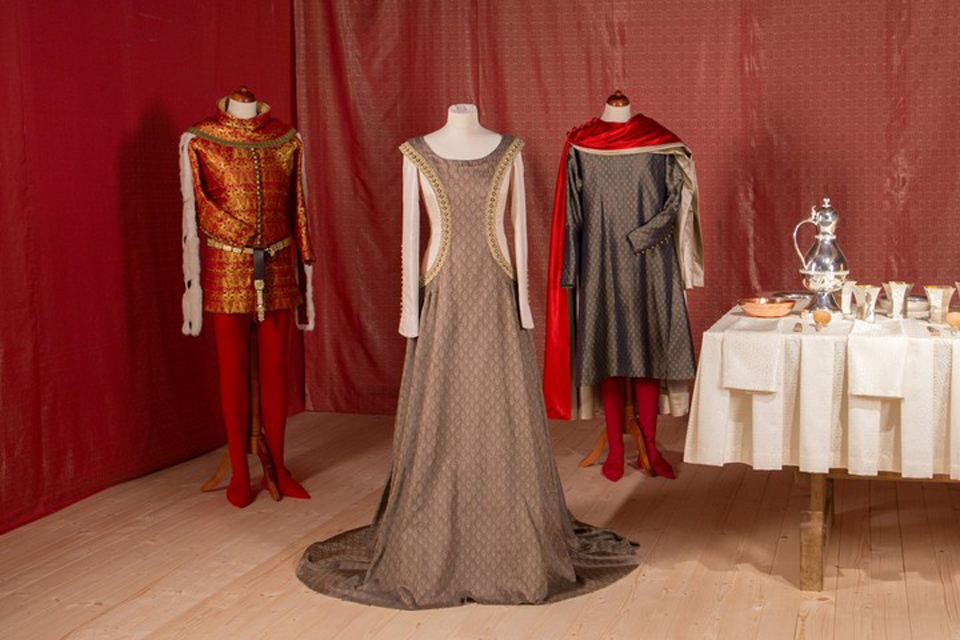
Based on the artefacts in the Karlstejn Treasure and combined with fragments of textiles found in the royal burial vaults in Prague in St. Vitus plus other written documentation, the Castle in Kalrstejn has worked to reconstruct the outfits of Charles IV, Wenceslas IV, Elizabeth of Pommerania and a cardinal, Jan Ocko von Vlasim. The Barrandov Studio has reconstructed the outfits as commissioned by the National Heritage Institute. It took more than 365 hours just to hand-sew the clothes. Just the doublet took almost 100 hours to make. The reconstruction was based on silk brocades found in the royal tombs (the are currently on show in the castle in Prague).
Charles’s outfit is made on the basis of the mural in the Chapel in the Castle of Karlstejn, where Charles receives a relic. It consists of a scarlet cape lined with grey silk. Beneath he wears a tunic and read trousers. The dress of Elizabeth of Pomerania is reconstructed from an illumination in the Grandes Chroniques des France, where Charles greats the sister of his first wife, She wears along dress with the arms fitted with densely sewn buttons. Above she wears a grey silk surcote with the large fashionable armholes. The clothes of the heir, the later Wenceslas IV, have been copied from the votive painting. Here, he is seen as wearing red trousers, a doublet of scarlet gold brocade and a short cape lined with ermine. Finally, the cardinal’s liturgical vestments have been recreated, including his mitra and liturgical gloves.


The Recreation of a Festive Meal
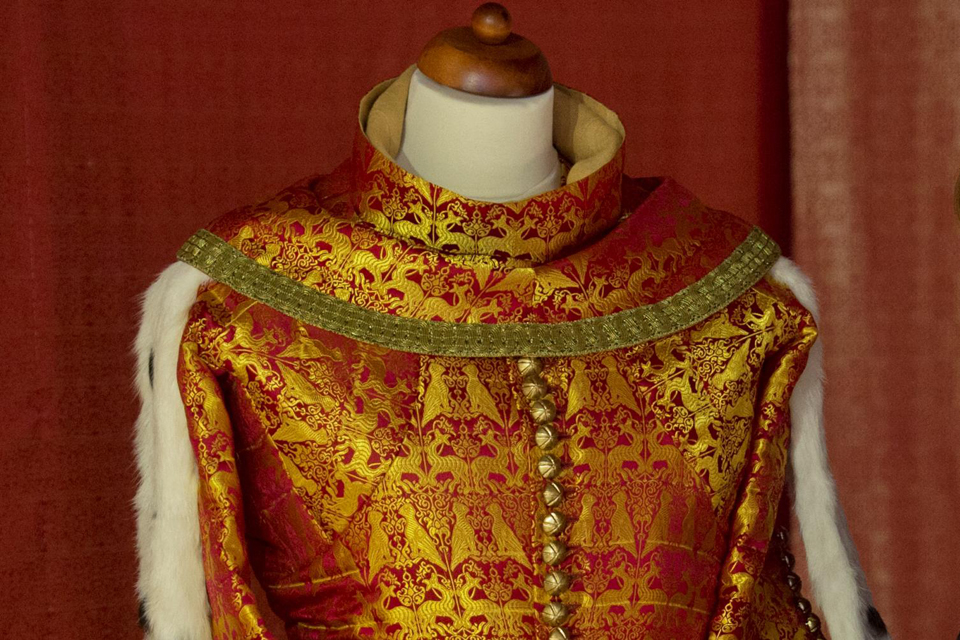
These outfits are lovingly exhibited in front of the recreation of a very well documented festive meal, held during the Christmas celebrations in Paris in 1377, when Charles together with Wenceslas visited his nephew, the French King.
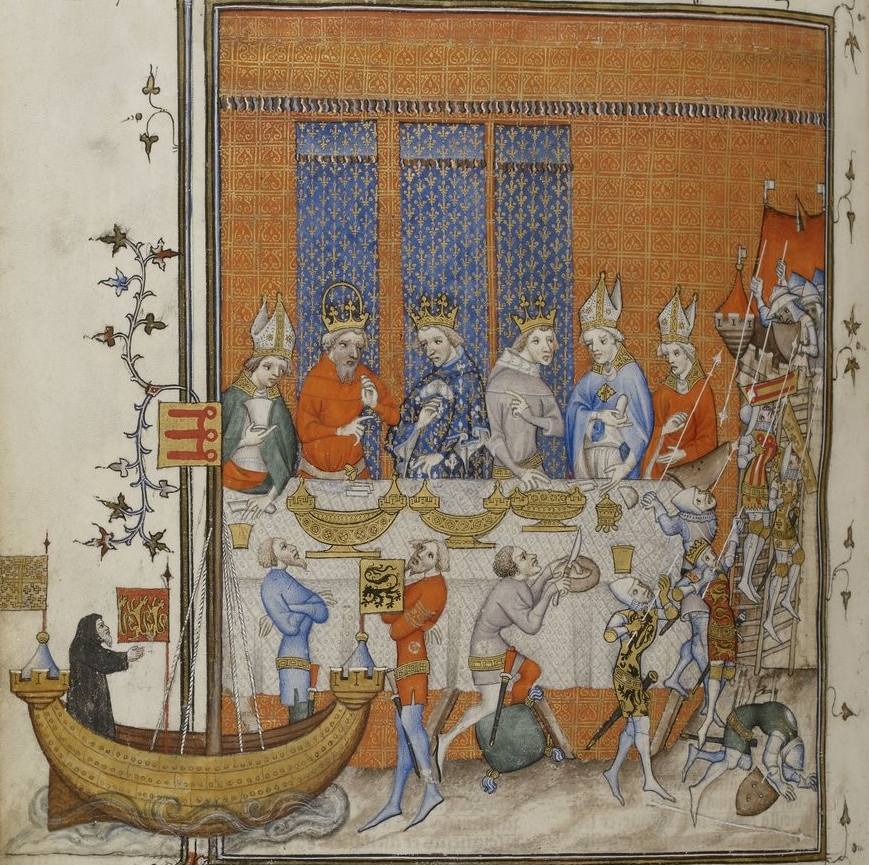
At this event the Charles IV, Wenceslas and the Frenchs King sat down to a table. At the back were wall-hangings made of brocade with interwoven French lilies and lined with velvet. In the reconstruction, the pattern of the hanging has been taken from the dalmatica, which Charles wore in his grave. At this event, the king had ordered four courses with a total of forty pairs of dishes. However, in the end, the meal was cut short because of the Emperors illness and the sweets – sweet peers, green apples and nuts – and wines of the fourth course were partaken in the Great Hall of the Parliament next door.
In between the courses, two spectacles or interventions were staged, both of which may be seen in the illumination from the Grandes Chroniques, which told about the visit in detail.
The first of these interventions was constructed around a mock ship placed at the end of the hall filled with knights embalking on the voyage of the First Crusade to the Holy Land. At the bow of the ship the story tells us that Peter, the Hermit stood. We can see in the illustration what it might have looked like. The second intervention consisted of a dramatisation of the taking of the Castle of Jerusalem by Godfrey of Bouillon as is also shown in the vignette otherwise showing the French king, while entertaining his guests.
This festive mail took place in the old palace of Saint-Louis at the Ile de la Cité in the Great Hall and more than 800 took part. This hall measured 935 m2.

VISIT:
Karlstejn Castle and the Karlstejn Treasure
SOURCE:
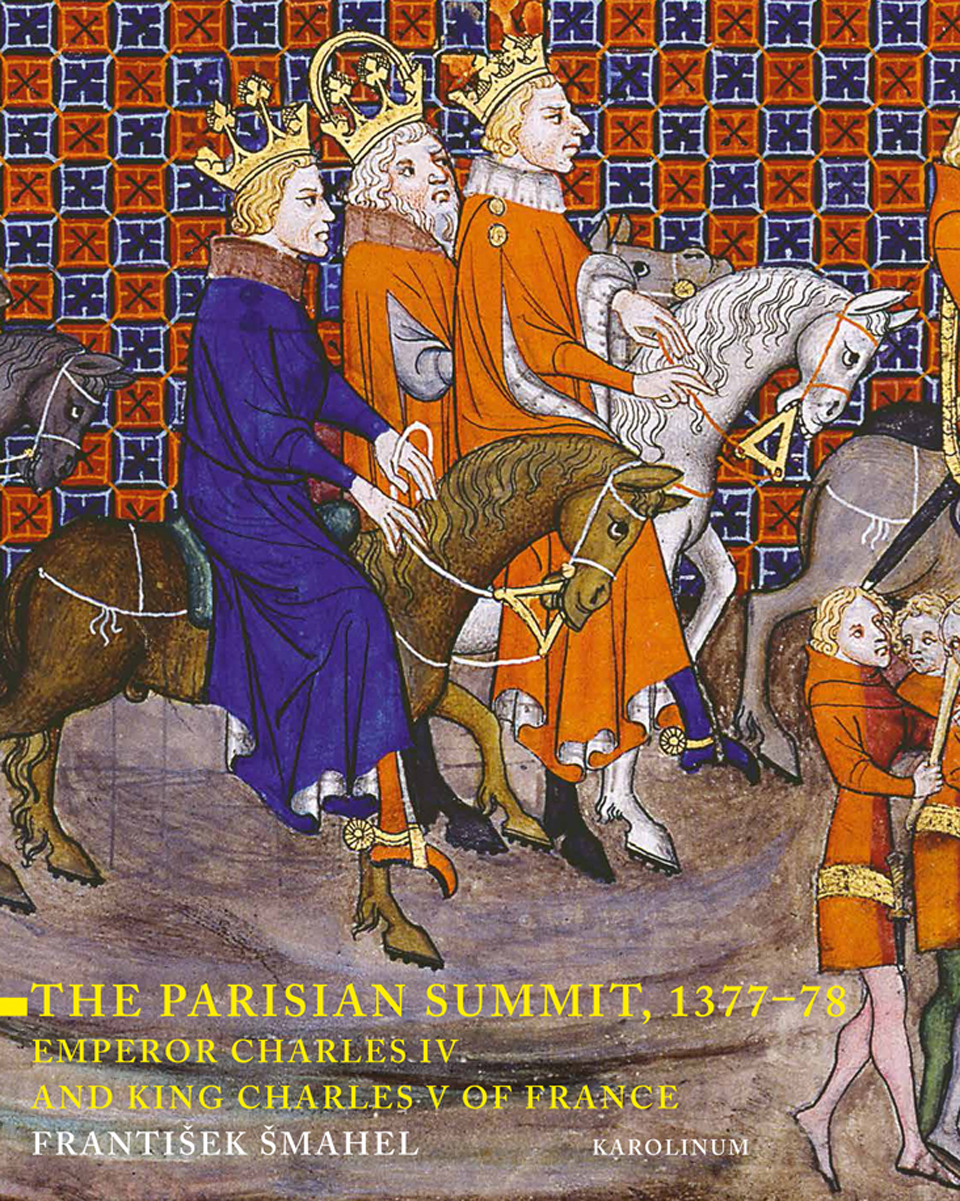 The Parisian Summit, 1377 – 78. Emperor Charles IV and King Charles V of France
By František Šmahel
Karolinum 2015
ISBN 9788024625225
READ MORE:
In the Barrandov workshops another unique work of art comes into being; the crown of the Holy Roman Emperor Charles IV – Press Release