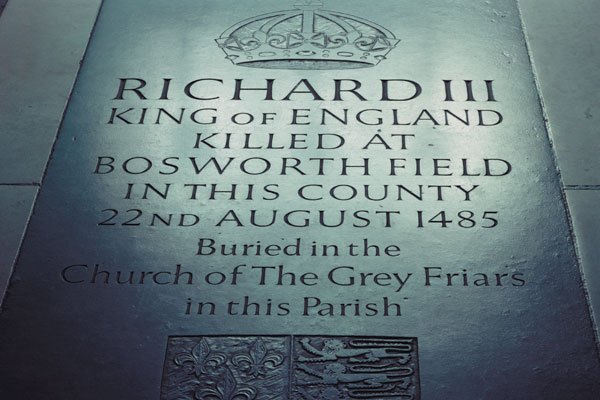
Leicester Cathedral is the obvious choice. Nevertheless two rival societies are fighting over what may be the bones of Richard III
While scientists are busy trying to extract and analyse the DNA of the presumed skeleton of Richard III, two organisations are fighting to have their say about the future place for the reburial of the remains – Leicester, where the king was taken after his death at the battle of Bosworth, or York Minster, where it is presumed he planned to be buried together with his wife and their only son.
One of these organizations, Richard III Society, which is responsible for the archaeological initiative, recently paid tribute to chief instigator Phillipa Langley, who is secretary of the Scottish Branch of the Society. According to The History Blog Philippa Langley, secretary of the Scottish Branch of the Richard III Society, who has spent years working to make the dig happen, is firmly on Leicester’s side, both for historical and practical reasons.
“When I started the process everybody said the remains should stay in Leicester. There’s a huge case for that because he’s been here for the past 527 years and it’s the Leicester authority which has paid for the dig and provided assistance from the start.” She says, York Minster waited 15 years before agreeing to house a stained-glass window dedicated to Richard. “It worries me to think the same will happen with the remains,” she says to the History Blog. “The problem is that York Minster is full and there might not be anywhere for him. I don’t want the body sitting around for more than decade before they decide where they’re going to put him”.
Two petitions
But the society is not the only player in the field. Although it took a few days after the find was announced for the Richard III Foundation, a competing organisation, to find a suitable way of reacting, they were quick to act. Soon the Foundation issued a press release congratulating the Society, while at the same time launching an online petition in order to gather support for a future reburial at York. So far 573 have signed this, many from overseas.
Now, as a counter move, a pensioner, Roy Shakespeare, living in Hinckley near Bosworth in Leicestershire has launched an alternative petion on the internet. So far more than 140 people have signed up. According to the Hinckley Times, he was “a bit annoyed at all the polls and petitions from people from America and all sorts of places clambering for the bones to be buried at York”. He further voiced it as his opinion that “York is a great place, but there is such a lot going on and it’s very expensive for a day out because there is so much to do”. In his opinion, “Leicester has not got a great deal for the general public and it would be a real boost for the economy there”.

Tourism
In this he might very well be right. Much is at stake in terms of tourism. Already at the Press Conference announcing the find, the Mayor of Leicester noted the future value of turning Leicester into a pilgrim-site for Richardians – people fascinated by this king, his moral fibre (or lack thereof). This matter was even later raised in the Parliament.
Recently a series of reports have been presented, reviewing the tourism business in Leicestershire County. Each year the County invests nearly £200.000 in supporting tourism (down 30% from 2011). According to a report from May 2012 tourism in Leicestershire has performed slightly worse from 2008 – 10 than expected compared to the rest of Britain. The value of the sector in Leicestershire was in 2010 £872 million (down from £902 million in 2009) with a corresponding reduction in the number of jobs at 13.5%. The research behind the brings a list of objectives, one of which is the need to transform day visitors to overnight guests.
In this perspective it is interesting to review the facts and figures for Bosworth Battlefield. Apart from Melton Mowbray with the food market, Bosworth is in fact the location par excellence, whither people might travel from afar. Further it is the place in Leicestershire (in a survey from 2008) where most people are willing to travel on “a day out”. No doubt there is room for a concerted effort to develop the Richardian tourist trail by adding a final resting place to the itinerary. In the end it might turn out to be highly advantageous for Leicester in the long run, if the local authorities invest properly. What Richard III himself might have thought of being turned into a tourist asset is 527 years after his death is quite another matter.
Who decides?
In the end, the decision about the re-interment will have to be made by someone. The chances are however that neither of the two polls will play any role at all in the decision.
According to an interview with the Bishop of Leicester, local views are likely to determine the outcome, because the man – whatever his identity – was buried at Greyfriars in what was and still is the Parish of Leicester Cathedral; this implies that it is legally a local decision to be made at the level there – though of course as stated by the Bishop after consultation with the proper organisations and institutions, including the Palace.
As to the state funeral, the question according to the Bishop remains whether there was a proper funeral back in 1485 or not; (which definitely seems to be the case); if so the service in connection with a re-interment will necessary have the character of a memorial service and less that of a funeral as such. As stated by the Bishop there are definitely liturgical precedents for such a service, which should be carefully considered.
Read other articles about Richard III and the dilemmas and politics in connection with the reburial.