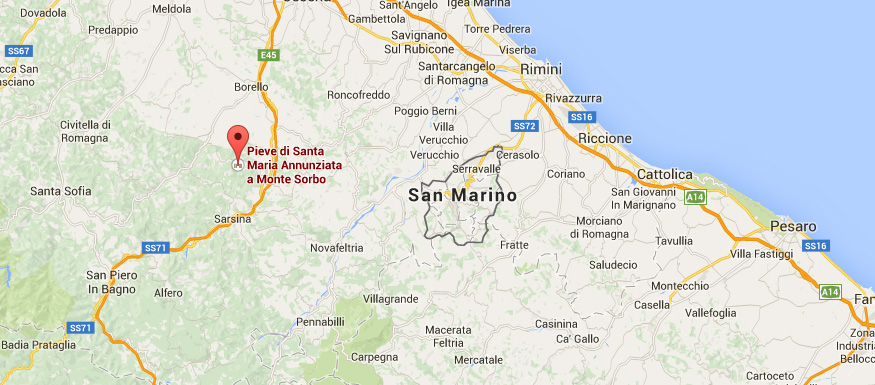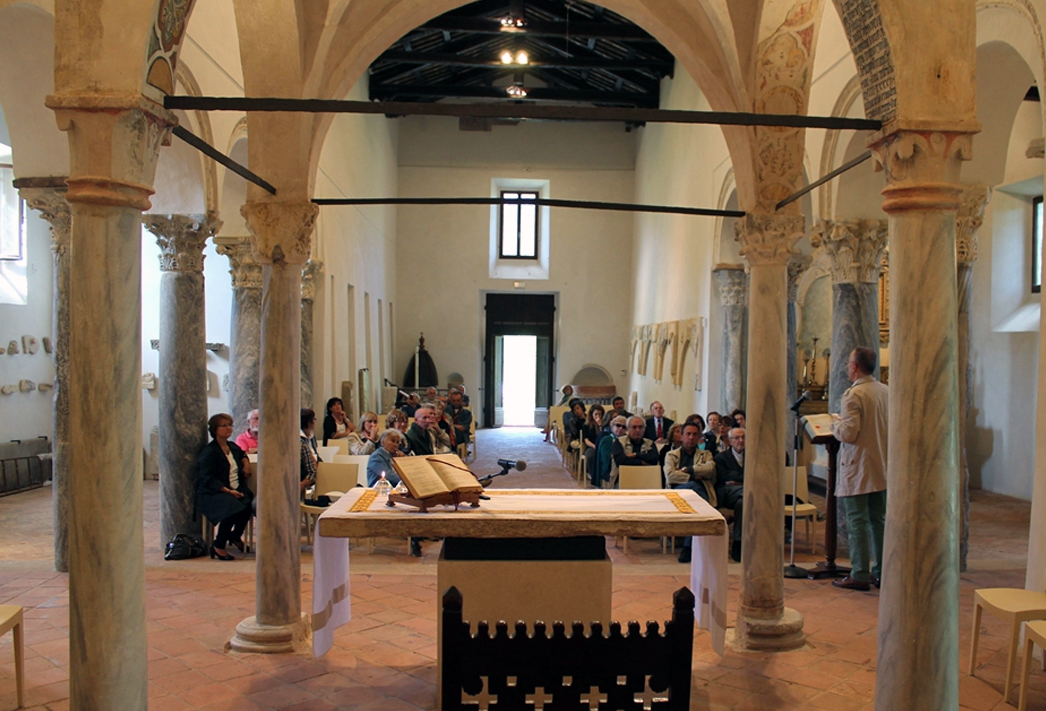
Along a small scenic route leading into the hilly countryside not far from Sarsina on the motorway between Ravenna and Citta di Castello lies a small church. Although secluded it is well worth a detour.
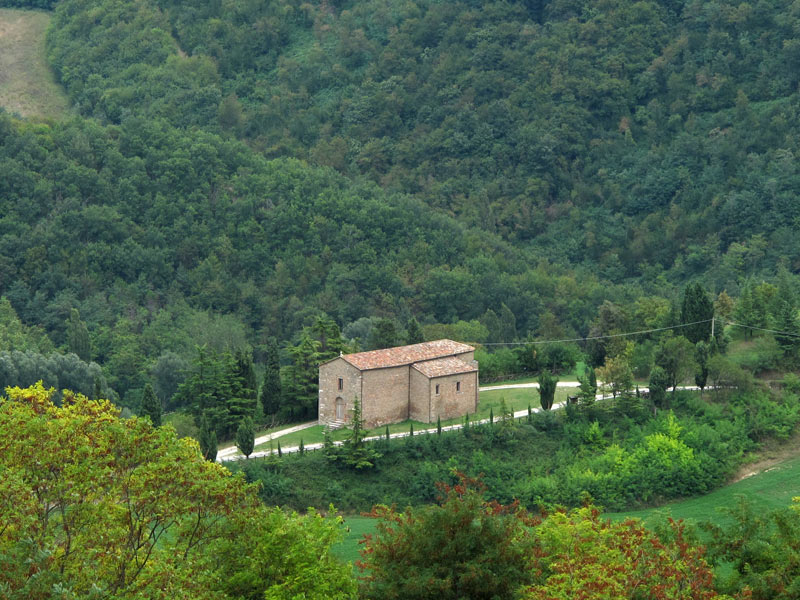 Maria Annunziata di Monte Sorbo – or Pieve di Monte Sorbo – is a beautiful Romanesque church, originally founded in the 8th century. It lies in the Valley of Savio, which was an important thoroughfare for people travelling to Rome from Ravenna. Early on, it must have been an important local centre, for – apart from the fancy construction and architectural grandeur (use of ancient spoliae), we can read on one of the tombstones in the church that a bishop from nearby Sarsina by the name of Florentius was buried there in 995. It has been speculated that the church was part of a local hospice or pilgrim- centre, located on the road between Ravenna and Rome; a road, which may have run another course than today. Or it may simply have been located near a hermitage of a local saint, Vicinius of Sarsina († AD 330). Even today, there is a local cult around San Vicinius and a dedicated pilgrimage-route – Il cammino di San Vicinio. It leads from Sarsina via Musella (the traditional location of the ancient hermitage) towards Monte Sorbo.
However, no written documentation of the foundation of the church have been found and archaeology points to a construction between the 8th and 9th centuries. The church is built like a Greek Cross, probably inspired by the Byzantines in Ravenna and was heavily restored in the 12th century; hence its Romanesque outlook.
Recently the church has undergone a careful restoration and a group of scientists, historians and archaeologists have studied the church and its historical context in detail.
 One prominent detail is the columns and other building materials used in the construction of the church. These were obviously spoliae from Antiquity. Each element, which differs from the others, has been carefully studied under the microscope. Until now, the presumption was that the spoliae were taken from the Roman city of Sarsina and that is perhaps also the most straight forward explanation. This city was endowed with a series of monumental buildings like for instance a temple dedicated to the Oriental Gods and a public bath. Not far from Sarsina was located the famous Bagno di Romagno, an extra-urban sanctuary and spa facility (still running its business today). Most of the columns at Monte Sorbo dates from the 2d and 3d centuries, when building activities in the region were vibrant.
Another explanation, though, for the presence of the exotic marbles in the church is that they may have been sourced either at Ravenna or Rome. After the destruction of the imperial palaces both places had been literally turned into gargantuan quarries. One way of deciding this might be a detailed examination of the actual spoliae in order to decide where they were originally sourced. Such an analysis has recently been carried out.
What has been discovered is, that the columns, carved stones and other fragments have been sourced from a wide variety of quarries. To sum just some of the results up
- The fossiliferous limestone used to manufacture the gravestones and one pillar seems to have come from Aurisina, a village west of Trieste, which was a well-known quarry in Roman Antiquity and later. (For instance the stone was used for the huge slab, which covers the grave of Theoderic in Ravenna).
- The marble for the columns were originally sourced in either Greece or Turkey (probably near Ephesos).
- Capitals seem to have been sourced in a diverse set of locations both in Greece and Turkey.
What this amounts to is, that the chuch in Monte Sorbo must be characterised as a typical example of a early medieval building, skilfully constructed out of a diverse set of spoliae sourced either in the local city of Sarsina or further away (Ravenna or Rome – with Ravenna the obvious choice because of the possibility of dragging the columns up the river Savio), writes the authors.
SOURCES:
The Archtectural reuse of Roman marble and Stone Spolia in the Early Medieval Monte Sorbo Church (Sarsina, Central Italy) By F. Antonelli, P. Santi , A. Renzulli and S. Santoro Bianchi
In: Archaeometry 2015
Early View: 30.04.2015 DOI: 10.1111/arcm.12170
ABSTRACT:
The article present the results of a multi-method archaeometric study concerning the architectural elements reused in Monte Sorbo church (Sarsina, central Italy) between the eighth and ninth centuries ad. The provenance study has focused on classical marbles and stones, which clearly do not originate from the local Apennine geological formations and are thought to come from extra-regional sources. A large fraction of the tested marbles is from Asia Minor, coming from both the Proconnesian district on Marmara Island and, probably, the Hasançavuslar site near Ephesus (Greco scritto). Of the four remaining marbles investigated, one is from the Carrara district and three are from different Greek quarrying areas, such as Mount Pentelikon (Athens) and the Thasos and Paros islands. The data also highlight the reuse of decorated gravestones made of Pietra di Aurisina as architectonic elements. This limestone is a fossiliferous carbonate stone outcropping in the Trieste Karst region (north-eastern Italy), which was exploited by both the Romans and the Byzantines. The assignment of all of the columns of the central nave to the same source area provides an argument in favour of their provenance from a single monument, which was probably located in Sarsina or Ravenna, with the ‘colourful taste’ that is typical of the late Antonine and Severian periods.
ABOUT THE AUTHORS:
 F. Antonelli, Laboratorio di Analisi dei Materiali Antichi, Università IUAV di Venezia, Venezia, Italy
P. Santi, Dipartimento di Scienze della Terra, della Vita e dell’Ambiente, Università degli Studi di Urbino ‘Carlo Bo’, Urbino, Italy
A. Renzulli and S. Santoro Bianchi, Dipartimento di Scienze Psicologiche, Umanistiche e della Terra, Università ‘G. d’Annunzio’ 66100 Chieti Pescara, Italy
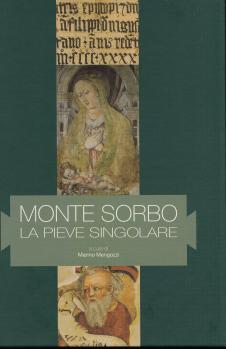
The article is an English presentation of a monograph published by the interdisciplinary team of historians, art-historians and archaeologists, who have studied the important church for a period of three decades.
Monte Sorbo: la pieve singolare.
Ed. by M. Mengozzi
Cesena: Editrice Stiligraf 2012