How should we wield toleration in the 21st century? May we perhaps learn from the Middle Ages? This question will be debated at Kalamazoo in May
How to make moral judgments when confronted with the recent appalling events in Kobani, Paris or Ferguson may seem easy. And yet, we have to acknowledge that apparently some people view them differently than does the majority. Which means that they posit a dilemma for us. On one hand, it seems we are (obviously) no longer able to play the game of tolerating every moral codex, we encounter, such as we used to demand of each other, when we were all supposed to be ‘politically correct’ and condone everything from cannibalism to polygamy. On the other hand the appalling events in Syria and Abu Ghraib have been busy teaching us to rethink our understandable wish to be basically ‘nonjudgmental’.
Further, this is happening at a time when more and more moral dilemmas seem to abound, which do not just touch upon questions of tolerance of abortions, same-sex marriages and assisted suicides, but increasingly also touch upon what toleration we shall accord the ways of lives of the ‘infidels’ – whether Jews, Christians and Muslims. What shall we for instance ‘think’ about circumcision, sharia, halal or shechita slaughtering, maintenance of male prerogatives concerning priesthoods etc.? It appears, we really don’t know how to wild proper ‘judgmental toleration’. In general, we are at a loss!
These are obviously questions, which have exercised the planning committee at The Medieval Academy, while organizing the upcoming meeting in Kalamazoo. Luckily for us, though, they have not kept their reflections for themselves. Instead they have made the decision to let these questions govern their choices of plenary lectures.
Modern Toleration Through a Medieval Lens: A ‘Judgemental’ View
The first lecture, which opens the conference, will be presented by Cary J. Nederman from Taxas A&M University and has the title ‘Modern Toleration through a Medieval Lens: A ‘Judgemental’ View. In his presentation Nederman will build upon the idea of ‘judgemental toleration’ as voiced by Michael Sandel, which calls us to assess ‘the moral worth or permissibility of the practice at issue, and permits or restricts it according to the weight of those moral considerations in relation to competing moral and practical considerations’[1].
This is no accident. In the philosophical reflection of Michael Sandel such venerable thinkers and theologians as Augustine and Thomas Aquinas have played a role. It appears ‘judgemental toleration’ is in fact an idea, which has been around for a long time.
In an earlier book on ‘Worlds of Difference. European Discourses of Toleration, C. 1100-C. 1550’, Nederman has done us a favor of presenting us with an impressive catalogue of other such important reflections. In the book he treats the positions of such diverse thinkers as John of Salisbury, William of Rubruck, Marsilio of Padua and Nicholas of Cusa
However, is it really true that “we may learn from our medieval ancestors”? Yes, says Cary Nederman: ‘In my paper I aim to consider how “judgemental toleration” may prove useful as a lens through which to view some issues arising in modern political theory, turning both to John Stuart Mill and to contemporary deliberative democratic theory. He continues: ’In sum, I attempt to demonstrate that in the case of an explicit and demonstrably medieval defense of tolerance, the lessons of the past are salient in the present, so that the early history of toleration provides vital and fruitful resources for understanding the limitations of classic liberalism and the potential for alternative routes to tolerant social and political institutions’.
It seems the time has come for us – once again – to learn how to wield ‘Judgemental Toleration’ when arguing for a better world. Inspiration may obviously be found at Kalamazoo in May. The Middle Ages does matter.
The Notion of the Middle Ages: Our Middle Ages, Ourselves.
But which ‘Middle Ages’? can we really use ‘the Middle Ages’ in this way, as a source for ethical reflection? And especially: Can we do this, when we touch upon ethical questions, which deal with more than queer issues and bioethics? What about such issues as “lived” religion? These are questions, which for some time have exercised the mind of the second plenary speaker in Kalamazoo 2015, Richard Utz, who is currently the leader of the distinct pack of scholars, who dabble in neo-medievalism inside the auspices of the ‘International Society for the Study of Medievalism’ (for which he is President).
In a spat of recent articles he has touched upon the fact that neo-medievalists seem to avoid religion; a fact, which he partly blames the reigning cultural etiquette for. Religion is – we have all been told – something ‘private, which should be treated with deference or better still, silence’ (Quoting Randy Cohen in NYTimes).
This is however, according to Utz, decidedly odd! Medieval Studies seem to be peopled with medievalists, who are busy finding refuge in a scholarly area, which allows them to simultaneously live out their academic and religious lives without continuously having to invent public or private excuses. It may be paradoxical lives, like those of C. E. Lewis’ and Tolkien’s, but at least they are still academically respectable in a way, which those of theologians seldom are. For many medievalists it is simply more than a boon ‘to have an intellectual habitat in journals accepting of religious belief as part of academic discourse like Christianity and Literature’, Utz has written. It should obviously be of concern to neo-medievalists how proper medievalists go about their ‘medieval business of religion’. Not least – one imagines – when they try to ‘do’ judgmental toleration in their work on for instance crusading!
Cistercian saints
To what extent Richard Utz is going to focus on this particular ‘habit of the heart’ of medievalists is presently unknown. However, it seems apparent that the full programme of the meeting at Kalamazoo is bearing him out. Religion does play a very significant role.
Doing a word count is always a neat way to uncover what goes on at large and rambling conferences like that at Kalamazoo, which traditionally gathers more than 3000 scholars and participants, hosting more than 550 sessions and 90 business meetings plus performances, exhibitions, concerts and much more. Obviously, there is room for a panoply of diverse and even esoteric objects.
Nevertheless, the word-count does uncover a decided sleight in the list of prominent words (not counting obvious “institutional words” like university etc.):
- 80 Saint
- 62 Chaucer
- 56 Women
- 46 Cistercians
What we may discern from this is that when push comes to shove, it appears that mainstream American medievalists are primarily interested in studies of a plethora of saints, the writings of Chaucer, the lives of medieval women and the Cistercians.
Hopefully, participants at Kalamazoo will pause and take time to listen to the plenary lectures, which may perhaps help to broaden their minds…
Karen Schousboe
NOTES:
[1] Judgemental Toleration
By Michael J. Sandel
In: Natural Law, Liberalism, and Morality: Contemporary Essays, Ed, by Robert George
Oxford University Press 2001
ISBN-13: 9780199243006
SOURCES:
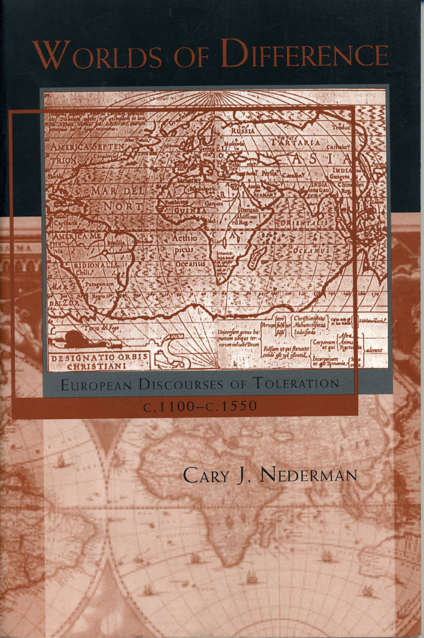 Worlds of Difference. European Discourses of Toleration, c. 1100–c. 1550
By Cary J. Nederman
Penn State University Press
Hardcover ISBN: 978-0-271-02016-7
Paperback ISBN: 978-0-271-02017-4
 Can We Talk about Religion, Please? Medievalism’s Eschewal of religion, and Why it Matters
By Richard Utz
In: This Year’s Work in Medievalism 2013, Vol. 28 (Special issue: Medievalism Now.)
Medievalism and the Subject of Religion.
By Richard Utz
In: Studies in Medievalism 24 (2015): 11-19
ABOUT THE LECTURERS:
Cary J. Nederman is professor of political science. His research concentrates on the history of Western political thought, with a specialization in Greek, Roman, and early European ideas up to the seventeenth century. He focuses on the relationship between historical traditions and contemporary theoretical concerns. He has also published in the field of comparative political thought. He is presently pursuing several lines of research, including book-length projects on the medieval reception of Cicero’s political philosophy and the role played by St. Thomas Becket’s career in twelfth-century political thought.
Richard Utz is Chair and Professor in the School of Literature, Media, and Communication at the Georgia Institute of Technology. His scholarship centers on medieval studies, medievalism, the interconnections between humanistic inquiry and science/technology, reception study, and the formation of cultural memories and identities. He currently serves as President of the International Society for the Study of Medievalism and editor of its review journal, Medievally Speaking, and its Proceedings, The Year’s Work in Medievalism.
FEATURED PHOTO:
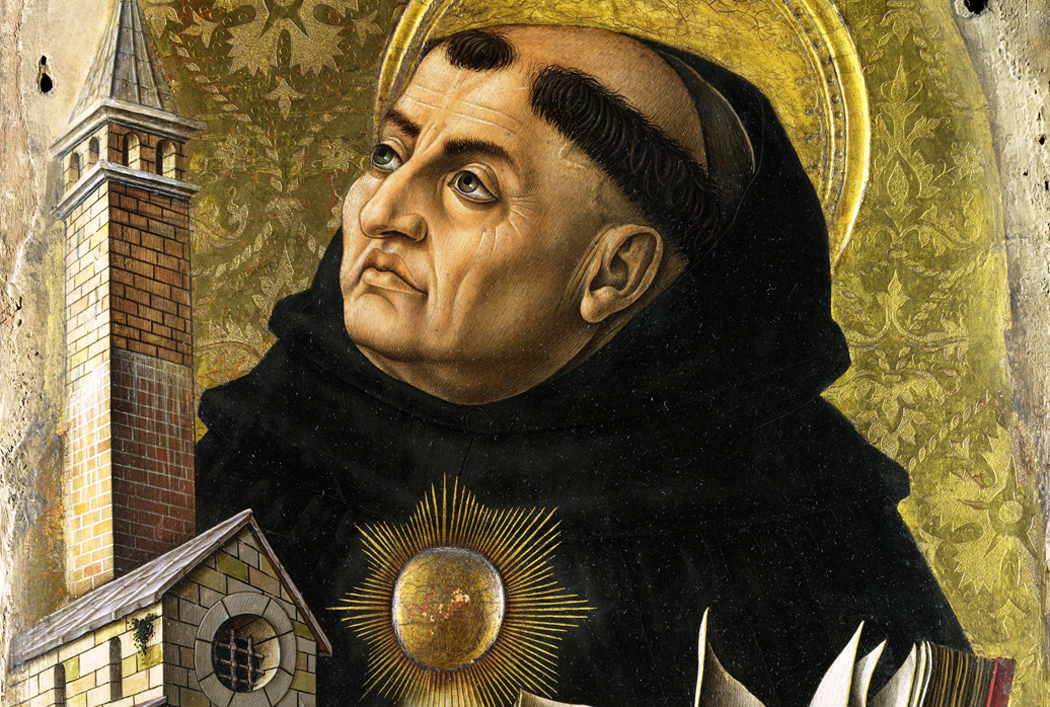
St. Thomas of Aquinas from an altarpiece in Ascoli Piceno, Italy, by Carlo Crivelli (15th century). Source: Wikipedia.
Michael Sandel expressly use Aquinas, when he tries to explain what judgmental toleration is. He writes that Aquinas: “conceded that ‘unbelief is the greatest of all sins’ – however in the case of Jewish rites he claimed that those rites ‘ which of old foreshadowed the truth of the faith which we hold, there follows this good – that our very enemies bear witness to our faith, and that our faith is represented in a figure, so to speak. For this reason, they are tolerated in observance of their rites’ . On (p 108) the other hand, Aquinas reasons, ‘the rites of other unbelievers, which are neither truthful nor profitable, are by no means to be tolerated, except perchance in order to avoid an evil, e.g. the scandal or disturbance that might ensue or some hindrance to the salvation of those who, if they were unmolested, might gradually be converted to the faith’ (Saint Thomas Aquinas: Summa Theologiae, 2:2 10.11). From: Judgemental Toleration
By Michael J. Sandel, p. 3 In: Natural Law, Liberalism, and Morality: Contemporary Essays, Ed, by Robert George, Oxford University 2001 Press, p. 3. (As Michael Sandel points out: we don’t have to agree with Thomas Aquinas in order to recognize the precise point, he is trying to make).