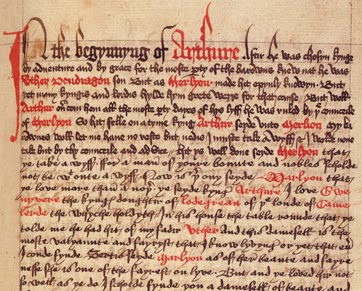
The manuscript of by Thomas Malory of Morte Darthur from 1480 is now digitised
What does one do when in prison? Write letters like Bonhoeffer (1906 – 1945)? Write philosophical treatises like Thomas Moore (1478 -1535)? Or write history like Sir Thomas Malory (1405 – 1471), who composed a lengthy rewriting in prose of the full story of Arthur and Camelot – Morte Darthur – later printed by William Caxton in 1485.
It has been a matter of contention, who Sir Thomas Malory was. However, scholars tend to agree that he is identical with the Sir Thomas Malory of Newbold Revel at Stretton-under-Fosse , who spent years in and out of prisons, while defending himself against a large catalogue of sordid crimes – rape, extortion and armed robberies. It appears from the text that at least parts of it must have been written while the author was incarcerated. For instance at one point it says: “For this was written by a knight prisoner Thomas Malleorre, that God send him good recovery”. Other parts must have been written while the author had access to a proper library filled with amongst other books, the great French “Vulgate Cycles”, containing prose rendering of the many and diverse tales of the Knights of the Round Table and the quest for the Holy Grail. Or did he have protectors, which furnished him with entertainment while languishing in Newgate?

The “Morte Darthur” by Sir Thomas Malory as printed by Caxton has been the prime source for countless retellings. It inspired Alfred Lord Tennyson’s “Idylls of the King”, Mark Twain’s “Connecticut Yankee” as well as films like the “Excalibur” from 1981 (and through this later adaptions like the TV-series “Merlin”).
However, even though the manuscript was not lost – it just lay hidden in the Winchester College Library – the text was only known from the edition by Caxton until 1934. The rediscovery of the manuscript ignited an intensive comparison of the texts, which revealed – amongst other things – how an early printer took liberties with his texts in order to fit the text to the page (much like graphic designers do these days if the authors are not careful in supervising them).
Recently the British Library digitised the Winchester manuscript presenting the public with the possibility of reading the book in its original form and promising that “the experience of reading the book in its manuscript form is quite different from that offered by modern editions, even those based on the Winchester version of the text.”
SOURCE:
Rediscovering Malory: Digitising The Morte Darthur
Full digitised Version of Morte Darthur
READ MORE:
Read more about Sir Thomas Malory
The Malory Manuscript
By Lotte Helinga and Hilton Kelliher.
In: British Library Journal 1977
The Camelot Project
The Camelot Project is designed to make available in electronic format a database of Arthurian texts, images, bibliographies, and basic information. The project, begun in 1995, is sponsored by the University of Rochester and prepared in The Robbins Library, a branch of Rush Rhees Library.