NEW RESEARCH: Negotiating normativities – ‘Odin from Lejre’ as challenger of hegemonic orders
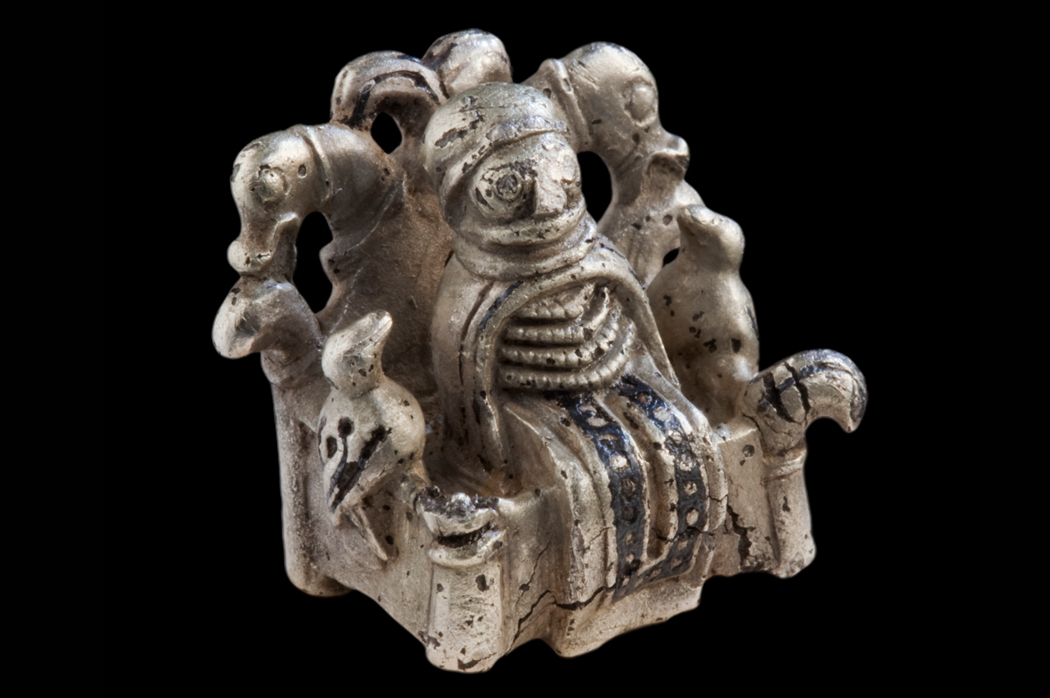
Major excavations in Lejre from 2008 – 09 in the old Royal stronghold in Eastern Denmark, yielded evidence of one of the largest mead-halls excavated as yet. Another intriguing find was a small silver statuette with niello inlay, no more than 1.72 cm x 19.8 cm x 12.4 cm. According to the official understanding, the figurine shows the God Odin, sitting on his throne, Lidskjalv. On each side of Odin from Lejre are the two birds, perhaps the ravens, Hugin and Munin, and behind him are his wolves, Geri and Freki. Around his neck is presumably the goldring, Draupner, which spawns 8 new goldrings every 9th night. As behoves Odin he is shown with a missing eye. As the myth goes he had to give Mimer an eye in exchange for the chance of drinking himself to unlimited wisdom in the well of Mimer.
However, due to some odd details this identification of the small figurine as Odin has been contested. Foremost “his” dress – the long garment and the pearls around the neck of the figurine – are by some believed to signal a female gender. Both can be found on a small pregnant figurine from Aska, which decidedly is female. On the other hand the figurine from Lejre not only boasts a male ring around his neck, but also – perhaps – a moustache. This is how Tom Christensen, the leading archaeologist
To this ambiguous character must be added the “wandering” or maybe even “roving” eye sported by the God, who can overlook all that happens on earth as well as in Valhal.
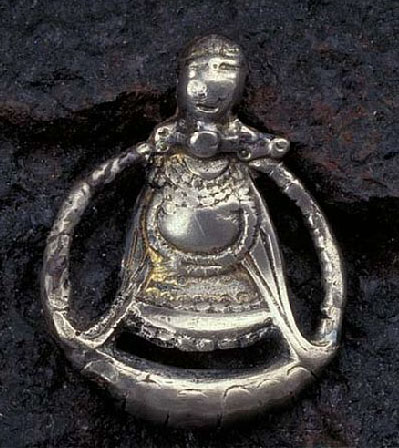
Especially this bodily phenomenon is brought forward in a new article by Elisabeth Arwill-Nordbladh. According to her detailed study of other figurines from the same time and milieu she concludes that the archaeological material shows that the ocular theme was part of various performative practices connected with prophesying and “future” gazing.
She concludes that the Vikings seem to have moved in a world where ambiguous gender pared with impaired sight might play a part in the negotiations of “body-normative practices”. In her own words “This corporal exceptionality in relation to (today’s) notions of body-normativity may imply that the Viking Age abled body sometimes was extended to include reduced visual capacity. The processing of both gender-normativity and body-normativity in one and the same precious item, may imply that the high-ranked setting of Lejre included performative practices that were negotiating both hetero-normative and body-normative hegemonic orders.”
Less “postmodern wording” may formulate it a bit differently. As old age approaches in a Viking setting, ambiguous “clothing” in the form of blankets and a visual impairment caused by cataract may not be considered signs of actual impairment. Maybe it was believed that old people who could no longer swing a sword, might still be of some “prophetic” value. On the other hand: It is evident from the Nordic Mythological writings from a later age that Odin was a shapeshifter, well-versed in shifting from male to female to animal.
However, whatever formulation we chose, the article by Elisabeth Arwill-Norbladh is interesting in the way in which she sums up the existing discussion about the small figurine at present exhibited at Roskilde Museum.
ABOUT THE AUTHOR:
Elisabeth Arwill-Nordbladh, Docent at Department of Historical Studies, University of Gothenburg, SE 405 30 Gothenburg, Sweden. She is especially interested in questions about gender and wrote her thesis on “Gender constructions in the Nordic Viking Age in 1998”
SOURCE:
Negotiating normativities – ‘Odin from Lejre’ as challenger of hegemonic orders
By Elisabeth Arwill-Nordbladh
Danish Journal of Archaeology: Published online: 28 May 2013
DOI:10.1080/21662282.2013.791131
SEE MORE:
A video with a 360o presentation of the figurine may be seen at Roskilde Museum, where it is exhibited.
READ THE FULL STORY HERE:
 ‘Medieval News’ from May 2016 brings you stories about Lejre in the land of the Scyldings and Beowulf, which is about to be unlocked. But it also shares a lot of notices about upcoming conferences, new books etc….
FEATURED PHOTO:
Odin from Lejre © Ole Malling/ Roskilde Museum