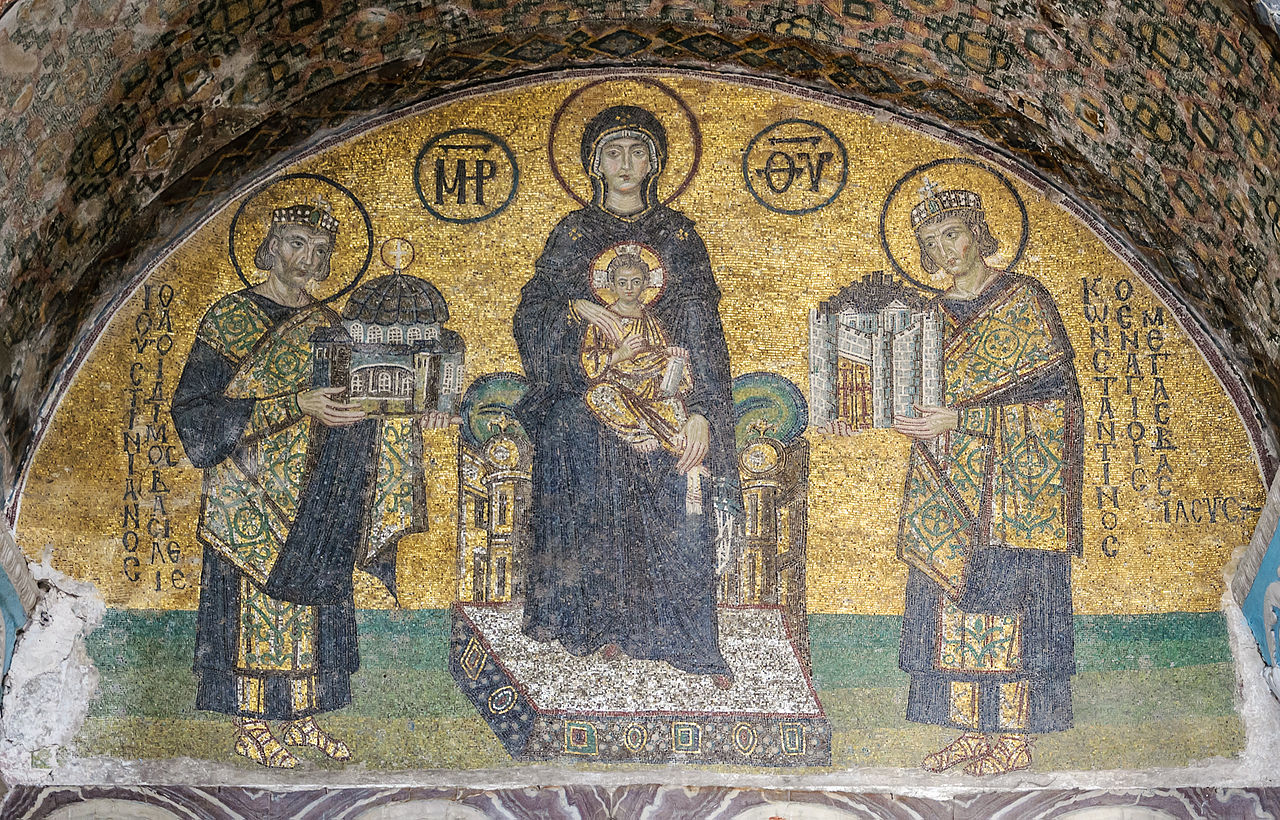
How lovely is your dwelling place, O Lord (Psalm 83)
‘How lovely is your dwelling place, O Lord’ (Psalm 83) wrote the Pope in the guest book, when he visited the Hagia Sophia in Istanbul on the eve of the first sunday in Advent 2014. (“Quam dilecta tabernacula tua Domine”, Psalmus 83). Restrained from praying in what is now officially a museum, it appears the Pope nevertheless succeeded in making his mark on this contested territory.

Source: Vatican Press Office
The current building was originally constructed as a church between 532 and 537 on the orders of the Byzantine Emperor Justinian and was the third Church of the Holy Wisdom to occupy the site. It was designed by the Greek scientists Isidore of Miletus, a physicist, and Anthemius of Tralles, a mathematician. Except for a short period between 1204 and 1261, when it was converted to a Roman Catholic cathedral under the Latin Empire, Hagia Sophia served as an Eastern Orthodox cathedral and the seat of the Patriarchate of Constantinople until 1453, when it was transformed into a Mosque. In 1935 it was secularized and turned into a museum.
In recent years the status of the building has been contested by an Islamic movement inside Turkey. Last year (in 2013) the The Nationalist Movement Party’s (MHP) submitted a bill to Parliament to turn the Hagia Sophia in Istanbul into a mosque, suggesting that the current function of the Hagia Sophia as a museum was “not legal.”
“This bill has been prepared aiming to open the Hagia Sophia – which is the symbol of the Conquest of Istanbul and which has been resounding with the sounds of the call to prayer for 481 years – as a mosque for prayers.”, claimed Yusuf Halaçoğlu, deputy chair of the group. This has been echoed by Deputy Prime Minister Bülent Arınç who has expressed his hope to soon see the Hagia Sophia used as a mosque.

Source: Aril Vågen/Wikipedia
The bill follows a series of controversial transformations of ruined churches into mosques, resulting in disfigurement of this ancient heritage. This has happened churches in Trabzon and İznik, which had been already turned into mosques. More recently the Monastery of Stoudios, also known as the İmrahor Monument, is being turned into a mosque titled the İmrahor İlyas Bey Mosque. The Monastery, which dates back to the fifth century, was the most important monastery in Istanbul during the Byzantium era, when it served as the center of the Byzantine intelligentsia. The basilica was converted to a mosque, during the period of Ottoman Sultan Bayezid II. After two major fires in the 18th and 19th centuries, the monastery was mostly destroyed. In 1946, it was turned into a museum in line with a ministerial cabinet decision. This re-transformation into a mosque has followed the recommendation of a parliamentary commission.
Such a commission is currently debating the future fate of Hagia Sophia in Istanbul, while more or less prominent Muslims stage Friday-prayers in front of the ancient Cathedral. As of now, nobody really know what the intentions of the Turkish government are. On one hand Erdogan is reported voicing that The Blue Mosque has to be filled first. On the other hand, it is obvious that the President is busy reworking the cultural climate of Turkey. Recently he was quoted for claiming that the Turks discovered America 300 years before Columbus. Now Erdogan is calling for the development of a new curriculum, stressing the fact that more Turkish children know more of Einstein than the Persian polymath İbni Sina (Avicenna) from the 11th century.
It is perhaps – in view of all this – pertinent that a couple of very recent books shed new light on the Hagia Sophia as well as the architectural and cultural climate, in which the building of this luminous piece of architecture, was undertaken.
READ MORE:
ICOMOS Turkey – Briefing on the Hagia Sophia Museum
 Hagia Sophia and the Byzantine Aesthetic Experience
By Nadine Schibille
Ashgate 2014
ISBN: 978-1-4724-3758-7
ISBN Short: 9781472437587
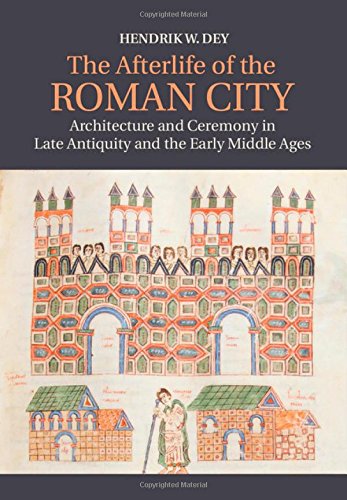
The Afterlife of the Roman City: Architecture and Ceremony in Late Antiquity and the Early Middle Ages
By Hendrik W. Dey
Cambridge University Press 2014
ISBN-10: 1107069181
ISBN-13: 978-1107069183