The town of Ribadavia – Burgo de Rippa Avia – is located in the southwest of the province of Ourense in Galicia. The town lies on the right bank of the river Miño, where the river Avia flows into it.
Although early settlements have been found, Ribadavia was first founded as an important town between 1065 and 1071 by Garcia of Galicia, who turned it into the capital of his short-lived Kingdom of Portugal. Garcia was the youngest son and heir of Ferdinand I, who was king of Castile and Leon and Sancha of Léon. He inherited her portion of the leonese inheritance. He was the first to use the title “King of Portugal”, but was forced into exile in Seville, while his brothers portioned his kingdom between them.
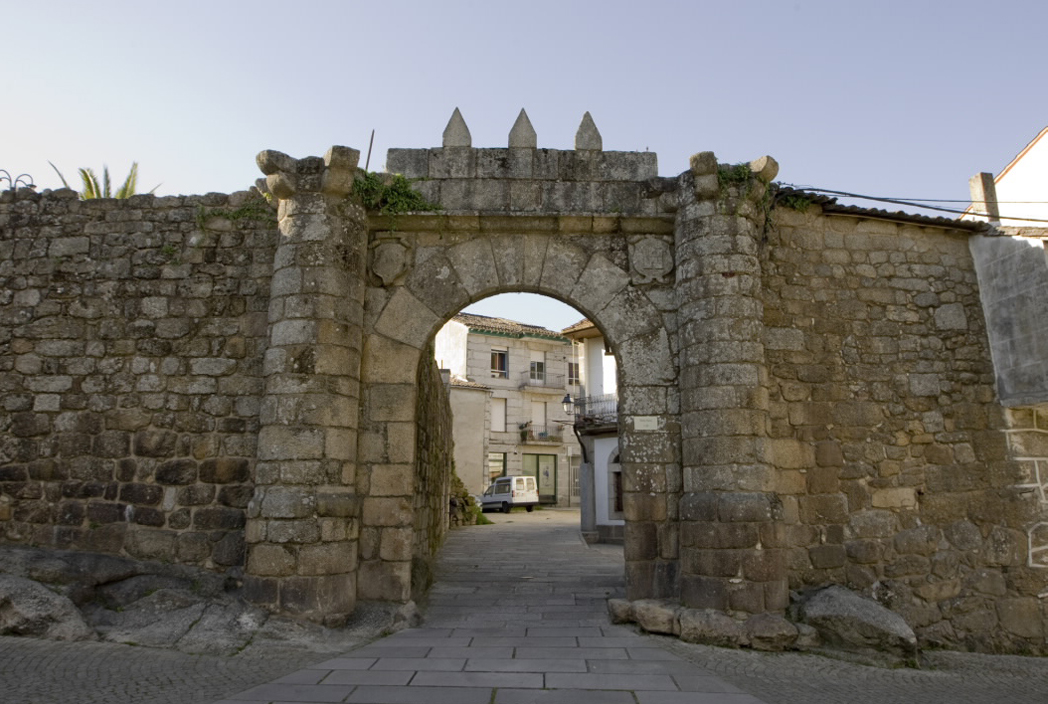
Parts of the medieval walls of the city are still standing as are the 16th century town hall and the remains of a large Jewish quarter including the synagogue. It is a very charming small town. Especially it is well worth a visit after having enjoyed the small Visigothic Church, San Ginés, in the nearby village of Francelos
The Wine

The main income in Ribadavia was undoubtedly the production of and trade with a particular sweet, white vine, the Ribeiro. Renowned already in the Middle Ages and exported from the 12th century and onwards throughout Europe, it continued to be sought after until the English discovered Madeira and Port. It has a fresh, slightly acidic and fruity character. Already in the 16th century a series of ordinances were agreed upon, making the Ribeiro into the oldest designated wine in Spain. The history of winegrowing is told at the Ethnological Museum of Ribadavia, founded in 1936. Winegrowing seems to have taken place there since the Romans, However, the specific grape and the practice involved in producing the Ribeiro was perhaps originally introduced into the region by Cluniacencians or Cistercians, following in the footsteps of the Dukes from Burgundy, which married into the royal family in Castille-Leon .
Currently the area set aside for the production of the Ribeiro Denomination of Origin covers 3000 hectares.
The Castle
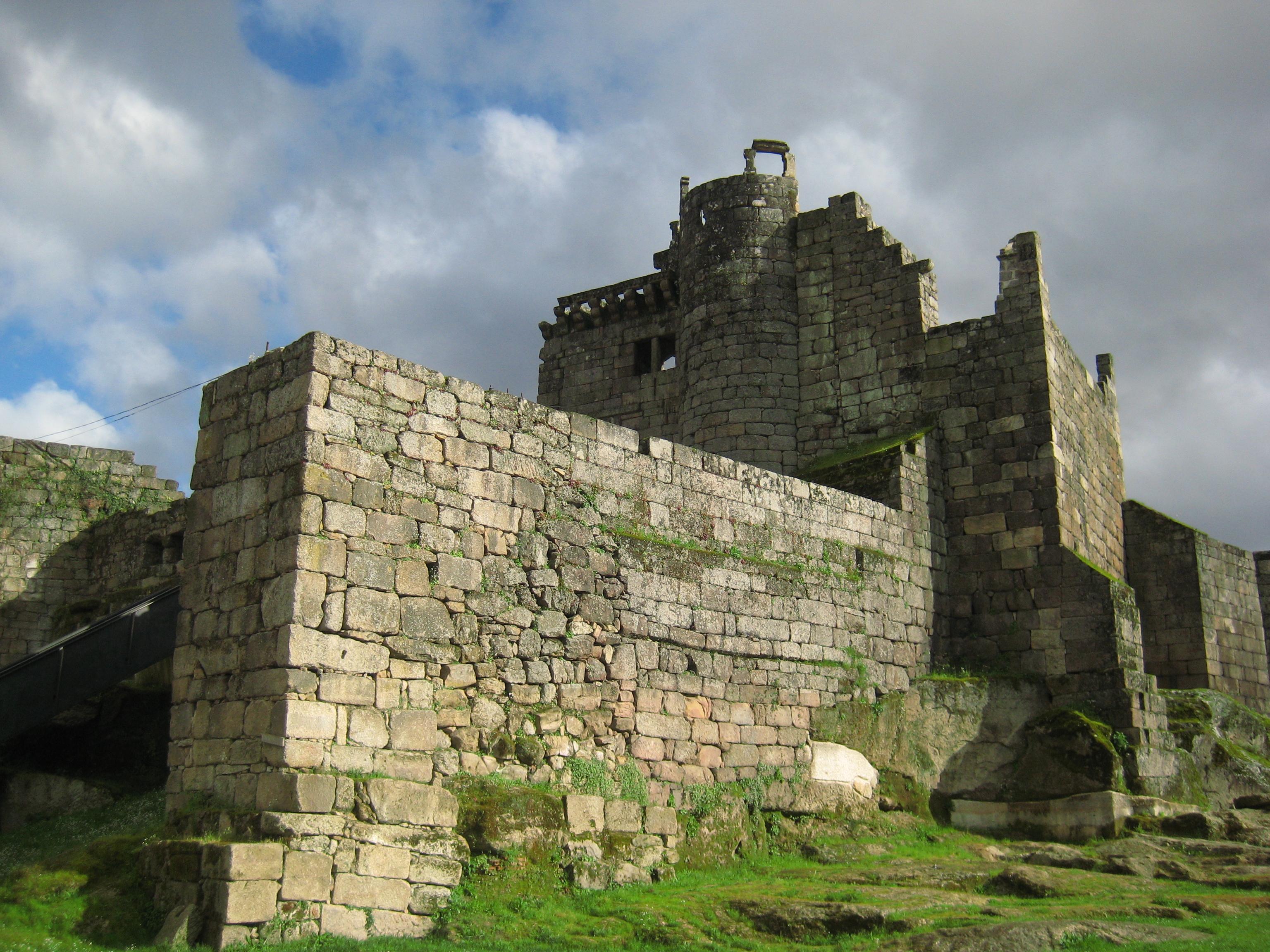
Near the Campo da Feira, the ruins of a castle from the 15th century can be found. This used to belong to the counts of Ribadavia. It was built at the location of a church, San Ginés, and a cemetery dated between the 800-1100. It occupies a space inside the castle walls covering 6790 M2.
In the 12th century a tower was built, the san Ginés tower, This tower was built as a defensive tower. It was dismantled in the 15th century to build the present castle. Together with the Mota tower on the other side of town, it comprised the defences. In the 13th century the walls around the city were built; this happened prior to the building of the castle, which was carried out in the 15th century at the instigation of Perez Zarmiento in 1471. It was probably not finished before the beginning of the 16th century. At this point the church of San Ginés, situated on the highest point was demolished. Somewhat later (1553) a special door was erected leading from the castle and to the town-hall, which was built at that time. In the end the castle was never inhabited; the counts preferred to stay in the modern renaissance palace lying at the main square
The castle is in ruins although significant vestiges remain of the water tank, the wineries and the gardens as well as the projected hall and living quarters. It belongs to the City, which bought it in 1939 in order to built low-priced houses there. This never came to fruiton and the castle was declared a Work of Monumental and Artistic importance. However, the surrounding gardens were not protected in the same way and in 1960 the council began to turn it into a sports-ground with a swimming pool. In 1981 a new transformation was carried out, when the city built an auditorium. At that time the pool was filled up and turned into a new garden. The level of this garden is unfortunately 4.3 meters higher than the remaining walls, which means that the general impression is rather strange.
Palace of the Counts of Ribadavia and the Town Hall

After the counts stopped rebuilding the castle, the counts build a sumptuous palace on the main square. This is organised around two courtyards and sports the coat-of-arms of the ruling family of Sarmiento. Opposite the palace lies the Town Hall, built between 1545 and 1555 as a corn-exchange and as a place for the meeting of the council.
Church of San Xoan and Church of St. James
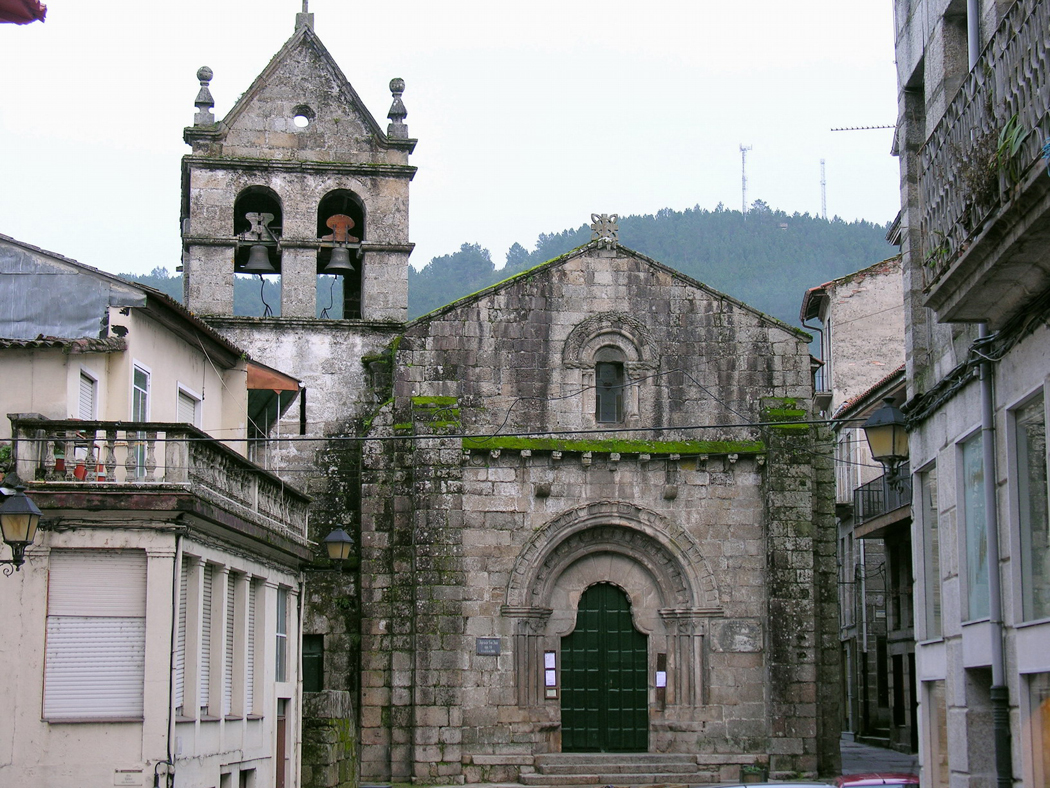
The church of san Xoan was erected by the order of St. John of Jerusalem in the Romanesque style. The Knights also set up a hospital to look after the numerous pilgrims, walking from Braga in Portugal to Santiago. Part of the building – the rectory – can still be seen at the back of the church.
The church of St. James is a late Romanesque church from the 12th century. This was the oldest parish church in Ribadavia. Known for its Romanesque carvings and its beautiful rose window, the church sports at the inside the usual Baroque trappings. Note, however, the sculpture from the 14th century of a seated St. James.
The Jewish Quarter

Probably due to the royal connection, the Jewish population established a community here in the 11th century, which continued to grow in the Middle Ages.
In 1386, when Ribadavia was besieged by the Englishman Sir Thomas Percy, the Duke of Lancaster, both Christians and Jews took part in the defence of the town as well as – not least – the payment of the ransom. At that time Froissart claimed in his chronicle that Ribadavia was home to nearly 1500 Jews or the equivalent of half the population at that time. Cohabitation seems to have been amicable. For instance a Jewish doctor was mentioned in the will of Diego Pérez Sarmiento, the Lord of Ribadavia, the count of Santa María de Ortigueira and Military Governor of Galicia in 1363. Later in 1453 a certain Abraham of Léon is known to have worked as rent-collector and master of the household (mayordomo) for the count. Later, however, the number of families was reduced and in 1482 numbered only four. In 1492 the Jewish population was given four months to either convert or disappear. During these months the Jews were not allowed to hold gold, silver or other valuables. The outcome was the well-known more or less crypto-conversion, but also the continued harassment by the church. The former Jewish quarter is located around the Xudería street. It is believed, that the former Synagogue was located here at the corner of the street of San Martiño.
The first visit of the inquisition to Ribadavia occurred in 1595. However, it was in 1606 a converted Christian, Xerónimo Bautista de Mena, presented the Inquisition with a list of 200 persons accused of continuing to secretly worship as Jews. On the list figured his mother and brothers. Those denounced included prominent people in the magistrate, students, doctors, lawyers and traders. Many of those denounced succeeded in escaping, but in 1608 a large auto de fe was held in Santiago, where 28 of the accused were burned at the stake. This was followed up by another auto da fe in 1609. In the end suspicions fell on the accuser also. He had been murdered in 1606, but was dug up and his remains were burned in 1610. The terrible happenings are generally known as the “Malshin”.
Today there is no-longer a Jewish congregation in Ribadavia. However, there is a Jewish Information Centre located next to the main Tourist office in the Palace of the Counts of Ribadavia.
The Jewish Bakery

Medieval travelers should remember to sample the many types of Jewish sweets on sale – macaroons, iced buns and doughnuts on sale at the Tafonia dea Herminia. Herminia bakes typical Jewish pastas according to traditional recipes: Bocadiños de améndoas (made from almond and cinnamon), kamisch-broit (made from walnuts or almonds), mamul (with dried fruits, poppy petals and orange blossom water), ma’amul (dates cream and rose water), ghorayebah (whole hazelnut flour), mostachudos (walnuts and clove), bocadiños de dates (dates and nuts), kupferlin (almond wholemeal flour), kijelej de mon (poppy seeds), masiñas de poppies (poppy sedes and vanilla flavouring) and cardamom (almonds and cardamom) are the main specialities, along with tasty doughnuts in the form of the Star of David.
House of Inquisition

At the corner of the streets of Martiño and Jerusalén lies a palace from the 16th century, the so-called “House of the Inquisition”. The portal boasts a series of coats-of-arms of the Spanish nobles as well as the official coat-of arms of the Spanish Inquisition, with its cross converted into a sword. Inside is a beautiful Renaissance courtyard.
Festa da Istoria
Each Year a medieval festival is organised in the last weekend of August, complete with a Jewish wedding and wine tasting. It is one of the more well-visited events of that type in Spain. Tired of all the people? There is a special medieval tavern well worth a visit, the Taberna Papuxa, situated just inside the Porta Nova. Tired of walking around? The local Parador is located in the old Cistercian Monastery – Monestir de San Clodio – eleven km to the North of Ribadavia.
SOURCES:
Network of Jewish Quarters in Spain – Routes of the Sefared
READ MORE:
El viñedo y el vino de Ribadavia: concideraciones jurídicas bajmedievales y de los primeros tiempos modernos.
By Ana María Rivera Medina
In: Hispania, 213, vol. 73, no. 243, pp. 51 – 78
Ribadavia Castle Remains Intervention: Conserve and Transform. Observation, Research, Traces, Intuition.
In: EAAE Transactions on Architectural Education / Conservation / Transformation.
Italy 2011, pp. 103 – 123
Historia de Ribadavia y Sus Alrededores
By P. Samuel Eiján
Madrid 1920/2005
VISIT MORE: