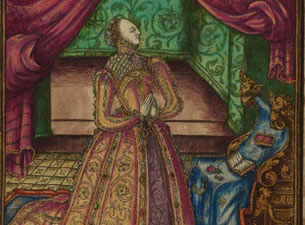
This year sees the celebration of the 350th anniversary of the Book of Common Prayer
The Book of Common Prayer has had an enormous influence upon the language and the traditions of the English people. Not only did it present the nation with a treasured collection of texts and words by which people were obliged to perform their daily rites of faith as well as rites of birth, christening, confirmation, marriages and burials. It also presented the English Nation with an iconic text at the same time symbolising unity and strife. And it became the primary vehicle for the exportation of the English Language and way of life to the British Empire and later the Commonwealth.
The story of how the Book of Common Prayer came to be is both circuitous and painful. In its first version, it was famously written by Thomas Cranmer and officially inaugurated at Whitsun in St. Pauls Cathedral in London in 1549. In 1553 it was officially banished, when Mary I was crowned queen of England and the realm reverted to Roman Catholicism. However, in 1552 her successor, Elisabeth I, once again reversed religious policy and in 1559 she and Parliament passed an Act of Uniformity and provided for a new edition of the seminal text. Never quite protestant enough nor satisfyingly Calvinist in its leanings, the Book of Common Prayer later became one of the key symbols of the division between the warring parties during the English Civil War. As such it was abolished in 1645. After the 1660 restoration, the book once again became the cornerstone of the Church of England, although in a new and revised edition. It is the anniversary of this “Book of Common Prayer” which is celebrated 2012.
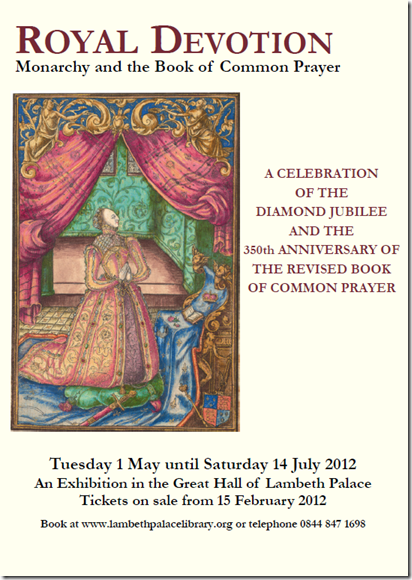 Royal Devotion
Lambeth Palace is the London seat of the Archbishop of Canterbury. The library – housed in the Great Hall – contains more than 120.000 manuscripts, books and letters. “Royal Devotion” is the name of the exhibition this summer, which runs from the 1st May to the 14th of July. The exhibition showcases a number of books relating to the connection between the English Monarchy and the Book of Common Prayer. The centrepiece of the exhibition will be the 1662 revision of the Book of Common Prayer. However, other highlights of the exhibition will include a 1549 printing of the Book of Common Prayer plus Medieval illuminated manuscripts such as the Book of Hours of Richard III, Queen Elizabeth I’s personal prayer book and a copy of the book of private devotions compiled for Queen Elizabeth II in preparation for her coronation. Another more recent item is the personal copy of the prayer book of The Prince of Wales, which was given to him by his godfather, Earl Mountbatten of Burma, who was killed by an IRA bomb in 1979. The exhibition will also include the silk and silver-thread gloves worn by Charles I at his execution in 1649 and an ornate ivory chalice belonging to his close friend, the Archbishop of Canterbury, William Laud. He is believed to have taken his final communion from the chalice at the Tower of London on the morning before he was executed in January 1645, a few days after the Puritans abolished the Book of Common Prayer.
Choral Evensong
Another flagship event of the celebrations this year (most of which are local) is the Choral Evensong in St. Paul’s Cathedral on the 2nd of May 2012 at 5.00 PM, followed by a reception in the Crypt (Tickets required in advance).
Seminal publication
Recently the three early texts of the Book of Common Prayer, more precisely the texts from 1549, 1559 and 1662, were edited by Brian Cummings, professor of English at the University of Sussex. This edition not only provides the reader with a meticulous edition of the three texts, but also presents him or her with an enjoyable introduction to this centrepiece of Englishness.
Popular history
However, if the interest lies more in the overall picture, the Prayer Book Society recently published a more popular introduction edited by Prudence Dailey. “The Book of Common Prayer: Past, Present and Future: A 350th Anniversary Celebration” is accompanied by a foreword by The Prince of Wales, while the afterword is by the Bishop of London, respectively Lay and Ecclesiastical Patrons of the Prayer Book Society. Prudence Dailey has edited this varied, nicely produced, inexpensive and very readable collection of essays, which also holds and appendix by Terry Waite, the well known Anglican and Quaker, who spent almost five years in captivity in Beirut. The book is in four sections, dealing in turn with the history, language, liturgy and mission of the Book of Common Prayer. A booklet with the story has also been published in connection with the anniversary.
The Lambeth Palace Library and the exhibition “Royal Devotion”
Booklet: Celebrating 350 years of the 1662 BCP