The Staffordshire Hoard consists of more than 4000 more or less broken pieces of gold and silver from 7th century Mercia. The last years have been spent on getting an overview of the pieces of this gigantic puzzle. Now the team is taking stock before moving on to the next stage.
Immediately after the Staffordshire Hoard was secured for the public, it became necessary to gather a team, which might clean and study the hoard in all its details – both on sight and under microscopes. This team has been working diligently since March 2012 performing, what has been termed stage 1 in the overall research project. In the Newsletter from May 2014 the current status is generously shared with the (very) interested public. In January 2001 none had a very precise overview of what the Staffordshire Hoard in fact contained. Apart from the fact that about a third stemmed from swords and seaxes, that there were pieces from helmets (one or more) and that a small handful of items were obviously Christian, no one could in fact say much more.
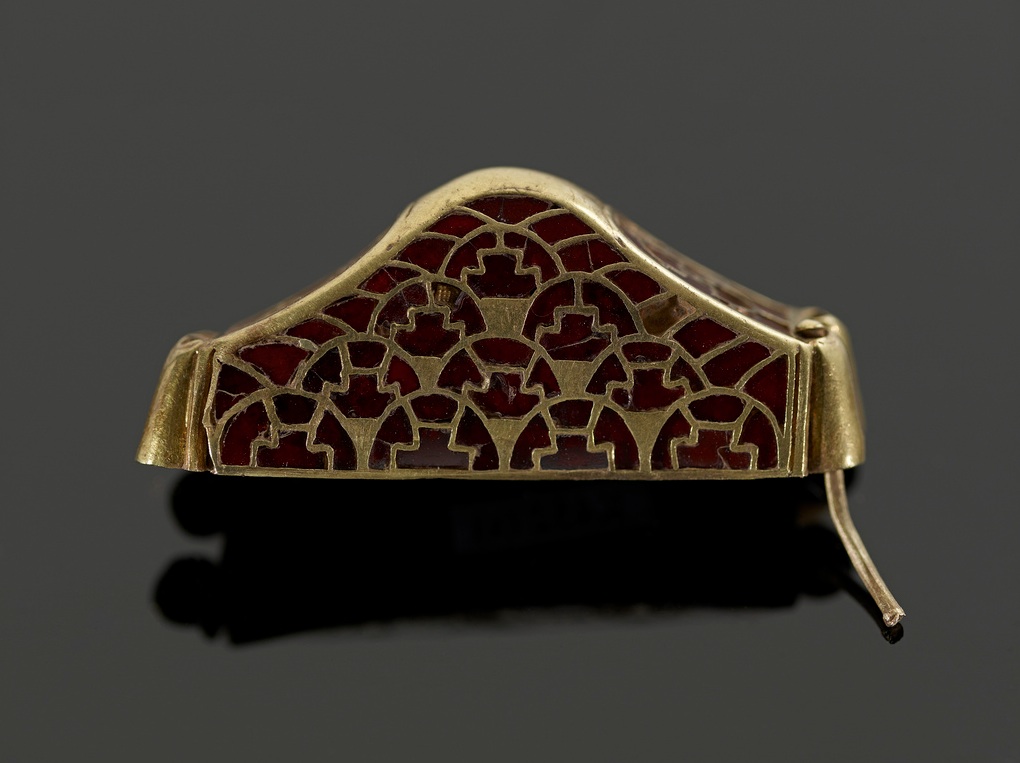
In February 2014, however, all the bits and pieces (more than 4000) had been catalogued. At this point there were all brought together in order to facilitate a ‘grouping exercise’, whereby hopefully some of the tinier fragments might be pared. During this grouping exercise it became possible to confirm over 200 physical joints, which were already suspected. But added to this should be more than 600 new ones, which appeared by placing the items next to each other. Out of this it was even possible to construct suites of ensembles of pieces, which could be fitted to each other. The team now know that over 350 fragments relate to only 120 items. All this is now making it possible to enter stage two. All this lead to the ‘Third Project Meeting’ whose participants were not only the team and members of the Hoard Management Group, but also scholars from the advisory Panel and the wider Anglo-Saxon scholarly community.
A Male and Military Hoard
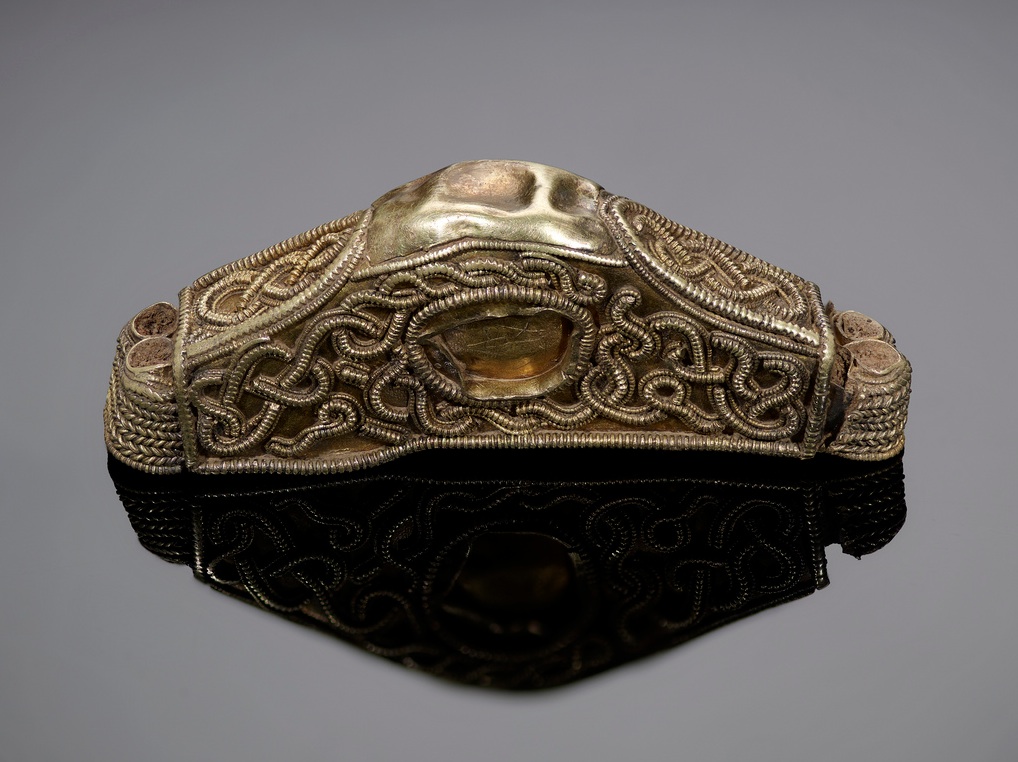
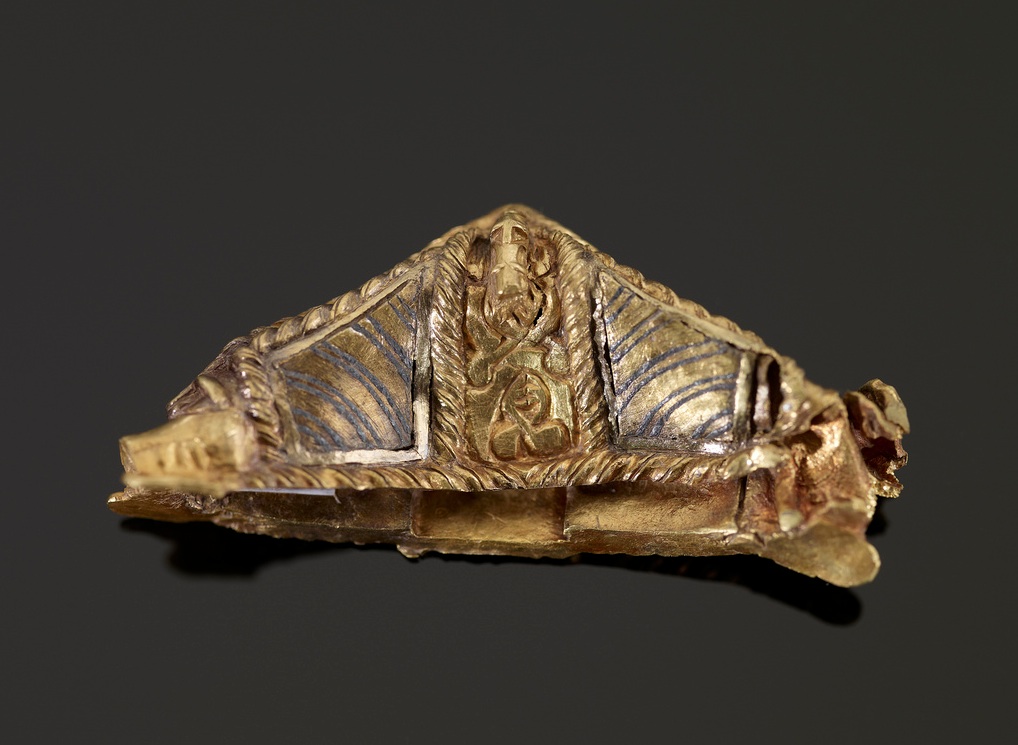
All this has strengthened the ‘conclusion that this is fundamentally a male and military hoard’. Nearly 60% of the identified material stems from swords and seax fittings. The team suggests, the hoard probably represents booty captured during multiple battles. Later the pieces have been chopped up to make them easily disposable as gifts for his retinue at a time and in a place (7th century Mercia) where coins were not minted. It has been estimated that the gold in the hoard represents something like 3000 contemporary golden coins. However, the small group of Christian items have increased slightly as there is believed to be yet another additional gold arm from a second pectorial cross, found in the hoard. And then there are the suites of large cloisonné mounts, as yet still enigmatic. Some of these appear to form pairs. They might just have been mounted on a thin plate, perhaps a book cover… Further information may be gathered from the techniques. For instance a number of suites of inlaid silver mounts have been made with a type of niello, which is not normally seen on Anglo-Saxon silver. Another major conclusion is that there are nearly three times as many filigree-decorated pommels, than cloisonné-decorated ones. Also the number of items decorated with Salin Style 2 (ca 570 – 700 AD) ornaments have risen to 130 pieces. Finally there is a group of silver pommels decorated with Insular non-zoomorphic ornamentation.
One intriguing find in the cloisonné pieces, is a type of green inlay, which has so-far not been identified. Perhaps it has been more widespread than generally believed, since old pieces in museums have often been to carefully cleansed, removing what might have been considered no-more than dirt. So far the scientific analysis has not yielded an answer to what the green stuff might be. However, further investigations are promised.
The Wider Programme
Currently funds will have to be found to continue with stage two. This is planned to be a 30 month long project leading to the final publication. And yes, it will be expensive. Meantime a new permanent gallery will be opened in Birmingham in October planned to exhibit parts of the magnificent find. Amongst other things a reconstruction of a mead-hall will be decorated by hangings embroidered by volunteers organised by the Embroiders Guild It is a great pleasure that the owners, the research team and the curators are so generous in providing updates on the scientific and scholarly investigations into the Staffordshire Hoard. Had it been in the old days, the tradition would have been to ‘hoard’ the results for scientific publications in the far-out future. Not so here!
SOURCE
Spoils of War. The brutal origins of the Staffordshire Hoards.
In: Current Archaeology May 2014.
Pioneering research shows ancient Hoard as ‘true archaeological mirror’ to early epic poem Beowulf.
Introduction into the Staffordshire Hoard Grouping Exercise – Video
Look out in the near future for a formal overview of the research results written by Chris Fern. When officially agreed upon, the text will appear at the Barbican Website.
FEATURED PHOTO:
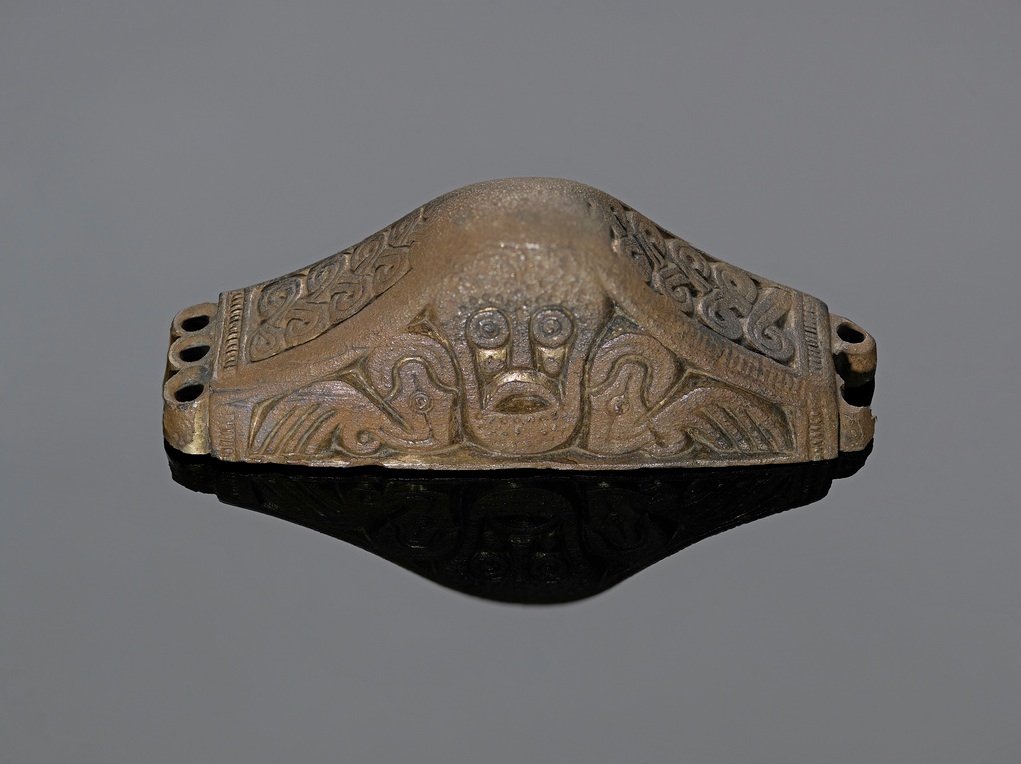
Silver Pommel with face. Probably mainland Europe, perhaps Scandinavia. The team call ‘him’ Dave, but perhaps Beowulf is more appropriate?