Home » Breaking Medieval History News » Page 6

Tag: Breaking Medieval History News

Breaking Medieval History News hold a wide variety of stories of a miscellaneous character

History of Italian Archives

AR.C.H.I.ves – A comparative history of archives 
in late medieval and early modern Italy

Most historians work in archives, but generally have not made archives their primary object of research. While we tend to be preoccupied by documentary loss, what is striking is the sheer amount of paperwork preserved over the centuries. We need to study the reasons for this preservation.

The project’s general aim is to study the history of the archives and of the chanceries that oversaw their production storage and organization in late medieval and early modern Italy from the late twelfth century to the opening of the Archivi di Stato that – after the ancient states’ dissolution – preserved documents as tools for scholarship rather than administration.

Italian states were at the forefront of the institutionalization of documentary preservation on a large scale, and the country as a whole has an extraordinary rich and diverse archival patrimony. Because of its fragmented political history, concentrating on Italy means having access to the archives of a wide variety of regimes; archives, which lend themselves to comparison, even though Italian archives often seem disorderly to scholars who have no local knowledge. However, this project builds precisely on the basis of the plurality of Italy’s archives, and on their overwhelming closeness to the pre-modern institutions that created them. The proposed research intends to approach their history in a doubly comparative framework, by focusing on a series of seven case studies of chanceries disseminated across Italy: Venice, Modena, Florence, the Vatican, Milan, Naples, and Palermo; and by comparing Italian chanceries with those of other European and non-European states and cities, chiefly by organizing and encouraging exchanges between scholars working in different countries.

Secondly, while histories of archives are generally inscribed in the framework of institutional history, the proposed research wishes to test the chanceries’ interactions within a wider social and cultural context, by focusing on six interconnected themes:

1)      the political role of archives, and the efforts devoted by governments to their development;

2)      their organization, subdivisions, and referencing systems;

3)      the materiality of record-keeping;

4)      the social characteristics of the staff, their education and selection;

5)      the archives’ place in society, including their access and (mis)use;

6)      their use by historians.

As implied in the choice of these themes, the project is deliberately interdisciplinary, and aims at the mutually beneficial exchange between social, political, and cultural historians, historians of art, and archivists.

The research team
The project has a deliberately long timeframe, it tackles a large variety of sources, and it needs to combine local knowledge with a wider vision. In order to tackle these challenges the project will employ a research team trained in different disciplinary skills, formed of five people:

▪        The Principal Investigator, Dr Filippo de Vivo, who will also be responsible for supervising the team’s work as a whole.

▪        Two post-doctoral research assistants, Dr Andrea Guidi, a specialist of the Florentine Chancery, and Dr Alessandro Silvestri, a specialist of the Aragonese Chancery of Palermo.

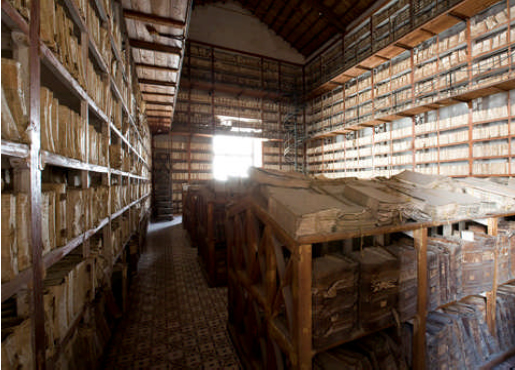
▪        Two PhD students who will research specific themes on the basis of one or two case studies alone. Mr Fabio Antonini will work on the theme of Archives and the writing of history, especially the use of archival sources by late medieval and early modern antiquarians and historians, with special reference to the Venetian case. Mr Giacomo Giudici works under the joint supervision of Dr de Vivo and Professor Evelyn Welch (QMUL) on the theme of “Paper and place”: the physical and material aspects of documentary evidence, such as the architecture and furnishings of the repositories, or the decoration and making of the records, with special reference to the cases of Milan and Venice.

There will be regular workshops with invited international participants, where team members will be able to present their findings before discussants. A final conference will conclude the project and it is expected that selected papers from the conference and the workshops will be published in a volume edited jointly by the PI and the PDRAs.

A first workshop on “Recent tendencies in the history of archives, documentary production and organization” has been planned for the 12th of December 2012.

The project is funded by a European Research Council Starting Grant

SOURCE:

AR.C.H.I.ves

Recent tendencies in the history of archives, document production and organization. Conference on Wednesday, the 12th of December 2012, Birkbeck, University of London, 2-6pm. Dreyfus Room, 26 Russell Square (TBC)
Conference program


Medieval Settlement Research

The Medieval Settlement Research Group

The Medieval Settlement Research Group (MSRG) is a long established, widely recognised and open multi-disciplinary group that facilitates collaboration between archaeologists, historians, geographers and other interested parties.

The Group is dedicated to developing understanding of rural landscapes and settlements including villages, hamlets and farmsteads between the 5th and 16th centuries AD. For information about membership, conferences, grants and other activities, please see the MSRG website.

The MSRG’s journal, Medieval Settlement Research (MSR), is published each year in the autumn. The journal is an internationally recognised publication, containing peer-reviewed research papers, fieldwork reports and news, reviews and an annual bibliography. Although the Group’s interests are concentrated on British and Irish medieval landscapes between the 5th and 16th centuries AD, it actively encourages wider chronological and pan-European perspectives. Medieval Settlement Research therefore welcomes papers on Britain, Ireland and Europe that help us to improve our understanding of medieval settlements and landscapes from the level of individual sites to the international scale.

A digitisation project is currently near completion and back issues of the MSR and its predecessor the MSRG Annual Report are now available to users free of charge via the Archaeology Data Service (ADS). Other bibliographic details of past content can be found on the British and Irish Archaeological Bibliography (BIAB).

Back issues of the Annual Report (1986-2007) and Medieval Settlement Research journal (2008-2010) are now available online from the ADS

Viking and Crusader Swords Sold at Steep Prices

The Crusadersword captured from Mamluk Arsenal in Alexandria gave £163.250 edge to Bonhams Arms and Armour sale. Viking swords sold for up to six times the evaluation

A rare medieval sword taken from the Mamluk Arsenal at Alexandria was the top item in Bonhams sale of Antique Arms and Armour on November 28th in London. The sword, estimated to sell for £40,000 to £60,000, was eventually bought for £163,250 after stiff competition in a sale that made a total of £1m with 90% sold.

The medieval Crusader Italian-made sword was given as a gift to the Mamluk rulers of Alexandria by the Christian ruler of Cyprus and Jerusalem, King Peter I as part of a gift sealing a treaty.

King Peter I, the King of Cyprus and Jerusalem, launched the last Crusade in 1362 against the Muslim Mamluk Empire in the region. A fleet set out from Cyprus and proved victorious, taking the city of Alexandria with immense amounts of plunder returned to Cyprus, including this sword. Such was the treasure and weapons taken from the captured city that many of the overloaded ships had to jettison cargo.

David Williams, Head of Bonhams Antique Arms and Armour Department, says: “The fascination of this sword is that it has survived some six centuries having been gifted by a Christian King to a Muslim ruler and kept in the famed Alexandrian armoury and then taken by force by Crusaders and returned to Europe. It is a remarkable survivor of the Crusader period.”

The sword has a flat tapering double-edged blade 92.5 cm. long and overall with the hilt 115.7cm. The weapon bears an inscription that reads: ‘Hubs Khazain al-Silah bi thughri al-Iskandariyya ayyam al-Sayfi Faris al […d.]’, ‘Donation to the armoury in the frontier city of Alexandria in the days of al-Sayfi Faris al- [Muhammadi]. Amir Faris was an inspector in 840H, corresponding to 1436-7 AD. Only three other swords appear to be recorded inscribed in the name of the Amir Faris. One in a private charitable foundation, another in Leeds Castle, Kent and the other in the Military Museum at Istanbul.

A stunning array of death-dealing swords from the Medieval period and earlier, including Viking weapons, formed the main thrust of Bonhams sale of Antique Arms and Armour on November 28th in Knightsbridge.

David Williams, Director of Arms and Armour at Bonhams, comments: “Many of these rare and remarkable weapons would have been used in battle. The scarring and damage goes some way to confirm this, though the years have also taken their toll.”

Among the collection of swords in the sale from the distinguished Danish collector the late E.A. Christensen, there were some seven Viking swords dating from the 9th and tenth centuries when the Vikings were invading the British Isles on a regular basis.

Lot 55, a Viking sword similar to one found in Ireland and estimated at £4,000 to £5,000, sold for a whopping £30,000.

A rare Viking sword from the 9th Century, found in 1887 in the mouth of the River Thieles, in Switzerland, (lot 57), estimated to sell for £6,000 to £8,000, made £27,500.

Lot 54, found in the River Meuse in Belgium estimated to sell for £3,500 to £4,500 made £10,625.

The Viking Age spanned the late 8th to 11th centuries.

The Viking destruction of Lindisfarne was reported by a Northumbrian scholar who wrote: “Never before has such an atrocity been seen”. More than any other single event, the attack on Lindisfarne cast a shadow on the perception of the Vikings for the next twelve centuries.

For more information please contact www.bonhams.com


Chronographia of Ioannes Malalas

Byzantine History of the World to be Studied and Made Accessible
Tübingen Historian, Professor Mischa Meier, heads new 12-year project examining the Chronographia of  Ioannes Malalas (490 -578 AD). He  wrote his Chronographia in Greek in the 6th century. In recent years, researchers have come to believe he was an official in the provincial administration of the Eastern Roman Empire. In that position, Malalas appears to have had access to important archives – which was important for the final books in the chronology, which dealt with the contemporary history.

Read more at University of Tübingen 

New book on Royal Seals of the Árpád Dynasty

New book on Royal Seals of the Árpád Dynasty
28.11.2012
A new book, written by Imre Takács on Royal Seals of the Árpád Dynasty was presented today at the Hungarian National Archives. The book is the first part of a new series, titled Corpus Sigillorum Hungariae Mediaevalis. The series aims to provide catalogue of Hungarian medieval seals – including royal seals, aristocratic seals as well as seals of towns, religious institutions and other organizations. The first volume is dedicated to seals issued by Hungarian kings of the Árpád Dynasty (1000-1301), and includes a total of 48 entries.
Read more at Medieval Hungary


New book on Royal Seals of the Árpád Dynasty
28.11.2012
A new book, written by Imre Takács on Royal Seals of the Árpád Dynasty was presented today at the Hungarian National Archives. The book is the first part of a new series, titled Corpus Sigillorum Hungariae Mediaevalis. The series aims to provide catalogue of Hungarian medieval seals – including royal seals, aristocratic seals as well as seals of towns, religious institutions and other organizations. The first volume is dedicated to seals issued by Hungarian kings of the Árpád Dynasty (1000-1301), and includes a total of 48 entries.
Read more at Medieval Hungary

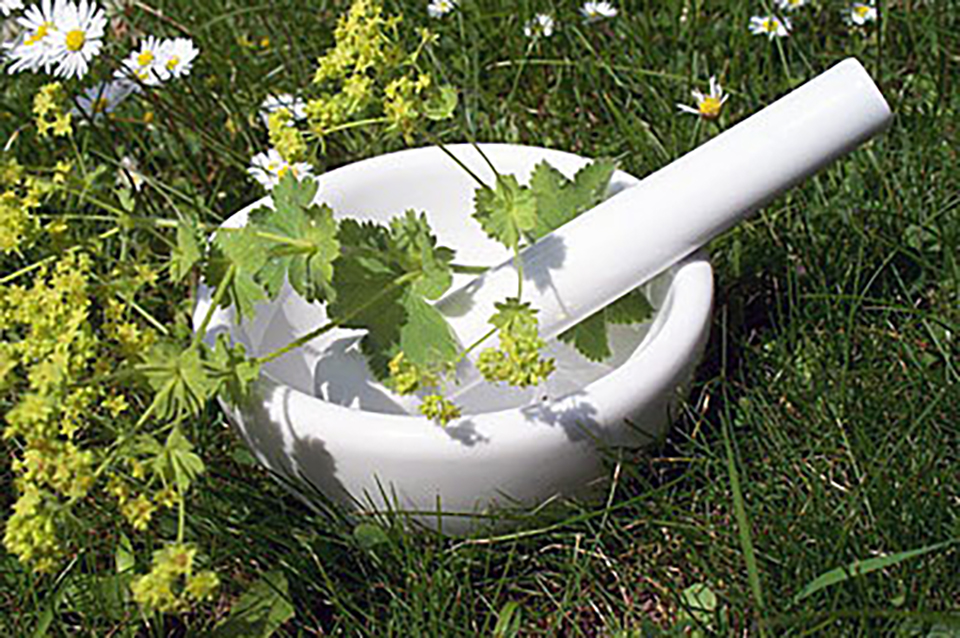
Phtotherapy inspired by Hildegard of Bingen. Source: Wikipedia

Hildegard von Bingen-Boom

In 2012,  as a recognition her her "holiness of life and the originality of her teaching", Hildegard of Bingen was named Doctor of the Church. This is boosting local heritage business at Bingen.

Read more

Medieval Charcoal

Can you talk about sustainability in the middle ages? This is the theme for a special session at the 49. Deutsche Historikertag

We all know by now that the earth is flat, hot and crowded. And that it will get worse the more we become. Might we learn from past techniques – and even medieval technologies – in order to find ways of living more sustainable lives? This is the overriding theme at the 49. Deutsche Historikertag, where “conflicts about resources” is the overriding theme.

As with all huge Conferences a number of sessions and papers tend to disregard this framework. However, one medieval session has tackled this question head-on.

According to the primary organiser of this session, Prof. Dr. Oliver Auge, sustainable development is a key paradigm in the global debate about our future. However, the question for medievalists is of course whether it makes sense to talk about this in a medieval historical context? Were medieval people ever voluntarily frugal in the sense that we use this concept? It is to this currently rather lively debate in scientific circles, which the session wishes to contribute – presenting a number of papers originating from historical subfields like environmental and technological history, archaeology and archaeobotany.

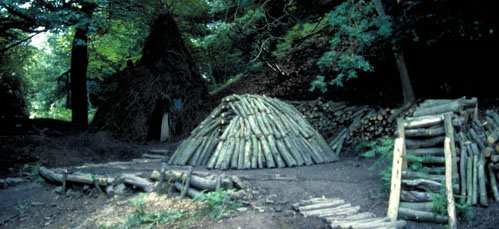
One point of perspective in the debate will be a reevaluation of the widespread medieval practice of charcoal production. Charcoal is usually produced by slow pyrolysis, where the heating of wood or other substances takes place in the absence of oxygen. To produce charcoal the collier pile billets of wood on their ends in order to form a conical pile. At the bottom an opening lets in air while a central shaft lets the smoke escape. The pile is then covered with turf and moistened clay. The firing – which is a special craft – begins at the bottom and gradually spreads outwards and upwards

The massive production of charcoal  in the Middle Ages was a major cause of deforestation. However all over Europe woods were managed as coppices, which were cut and regrew cyclically, so that a steady supply of charcoal would be available.

Archaeologists have shown how the production of charcoal usually was part of the peasant economy in forested areas; but hornbeam coppice wood as well as alder and birch swamps were systematically forested in order to feed these kilns. The use of fast growing coppiced woods was a common sustainable technique among medieval peasants. However, studies by the archaeologist, Arne Paysen, have shown that when charcoal production was instigated by the large landowners, the production was not sustainable. Here old trees were used ending in a massive and non-sustainable deforestation. Several papers will report on these aspects of medieval forest-management, more specifically in the region of Schleswig-Holstein.

It is the University of Kiel, which is active in the broad field of research into historical ecosystems.

Sustainable energy consumption in the Middle Ages and Early Modern Europe

Medieval charcoal burning is practiced  at the Open-Air Museum in Schleswig-Holstein