Richard III: Where to rebury him? And How?
Tag: Breaking Medieval History News
Breaking Medieval History News hold a wide variety of stories of a miscellaneous character
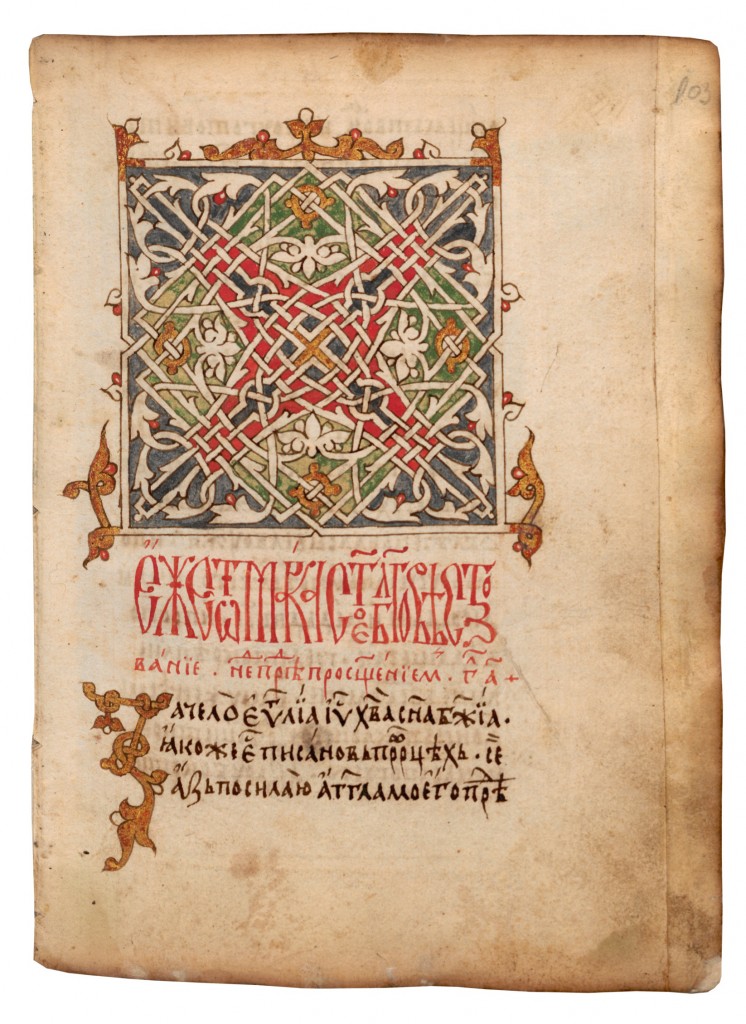
Medieval Macedonia?
Exhibition in Brussels of so-called Macedonian Manuscripts is met with uproar…
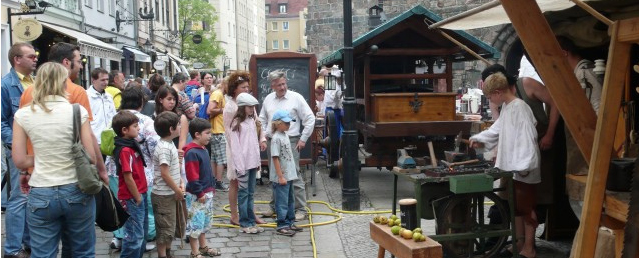
Historiale at Berlin
History festivals may be the way forward to “sell” history in a serious yet popular manner
The Historiale in Berlin has the ambition to be the largest historical festival in Europe. Since 2006 The foundation behind this festival has been the driving force behind a magnificent staged series of events focusing on a wide variety of themes, from “Napoleon in Berlin” to “Haupstadt der Spione”. This year the Historiale celebrates the 775 anniversary of Berlin from the 20th to the 26th of August with a huge mixture of musical events, theatre-performances, lectures, public debates plus guided tours and much more. At the end of the week there will be a large parade where people who are willing to dress up can take part.
A significant part of this takes place around the Nikolaikircheviertel where there is also a marketplace. In the Nikolaikirche itself an exhibition tells the story of this 800-year old building and the personalities, who lived and worked there. At the same time eight small exhibitions along the former city walls show the results from excavations which were carried out in connection with work on the Metro.
However, the gate to the festival is the exhibition in the Berlin Museum where the changing fortunes of the city are told through a combination of multimedia installations, audioguides etc. For the really interested it might be worthwhile to start out by visiting the City Museum of Berlin (Märkisches Museum) where amongst other fascinating thing large models of the historical city from its early beginnings may be studied in detail. For the medieval buff the museum in itself is interesting: the building is more than a 100 years old and in full-blown “historismus” style with a tower built out of red brick and a “Gothic Chapel” with a remarkable collection of medieval sculptures; all newly restored to its former grandeur. At the Museum annex at Ephraim-Palais there is a special exhibition “Berlinmakers ‘n’ shakers. 775 Portraits – One Network” which showcases seven hundred present-day and seventy-five historical figures. Their stories shed light both on the lives of Berliners and also on the uniqueness of Berlin.
Tired of all the noise and jostling from more than 100.000 guests and participants? Maybe it is time to take the train out South and visit one of Berlin’s more hidden gems: The village of Düppel (Museumsdorf Düppel). Here guests can experience a medieval village complete with a fully-fledged farm cultivated with traditional three-year rotation and showcasing old grains as well as medieval gardens. On Sundays volunteers enliven the place with their handcrafts. All scientifically well-documented in an orderly way. (The Museumsdorf is part of the Stadmuseum of berlin).
The program for the Historiale
Accompanying this years “Festivale” is a book about “Berlin im Mittelalter”:
Berlin im Mittelalter: Berlin/Cölln unter den Askaniern. By Norbert F. W. Meier. Berlin Story / Alles Uber Berlin 2012
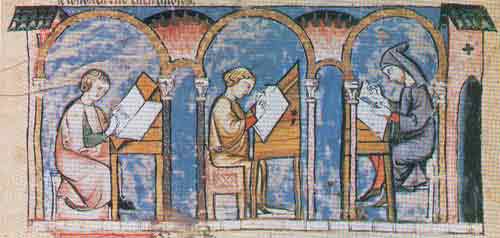
Medieval Publishing will be hit by EU Plan
Last year UK proposed to make research papers stemming from work paid by British Taxpayer’s free online by 2014. July 16 the proposal was confirmed. Next day the European Commission followed the plan of the UK government and made all EU-funded scientific research available for free from 2014. It is believed that scientists will benefit, as they will be able to more productive as no publishers will be able to act as gatekeepers and scholars – due to copyright issues will not be obliged to publish the same results twice albeit with different wording (so-called “slicing the salami thin”). Likewise voluntary and charitable organisations as well as independent scholars will be able to access information hitherto reserved for Universities. “Last, but certainly not least, citizens will have direct access to publicly-funded research in addition to benefitting from the indirect effects resulting from everybody else’s faster access”, says the Memo.
As a first step, the Commission will make open access to scientific publications a general principle of Horizon 2020, the EU’s Research & Innovation funding programme for 2014-2020. As of 2014, all articles produced with funding from Horizon 2020 will have to be accessible: Articles will either have to be made immediately accessible online by the publisher, which can get reimbursement of up-front for publication costs, or researchers will be obliged to make their articles available through an open access repository no later than six months (12 months for articles in the fields of social sciences and humanities) after publication (“Green” open access).
In a press release the European Commissioner for Research and Innovation, Máire Geoghegan-Quinn, declared that open access to scientific papers and data “will speed up important breakthroughs by our researchers and businesses, boosting knowledge and competitiveness in Europe.”
This will definitively hit the lucrative business of Medieval History Publishing as most European Research in the Humanities is funded by the member-states. Of course there will still be a market in US, but as much research here is dependent on grants from European Universities – hosting visiting overseas scholars working in Archives or Museums – matters will not be that simple.
From a recent roundtable discussion on “The Future of Academic Publication” in Leeds at the 19th International Medieval Congress it appeared that the usual print-run for a book is 300, with 50 presented to the authors, while app 200 – 250 are sold to (American) University Libraries. As most books published by the more prestigious publishers are sold on average for between €100 -120 (whether in print or as an E-Book) this is a lucrative business.
Although the publishers at the roundtable stressed the value of their work connected with the so-called “editorial process”, some scholars, who were present at a later reception, afterwards claimed, that they did most of the editing themselves. Further it was apparent that in a number of instances, these scholars had even been obliged to pay for the editing process, thus in reality the privilege to publish. Further some scholars had experienced that publications, they had contributed to, were not available at their national or academic libraries (in the minor European countries). As copyright was strictly policed, they were not even allowed to circulate their results among colleagues. Added to this should be the dissatisfaction with the fact that the large publishing houses routinely declined collections of papers from conferences. Finally a general dissatisfaction with the quality of the publications was sounded: photos and illustrations were printed in non-colours and LD.
“Something has to give”, as one scholar voiced it! Apparently sooner than later if the different European Countries follow up on the recent decisions by the Commission.
Karen Schousboe
Anglo-Saxon Art
 Anglo-Saxon Art. A New History.
Leslie Webster
The British Museum Press 2012
One of the very puzzling things about the more prominent pieces of Anglo-Saxon Art – the jewellery, the weapons, the manuscripts etc. – are their intricate character and their invitation to close-up inspection.
The Anglo-Saxons – not least the early bands of warriors of the 5th century and their ancestors up until mid 9th century – must have presented themselves as close-knit elites, bands of brothers. How else explain the fact that you nearly would have had to sit on the lap of a chieftain or a kinglet to get a glimpse of his brooches; or stand close to the altar at mass to get a glimpse of the book-craft and miniatures.
Of course there were stone sculptures to entice the public to enter the churches and marvel at the wall-paintings, the glittering textiles and the tabernacles of shrines and imported icons. And we might believe that at some point there existed a carved wooden sculpture-tradition, now completely lost except for a few fragments. In general though, the art of the Anglo-Saxons was best consumed close up.
Accordingly the art of the Anglo-Saxons is no easy matter to tackle head on, as is very well documented by a new introduction to the various art forms, written by archaeologist and art-historian, Leslie Webster.
Following this insight – that each piece of art – must be read carefully, the book very appropriately opens with an introductory chapter, which shows what might be gained from a close reading of the images, and seeing the text.
One of the more fascinating examples of this is a silver gilt pommel from the Woodeaton area in Oxfordshire. Seen from the wearer’s point of view it has the form of a horned animal. Seen from the enemy’s point of view it looks like a stinging bee or a winged bird, where the blade might have presented the sting or the beak. Indeed, very cheeky… (seen on page 36).
Having “learned” to read the artistic language, we are treated to a numer of well-written chapters outlining the heavy Roman influence, both the ancient and Christian. The final chapters present a more secular perspective and introduce the reader to the connections between “Art and Power” and the “Viking Impact”. Illustrated with more than 200 colour and black-and-white illustrations the book gives us ample opportunity to get close to this very close-knit social world, its mentality and world-view.
If one wishes to explain the entangled and obviously complex mythic stories of fabulous birds or crouching dogs, twisting in shaman-like transcendence, this is a good start. And where else learn to properly appreciate the artistic merits of the miniatures in the manuscripts?
There is always room for some quibble. Does it make sense to publish an introduction to Anglo-Saxon Art and leaving out an introduction to another of the major art-forms, poetry? Especially as the deep layers of storytelling found in many of the art-pieces seem to be echoed in literature and poetry – as may be witnessed by the visual program of Franks Casket, which is discussed in some detail in the book, while the inscriptions are only cursorily touched upon.
Maybe, however, this will be remedied in the next publication from the pen of Leslie Webster: a monograph of the said casket and to be published in the autumn.
Until then we have to be content with this fascinating and tho-roughly enjoyable introduction; as with all good reads it invites us to further explorations, museum visits and detailed examination of the many pieces of arts presented here.
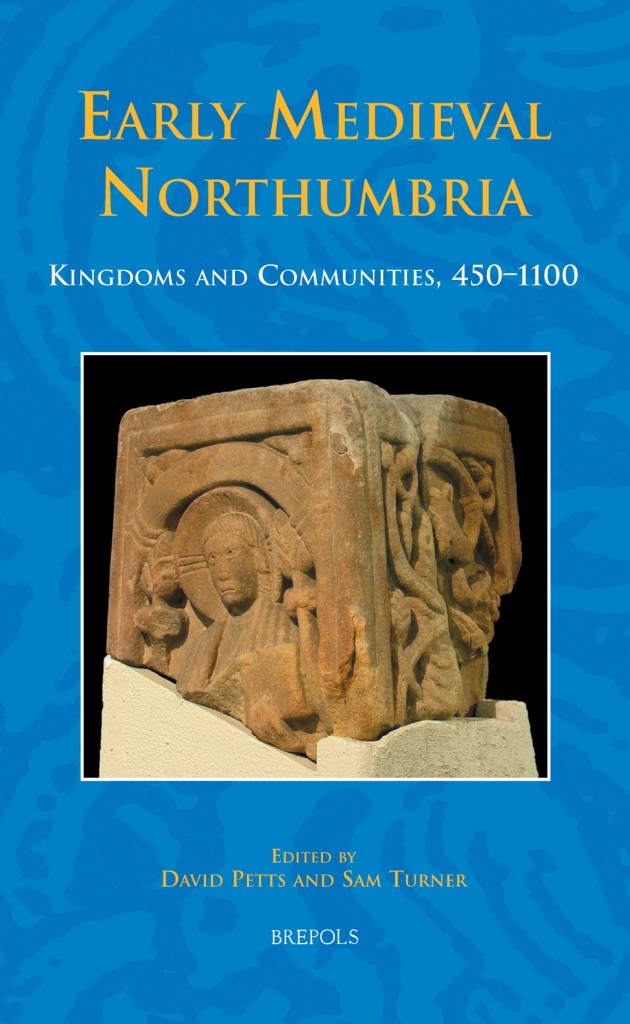
Early medieval Northumbria
Early Medieval Northumbria. Kingdoms and Communities, AD 450 -1100.
David Petts and Sam Turner (eds).
Studies in the Early Middle Ages. Vol 24.
Brepols 2011.
In a sense, early medieval Northumbria is an enigma. On one hand it presents us with some of the most evocative historical sources – foremost the writings of Bede, but also other material like hagiographies and letters. On the other hand charters are non-existent as are compilations of law. This leaves the Early Medieval Northumbrian historian with a dire need to consult archaeologists, art historians, onomastic scholars, biologist and zoologists in order to get a better grip on the lives and thoughts of people at that time. And vice versa!
In 2006 a group of researchers got together in Newcastle in order to try and bridge the many traditions and see if the merging of their different nitty-gritty and specialised enquiries might throw new light on the region as well as raise the interdisciplinary awareness of the need for further collaboration.
The papers from this conference are now available in a very interesting edition prepared by Davis Petts from Durham University and Sam Turner from Newcastle.
Of course, as with any collection of papers, you have to sift the wheat from the chaff. Nevertheless it is a very interesting collection, in so far as it really tries to bring the reader up to date on the many lingering questions and scholarly controversies: To what extent constituted the Anglo-Saxon immigration a brutal subjugation of the British? Or was there rather an atmosphere of “continuity and convivencia ”, which the archaeological excavations of Yeavering have hinted at? Should Early Medieval Northumbria be considered a homogenous kingdom albeit marked by strife and upheavals? Or was it rather a poly-cultural region consisting of an Anglo-Saxon coastal region and a less subdued hinterland in the West, characterised as a frontier zone – a zone of process more than place?
Lots of good questions and many interesting answers! As an example may be mentioned the analysis by Jenny Walker of the great halls at Doon Hill and Yeavering, showing how the “later” halls from the first half of the 7th century might be interpreted as evidence for a more hierarchical social structure, organising space for ritual processions and gatherings in order to showcase might and power of a new kind. Or as claimed by Colm O’Brien in his revaluation of the excavations at Yeavering: “ Here the elite played out inside great timber constructions, clad to simulate Roman stone, the drama of the Hall in which a king received and gave honour, and fealty was confirmed with gold and mead”.
There is definitely and increased appreciation of the need for regional studies as well as the need for more holistic oriented studies of the material culture in order to grasp Early Medieval History. For a long time this was a specialty of German Historians.
Now, it seems the English are getting there…
Serpent and Lamb
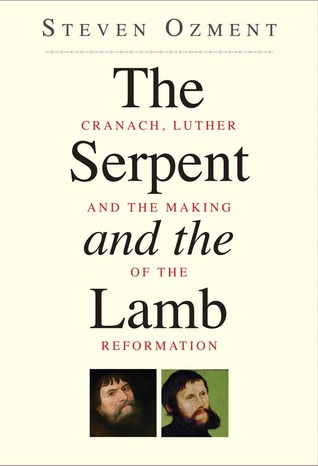
The Serpent and the Lamb. Cranach, Luther, and the Making of the Reformation
Steven Ozment
Yale University Press 2011
Lucas Cranach the Elder (1472 – 1553) belonged – next to Albrecht Dürer, Hans Holbein the Younger and Hans Memling – to the most important artists of his time. He spent his youth in Kronach, where his father lived as a painter. Around 1500 he left for Nürnberg (to learn from Dürer) and later Wien. In 1505 he was appointed court-painter to the ducal household of Saxony and set up shop in Wittenberg. At first he followed the duke around having bed and board at the different castles in Wittenberg, Torgau and Coburg. In 1512, however, he married Barbara Brengbier and bought a huge house in Wittenberg, where he sat up shop as a painter, printer and designer.
This brought him in close contact with Martin Luther, who started teaching at the University of Wittenberg in 1508. Soon they were fast friends and later collaborators in the dissemination of the reformation. Especially his work as a publisher and printer was indispensible in the years after 1517, when Luther published his 95 theses and began his work as a reformer.
A recent book by professor Steven Ozment – known for his fascinating stories about life in late medieval and early modern Germany – tells the story of how the fates of the “Serpent” (Cranach) and the “Lamb” (Luther) were intertwined as were their very early use of their coats of arms and their emblems as ways of enforcing some sort of copyright on their combined works as author and publisher. Although somewhat “weak” on the latest scholarship on Martin Luther, the book is fascinating because it explains in an original way, how Cranach albeit heavily investing in the reformation was able to move effortlessly amongst both reformers and Catholics.
Naked virtue
At the same time as he painted powerful people in both worlds, he created the series of beautiful naked “mothers” nursing their children, thus showing how Eros and the body should no longer be considered hellish; quite the opposite: The naked woman was the fountain of precisely that God-given love and nourishment, which graced the new life in the new church.
The book makes the claim that the reformation had never succeeded without Cranach’s visualization of the new theology. That may very well be. Whether he was the second most important reformer next to Luther, as the author claims is however less certain. Maybe it is more accurate to claim that the reformation was a result of the actions and efforts of a number of people, who simply happened to converge in the same place at an opportune moment in history.
Open database
Cranach the Elder was compared to his contemporaries a prolific artist. A “fast hand”, he was called by people, who marvelled at the vast production capacities of the man and his workshop – paintings, portraits, altarpieces, woodcuts, drawings, set pieces for hunts and tournaments and even wallpapers are just some of the results of a life long working career and business enterprise of the renaissance painter.
Now 400 paintings, 5000 drawings and woodcuts plus 2000 pages of research are available for in-depth perusal at the official “Digital Cranach Archive”, which recently opened some of its collections up for the public eye. Here it is possible to get detailed information of dates provenience etc. as well as access to a large part of the research hitherto hidden in obscure corners of scientific journals. As this is only the first installment, more is yet to come. The database is financed by the Andrew Mellon Foundation and a joint venture of institutions from all over the world. Undoubtedly the plan is to finish the work around 2015, which is named as Cranach-year as part of the Luther-Dekade leading up to the 500 – year reformation jubilee in 2017. Maybe at that time the three planned exhibitions in Weimar, Eisenach and Gotha will be superfluous as all the works of Cranach can be studied at home in high resolution and copiously documented.
www.lucascranach.org – not to be mistaken for www.cranach.net, which is an exclusive database, fenced off for anyone who is not a registered researcher.
Authoring the Past
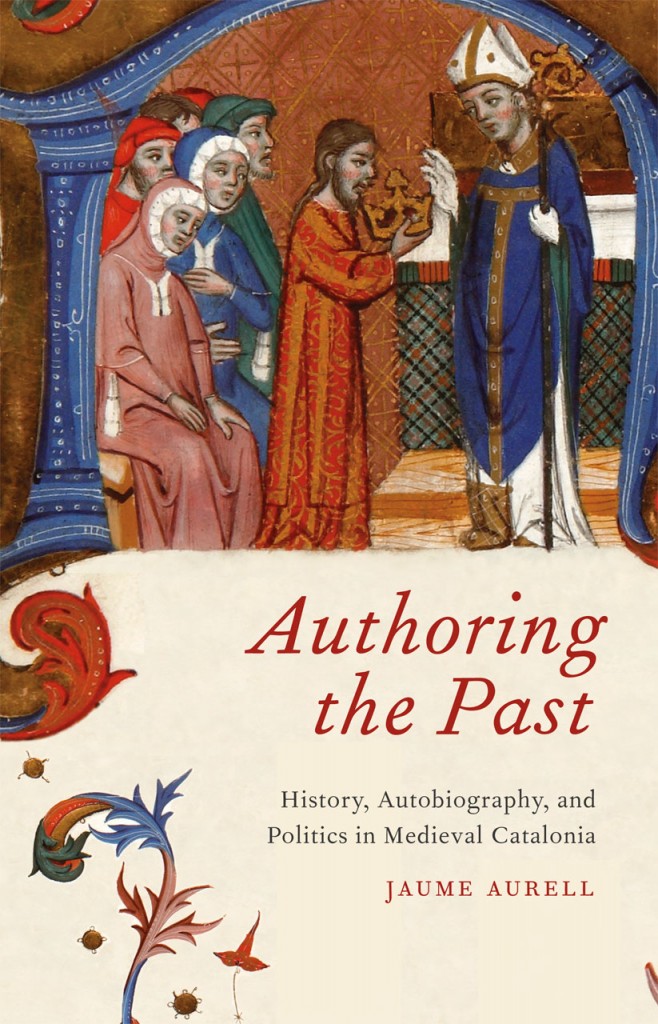
Authoring the Past. History, Autobiography, and Politics in Medieval Catalonia. by Jaume Aurell. University of Chicago Press 2012
Lineage, chivalry, hegemony, heroic deeds and political supremacy – all are ways in which diverse Catalonian counts and later Aragonese kings tried to validate their rights as rulers. At least this is, according to a fascinating new book, how these counts and kings wished to present their case to their contemporaries as well as posterity through the historical writings, which they initiated and took more or less active part in writing and editing.
The book – Authoring the Past – is written by the historian Jaume Aurell. In it he examines five central texts from the Catalonian Middle Ages – the Latin Gesta Comitum Barcinonesium and four histories in Catalan: the Llibre dels fets by James I, the Crònica of Bernat Desclot, the Crònica of Ramon Muntaner, and the Crònica of Peter the Ceremonious
Master Fictions
All political authority requires what the anthropologist Clifford Geertz famously called “a cultural frame” or a “master fiction”.
According to Jaume Aurell it is exactly this, which these Catalonian genealogies, chronicles and autobiographies from the late 12th to the late 14th century tried to establish through manipulation of genres, sources and narrative strategies. As such these precious Catalonian texts represent special ways of framing their respective proponents or “heroes”. Each in their own way shows how the counts and later kings anchored their rights to rule.
As such each text primarily represents a relic of the diverse ways in which these rulers (or their servants) thought of themselves and their rights to rule – whether this right was founded in their lineage, their chivalric competence, their military prowess and heroic deeds or finally their political proficiency.
At the same time, however, each text represent specific genres – chronicles, autobiographies etc. – which are extensively discussed in order to show the interrelationship between them.
Without prior recognition of this, historians should keep away from naively using these texts as sources. This is one of the obvious conclusions of this erudite exposé.
In this sense, however, the book is also an invitation. The reason is that we get small glimpses of exactly the kind of historical anthropological insights, which might be gleaned from these texts after their genre and intentions have been laid bare.
For instance this is demonstrated in the presentation of a number of coronation vignettes, where we learn how the later kings of Aragon established self-sufficient gestures, like the practice of Self-Coronation as opposed to the earlier sacralisation, which was instituted by the church and where the climax consisted in the officiating Archbishop crowning the king.
One must ardently hope that the book on “Authoring the Past” will not only invite scholars to continue in performing the same kind of penetrating analysis of other historical chronicles of the Middle Ages in order to establish a proper comparative perspective; a work which is in progress all around Europe. But also that historical Anthropologists per se will find plentiful inspiration here to delve into these quite remarkable Catalonian histories.
Although only some of the texts discussed in the new book may be found in adequate editions and translations, it is of great value that Jaume Aurell has presented future historians and students with an overall grid, whereby it becomes possible to read these texts anew and – not the least – between the lines, so to speak.
Jaume Aurell
Jaume Aurell is associate professor of History and dean of the College of Humanities and Social Sciences at the University of Navarra. He is the author of La escritura de la memoria. De los positivismos a los postmodernismos and La cultura del mercader en la Barcelona del siglo XV. He is also editor of the series: Rewriting the Middle Ages in the Twentieth Century (Brepols). Articles and essays have appeared in Annales, Biography, Rethinking History: Journal of Theory and Practice, the Journal of English and German Philology, and the Journal of Medieval History.
Read more about Medieval Catalonia in Medieval Histories 2012 4 : 2