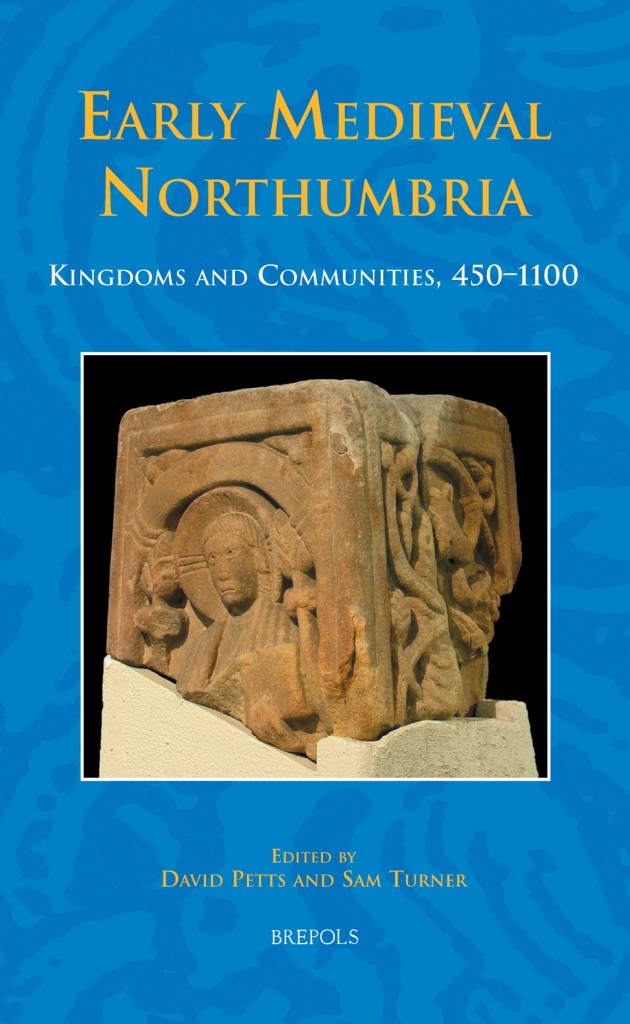
Early Medieval Northumbria. Kingdoms and Communities, AD 450 -1100.
David Petts and Sam Turner (eds).
Studies in the Early Middle Ages. Vol 24.
Brepols 2011.
In a sense, early medieval Northumbria is an enigma. On one hand it presents us with some of the most evocative historical sources – foremost the writings of Bede, but also other material like hagiographies and letters. On the other hand charters are non-existent as are compilations of law. This leaves the Early Medieval Northumbrian historian with a dire need to consult archaeologists, art historians, onomastic scholars, biologist and zoologists in order to get a better grip on the lives and thoughts of people at that time. And vice versa!
In 2006 a group of researchers got together in Newcastle in order to try and bridge the many traditions and see if the merging of their different nitty-gritty and specialised enquiries might throw new light on the region as well as raise the interdisciplinary awareness of the need for further collaboration.
The papers from this conference are now available in a very interesting edition prepared by Davis Petts from Durham University and Sam Turner from Newcastle.
Of course, as with any collection of papers, you have to sift the wheat from the chaff. Nevertheless it is a very interesting collection, in so far as it really tries to bring the reader up to date on the many lingering questions and scholarly controversies: To what extent constituted the Anglo-Saxon immigration a brutal subjugation of the British? Or was there rather an atmosphere of “continuity and convivencia ”, which the archaeological excavations of Yeavering have hinted at? Should Early Medieval Northumbria be considered a homogenous kingdom albeit marked by strife and upheavals? Or was it rather a poly-cultural region consisting of an Anglo-Saxon coastal region and a less subdued hinterland in the West, characterised as a frontier zone – a zone of process more than place?
Lots of good questions and many interesting answers! As an example may be mentioned the analysis by Jenny Walker of the great halls at Doon Hill and Yeavering, showing how the “later” halls from the first half of the 7th century might be interpreted as evidence for a more hierarchical social structure, organising space for ritual processions and gatherings in order to showcase might and power of a new kind. Or as claimed by Colm O’Brien in his revaluation of the excavations at Yeavering: “ Here the elite played out inside great timber constructions, clad to simulate Roman stone, the drama of the Hall in which a king received and gave honour, and fealty was confirmed with gold and mead”.
There is definitely and increased appreciation of the need for regional studies as well as the need for more holistic oriented studies of the material culture in order to grasp Early Medieval History. For a long time this was a specialty of German Historians.
Now, it seems the English are getting there…