
The Medieval Court of Llys Rhosyr to be rebuilt at St. Fagans
Reconstruction of the medieval court of the princes of Gwynedd, excavated a decade ago, has begun at St. Fagans, the National Museum in Wales.
In 1992 the archaeologist Neil Johnstone discovered the remains of Llys Rhosyr, one of the royal courts of llywelin Fawr, prince of Gwynedd in the 13th century. It was located in the South West of isle of Anglesey near Newborough on the way to Llanddwyn island.
The Llys Rhosur was one of the royal courts, through which the princes ruled when in residence. These ‘Llys’ were placed at regular interval in the Welsh Kingdom, each covering an administrative region, called a ‘commotes’. Llys Rhosyr was at the heart of the ‘Menai Commote’.
After king Edward I’s conquest in 1282, Rhosyr was largely abandoned. Perhaps stones and timber was removed from the dismantled court and used in his large castles. Later in 1332 the area became covered by sand-dunes, where it lay undisturbed until it was discovered in 1992.
The site has since then been partially excavated, revealing the remains of the main hall and a building believed to have housed the private apartment of the prince. The site has also yielded a number of finds like coins, pottery and other small artefacts. Much of this is exhibited at the local museum in the Prichard-Jones Institue in the nearby village.
 The royal court occupied 1.3 acres, while the royal demesne is believed to have extended over the 600 acres, on which the new town of Newborough was established after the conquest. The prince’s tenants worked the land, while other peasants were responsible for the repair and maintenance of the royal buildings: the fence, the hall, the chapel and the lord’s privy and stable. These and other buildings (kilns, barns etc.) were outlined in the Welsh laws as the responsibility of the local peasants to keep and repair. Fair and markets were of course part of the regular on-goings at the Llysoedd
Although more than ¾ of the site is still waiting to be excavated it has recently been decided to spend funding on a reconstruction in the National Museum of Wales.
Reconstruction at St. Fagans
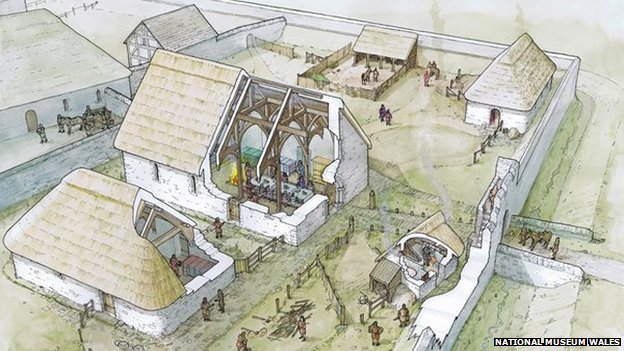
The complete court cannot be replicated without damage to the adjoining woodland so it is proposed that the main hall and adjacent chamber with only part of the surrounding wall should be constructed. These comprise replicas in rubble walling bonded with clay beneath thatched roofs. The hall will have a footprint 11m x 17m and the chamber 7.5m x 13m. With 9 meters high stone walls and a thatched timber roof, the building of the court will provide apprenticeships and trainee placements within the Historic Buildings Unit.
After the reconstruction the plan is to use the buildings for overnight stays so children may improve their understanding of medieval life.
The project feeds into the overall plan of Cadw (the Welsh Government’s historic environment service to focus on the Princes of Gwynedd and the places associated with that medieval dynasty as part of a development of the “ Wales Heritage project”.
SOURCES:
Application Plan for development of St. Fagans
Interpretation Plan for the Princes of Gwynedd for Cadw May 2010
READ MORE:
Cae llys, Rhosyr: A Court of the Princes of Gwynedd
By Neil Johnstone
In: Studia Celtica 2000, Vol. 33, pp. 251 – 295
A Brief Report on Pen y Bryn and Aber Llys and castles of Gwynedd
By Paul Martin Remfry
Castle Studies Research and Publishing 2012
 Political Power in Medieval Gwynedd. Governance and the Welsh Princes
By David Stephenson
Series: Studies in Welsh History
2014, 2. edition (1984)
ISBN-10: 1783160047
ISBN-13: 978-1783160044
 Llywelyn ap Gruffudd: Prince of Wales
By Beverley Smith
University of Wales Press; 2014 New edition (2001)
ISBN-10: 1783160063
ISBN-13: 978-1783160068