Home » Medieval Literacy

Tag: Medieval Literacy

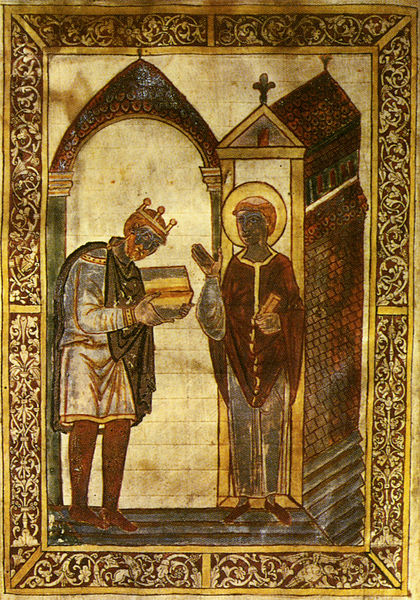
King Athelstan presenting a copy of Bede's two lives of St Cuthbert to the saint in his shrine at Chester-le-Street in 934. This is the earliest surviving royal Anglo-Saxon portrait (Corpus Christi Cambridge MS 183, fol. 1v)

Anglo-Saxon Law Codes and Legal Norms

Law codes and legal norms in later Anglo-Saxon England
Levi Roach, University of Exeter
In: Historical Research, Volume 86, Issue 233, pages 394–407, August 2013
DOI: 10.1111/1468-2281.12001

ABSTRACT:

The article seeks to provide a fresh perspective on long-standing debates about the role of the written word in later Anglo-Saxon legal culture. Using the Anglo-Saxon law codes of King Æthelstan’s reign as a ‘case study’, it argues that many of the unusual features of early English law are not so much products of orality, as of a fundamentally different approach to legal norms than is prevalent in the modern Western world. It thus seeks to move beyond recent literacy-orality debates, suggesting that it is more profitable to investigate the attitudes shown towards legal norms (both written and oral) within Anglo-Saxon society. “The crucial distinction, writes Levi Roach, lies less between “oral” and “literate” legal cultures, than between two fundamentally different approaches to legal norms: one according to which these are treated as flexibly, more like guidelines and rules; and another according to which they are regarded as prescriptive regulations” (p. 468) This is demonstrated through a careful reading of Æthelstan’s laws which is finally compared to recent research into the comparable Frankish laws as well as some ethnographic case studies. The article represents a good introduction to the scholarly debate concerning how to understand the context of Anglo-Saxon law codes and legal norms

The article is part of a collection of papers presented at a conference in Copenhagen in 2011 organised in collaboration between three digitisation projects: “Early English Law“, “Nordic Medieval Laws” and “Relmin”.

READ MORE:

Read also about the context of the article in “Medieval Law” in Medieval Histories


Runes – A Handbook

runes-a handbookRunes: a Handbook
Michael P. Barnes (Author)
Hardcover: 256 pages
Publisher: Boydell Press; 2013 (2012)
Language: English
ISBN-10: 1843837781
ISBN-13: 978-1843837787

Runes, often considered magical symbols of mystery and power, are in fact an alphabetic form of writing. Derived from one or more Mediterranean prototypes, they were used by Germanic peoples to write different kinds of Germanic language, principally Anglo-Saxon and the various Scandinavian idioms, and were carved into stone, wood, bone, metal, and other hard surfaces; types of inscription range from memorials to the dead, through Christian prayers and everyday messages to crude graffiti. First reliably attested in the second century AD, runes were in due course supplanted by the roman alphabet, though in Anglo-Saxon England they continued in use until the early eleventh century, in Scandinavia until the fifteenth (and later still in one or two outlying areas).
This book provides an accessible, general account of runes and runic writing from their inception to their final demise. It also covers modern uses of runes, and deals with such topics as encoded texts, rune names, how runic inscriptions were made, runological method, and the history of runic research. A final chapter explains where those keen to see runic inscriptions can most easily find them.

Professor Michael P. Barnes is Emeritus Professor of Scandinavian Studies, University College London.

Contents

  • 1  Introduction
  • 2  The origin of the runes
  • 3  The older futhark
  • 4  Inscriptions in the olderfuthark
  • 5  The development of runes in Anglo-Saxon England and Frisia
  • 6  The English and Frisian inscriptions
  • 7  The development of runes in Scandinavia
  • 8  Scandinavian inscriptions of the Viking Age
  • 9  The late Viking-Age and medieval runes
  • 10  Scandinavian inscriptions of the Middle Ages
  • 11  Runic writing in the post-Reformation era
  • 12  Cryptic inscriptions and cryptic runes
  • 13  Runica manuscripta and rune names
  • 14  The making of runic inscriptions
  • 15  The reading and interpretation of runic inscriptions
  • 16  Runes and the imagination: literature and politics
  • 17  A brief history of runology
  • 18  Where to find runic inscriptions
  • 19  Glossary
  • 20  Phonetic and phonemic symbols
  • 21  The articulation of speech sounds
  • 22  Transliteration conventions
  • 23  The spelling of edited texts
  • 24  Index of inscriptions