How shall we understand the events on New Years Eve in Cologne? As the acts of sexually famished young men? As the reflection of another culture? Religion? Or were they primarily culturally inspired coordinated political acts? Comparison of Taharrush Jama’i with the medieval charivari institution points in that direction

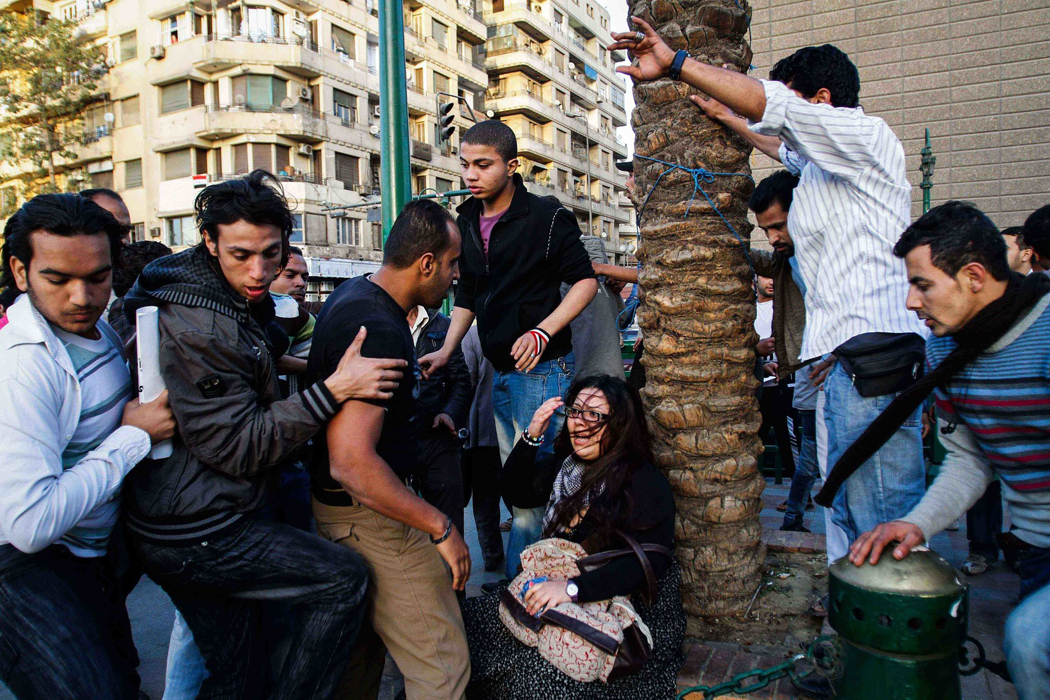
In the years leading up to the Arabic Spring, sexual harassment was widely used in Egypt as a political instrument to prevent women to gain access to public spaces and rallies. At first the phenomena did not play a significant role in the international media. However, after an instance of an Egyptian taharrush jama’i (also called taharrus gamea) attack at CBS reporter Lara Logan, a prominent female journalist, who was molested by hundreds of men in Cairo’s Tahrir Square, it became part of the general lore of Western Women travelling in the Middle East to avoid “open spaces”.
New Year’s Eve, this specific type of sexual harassment finally became mainstream in European media, when more than a 1000 refugees and illegal migrants attacked and molested a very large number of young girls in the central square in Cologne. As of now, more than 500 females have lodged a complaint with the police, including two allegations of rape. Afterwards, it has become apparent that the phenomena have played out for several years at musical festivals all over Europe. However, in several instances (not least in Sweden) police and politicians have colluded in order not to feed what they have characterised as the xenophobic feelings of the rabble. It appears this has also been the case in several other German situations. What has been missed in this discussion, however, is the political agenda built into the phenomenon of “Taharrush jamaʿi “.
In the aftermath of Cologne, the events there have primarily been described as the result of sexually starved young men, growing up in a culture, where girls as a rule are kept sequestered until the time, when a marriage can be successfully negotiated. Coming to Europe, it thus appears that girls are offering themselves up for the taking. Not knowing the law of the land, these young men go on a rampage. Comparing the events in Cologne with those in Cairo must, however, leave us with a very uneasy feeling: that this might also be a political instrument used to make a statement about the way of life of ordinary Europeans and European girls.
As such, the acts of violence are the mirror image of the sexual harassment, which Muslim girls often experience in public spaces and in schools, when gangs of young Muslim men try to “police” them, if they are not veiled or otherwise properly dressed according to the law of Sharia. The difference is of course that these girls do not complain to the police or their teachers as did the German girls, who were molested in Cologne.
The Medieval Charivari
Such customs are of course not unknown in a European context. The medieval and early modern phenomenon of the Charivari springs to mind. Charivari (also called “rough music”) is the term for a French folk custom in which the community gave a noisy, discordant mock serenade, while pounding on pots and pans, at the home of newlyweds. The loud, public ritual evolved into a form of social coercion used to force an as-yet-unmarried couple to wed or to voice opposition to heterogeneous marriages when elderly men had scored one of the younger women. Villages also used charivari in cases of adulterous relationships, wife beaters, and unmarried mothers. In some cases, the community disapproved of any remarriage by older widows or widowers. The difference, however, is that while the Charivari was a medieval practice, now long forgotten except by medieval geeks, the modern harassment of Taharrush jamaʿi is here to stay.
SOURCE:
The Reasons of Misrule: Youth Groups and Charivaris in sixteenth- century France.
By Natalie Zemon Davies
In: Past and Present 50 (1971) pp. 49 -75
“When She Stands Among Men”: Sexual Harassment of Women at Political Protests in Cairo, January 2011 – August 2013.
By Serena Hollmeyer Taylor, Amy Tan, Phoebe Sloane, Maggie Tiernan, and Faiqa Mahmood In: The Fletcher School’s online journal on Southwest Asia and Islamic Civilization 2014.