


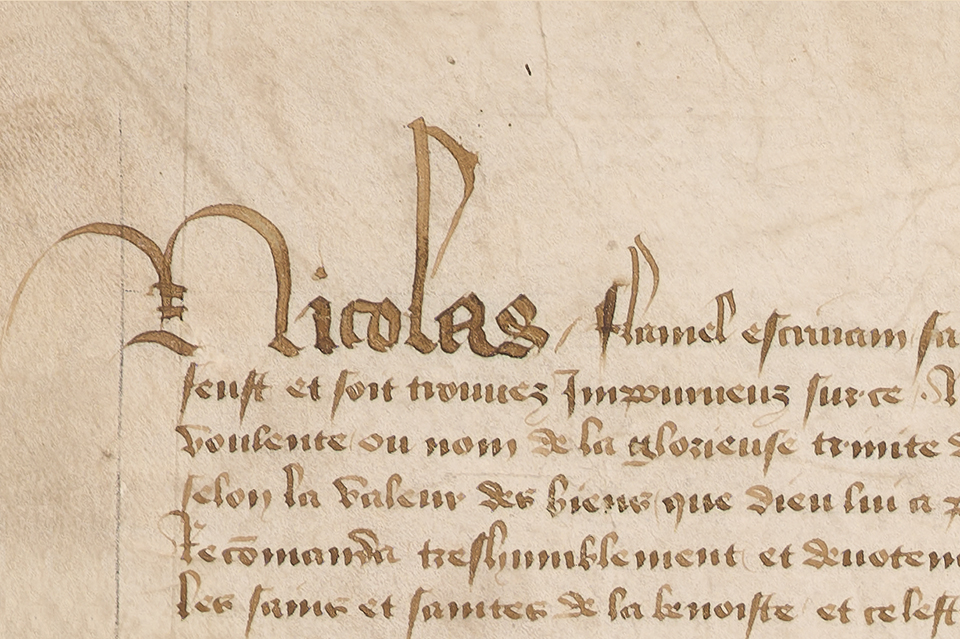
Nicolas Flamel, was a very wealthy Parisian slumlord making his living from renting out rooms and apartments in houses build on the right side of the Seine in the fourteenth and fifteenth centuries. Upon his death, he donated his entire wealth to churches and hospitals to atone for his sins.
In 1416, the Parisian slumlord Nicolas Flamel had his last will and testament (1) drawn up to ensure that his wealth would be devoted to pious purposes, including annual commemorative masses for himself and to some extent his wife, Pernelle. Unfortunately, not everything went according to plan. The church he chose as his final resting place was demolished in the aftermath of the French Revolution, his tombstone was reused as a slab by a Parisian grocer before eventually ending up in Museé de Cluny, and his name became associated with the world’s most famous alchemist – the creator of the philosopher’s stone.
The Testament represents a fine example of how parts of the lifeworld of this Parisian Burgher living around ca. 1400 may be unraveled. Notice his precise calculations of the “worth” of different kinds of people. For instance, when he donates brown coarse cloth to his poor dependents which costs half the price of the fine blue cloth donated to clerics and churches. This was a world in which of harsh and precise social distances were nourished and kept intact.
The following is an English translation of his last will and testament from a French transcription provided here:
Étienne-François Villain, Essai d’une histoire de la paroisse de Saint-Jacques de la Boucherie, Paris, 1758), pp. 276 ff. The translation thus follows the printed French transcription, and do not represent a fresh collation of the original parchment. Obvious defects and discontinuities in that transcription are identified very cautiously; institutional names, monetary denominations and legal distinctions have been retained. “Item” introduces a new testamentary provision. “Livres Parisis” denotes the Paris monetary standard, with the value around 1425 of 38.2 gr of silver or 3.6 gr of gold. This is reflected in the value of lesser coins.
THE TESTAMENT OF NICOLAS FLAMEL (1416)
To all who shall see this letter, Tanneguy du Chastel, knight, counsellor and chamberlain of our lord the King, keeper of the Provostship of Paris, sends greetings.
Be it known that before Hugues de la Barre and Jehan de la Noë, clerks and notaries of our lord the King, appointed by him to his Châtelet in Paris, there appeared in person Nicolas Flamel, writer, sound in body and mind, speaking clearly and possessed of good and true understanding, as he declared and as appeared at first sight.
Reflecting wisely that nothing is more certain than death, and nothing less certain than its hour, and wishing that no difficulty should arise at the end of his days, he did not wish to depart this world for the next intestate. Thinking upon heavenly things, while sense and reason still governed his mind, and desiring to provide for the salvation and welfare of his soul, he made, ordered and determined his testament, or ordinance of last will, in the name of the glorious Trinity, Father, Son and Holy Spirit. He directed that it should be performed, paid, ratified and fulfilled by the executors hereafter named, or by others appointed for that purpose, according to its several provisions concerning services, gifts, alms, legacies, ordinances and conditions, within the value of the goods that God had lent him, as written and declared below. Nothing was to be altered, done differently or changed for any cause, necessity or occasion whatsoever, whether by petition or otherwise.

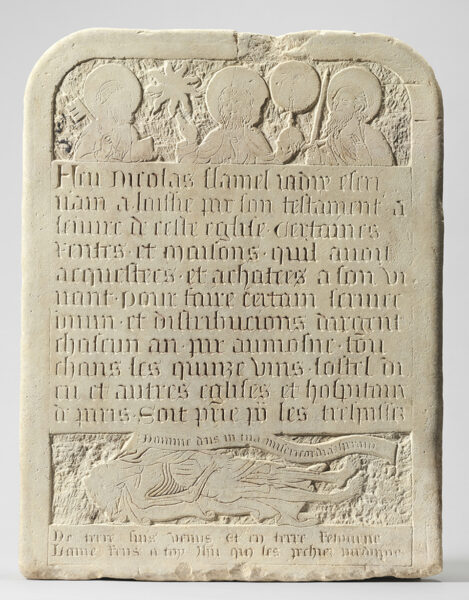
FIRST. As a good and faithful Catholic, he most humbly and devoutly commended his soul, when it should depart from his body, to the blessed Trinity in Paradise, to the glorious Virgin Mary, to Saint Michael the Archangel, to Saints Peter and Paul, Saint James, Saint Nicholas, Saint Catherine and all the male and female saints of the blessed heavenly court of Paradise, praising God for all the good things that He had bestowed and lent to him in this mortal life. He ordered that his body should receive Christian burial, choosing his grave in the church of Saint-Jacques-de-la-Boucherie, before the Crucifix and Our Lady, for which fourteen francs had been paid to the church fabric, as had long since been recorded in letters exchanged between the churchwardens and himself. Upon his grave, as a memorial, there should be placed a small tombstone then in his house, or another if it seemed good.
He wished and ordered all his debts to be paid without delay and any known obligations or wrongs committed to be made good and restitution made. Unknown wrongs should likewise be made good to honest persons worthy of trust, whether from within or outside, who affirmed them on oath within one year of his death, up to forty livres parisis in individual claims, if equity required it.
ITEM. For the torches, candles and other lighting required at his funeral he assigned one hundred sols parisis. To the parish priest of the said church of Saint-Jacques, twenty sols parisis; to its chaplains, twenty sols parisis; to its clerks, sixteen sols parisis. For solemn masses and services, high and low, on the day of his burial and the following day, sixty sols parisis. For fifty low Requiem masses, with commemorations at their conclusion of the Holy Spirit, Our Lady and all the saints, on the day of his burial and the next, one hundred sols parisis. For the solemn ringing of the bells of the church, thirty-two sols parisis. To the fabric of Notre-Dame of Paris, twenty sols parisis. To his neighbours who accompanied the service, to go and drink or dine as they pleased and pray for him, four livres parisis.

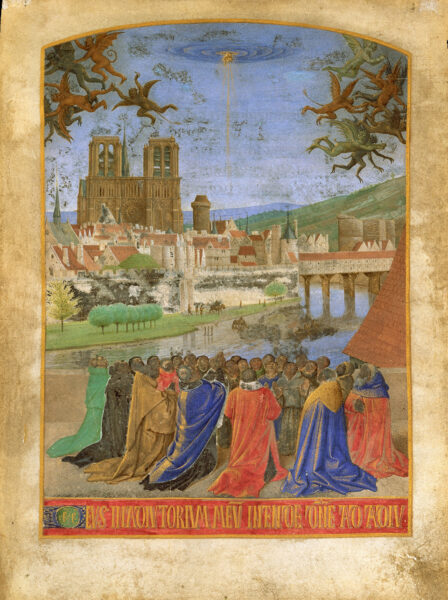
ITEM. His executors were to distribute, during the services on the day of his burial and the next, four deniers parisis directly into the hands of each of three hundred poor persons, totalling one hundred sols parisis. To each of the four mendicant orders, the Hôtel-Dieu of Paris, the Saint-Esprit en Grève, the Blancs-Manteaux and the Quinze-Vingts, sixteen sols parisis for saying vigils. To the tenants living at that time in his houses beyond the Porte Saint-Martin and opposite the church of Saint-Jacques, he left, as alms and in return for prayers for him, twenty sols parisis each, or an equivalent deduction from their rents.
ITEM. His executors were to purchase three hundred aunes (ells or aulnes) of good brown cloth at twelve sols parisis an aune, to be distributed as alms to one hundred poor working households, men and women, wherever it would best serve. Each was to receive three aunes, with which each recipient was required to make a tunic, hood and hose for personal wear, using them for as long as they lasted, without selling the cloth or putting it to other uses, on pain of repayment of its value. The distribution was to include thirteen persons at La Villette-Saint-Ladre, thirteen at Issy, fourteen at Rueil and forty at Nanterre. Particular preference over all others was to be given to persons, their children or heirs, who had formerly dealt with the testator in the sale of rents payable in money or wine, or otherwise, provided they were in need and the gift would be well employed.
ITEM. Ten poor working householders, masons’ labourers and others frequenting and chosen in the Place de Grève, and ten poor householders, men or women, living in the parish of Saint-Jacques near the testator’s house, were also to benefit wherever the gift would best be used, and should issue receipts. Each of the aforesaid householders and labourers, women as well as men, was to receive three sols parisis in hand, with which to buy a solemn mass, during which they should pray to God for the testator.
ITEM. The executors were to buy two hundred aunes of dark blue cloth, suitable for the recipients named below, at a price of twenty-four sols parisis for each aune, and distribute it to fifty persons, each receiving four aunes to make, as appropriate, a habit of his religious order or a houppelande. The recipients were to wear and use these garments and neither sell, give away nor otherwise dispose of them, on pain of repaying the money and value of the cloth. Two priestly members of each of the four mendicant orders, two religious of the Mathurins, two of Sainte Croix de la Bretonnerie, two of the Blancs Manteaux and two of the Billettes, where God was boiled [an allusion to the host-desecration legend associated with the Billettes], all priests who needed it, were each to receive four aunes of cloth appropriate to their order for making habits.
ITEM. Thirty-four other people, half poor priests and half poor clerks, all scholars, masters of arts or others chosen as deserving recipients from colleges and elsewhere, were each to receive four aunes of brown cloth for making houppelandes to clothe themselves. Neither they nor the religious recipients were to sell, give away or otherwise dispose of it. The cloth was to be distributed to the religious, priests and students aforesaid on the advice and instructions of the minister or prior of the Mathurins, who should enquire where the gift would best be employed. The recipients were to undertake to pray daily to God for the testator. For the trouble of arranging this, and of seeing on occasion that the testator’s instructions were fulfilled, the minister and prior was to receive the value of a mark of silver. To a trustworthy chaplain or other competent man commissioned by the executors to carry and distribute the cloth, chalices and other legacies to priests, clerks, poor labourers, churches and other places as specified above, the testator left ten livres parisis for his due and diligent labours and for rendering a proper account to the executors, who were to oversee and pay everything and obtain good receipts.

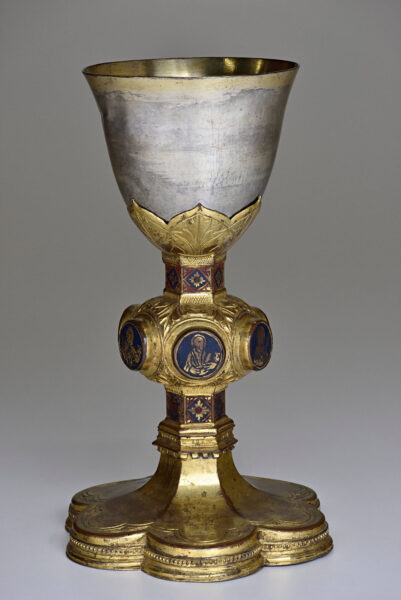
ITEM. To nine confraternities or more of which he was then a member, namely the confraternities of Saint Anne, Saint James and Saint Christopher in Saint-Jacques, Saint Catherine of the Val des Écoliers, Notre Dame de Boulogne sur Mer, Notre-Dame de la Septembreche in the church of the Sepulchre, Notre-Dame de Mezoche in Saint-Honoré, Saint Michael of the chapel of the Palais, Saint Michael and Saint Eustace in Saint Eustache in Paris, and Saint John the Evangelist in Saint André des Arts in Paris, and to any other confraternity of which subsequent membership should be established in writing in his own hand, but not otherwise; likewise to each of the church fabrics of Saint Jacques de la-Boucherie in Paris, Saint Jacques du Haut Pas beyond the Porte Saint Jacques, Notre Dame de Pontoise, Sainte Geneviève in the rue Neuve Notre Dame, the church of the Mathurins, the chapel of Notre Dame d’Aubervilliers, and the parish churches of Nanterre, Rueil, La Villette-Saint-Ladre and Issy: to each of these places and confraternities he gave and bequeathed, for God’s sake, in alms, to increase and perpetuate divine worship, and so as to share for ever in their masses, prayers and good works, a chalice bearing on its base enamelled figures of the Crucifix, Our Lady and Saint John, and on its side an N and a T, together with a cover, all of fine gilded silver, to be specially made by his executors, each supplied with a leather case and of the price and value specified as sixteen Livres parisis.
He further wished each of those churches and confraternities to receive a torch [wall lamp] worth twenty sols parisis, to be used in worship and then for the continuation of divine service in those places for as long as it lasted. Neither the chalices nor torches were to be sold or removed elsewhere, and the priests or other administrators of the churches were not to take anything from them. On the day they received the gifts, each institution was required, at its own expense, to have a solemn service said in Saint Jacques de la Boucherie: vigils with nine psalms and nine lessons, a solemn Requiem mass with deacon and subdeacon, and a notable commendation for the salvation of the testator.
ITEM. To Margot la Quesnel, his maidservant, and Colette her daughter jointly, if both were alive, or wholly to whichever survived, he left household goods from his residence up to the value of twenty livres parisis, together with an annuity of forty livres parisis payable at the customary four terms for the duration of their lives, or the survivor’s life, charged upon his share of the house facing Saint Jacques de la Boucherie and upon all his other houses. He likewise gave them for their lifetimes, or wholly to the survivor, half of the wine rents and arrears owed to him after his death on various properties and inheritances, for the lives of certain persons in the town and territory of Nanterre.

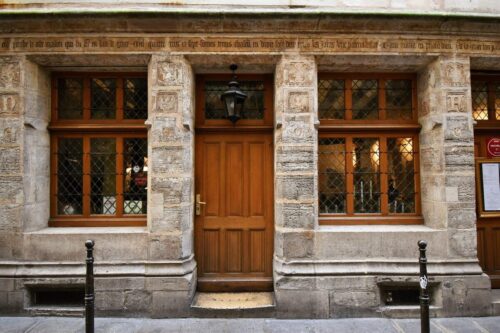
Translation:
We, men and women, workers living in the porches of this house that was made in the year of grace one thousand four hundred and seven are, each of us, required by law to say every day one Our Father and one Hail Mary while praying to God that his grace brings forgiveness to the poor deceased sinners, amen.
Source: Wikipedia
He further left Margot, for her own residence or for letting to her profit during her life alone, the three lettings beneath the porch of his house facing Saint-Jacques, if the partition of the estate presented no obstacle, or the ground-floor letting in the tall house with the well in the rue de Montmorency, at their choice. These legacies were made as alms, for the love of God and for prayers for the testator, and were entrusted to their consciences, provided Margot did not marry and that both women always conducted themselves well and honourably, without any scandal touching their bodies, on pain of forfeiting the legacies. Neither woman, nor any other person on her behalf, could sell, pledge or alienate the wine or money rents for any cause or necessity during their lives, but only live upon and enjoy them in the manner stated. If Colette should die having had children in marriage within ten years after her marriage, each of her children then living should receive ten livres parisis in cash, once only, as an alms gift from the assets of the estate. The executors named below were to deliver these gifts and rents. After the women’s deaths, the money annuity alone was to revert to the purposes of the execution of the will.
The testator wished Margot to participate throughout her life in carrying out his will, on the same footing as the executors named below, being summoned and received to assist, oversee and ensure the fulfilment of its legacies and provisions, and he appointed her to act with them. Every Saturday throughout the year, after vespers had begun, Margot was required, at her own expense during her life, to hold herself, or cause another woman on her behalf to hold, five wax candles worth one denier each, kneeling before the image of Our Lady in the church, to burn until half consumed or thereabouts. At each feast of Our Lady, at high mass, fifteen such candles were likewise to burn and afterwards to be offered and fixed before the image, with prayers to God and Our Lady for the testator.
ITEM. He left Margot la Quesnel four livres parisis, as alms and remuneration for carrying every day to the offertory the bread, wine, candle and money which the executors were to provide for the masses and services during seven years and forty days and for the monthly masses and services. If she were not alive, one of the female candle-sellers of that church or another woman should receive fifty sols parisis for this service during those seven years and forty days. Afterwards that woman should receive an annual annuity of twelve sols parisis for carrying the offertory at the monthly service, as remuneration and alms.

ITEM. To his relatives, if there were any who claimed to be his heirs, he left, both in alms and in full satisfaction of all inheritance and other rights whatsoever, forty livres parisis in cash, once only, to all of them together. He excluded, dismissed and barred them from the inheritance. If they or any of them objected to any part of this, or would not accept the legacy, it was to be converted into alms in equal portions for the fabrics or charitable works of the Hôtel-Dieu of Paris and of the Saint-Esprit en Grève. In that event the governors of those establishments could demand and receive the money for their charitable purposes under the execution of the will.
ITEM. The testator wished and ordered that immediately after his death, for the next seven full years and forty days, there should be said and celebrated in Saint-Jacques, or in another church entrusted with the execution of his will, a low Requiem mass every day, except Fridays, with bread, wine and candle, and at the end of each mass commemorations of the Holy Spirit, Our Lady, All Saints and the Angels. At each mass a pint of red wine worth six deniers, a loaf worth four deniers parisis and a candle worth one denier should be offered. These masses should be celebrated by the members of the four principal mendicant orders of Paris, one friar from each order coming on his appointed turn to Saint-Jacques to celebrate a mass, without being required in conscience to perform any other service that day. At the end of each mass the friar was to sprinkle holy water upon the testator’s grave, recite the De profundis and other prayers commending his soul to God. The executors were to pay the friars two sols and six deniers parisis each day throughout this period for these masses and services.
ITEM. Every Friday during those seven years and forty days the executors and churchwardens of the church are to arrange a notable service for the dead: on the preceding evening vigils with nine psalms and nine lessons and a solemn ringing of bells, and on the following morning matins and the complete lauds of the dead, with all the appropriate solemnities and bell-ringing; afterwards high mass at the high altar, with deacon, subdeacon, four chaplain-priests in copes, and the clerks. The parish priest, his deputy or his appointed representative, who said the high mass and attended the vigils on both days, was to receive six sols parisis. The deacon, subdeacon, chaplains and clerks were each to receive two sols and six deniers parisis. They were to sprinkle holy water upon the grave, recite the De profundis and prayers for the dead, and faithfully observe the prescribed services throughout the period. At every Friday high mass there should be offered a quart of red wine worth twelve deniers parisis, a loaf worth four deniers and a candle worth one denier.
The churchwardens are to select seven poor persons, men or women, for whom it would be of benefit. During these Friday high masses they were to stand in rows on either side, praying to God for the departed, and each was to go to the offertory with one denier parisis from the money given to them. At the end of the service the churchwardens were to give each of them thirteen deniers for God’s sake, as alms and in return for prayers for the departed, and to provide candles in the same manner as at the anniversaries and obits described below. If seven poor persons of the Quinze Vingts wished to attend these Friday services, they were to be received in preference to the others.
ITEM. Furthermore, and above all, for the salvation of his own soul and those of his deceased father and mother, relatives and other benefactors, the testator wished and ordered that every year, in perpetuity, in Saint Jacques de la Boucherie, or in another church if there was default or opposition there, twelve solemn double obits or anniversaries and services should be celebrated, insofar as their cost could be met from his rents according to his instructions. Immediately following his death, one such double obit and anniversary was to be held every month, at the high altar or another prominent altar, on the first, second, third or fourth day of the month.
The service was to comprise vespers and vigils of the dead with nine psalms and nine lessons on the preceding evening; matins and the full lauds of the dead the next morning, together with every other appropriate solemn service; followed by high Requiem mass with deacon and subdeacon, ending with commemorations of the Holy Spirit, Our Lady, All Saints and the Angels. The parish priest of Saint-Jacques, or his tenant or deputy, present and future, was to attend vested in cope, surplice and amice; there were also to be a priest to say mass, a deacon, a subdeacon, two curates, the four chaplains of Saint Jacques or others appointed for the purpose, and the two church clerks in copes and ecclesiastical vestments. The altar was to be draped in black, with a pall spread before it, four adequate burning candles upon it, and four further burning wax candles, together with all other solemnities and ornaments customary at a notable service for the dead. The bells were to be rung solemnly both on the eve and on the day of the service.
At each mass two white loaves, each worth four deniers, two pints of wine, each worth eight deniers, and a small candle or taper worth four deniers parisis with a denier fixed into it were to be offered. Notice was to be given on each occasion to the residents of the Hospice de Quinze-Vingts in Paris of the day and hour of the mass. Up to thirteen of them or more, brothers and sisters, blind and others, taking turns, were required to attend, provided they were able to walk. A priest and a clerk carrying the cross in surplices were to accompany them. Throughout the service they were to stand in their own rows on either side and pray for the testator. Each was to go to the offertory with a denier or a tournois from his or her own money, except for the priest and clerk.
Immediately after the mass the parish priest, chaplains, clerks and members of the Quinze-Vingts were to go to the place where the testator’s body lay in the church, sprinkle holy water and recite the De profundis with a solemn commendation and prayers for the dead. Before the Quinze Vingts group left the church, their priest and clerk were to say a low Requiem mass, ending with commemorations of the Holy Spirit, Our Lady, All Saints and the Angels. The testator directed that those priests, chaplains, clerks and persons from the Quinze Vingts who had attended the entire service were to be paid cash by the executors as follows: the parish priest or his tenant or deputy, for assisting, advising, supervising and ensuring the performance of the services and their associated duties, in whichever church in Paris they were held, without allowing them to be curtailed or discontinued, eight sols parisis; the priest celebrating high mass, four sols parisis; the deacon, subdeacon, chaplains and clerks, three sols parisis each.
ITEM. At each service the community of the Quinze Vingts was to receive thirty-two sols parisis for attendance and performance of the duties described. Every one of the poor residents attending in rotation, up to thirteen men or women at each service, and also their priest and clerk, was to receive separately and into his or her own hands twelve deniers parisis in alms to spend as desired. No other member of the Quinze-Vingts community was to share in these individual payments. If the Quinze-Vingts failed or refused to attend, the parish priest or his deputy was empowered to transfer the duty to the religious of the Hôtel-Dieu in Paris, the Saint-Esprit en Grève, or other hospitals or mendicants in Paris. Thereafter, and only in that case, they could claim and receive the legacy originally assigned to the Quinze Vingts in return for performing the same services in accordance with the directions. The churchwardens and executors charged with organising all the services and distributions prescribed in the will are to supply candles, vestments and everything else properly required for each service, from the income and profits assigned to them, for as long as these lasted in value. If a solemn feast, a day in Lent or another impediment prevented a perpetual service from being celebrated on its appointed day, it was to be celebrated and paid for on the nearest following day, like all the other services.
ITEM. The testator, who had been one of the executors of his late wife Pernelle, appointed and established his own executors in his place, to oversee and fulfil the testament and codicil of his deceased wife, just as he could have done in his lifetime.
ITEM. Subject to the provisions concerning the sale and conveyance of his houses, he set aside the one hundred and eighty livres parisis in rents which his executors were entitled to select from the best he possessed in the city and surroundings of Paris, where no right of redemption had been granted. These were intended to pay for the twelve annual obit services and distributions of money set out above. The remaining rents in Paris and elsewhere, acquired or to be acquired by him and enjoyed at his death, for which he had not granted redemption, were to be collected annually or sold to best advantage; and his movable goods, debts owed to him and everything else lawfully belonging to him were likewise to be devoted to the alms and daily services for the dead over seven years and forty days and all other legacies, alms and gifts provided in this will.
If there were insufficient goods to meet these obligations, every particular legacy and provision should be reduced proportionately and equally, without touching the rents reserved for the twelve obits, and the directions of the will were to be observed as justly and faithfully as possible. He also ordered that those who had sold him rents, or their children, living at Nanterre, Rueil, Issy and La Villette-Saint-Ladre, should be forgiven half of the arrears they owed as alms. If they wished to repurchase their rents for themselves, but not on behalf of others, the rents were to be conveyed back to them at their original purchase price. All or several of them should have written instruments of redemption; whoever had such an instrument should produce it. Any remaining rents should be sold to advantage and debts recovered, the proceeds going towards particular legacies and the provisions of the testament.
ITEM. From the money received from his houses, rents and revenues, whether held in mortmain or not, the testator ordered annual payments in perpetuity at the feast of Saint Remigius to the charitable works of the following churches and hospitals: the Hôtel Dieu of Paris; the Saint-Esprit en Grève; the hospitals of Saint Gervais, Saint Julien in rue Saint Martin, Sainte Catherine, the Sepulchre, Saint Jacques de l’Hôpital, and the Trinité in rue Saint-Denis; Sainte Geneviève la Petite; Saints Cosmas and Damian; the religious of the Mathurins; Saint Nicolas des Champs and Saint Merry for their church fabrics; and the Quinze Vingts of Paris, present and future. Each hospital or place was to receive ten sols parisis annually for its fabric or charitable purposes, both as alms and on condition that each should have a chaplain or another priest celebrate a low Requiem mass in Saint Jacques de la Boucherie during November, with a commemoration of Our Lady at the end, for the departed, for as long as it received the rent.
The responsible persons of these churches and hospitals, and of the Quinze-Vingts, present and future, were empowered by the testator, together with their successors, to investigate how the anniversaries, services, money distributions and other provisions of his will were being performed and continued; to remedy any default; and to ascertain the value and yield of the rents and houses, without changing anything. Those who held and enjoyed the rents, houses and other property assigned to the services were required, when necessary, to provide adequate information about everything in their hands concerning the testament to those hospitals and churches and anyone else with an interest, so that they could assist in securing performance should any default occur.
ITEM. To ensure that all particular legacies, services, money distributions and other instructions in this testament were carried out, paid and continued without exception or reduction, the testator bequeathed to the fabric of Saint Jacques de la Boucherie in Paris all movable goods, rents, houses and real property belonging to him at his death, both within Paris and outside it, on condition that it paid, performed and fulfilled all the legacies and instructions herein, and on no other condition, as far as the value of those assets would extend. In particular, he bequeathed to that fabric one hundred and eighty livres parisis of his best rents in Paris and its suburbs, to be chosen by the churchwardens and held in force for ever. These included rents bought from the executors of his deceased wife and others, where he had not granted redemption, along with his undivided half-share in the corner house in the rue Marivaux and all his other houses, held in mortmain or otherwise, including those in rue de Montmorency, subject to their existing charges. All of these were to strengthen and perpetuate the twelve annual obits or anniversaries and distributions of money which he prescribed.
These rents and houses were to be preserved, collected and maintained for ever at the expense of the church fabric, so long as it administered them and received their profits. The fabric was bound, through its churchwardens, to arrange, continue, pay and fulfil all the services, distributions, particular legacies and other provisions of this testament, at the expense of the estate, through the churchwardens of Saint-Jacques, present and future, who were to carry responsibility in the church’s name, as executors or otherwise. Neither the churchwardens nor anyone else acting in the church’s name or otherwise might in future sell, convey, pledge, exchange or alienate any of those rents or houses, whether permanently, for a lifetime or otherwise. Nor could they divert them to the repair, maintenance or other needs of the church or elsewhere, or use money assigned to the services, distributions and rents payable at the appointed terms for other purposes, save as necessary to make the prescribed payments in another manner.
Once the monthly and annual services, distributions and other directions had been duly performed and paid, any surplus profits and revenues from the one hundred and eighty livres parisis of rents and the houses should remain with the fabric of Saint-Jacques, or whichever other church bore responsibility. This was both an alms gift for God’s sake and compensation for the trouble and cost of preserving, managing and maintaining the houses, receiving the rents, paying the money distributions, supplying vestments and lighting and arranging the services, so long as the rents and houses retained value. The churchwardens were to account for these matters when required to the parish priest of Saint-Jacques, the Quinze-Vingts and the other hospitals and churches entitled to the annual rents and profits described above.
If at any time the value of the houses and rents declined to the point that the churchwardens received no greater profit than the annual cost of the services and alms, the entire loss was to fall upon the profits otherwise due to the church fabric, without any reduction in the anniversaries, distributions and other required payments. If the revenues declined so far that they barely equalled the annual cost of the obits and distributions, the fabric, through the churchwardens, should receive from the revenues only the sums necessary to meet the services and distributions, apportioned fairly. If income fell still further, the services and distributions were to be reduced proportionately from month to month, by as little as possible. Any reduction caused by want of revenue was to entail an equivalent proportionate reduction in the income allocated to the church fabric and in the perpetual rents granted to the churches and hospitals named above.
Whatever decrease took place, he wished the services and distributions to be performed, paid and continued, diminishing step by step and from month to month as little as possible until, in the event of a loss so great that God forbid it, the twelve services and anniversaries could no longer be sustained. The church fabric was to take only the same proportionate amount each year, according to the reduction, for as long as the income lasted, and could not claim any surplus. Nothing else was to be done or ordained contrary to these provisions.
ITEM. The testator ordered that any residue of his movable and landed goods remaining after all the particular legacies and instructions had been paid and performed, subject especially to the permanent preservation of the twelve anniversaries, should be divided into four equal parts: one quarter to the fabric of the church responsible for the anniversaries, one quarter to the fabric of Sainte- Geneviève la Petite, one quarter to the fabric of Notre-Dame of Paris and one quarter to the fabric of the Hôtel-Dieu of Paris, to purchase vestments and books for divine service.
ITEM. The churchwardens and administrators of those church fabrics, and any other present or future persons acting for them, were not to acquire ownership, possession or legal power by prescription of time or otherwise over the houses and rents in whole or in part, nor to divert any portion to the maintenance of those churches or any other purpose, whatever necessity arose, except by wholly carrying out and paying everything specified herein.
ITEM. If the church fabric or other beneficiary could not hold or enjoy the houses and rents without their being placed in mortmain, the churchwardens were required, from the value of those houses and rents, to procure the necessary mortmain licences for all or part of them, or to make an appropriate settlement with the feudal lords, or arrange for the holdings to pass securely into other hands. The purpose was that the services, instructions and distributions should always be properly performed from the revenues by the churchwardens or others acting for the church, without deductions. The whole was to be entered in the churches’ register [the word in the supplied transcription is uncertain], and engraved conspicuously on stone or brass if necessary.
ITEM. If the fabric of Saint-Jacques or its churchwardens, present or future, refused to undertake the fulfilment of all the legacies and directions of this will, or at any later time failed or resisted doing so, then, and only then, the testator left the houses and rents to the fabrics of the parish churches of Saint Merry, Saint Jean en Grève, Saint Nicolas des Champs, Sainte Geneviève la Petite, Saints Cosmas and Damian, Saint Eustache and Saint Germain l’Auxerrois in Paris. Their churchwardens were to receive them at their proper value and arrange the same services, money distributions and other obligations without variation, in the same manner as originally directed for Saint Jacques.
He wished the churchwardens of whichever one of these churches first undertook faithfully to execute the provisions of the will, and first requested or caused the assets to be requested, to take the rents, houses and revenues and to be appointed executors for that purpose. If one church refused, another was to take over and perform the same obligations. The priest of Saint-Jacques, the representatives of the Quinze-Vingts and others concerned could advise and assist in finding a church willing to undertake the execution.
If none of the churchwardens of the aforesaid parish churches, upon diligent request, would undertake the execution according to the testator’s intention, so that the houses and rents remained without an administrator, then all the churches, hospitals, religious establishments and other institutions lodging poor people within Paris should, in that event alone, receive the houses and rents as alms for God’s sake. They were to sell them as profitably as possible and divide the proceeds equally among those hospitals and institutions, devoting the greater part to cloth, coverings and other necessities [one noun in the transcription is uncertain] for the poor and the remainder to essential repairs of their hospitals and buildings.
To maintain, preserve, ratify, pay, continue, fulfil and loyally execute each and every instruction in this testament, so far as the value of his movable property and real estate should permit, under the conditions laid down above, Nicolas Flamel, the aforesaid testator, chose, constituted, appointed and named as his beloved and faithful executors and trustees the present and future churchwardens of Saint-Jacques-de-la-Boucherie, acting for and in the name of that church. If they refused or resisted, he appointed as executors the present and future churchwardens of whichever of the other aforesaid parish churches would undertake the task, successive churchwardens continuing the duty in the name of their churches, in the order of those first willing to accept, until all had refused or resisted its performance.
Those churches willing to undertake the task might claim, hold and possess the houses, rents and revenues, whether in mortmain or not, notwithstanding prescription by time, long-established possession, petitions or any contrary circumstances. They might receive these properties and perform the services in their churches, make the prescribed distributions and fulfil the instructions without change, notwithstanding any petition or dispensation by pope, king, prelate or other authority, any written law, constitution, or other means, reason, necessity or occasion whatsoever. If, through someone’s efforts or otherwise, the present or a future pope, a legate, commissioner or another person with authority wished to order otherwise, or if the churchwardens were prevented from holding or enjoying the property so as to fulfil the testator’s intentions, he declared that, in that event and no other, he then and there gave and bequeathed the rents to the fabrics and charitable works of all the aforesaid hospitals and churches, in equal shares, to be devoted to the works and maintenance of those institutions as previously prescribed.
To the churchwardens, present and future, who should begin execution of this testament for the benefit of the church and the salvation of the testator, and likewise to the parish priest of Saint-Jacques, or his deputy if the priest lived outside Paris, for advising, supervising and attending to the execution, the testator left, once only, to each of two such persons, as a token of affection and although they were already worthy and competent, a silver cup or goblet weighing one mark of silver.
Margot la Quesnel was to be called and present at the arrangements, payments and other acts, having been appointed, as aforesaid, to participate in the execution as executrix alongside the other executors. If alive, she was to receive one mark of silver for her time and attention.
For the payment, ratification and complete fulfilment of all these directions by the representatives of the churches appointed executors of this testament, the testator divested himself, into the hands of the notaries as the sovereign hand of our lord the King, of all the movable and landed property which he should possess at his death. He charged those goods with the obligations stated in this instrument and wished his chosen present and future executors and churchwardens to be invested with and put in possession of them for this purpose. He submitted them entirely to the jurisdiction and enforcement powers of the Provostship of Paris and of any other courts before which they might be brought to give effect to the testament. He placed the execution of this last will, together with the hearing and rendering of its accounts and all associated matters, under the court of the Provostship of Paris.
He revoked, annulled and declared void all other testaments and letters expressing his last will which he might previously have made. This present testament alone was to stand, and he wished every point and clause to have full legal effect as a testament, codicil and ordinance of last will, or in whatever other form it might legally take effect according to law, reason, custom or otherwise.
He directed that full faith and credit, as to an original, should be given to an authenticated copy (vidimus) of these testamentary letters made under the royal seal, to shorter instruments or minutes signed by notaries of the Châtelet or bearing a manual signature, and likewise to all instruments of redemption and other letters signed with his name or mark, whether made during his late wife’s lifetime or afterwards, or to be signed by him in future. Every such letter, minute, instrument of redemption and other writing was to have the force of an original, whenever the occasion arose.
The testamentary letters had, at his request and with his agreement, been made and passed in quadruplicate, in four instruments or minutes, which were to be equally valid whether engrossed or not, each in its own right as an original. Thus, if one were lost by mischance or otherwise, another would remain valid; the multiple copies would also give greater security and knowledge to the ecclesiastical persons and other institutions mentioned in the will, who might need to demand or receive whatever rights and goods belonged to them under its terms. The four testamentary letters, together or separately, and the minutes and authenticated copies made from them, were each to enjoy full credit, authority and effect, notwithstanding that they comprised only one and the same testament and ordinance of last will.
In witness whereof, upon the report of the aforesaid notaries, we have affixed the seal of the Provostship of Paris to these testamentary letters, made and passed by Nicolas Flamel in the manner described, in the year of grace 1416, on Sunday the twenty-second day of November, signed by de la Noë and de la Barre with their flourishes.
END
FEATURED PHOTO:
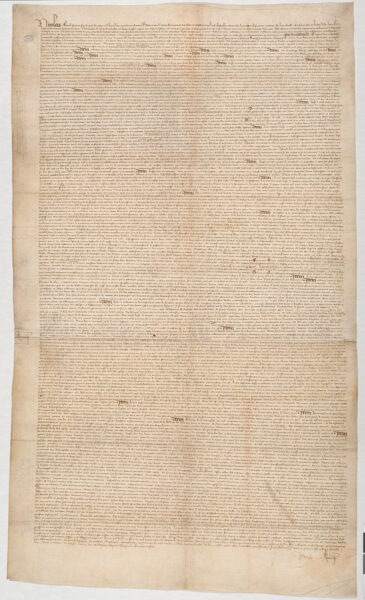
Last will and Testament of Nicolas Flamel 1418. © Archives nationales de France
SOURCE:
English translation from a French transcription provided here:
Étienne-François Villain, Essai d’une histoire de la paroisse de Saint-Jacques de la Boucherie
Paris, 1758), pp. 276 ff.
NOTES:
(1) Not to be confused with the “The Testament of Flamel”, which is often titled The Testament of Nicholas Flamel, and which is an alchemical pseudepigraphon—a text written in the 18th century.
READ MORE:


